Introduction
Saying "yes" to the wrong federal opportunity is expensive. Deltek's 2026 GovCon Clarity study — based on more than 900 contractor respondents — reports that a single RFP response can consume up to 84 hours of proposal team time. That same study found an average win rate of 48% across the industry, versus 72% for top performers. The gap between average and top-tier isn't talent — it's discipline in how teams decide what to pursue.
AI addresses that discipline problem directly. The best bid teams now use it to compress the research cycle before committing Bid and Proposal (B&P) resources — turning days of manual incumbent research and eligibility scoring into pre-scored opportunity summaries that arrive before the first stakeholder meeting.
Key Takeaways:
- A Go/No-Go is a structured bid qualification decision — not a gut-check meeting
- GovCon adds unique filters: contract vehicle fit, set-aside eligibility, and incumbent positioning
- AI compresses opportunity scoring from days to minutes, before B&P dollars are committed
- Teams using AI-powered Go/No-Go workflows evaluate more opportunities without adding headcount
- Documented No-Go decisions build institutional bid intelligence that sharpens future pursuit choices
What Is the Go/No-Go Decision in Government Contracting?
A Go/No-Go decision is a structured evaluation that determines whether a GovCon team should invest B&P resources in pursuing a specific federal or state solicitation. Unlike commercial sales qualification, GovCon Go/No-Go decisions must account for procurement regulations, agency relationships, and compliance thresholds that have no equivalent in the private sector.
The Three Outcomes Most Teams Ignore
Most teams treat Go/No-Go as binary. That's a gap. A modern framework should allow three outcomes:
- Go — pursue fully, with B&P resources committed and capture milestones set
- No-Go — decline and document why (this data matters for future scoring)
- Conditional Go — pursue only if a specific condition is met, such as securing a teaming partner, confirming vehicle access, or waiting for a pre-solicitation amendment
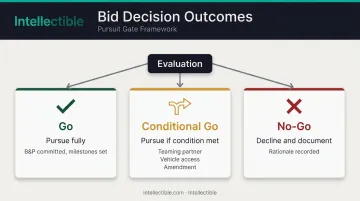
The Conditional Go is where experienced capture teams live. Most strong opportunities that fall here have exactly one solvable problem. Naming it upfront saves weeks of downstream rework.
What the Go/No-Go Is Not
It is the first resource allocation decision, not the final one. Its purpose is narrow: does this opportunity clear the threshold for capture investment?
AI enhances this by scoring each opportunity against pre-set criteria automatically, so meeting time focuses on the judgment calls a system can't make:
- Relationship context and agency history
- Strategic priority relative to the pipeline
- Teaming dynamics and partner availability
Why GovCon Bid Teams Burn B&P Budget Without a Structured Framework
Without a formal Go/No-Go process, bid teams default to internal politics. The logic becomes: "we should stay visible to the agency." Every solicitation that comes through the pipeline gets a yes, proposal quality gets diluted across too many pursuits, and win rates stay flat.
The GovCon-Specific Pressures That Make This Worse
The federal procurement environment punishes undisciplined pursuit decisions in specific ways:
- Short response windows — FAR 5.203 sets minimums of 30 days for many competitive actions above the simplified acquisition threshold, but agencies regularly compress timelines. A team without a fast intake process loses those hours to manual research.
- Recompete depth — competitive recompetes require months of capture investment to displace a strong incumbent. Entering without that groundwork is a structural disadvantage.
- LPTA pricing environments — GAO data shows DoD used Lowest Price Technically Acceptable (LPTA) on an estimated 25% of competitive contracts and orders worth at least $5M in FY2018. Bidding LPTA without understanding the pricing environment means you're guessing on margin.
Where AI Changes the Equation
Manual opportunity review across SAM.gov or agency forecast tools is slow and produces inconsistent results depending on who does the review. An AI-powered intake system can assess dozens of opportunities against team-defined criteria — NAICS code, contract vehicle, agency, dollar threshold, set-aside eligibility — in minutes rather than hours.
Intellectible's GovCon Engine processed 3,217 opportunities in a single 24-hour period in documented deployments, transforming each federal notice into a structured capture record — covering agency, office, NAICS, PSC, timing, scope, fit rationale, risk signals, and recommended action — before any human review began, without adding headcount.
6 Critical Factors to Score in an AI-Powered GovCon Go/No-Go
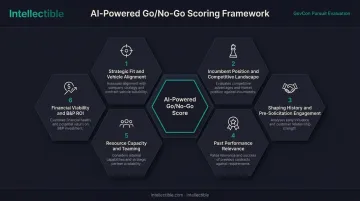
Effective GovCon Go/No-Go scoring requires criteria beyond standard commercial frameworks. The six factors below are the most operationally significant — and each can be partially or fully automated when the right data inputs are connected.
1. Strategic Fit and Contract Vehicle Alignment
Even a well-funded opportunity is a No-Go if your company lacks the right NAICS code, contract vehicle access (GWAC, IDIQ, GSA Schedule), or business size standard eligibility. These are binary gates — not scoring dimensions.
AI can cross-reference solicitation requirements against your company profile and registered vehicles to flag mismatches before anyone reads the Statement of Work. The KPI this drives: pursuit-to-proposal ratio. Teams that filter on eligibility early spend less time on bids they cannot legally win.
2. Incumbent Position and Competitive Landscape
The incumbent contractor knows the program, the people, and the work. That's a structural advantage, not just a preference. USASpending.gov and FPDS award history can identify who holds the current contract, how long they've been on it, and whether modification patterns suggest agency dissatisfaction.
This informs estimated Pwin. If the incumbent has strong performance history and your team has no prior agency relationship, that's a well-documented No-Go signal — or an indicator that a longer-term capture investment is needed before the next recompete.
3. Shaping History and Pre-Solicitation Engagement
Capture authorities consistently place the most important strategic work before the RFP drops. If your team has not been involved in shaping the requirement — agency meetings, demos, technical exchanges — the solicitation may reflect a competitor's influence.
RFP language and Statement of Work structure can reveal whether requirements were written around a competitor — and that's one of the strongest predictors of win probability, yet one of the most under-evaluated factors in manual reviews. The scoring model should pull from:
- Prior agency engagement records
- Demo and technical exchange logs
- Pre-solicitation correspondence and Q&A submissions
4. Past Performance Relevance
FAR 15.304 requires past performance evaluation in negotiated competitive acquisitions above the simplified acquisition threshold. A GAO protest case (Computer World Services Corp.) shows the stakes clearly: CWS submitted a bid $5.71M lower than SAIC but received a Neutral Confidence rating after the Army found its cited subcontractor work only somewhat relevant. SAIC won despite the higher price.
Past performance gaps are quantifiable. Scanning a past performance library against the solicitation's scope, dollar value, and agency type can surface mismatches early — and if the gap between your best reference and the requirement is too large to bridge, that's a documented No-Go signal, not a judgment call.
5. Resource Capacity and Teaming Requirements
Go/No-Go must account for current pipeline load and proposal team bandwidth. A pursuit that competes directly for resources with a higher-probability opportunity is not a free decision — it carries real opportunity cost.
If a subcontractor or partner is needed to fill a capability or certification gap, the Go/No-Go decision should include a feasibility check on that partner's availability before the team commits. Key questions to answer at this stage:
- Is the teaming partner already committed to a competitor on this pursuit?
- Does adding this pursuit displace bandwidth from a higher-Pwin opportunity?
- Can the required certifications or clearances be confirmed before proposal kickoff?
6. Financial Viability and B&P ROI
Every pursuit has a cost — proposal writing, pricing analysis, solution design, review cycles. That cost must be weighed against the realistic contract ceiling, the pricing environment, and the probability of award.
The model is straightforward: expected B&P spend vs. (expected contract value × estimated Pwin). For small and mid-size GovCon firms, a single bad pursuit can tie up the entire proposal team for weeks. Running the numbers before committing — not after kickoff — is where win rate improvement actually starts.
How to Build an AI Go/No-Go Workflow for Your GovCon Bid Team
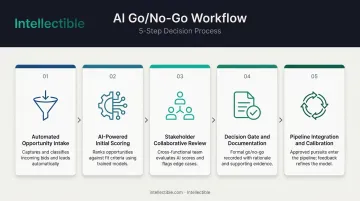
Step 1 — Automated Opportunity Intake
The workflow starts with AI-connected feeds from federal data sources. Instead of manually reviewing daily SAM.gov postings, an AI system filters opportunities against pre-defined parameters — NAICS code, agency, dollar threshold, vehicle type, set-aside eligibility — and surfaces only the candidates that clear the baseline criteria.
No human touches an opportunity until it's already cleared your filters.
Step 2 — AI-Powered Initial Scoring
Each surfaced opportunity gets scored against the six factors above using connected data:
- Award history and incumbent analysis
- Solicitation language and set-aside signals
- Internal capture profile and past performance alignment
Each factor receives a weighted score, producing an initial Pwin estimate and a risk flag before any human review.
The output is a structured capture record with fit rationale, risk signals, and recommended next steps already populated — ready for human review, not raw solicitation text.
Step 3 — Stakeholder Collaborative Review
The pre-scored summary is routed to a defined review team: capture lead, technical lead, BD director, and contracts. Each reviewer adds qualitative inputs that AI cannot independently assess — relationship context, teaming status, strategic priority, known agency dynamics.
Keep the review group to five or fewer people and time-box the meeting. If you need two hours to decide on a solicitation you've never shaped, that's already a signal.
Step 4 — Decision Gate and Documentation
Go, No-Go, or Conditional Go is recorded along with the reasoning, weighted scores, and any attached conditions. Documenting No-Go decisions is as valuable as documenting wins — it creates a learning dataset that refines scoring weights over time.
Without this record, there's no mechanism to distinguish a disciplined pass from a missed opportunity.
Step 5 — Pipeline Integration and Continuous Calibration
Go decisions feed directly into the active pipeline with:
- Capture milestones and assigned ownership
- B&P budget allocations
- Proposal deadlines and gate review dates
No-Go decisions are stored with their rationale. Every quarter, the team reviews historical decisions against actual outcomes to recalibrate scoring weights — each completed pursuit cycle makes the model sharper for the next one.
How Intellectible Helps GovCon Teams Automate Go/No-Go Decisions
Intellectible is an AI build platform that gives GovCon bid teams the tools and workflow logic to deploy the process described above — without rebuilding data pipelines or decision logic from scratch for each engagement.
Oceus, a defense contractor, used Intellectible's GovCon Engine and more than doubled the qualified opportunities it surfaces and reviews each month — reaching approximately seven to eight opportunities per month clearing their Go threshold, up from roughly half that.
CEO Jeff Harman noted that the platform created new pipeline exposure that "didn't exist before," including a potential customer sourced directly through the platform's automated outreach capabilities.
Platform Capabilities Specific to Go/No-Go
Intellectible's visual workflow builder connects AI decision nodes, federal data sources, scoring logic, and human review steps in a single system. Relevant capabilities include:
- Automated intake: transforms federal notices into structured capture records with agency details, NAICS/PSC codes, scope, fit rationale, and risk signals
- Configurable capture profiles: organizations encode target agencies, vehicle access, past performance parameters, deal-size thresholds, and disqualifiers — so scoring reflects the organization's actual strategy
- Go/No-Go report generation: produces an executive summary, opportunity snapshot, reasons to pursue or decline, identified data gaps, and recommended next steps before the stakeholder review meeting
- Review routing: high-fit pursuits are routed to review queues with daily match summaries delivered to capture, BD, and leadership teams
- Feedback loops: human reviewer inputs refine future scoring and rule gates over time
Connected from Intake Through Submission
A Go decision doesn't end the process — it starts it. The same platform environment supports the full pursuit lifecycle without switching tools:
- Market and competitive intelligence — bidder density, vendor concentration, past performance profiles, and vehicle access surfaced from federal award data at the capture stage
- Pre-RFP market reports built from RFIs and sources-sought notices to support early positioning before a solicitation drops
- Pipeline tracking across all stages from Discover through Submit, with stage-change automations, deadline flags, and leadership dashboards
HHS also selected Intellectible to automate its bid revenue operations, and Empire Equipment Service deployed the platform specifically to expand its federal opportunity capture. Across these engagements, teams evaluated more opportunities, cut wasted B&P spend, and maintained a documented rationale for every decision — without adding headcount to do it.
Conclusion
A structured, AI-powered Go/No-Go process helps GovCon bid teams stop reacting to solicitations and start running a proactive, intelligence-driven pipeline — one where every decision is faster, documented, and grounded in real data.
The Go/No-Go decision is not a one-time meeting — it is a living system. It gets smarter as it accumulates data on which bids win, which don't, and the patterns that explain both. Teams that build this workflow now start seeing returns immediately — clients using Intellectible's GovCon system have reported 95%+ time savings on opportunity decisions and a 150%+ increase in actionable pipeline opportunities. The system improves with every cycle because the data it captures becomes the foundation for the next decision.
Frequently Asked Questions
What is a Go/No-Go decision?
A Go/No-Go decision is a structured evaluation process used to determine whether a company should invest bid resources in pursuing a specific opportunity. It balances win probability, resource availability, and strategic fit against the cost of pursuit — producing a documented Go, No-Go, or Conditional Go outcome.
What are the parts of an AI Go/No-Go decision?
An AI-driven Go/No-Go process typically includes five core components:
- Automated opportunity intake and scoring
- Weighted evaluation across strategic fit, incumbent position, past performance, resource capacity, and financial viability
- Structured stakeholder review
- Documented decision gate with recorded reasoning
- Pipeline integration with feedback loops for continuous scoring improvement
What is the "30% rule" in GovCon capture?
The "30% rule" is a practitioner principle holding that if your team hasn't shaped a requirement before the solicitation drops, the RFP was likely written around a competitor — reducing your win probability. AI tools can flag this early by analyzing solicitation language for incumbent-tailored specifications. The rule has no single verified source; it reflects qualitative guidance widely shared among capture professionals.
What GovCon-specific factors should be included in a Go/No-Go checklist?
Beyond standard commercial criteria, GovCon checklists should include:
- Contract vehicle and NAICS eligibility
- Set-aside classification match
- Incumbent identification and performance history
- Pre-solicitation shaping engagement
- Clearance and certification requirements
- Past performance relevance to the specific agency and scope
When should a GovCon bid team say No-Go on a federal opportunity?
Say No-Go when any of these conditions apply:
- The solicitation falls outside your contract vehicles or eligibility
- A strong incumbent exists and you have no agency relationship or differentiating capability
- You lack the bandwidth to compete without deprioritizing a higher-probability pursuit
- Estimated B&P cost exceeds a reasonable share of expected contract value multiplied by your Pwin