That scrutiny is exactly why cost estimating software has moved from "nice to have" to standard equipment for contractors of any size. As DCAA audits get more pointed and DFARS 252.215-7002 compliance becomes non-negotiable at scale, contractors need systems that produce documented, defensible numbers, not spreadsheets held together with tribal knowledge.
This guide covers the estimating levels and methods DCAA expects to see, what DFARS actually requires (the $50 million threshold is more nuanced than most people think), and how to evaluate software that can keep up.
Key Takeaways
- Cost estimating software helps contractors build audit-ready, DCAA-compliant proposals faster and with less rework
- DFARS 252.215-7002 applies at $50M+ in prior-year DoD contracts (extendable to $10M with written contracting officer notice)
- Estimating methods (analogous, parametric, bottom-up, three-point) should be layered, not locked in after a single choice
- The right platform can cut time to final pricing while keeping full audit trail control
What Estimating Software Has to Carry for Federal Work
The cost buildup is the easy part. What separates federal estimating tooling is everything attached to the number: a basis of estimate a DCAA reviewer can follow line by line, FAR/DFARS cost principles applied consistently, and alignment with Cost Accounting Standards where they apply.
A commercial budgeting app tracks spend against a plan and stops there. On a federal proposal the estimate has to withstand someone reconstructing how each element was derived, months after submission.
Core capabilities typically include:
- Rate libraries for labor categories, geographic pricing, and fully burdened hourly rates
- Historical data analysis to pull forward costs from comparable past work
- BOE documentation tools that capture assumptions, sources, and methods at the WBS level
- Approval workflows that route estimates through review before submission
- Integration with accounting and ERP systems so labor rates and actuals stay current
There's no independently verified industry statistic quantifying exact time or error reduction from automated estimating versus manual spreadsheets. The honest answer is that most contractors haven't measured it rigorously.
What GAO's Cost Estimating and Assessment Guide does establish is that estimates need to be traceable, repeatable, and reproducible from source data to final number. Manual spreadsheets consistently struggle to prove that under audit.
Even contractors well below the DFARS mandatory threshold benefit from this discipline. Source selection evaluators favor bidders with an established, documented estimating process. A clean, repeatable BOE can be a competitive differentiator long before compliance becomes mandatory.
Choosing an Estimating Method as Scope Firms Up
The method follows the maturity of the scope, and the common failure is letting an early figure travel further than it should. A rough order of magnitude (ROM) estimate is a screening tool, not a proposal number, and treating it as budget-quality is how unsupportable figures reach a cost volume.
As scope firms up, teams often build a budgetary estimate with firmer assumptions, then move to a definitive estimate with tighter accuracy ranges and full supporting detail.
Four methods dominate government estimating, and most mature estimating shops use more than one:
- Analogous estimating — Uses costs from a similar past project as a starting point, adjusted for differences in scope, complexity, or timing.
- Parametric estimating — Applies a statistical relationship (a cost-estimating relationship, or CER) between historical data and cost drivers like square footage, labor hours, or units produced.
- Bottom-up (task-based) estimating — Breaks work into WBS-level components and estimates each one individually before rolling everything up into a total.
- Three-point estimating — Blends optimistic, pessimistic, and most-likely scenarios to account for uncertainty, often layered on top of bottom-up or parametric outputs.

Why Method Flexibility Matters
These methods rarely stand alone. A contractor might use analogous estimating to screen an opportunity, parametric modeling to price a recurring service line, and bottom-up detail for the final proposal—sometimes all within the same bid.
Software that locks you into one method creates rework every time scope shifts. Stronger systems let estimators apply different methods to different WBS elements and flag inconsistencies as assumptions change.
That flexibility supports audit readiness: GAO guidance requires every element to be traceable back to its source data and rationale.
Meeting DFARS Estimating System Criteria
DFARS 252.215-7002 is assessed against your process, not your tooling. Compliance hinges on a documented, repeatable estimating practice that produces the same result when a different estimator applies it — no software feature substitutes for that.
DCAA's review under Audit Program 24010 checks criteria such as:
- Documented basis of estimate — sources, methods, and rationale for every cost element
- Consistent application of techniques across proposals
- Trained personnel with clear guidance and supervision
- Rate and historical data analysis
- Management review and internal accountability, including projected-versus-actual comparisons
The $50 Million Threshold, Precisely
This isn't a blanket revenue test. The clause applies to a large business whose prior fiscal-year DoD prime contracts or subcontracts totaled $50 million or more and required certified cost or pricing data. Contracting officers can also apply it to businesses in the $10 million to under-$50 million range, but only with written notice. Growing contractors should build documented estimating habits well before they approach either number.
What Happens After a DCAA Audit
- The contracting officer (not DCAA) issues a written notice of material weaknesses
- You have 30 days to respond or contest the finding
- The CO evaluates your response and either accepts corrective action or issues a final disapproval
- After final determination, you get 45 days to fix the weakness or submit an acceptable plan with milestones
- On a CAS-covered contract, disapproval can trigger payment withholding, capped at 5% for one business system

Estimating software supports that cycle when it preserves basis-of-estimate detail, rate history, and management-review trails so you can produce a consistent file on demand—not rebuild one after the audit notice arrives.
How to Choose the Right Cost Estimating Software
Not every tool marketed as "DCAA-compliant" can actually prove it. Evaluate against these criteria:
- Compliance support — Can it document sources, methods, assumptions, and approvals at the WBS level—and reproduce a prior version on demand?
- Integration — Does it connect with your existing accounting or ERP data without manual re-entry?
- Audit trail transparency — Can a reviewer trace a final number back to its source data in minutes, not days?
- Scalability — Will it hold up with more concurrent proposals, users, and permission tiers as you grow?
Prioritize platforms that support multiple estimating methods rather than forcing everything through one model. A tool that only does parametric estimating will fail you the moment a proposal needs detailed bottom-up justification.
Also test how the tool handles mid-proposal change:
- Scope or labor-category updates should cascade without rebuilding the estimate by hand
- One assumption change should not force a full manual rework
- Architecture should absorb government-style revisions, not fight them
How Intellectible Helps Government Contractors Streamline Cost Estimating and Pricing
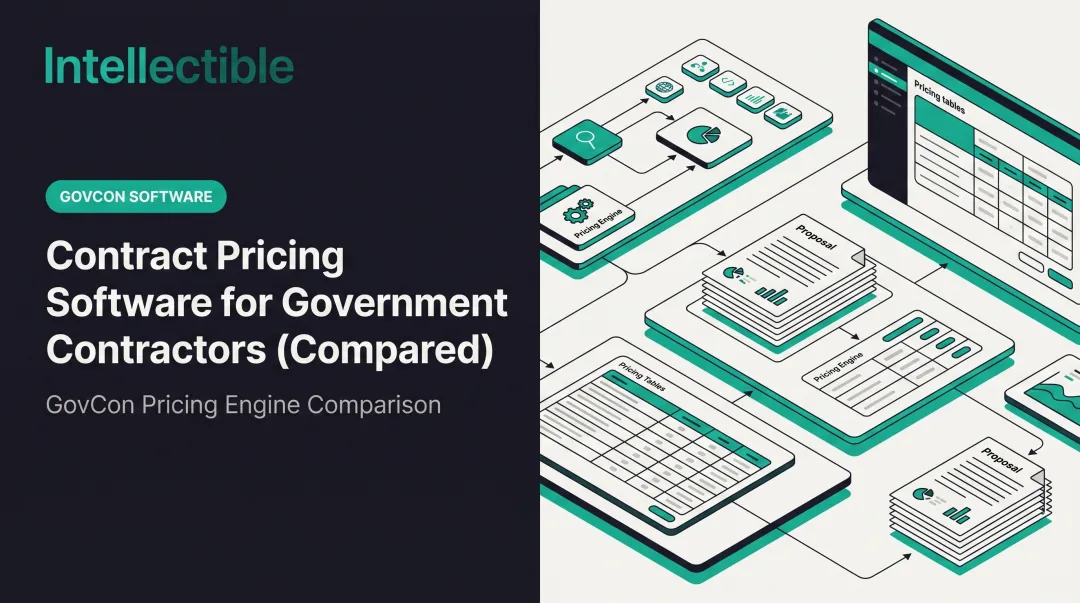
Intellectible is a horizontal AI build platform. It connects workflow automation, data, and pricing logic into one operating system rather than handing contractors another rigid point solution.
Its Pricing Engine runs a five-stage workflow:
- Intake
- Extract
- Review Assumptions
- Build Cost Model
- Publish Pricing
The engine pulls from RFPs, scope documents, and CRM notes, applies configurable labor rates and cost libraries, models scenarios by geography and service level, and routes work through approval before publish. The documented outcome is a 90% reduction in time to final pricing, with full audit trail control preserved throughout.

That audit trail matters for DCAA readiness. Intellectible's PostgreSQL-backed project databases store estimate inputs, source evidence, and version history in structured, queryable form.
Human-review nodes route draft estimates to approvers, separating drafts from approved records and preserving decision history. Activity logs, version tracking, and timestamped approval status feed a reviewable trail, even though the platform doesn't claim formal DCAA certification.
Client results on scaling without added headcount:
- Oceus more than doubled qualified opportunities per week after implementing Intellectible's GovCon Engine
- HHS's corporate director said the platform removed "tedious, monotonous hours" from RFP work, freeing staff for analysis and selling
- Pricing teams cut time to final pricing by 90% while keeping full audit trail control
For contractors approaching the DFARS threshold, platform flexibility matters. Use the production-ready Pricing Engine as-is, or build a custom estimating workflow on the same infrastructure. Add labor variables, geography rules, or risk factors for your contract mix without starting from scratch.
Frequently Asked Questions
How deep does a basis of estimate need to go?
Deep enough that an evaluator can follow every number to its source. Estimates move from ROM to definitive as scope solidifies, but the BOE is what carries the weight: method used, data relied on, and why it applies to this scope. Analogous and parametric estimates need that reasoning documented most, since the line-level detail is not there to speak for itself.
What are the DFARS estimating system criteria?
DFARS 252.215-7002 requires documented, consistent, and reviewable estimating practices, including trained personnel, rate analysis, and internal review. Mandatory compliance applies to large businesses with $50 million or more in prior-year DoD contracts requiring certified cost or pricing data.
What is the difference between a cost analysis and a price analysis?
Price analysis evaluates a proposed total price without breaking down individual cost elements. Cost analysis reviews each cost element separately, along with profit or fee, and is typically required when certified cost or pricing data are involved.
Do small businesses need a formal cost estimating system?
Formal DFARS compliance only kicks in above $50 million in covered DoD business. That said, smaller contractors benefit competitively from a documented, repeatable estimating process during source selection.
What happens if DCAA disapproves an estimating system?
The contracting officer issues a final determination, and the contractor has 45 days to correct the weakness or submit an acceptable corrective action plan. On CAS-covered contracts, payment withholding can follow if the system remains disapproved.
Can software fully automate DCAA-compliant cost estimating?
No. Software accelerates the process and keeps documentation consistent, but trained personnel, management review, and internal accountability are still required. Automation supports the system; it does not replace human oversight.