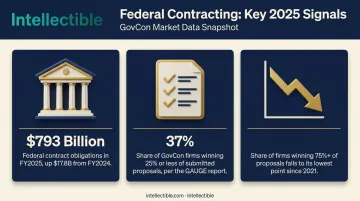
The federal government obligated roughly $793 billion on contracts in FY2025, up $17.8 billion from FY2024 after adjusting for inflation, according to GAO's government-wide contracting dashboard. That's a massive, document-heavy market, and every dollar of it runs through solicitations packed with FAR clauses, compliance requirements, and hard deadlines.
Bid management tools exist to help capture teams keep pace. This guide compares five options built for GovCon bidders, from narrow proposal-writing assistants to a horizontal build platform teams can shape around their own capture process.
TL;DR
- A GovCon bid management tool finds, qualifies, and manages RFP, RFI, and Sources Sought responses while tracking compliance deadlines.
- Your best pick depends on bid volume, response format, and required customization level.
- Prioritize compliance-matrix accuracy, GovCon data integrations, and security posture over AI marketing hype.
- We compare five tools: GovDash, UseRogue, Vultron, Unanet, and Intellectible.
- Intellectible suits teams building a tailored opportunity-to-proposal pipeline instead of a rigid template.
Overview of Bid Management Tools in GovCon
A GovCon bid management tool is software that automates the mechanics of pursuing government work: finding opportunities, running Go/No-Go decisions, generating compliance matrices, and drafting proposal content for federal, state, and local solicitations.
That last part matters because GovCon bidding doesn't look like commercial RFP work. Federal solicitations carry legal weight that commercial ones simply don't.
A few structural differences worth knowing:
- Offerors generally must be registered in the System for Award Management before submitting an offer, per FAR 4.1102.
- Proposals must conform to strict formatting and deadline rules under FAR 52.215-1 — late submissions are typically disqualified outright.
- Evaluators can only score proposals against factors stated in the solicitation, per FAR 15.305, the reason compliance matrices exist.
None of this is theoretical. Unanet's 10th annual GAUGE report surveyed more than 1,200 GovCon executives and found that 37% of firms won 25% or less of the proposals they submitted.
The share winning more than 75% hit its lowest point since 2021, according to Washington Technology's coverage of the report.
Given those stakes, the tools below range from narrow proposal-drafting assistants to full build platforms that let teams customize the entire capture-to-proposal pipeline.
Top Bid Management Tools for GovCon Compared
We evaluated each tool through four lenses:
- Fit for federal solicitation structure: does it handle FAR-based formats natively?
- Compliance rigor: how well does it map requirements to responses?
- Integration depth: does it connect to the data sources capture teams already use?
- Flexibility to scale: can bid volume grow without adding headcount?
GovDash
GovDash is an AI platform built specifically for US federal contractors, covering opportunity discovery, capture, proposal drafting, and post-award workflows in one system.
Its standout feature is sentence-level requirement extraction: the tool breaks solicitation documents down to sentence level and generates a compliance matrix that updates automatically when amendments hit. Drafting happens inside Microsoft Word with source citations attached, which keeps the workflow familiar for proposal writers used to traditional tools.
| Best For | US federal contractors running capture-to-contract workflows on long-form narrative proposals |
| Key Features | Opportunity discovery, capture workflows, sentence-level requirement extraction, compliance matrices, structured drafting |
| Limitation | Federal-market focus makes it costly or excessive for teams also handling commercial/short-form solicitations |
UseRogue
UseRogue is a GovCon-focused AI proposal-writing platform built around Sources Sought, RFIs, and RFPs specifically.
The AI RFP Writer generates a draft from a title, description, and template, while first-pass draft generation from prior submissions builds a starting response fast. Its inline editing actions let writers refine highlighted text through predefined actions, so they don't need to prompt-engineer anything.
| Best For | GovCon proposal teams needing faster long-form draft turnaround |
| Key Features | RFP Writer, Compliance Matrix Generator, first-pass draft generation from prior submissions, inline editing actions |
| Limitation | GovCon-first design means weaker fit for commercial solicitations; draft quality depends heavily on clean uploaded past-proposal content |
UseRogue also publishes tiered pricing, starting around $400/month for a single seat, scaling to $1,250/month for five seats on its Professional plan, a rarity in a market where most vendors push buyers straight to sales.
Vultron
Vultron is an AI-native platform focused on proposal generation, with drafting trained on licensed successful federal submissions. It aligns requirements against past performance, checks compliance, and runs evaluator-style reviews for clarity and persuasiveness before submission.
Unlike some competitors, Vultron doesn't publicly claim a dedicated pricing or price-to-win module. Its focus stays on the drafting and compliance side of capture.
| Best For | GovCon teams wanting drafting support tightly coupled with compliance tracking |
| Key Features | AI drafting, compliance tracking, evaluator-aligned review cycles built around federal RFP structures |
| Limitation | Narrower focus than a full build platform; less flexible for teams whose workflows extend beyond proposal writing |
Unanet
Unanet takes a different approach entirely. It's an established CRM and capture management platform, paired with project accounting, that's been the backbone for many GovCon back offices for years. More than 2,000 organizations reportedly rely on Unanet ERP.
Rather than drafting proposals, Unanet CRM tracks opportunities through drag-and-drop pipeline stages and generates automated proposal shells using resumes, past-performance content, and pricing history. Its ERP side then handles project costs, billing, and revenue recognition across firm-fixed-price, cost-plus, and time-and-materials contracts.
| Best For | Established GovCon firms needing capture pipeline and project financials in one system |
| Key Features | Opportunity tracking, capture management, integrated project accounting for government contractors |
| Limitation | Not built as an AI drafting or proposal-automation tool; requires pairing with a separate response tool |
Intellectible
Intellectible takes a different bet: instead of a fixed proposal-writing tool, it's a horizontal AI build platform. GovCon capture teams get a GovCon Engine built for opportunity search, Go/No-Go decisioning, and structured capture intelligence out of the box, then customize the logic underneath with a full developer suite: visual workflows, PostgreSQL databases, and React-supported interfaces.
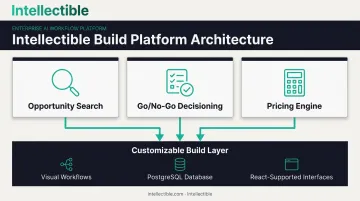
That combination matters because most point-solution tools automate one step and leave every handoff to manual work. Intellectible's approach lets a team encode its own capture rules (target agencies, NAICS codes, deal-size thresholds, disqualifiers) directly into the platform, then route qualified opportunities straight into a governed pricing workspace with full audit-trail control.
Reported outcomes for GovCon clients include:
- 95%+ time saved on opportunity search and Go/No-Go decisions
- 150%+ increase in actionable top-of-funnel pipeline
- 90% reduction in time to final pricing, with audit trails intact for compliance review
Oceus, a GovCon client using the platform, saw qualified opportunities more than double week over week. CEO Jeff Harman reported the team went from a trickle to seven to eight qualified opportunities a month clearing their internal threshold.
HHS's Corporate Director of Business Development, John Grady, put it plainly: "Intellectible is taking the tedious, monotonous hours of RFP efforts out of human hands. This allows us to do what we should be doing, analyzing and selling."
Intellectible's Terms of Service state its services aren't tailored to FISMA or HIPAA compliance, so teams handling regulated federal data should confirm fit directly before onboarding.
| Best For | GovCon pursuit and revenue-ops teams that need customizable capture-to-pricing workflows beyond what point-solution proposal tools offer |
| Key Features | Visual workflow builder, Go/No-Go automation, structured capture records, incumbent and award mapping, project workspaces, audit-trail controls |
| Limitation | Best suited to teams ready to configure a build platform rather than use an out-of-the-box narrative-writing tool |
How We Chose the Best Bid Management Tools for GovCon
The most common mistake we see: picking a generic commercial RFP tool that has no idea what a compliance matrix should look like under FAR structure. That gap shows up fast once amendments start hitting a live solicitation.
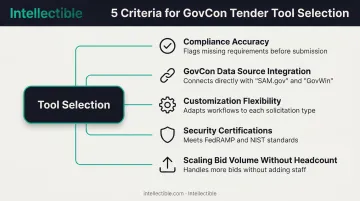
We weighed each tool against five factors, tied to outcomes that actually move win rates:
- Compliance accuracy: how reliably the tool maps requirements to response sections, since misaligned matrices get proposals disqualified before evaluators score them
- Integration with GovCon data sources: fewer manual exports from SAM.gov and GovWin mean faster notice-to-Go decisions
- Customization flexibility: whether the tool bends to your capture methodology or forces your team into its template
- Security certifications: critical for teams handling sensitive procurement data, not just a checkbox
- Scaling bid volume without added headcount: separates tools that help you win more from those that just add another system to manage
With win rates under pressure industry-wide, per the GAUGE data cited above, the tools that win are the ones that cut proposal cycle time without cutting compliance corners.
Conclusion
The right bid management tool depends on your team's capture maturity and proposal format, not a universal ranking. A team running high-volume, long-form federal proposals needs different horsepower than a team just starting to build capture discipline.
Match the tool to your capture maturity and response format, not the vendor with the loudest AI claims. Then pilot it against a real, live solicitation. Check compliance-matrix accuracy, integration depth, and total cost before you commit budget.
If your team is outgrowing rigid, out-of-the-box proposal tools and wants a capture workflow built around how you actually work, Intellectible's platform is worth a look.
Frequently Asked Questions
What is a solicitation and how does it work?
A solicitation is a formal competitive process where a buyer, often a government agency, invites suppliers to submit competitive proposals for goods or services. The process runs from public notice through submission, evaluation, and contract award.
What is a solicitation line item?
A solicitation line item is a specific line, deliverable, or requirement within a solicitation that bidders must price individually. Federal contracting often calls these line items, each describing a distinct product or service being purchased.
How is GovCon bidding different from commercial RFPs?
Federal solicitations carry FAR-based eligibility rules, like SAM registration requirements, along with mandatory compliance-matrix structures and long-form narrative expectations. Commercial RFPs rarely carry this level of regulatory formality or strict late-submission penalties.
Do GovCon bid tools require a maintained content library?
Traditional library-based drafting tools need ongoing content upkeep to stay accurate as past performance and capabilities evolve. Build platforms and live-knowledge tools pull from connected data sources instead, reducing the manual maintenance burden.
How much does GovCon bid management software typically cost?
Pricing ranges widely, from published monthly seat plans (some starting around $400/month) to fully quote-based enterprise contracts. Most GovCon-specific vendors don't publish rates publicly and direct buyers to a sales conversation instead.
Can AI tools reliably handle compliance matrices for federal RFPs?
AI can extract and structure compliance requirements quickly, especially when criteria are stated plainly. Vague or contradictory language still needs human review, so verify every AI-generated matrix against source clauses before submission.