Many teams assume RFP success comes down to answering questions and submitting on time. The reality is different. GAO received 1,617 bid protests in FY2025 with a 52% effectiveness rate, revealing how often evaluators find technical approaches inadequate, pricing unrealistic, or proposals non-responsive. Success rates vary dramatically based on how well teams understand evaluation criteria, compliance obligations, and strategic positioning.
This guide explains when to bid, what preparation is required, the exact response process, key factors evaluators score, and critical mistakes that disqualify proposals before evaluation begins.
Key Takeaways
- GovCon RFPs demand strict FAR compliance and agency-specific criteria unlike commercial proposals
- Wins require requirement fluency, recent relevant past performance, and mission-aligned solutions
- Most losses stem from weak capture, recycled content, or missed compliance, not capability gaps
- Responses need multi-week coordination across capture, technical, contracts, and pricing teams
- Automation platforms cut search and qualification time by 95%+ while tightening compliance tracking
How to Create a Winning RFP Response for GovCon
A winning GovCon RFP response is built in stages: decide whether to bid, lock the win strategy, write to the evaluation factors, price to the stated methodology, and submit a clean, compliant package. Skip a stage and strong technical content can still lose.
Step 1: Compliance Review and Bid Decision (Go/No-Go)
Start with the solicitation fundamentals:
- Review the cover page for submission deadline, set-aside type (8(a), HUBZone, WOSB, SDVOSB), NAICS code, size standard, and contract vehicle
- Extract all Section L (instructions) and Section M (evaluation criteria) requirements into a tracking system
- Verify your SAM.gov registration is active. It must renew every 365 days and includes your Unique Entity ID (UEI replaced DUNS in April 2022)
Conduct a formal Go/No-Go assessment:
- Technical capability match: Can you perform the work with current staff and resources?
- Past performance relevance: Do you have recent, similar-scope contracts with positive outcomes?
- Competitive position: Are you displacing an incumbent with excellent performance, or do you have existing customer relationships?
- Price-to-win: Can you price competitively while protecting margins?
- Resource availability: Can you produce a quality proposal without disrupting ongoing contracts?
Identify teaming requirements early. If you lack critical capabilities or relevant past performance, pursue partnerships as prime or subcontractor. According to 2025 GovCon benchmarking research covering 1,200+ contractors, firms with structured proposal processes pursue 10 more opportunities annually and show 13% higher predicted growth.
Document your decision with clear rationale. Declining low-probability opportunities preserves resources for winnable work.
Step 2: Capture Planning and Win Strategy Development
Use pre-RFP intelligence you've gathered:
- Agency pain points from industry days or pre-solicitation engagement
- Incumbent weaknesses or performance gaps
- Customer priorities beyond the stated requirement
- Strategic documents (if public) showing the agency's mission and operational environment
Develop 3-5 win themes that differentiate your solution and map directly to Section M evaluation criteria. Example: "Proven Mission Success: 98% on-time delivery across 12 similar DoD logistics contracts."
Assign roles clearly:
- Proposal manager (overall coordination and schedule)
- Volume leads (technical, management, past performance)
- Pricing lead
- Contracts lead
- Subject matter experts (SMEs)
- Executive sponsor with final approval authority
Create a detailed outline mapping each RFP requirement to the section addressing it, ensuring complete coverage with no duplication or gaps.
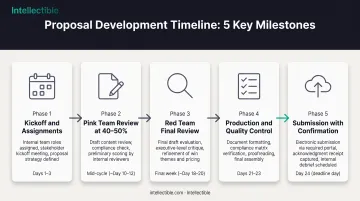
Establish a realistic schedule with milestones:
- Kickoff and assignments
- Pink team (early draft review at 40-50% completion)
- Red team (final review by evaluators unfamiliar with the proposal)
- Production and quality control
- Submission with confirmation buffer
Step 3: Content Development with GovCon-Specific Requirements
Write your technical approach to directly respond to the Performance Work Statement (PWS) or Statement of Objectives (SOO). Use the same task structure and terminology the government uses. If the solicitation provides an SOO, your technical approach becomes the proposed PWS.
Develop your management approach to demonstrate:
- Organizational structure aligned to the requirement
- Quality control processes with measurable standards
- Transition plan if displacing an incumbent
- Risk mitigation strategies for each identified risk
Compile your past performance section with contracts of similar scope, complexity, and dollar value. FAR requires agencies to evaluate past performance based on currency, relevance, source, context, and trends. Include:
- Customer names and contact information
- Contract numbers and period of performance
- Relevance narrative explaining similarity to the solicitation
- Positive outcomes and CPARS ratings if available
CPARS ratings use a five-level scale (Exceptional, Very Good, Satisfactory, Marginal, Unsatisfactory) and evaluate technical quality, cost control, schedule, management, and small-business subcontracting. Under FAR 15.305, proposals with no relevant past performance record cannot be rated favorably or unfavorably.
Address every evaluation subfactor by name. If Section M lists "Innovation," include a clearly labeled innovation section or callout boxes that show where you exceed minimum requirements.
Build compliance matrices showing where each RFP requirement, FAR clause, and deliverable is addressed in your proposal.
Integrate your differentiators and win themes throughout all volumes, not just the executive summary, so evaluators see your competitive advantages at every touchpoint.
Step 4: Pricing Strategy and Cost/Price Volume Development
Your pricing strategy must align with the evaluation methodology stated in Section M:
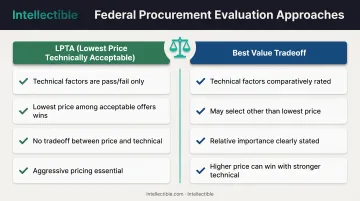
Lowest Price Technically Acceptable (LPTA): The lowest evaluated price among technically acceptable offers wins. Non-price factors are acceptability tests, not comparative rankings. Aggressive pricing is essential.
Tradeoff/Best Value: The government may select other than the lowest price or highest technical rating. Relative importance of price versus technical factors must be clearly stated. You can trade higher pricing for stronger technical scores, but the tradeoff must be justified.
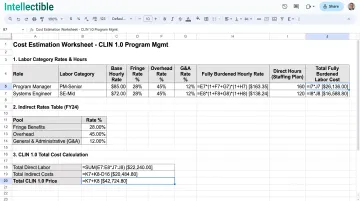
Build your cost model covering:
- Direct labor by labor category and hour
- Materials and equipment
- Subcontractor costs with supporting quotes
- Other direct costs (travel, ODCs)
- Overhead rates
- General & administrative (G&A)
- Profit or fee
Prepare all required cost/price forms:
- SF-1449 for commercial products/services
- SF-1442 for construction, alteration, or repair
- Labor rate tables showing fully burdened rates
- Subcontractor quotes
- Cost narrative justifying your approach
Ensure your price volume cross-references and supports your technical approach. Labor hours should align with your technical staffing plan and management processes. FAR requires cost realism analysis for cost-reimbursement contracts and may apply it to fixed-price contracts in exceptional cases.
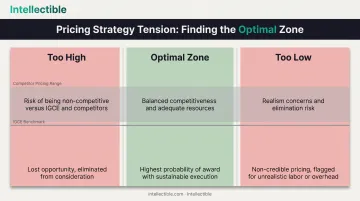
Conduct price-to-win analysis against the Independent Government Cost Estimate (IGCE) if available and competitor pricing intelligence. Adjust rates or scope approach to remain competitive while protecting margins. Unrealistically low pricing raises realism concerns that can eliminate you from consideration.
Step 5: Review, Production, and Submission
Pink team review (40-50% draft): Ensure the proposal is responsive, compliant, and incorporates win themes. Focus on content gaps, strategy alignment, and whether evaluators will understand your solution.
Red team review (near-final draft): Use evaluators unfamiliar with the proposal to score it against Section M criteria exactly as the government will. Address all weaknesses, ambiguities, and missing evidence they identify.
Final compliance check against Section L:
- Page limits and format requirements
- Font type, size, and margin specifications
- Required certifications and representations
- SAM.gov registration confirmation
- All amendments acknowledged by specified deadlines
Produce final volumes with professional formatting:
- Consistent headers and footers
- Clear graphics supporting key points
- Compliant cover pages
- Table of contents with accurate page numbers
- Logical flow and readability
Submit through the required method with buffer time before the deadline so you can handle portal issues or delivery problems. You are responsible for receipt at the named office by the exact time; late offers are rarely considered. Confirm receipt and keep the submission confirmation.
When Should You Respond to a GovCon RFP?
Not every RFP deserves a response. GovCon teams should bid selectively based on strategic fit, competitive positioning, and resource availability to maximize win rates and protect capture investments.
Respond when you have:
- Strong past performance in similar work (recent contracts with comparable scope, complexity, and dollar value)
- Existing relationships with the customer or deep understanding of their mission
- Technical discriminators competitors cannot easily match (proprietary tools, specialized certifications, unique facilities)
- Adequate resources to produce a quality proposal without disrupting ongoing contracts
- Competitive pricing position based on realistic cost models
Decline to bid when you:
- Lack relevant past performance, making you non-responsive to mandatory evaluation criteria
- Face an entrenched incumbent with excellent performance and no visible weaknesses
- Cannot meet minimum qualifications (clearances, facilities, certifications, bonding)
- Identify unusual requirements clearly wired for a specific competitor
- Cannot price competitively due to cost structure or lack of economies of scale
Consider strategic bids to build past performance in new areas only if you can partner with strong teammates, offer compelling technical innovation, and accept lower initial win probability as a longer-term investment.
FAR requires evaluation solely against announced factors. Your strategic rationale does not change how evaluators score your proposal.
What You Need Before Starting Your RFP Response
Preparation determines response quality and efficiency. Teams that organize assets before the RFP drops respond faster and produce stronger proposals than those starting from scratch.
Team and Organizational Readiness
Assemble your core team:
- Proposal manager with overall coordination authority
- Volume leads for technical, management, past performance, and price sections
- Subject matter experts (SMEs) with direct domain experience
- Contracts and compliance specialists to interpret FAR/DFARS clauses
- Executive sponsor with final approval authority
Verify your corporate registrations:
- Active SAM.gov registration (renews every 365 days, takes at least 10 business days to activate)
- Current CAGE code
- Unique Entity ID (UEI)
- Verified representations and certifications in SAM
Content Library and Past Performance
Build a repository of reusable assets:
- Past performance docs: contract references, CPARS ratings, testimonials, and project summaries
- Corporate capability statements formatted for proposal reuse
- Resumes for key personnel (remove personal contact information)
- Facility descriptions and photos
- Quality certifications (ISO 9001, CMMI, etc.)
- Template library for standard sections: company background, management approaches, quality frameworks, subcontracting plans
Proposal writers spend 30-40% of their time searching for this material. Organize it up front and you reclaim that time for writing.
Technical and Pricing Capabilities
Confirm SMEs who know the technical domain and can shape solutions that map to the agency's mission—not just staff who can review drafts.
Then lock down labor rates by category and indirect rates (overhead, G&A). Rates should be audited or otherwise defensible in negotiation.
Pair that with cost-estimating tools that produce detailed breakdowns tied to your staffing plan and task structure. Pricing is often the critical path; slow rate or estimate work stalls the whole response.
Key Factors That Determine RFP Response Success
Evaluators score proposals systematically against Section M criteria. Understanding what drives their scoring decisions separates winning proposals from also-rans.
Compliance and Responsiveness
Non-compliant proposals never reach evaluation. Even minor violations (wrong font, missing certifications, page limit overruns) can disqualify an otherwise strong proposal.
Strict adherence to Section L instructions and a complete response to every Section M criterion keep you in the running. Use a compliance matrix to track coverage and confirm nothing is missed.
Past Performance Relevance and Quality
Federal evaluators weight past performance heavily as the best predictor of future success. FAR 15.304 requires agencies to assess contractor past performance in source selections unless they document why it is inappropriate.
What moves the score:
- Recent contracts with similar scope, complexity, and dollar value
- Positive CPARS ratings or credible customer references
- Clear performance trends, not one-off wins
- Source credibility evaluators can verify quickly
Between technically equal competitors, this factor often decides the award.
Win Themes and Differentiation
Compliance and past performance get you scored. Differentiation gets you selected. Evaluators compare multiple proposals against the same requirement, so clear discriminators (unique technical approaches, proprietary tools, specialized experience) raise your technical score above the pack.
Integrate win themes throughout the proposal, not only in the executive summary. Consistent reinforcement makes it easier for evaluators to justify selecting you in the source selection decision document.
Price Competitiveness and Realism
In LPTA evaluations, lowest price wins if you are technically acceptable. In Best Value, price still carries significant weight. Unrealistically low prices trigger realism concerns that can eliminate you.
Pricing has to balance two pressures:
- Competitiveness: not significantly above competitors or the IGCE
- Realism: enough resources to perform the work
Detailed cost narratives that justify rates and hours show you understand the requirement and reduce realism risk.
Technical Solution Quality and Innovation
Your technical approach proves you understand the requirement and can execute it. Generic boilerplate scores lower than tailored solutions that address the agency’s specific mission challenges.
Strengthen the technical volume by:
- Using the agency’s own terminology
- Referencing public strategic documents where relevant
- Showing awareness of their operational environment
- Offering innovations that cut risk, improve outcomes, or add value inside the price structure
Common Mistakes in GovCon RFP Responses
Knowing what gets proposals thrown out helps you avoid expensive errors:
- Non-compliant submissions: Exceeding page limits, wrong fonts or margins, missing certifications, or ignoring the required outline triggers disqualification before evaluation starts.
- Generic boilerplate: Evaluators spot recycled text that could fit any bid. Content that skips the specific requirement, mission, or agency scores poorly on "understanding."
- Weak past performance: Dissimilar scope, references older than five years, or small-dollar work for a large complex program signals you lack relevant experience.
- Ignoring evaluation weights: Equal effort on every section when Section M weights factors unevenly (for example, 40% technical, 30% past performance, 30% price) wastes limited resources.
- Pricing that ignores the method: Bidding high on LPTA guarantees a loss. Unrealistically low Best Value pricing raises realism flags and suggests you don't understand the work.
Troubleshooting RFP Response Challenges
Even experienced GovCon teams encounter obstacles. Recognizing and addressing these issues quickly determines whether you submit a winning proposal or withdraw.
Issue: Insufficient Past Performance References
Likely Cause: Your company lacks direct experience with the specific work type, agency, or contract size, or previous contracts had performance issues documented in CPARS.
What to Do: Close the gap with structure, not spin:
- Partner as a subcontractor to a prime with strong past performance
- Highlight relevant commercial or state/local work that shows similar capabilities
- Pursue as a Best Value bid if the RFP lets technical innovation offset past-performance gaps
Issue: Unclear or Ambiguous Requirements in the SOW/PWS
Likely Cause: The agency's requirements development process left gaps, used vague language, or the technical point of contact lacks acquisition expertise.
What to Do: Clarify early, then document what remains open:
- Submit questions through the official Q&A process before the deadline
- Use FAR-supported pre-proposal exchanges (draft RFPs, RFIs, conferences, meetings) within procurement-integrity limits
- State assumptions clearly in the proposal if ambiguity remains after Q&A closes
- Do not guess—wrong interpretations will hurt your technical score
Issue: Unrealistic Timeline or Resource Constraints
Likely Cause: The RFP drops with a short response window, your proposal team is already committed elsewhere, or key SMEs are unavailable. FAR generally requires at least 30 days for actions above the simplified acquisition threshold and 45 days for R&D—but real calendars still collide.
What to Do: Protect quality by matching scope to capacity:
- Run an honest Go/No-Go on opportunity size, win probability, and resource load
- If you proceed, scale the response (fewer graphics, tighter content, sharper differentiators)
- Use tools such as Intellectible's GovCon and Proposal Engines to cut qualification time by 95%+ with automated compliance tracking, requirement mapping, and structured workflows
- Partner so teammates can own discrete sections
Frequently Asked Questions
What is an RFP response?
An RFP response is a formal proposal that answers every requirement in a Request for Proposal. It presents your qualifications, solution, and pricing so the agency can score you against other offerors.
How do you respond to an RFP?
Start with a compliance review of the solicitation, then build a win strategy and tailored technical solution. Draft the required volumes—technical, management, past performance, and price—and submit through the specified method before the deadline.
What are the phases of the RFP process?
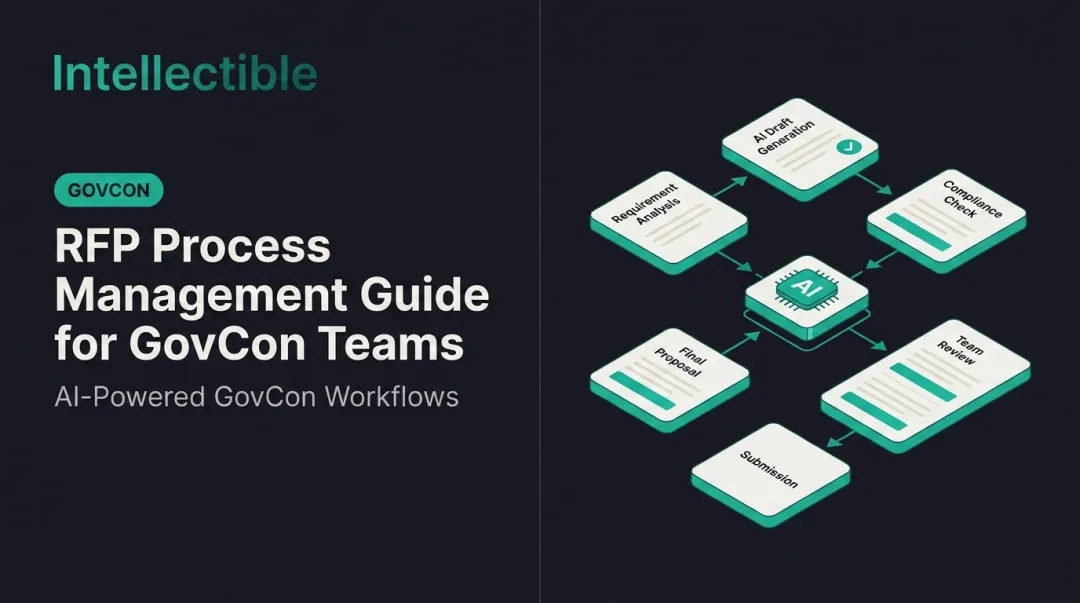
Most GovCon pursuits move through five phases:
- Bid decision and capture planning
- Content development across all volumes
- Internal reviews (pink team and red team)
- Production and quality control
- Final submission with confirmation of receipt
How long is a typical RFP response?
Length depends on complexity and Section L page limits. Smaller contracts often run 30–100 pages; large programs can exceed 200 pages based on evaluation criteria and agency instructions.
What makes a good RFP response?
A strong response is fully compliant, maps tailored content to each evaluation criterion, and proves relevant past performance. It offers a credible technical solution and competitive pricing that fits the evaluation methodology.
Can you provide an example of an RFP response?
Full responses are usually proprietary, but strong packages share a clear structure: executive summary with win themes, technical approach by PWS task, management and past performance volumes, and a price volume with cost narratives that justify rates and hours.