Introduction
Federal contracting is a pursuit sport. With approximately $793 billion committed in FY2025 federal contracts, the market is enormous and intensely competitive.
GovCon firms don't just compete on price. They compete on positioning, relationships, compliance discipline, and the ability to identify the right opportunities months before an RFP ever drops.
Managing all of that across dozens of active pursuits simultaneously is genuinely hard. Most firms don't fail because they lack the capability to deliver contracts. They fail because they can't coordinate the intelligence, strategy, and execution required to win them.
The bidding manager is the central figure holding all of that together.
This article covers what a GovCon bidding manager actually does, how the role fits into the capture management lifecycle, the core responsibilities and skills required, and how modern teams are using AI to extend what a single bidding manager can realistically accomplish.
Key Takeaways:
- The bidding manager owns the full federal pursuit lifecycle, from opportunity identification through post-award debrief
- Capture and proposal management are distinct functions; in smaller firms, one person typically covers both
- Go/No-Go discipline matters as much as winning bids: knowing when to pass protects team capacity
- AI is shifting the role from manual triage toward strategic judgment, not replacing it
- Modern AI platforms let GovCon teams scale pipeline without scaling headcount
What Is a GovCon Bidding Manager?
The Role Defined
A GovCon bidding manager is the professional responsible for orchestrating the end-to-end pursuit of federal contracts — from early opportunity identification through solicitation response, evaluation, and award. They own pipeline strategy, pursuit decisions, and ultimately bid outcomes.
The title maps to adjacent roles in ways that matter practically:
| Role | Primary Focus |
|---|---|
| Capture Manager | Pre-RFP intelligence, relationship development, win strategy |
| Bid/Proposal Manager | Response planning, team coordination, compliant submission |
| Bidding Manager | Full lifecycle ownership — both capture and proposal functions |
APMP (the Association of Proposal Management Professionals) treats these as connected stages in a single ecosystem rather than interchangeable job titles. In large prime contractors, these functions are split across specialists. In small-to-mid-sized GovCon firms, one person typically covers all three — which is why "bidding manager" often appears as a catch-all title.
What Makes GovCon Different from Commercial Bid Management
Federal pursuits operate under constraints that don't exist in commercial environments:
- FAR/DFARS compliance requirements govern every solicitation response
- SAM.gov monitoring is required for opportunity discovery and contractor registration
- IDIQ vehicles, GWACs, and BPAs create complex teaming and vehicle-access decisions
- Pursuit timelines can run 12–24+ months from initial intelligence gathering to award
- Evaluation criteria are explicitly published — meaning strategy must map directly to stated scoring factors
That combination of regulatory constraints, long pursuit cycles, and published scoring criteria means the bidding manager's decisions carry consequences that compound across months — making process discipline a competitive advantage, not just an operational preference.
The Capture Management Lifecycle: Where the Bidding Manager Operates
The bidding manager doesn't just respond to RFPs. The most consequential work happens before the solicitation is ever released.
Pre-Solicitation: The Strategic Window
Early market intelligence is where competitive advantage is built. Before an RFP drops, the bidding manager should be:
- Monitoring SAM.gov and agency forecast portals for early signals
- Building agency relationships and understanding buyer pain points
- Identifying likely incumbents and their contract expiration timing
- Gathering intelligence on evaluation priorities and acquisition strategy
Shipley Associates defines capture planning as identifying opportunities, assessing the competitive environment, and devising a win strategy before proposal execution begins. The goal is to reach RFP release already positioned, with a clear win strategy in hand rather than starting from zero once the clock starts.
The Go/No-Go Decision
Few decisions consume more bidding manager judgment than Go/No-Go. APMP's framework is clear: selectivity drives win rates. Pursuing 15 well-qualified opportunities produces the same number of wins as pursuing 100 indiscriminate ones — with a fraction of the resource cost.
The bidding manager evaluates:
- Probability of win (Pwin) based on competitive landscape and positioning
- Internal capacity to staff and execute the pursuit
- Strategic alignment with the firm's target markets and growth priorities
- Compliance viability — can the firm credibly meet the solicitation requirements?
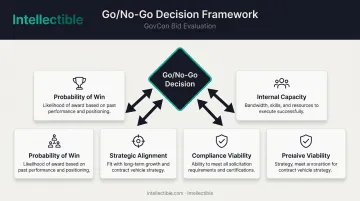
Disciplined no-bids protect the team's capacity for pursuits where winning is actually realistic. Saying no selectively is how high-performing capture organizations maintain strong win rates.
Solicitation Analysis and Response Planning
Once an RFP is released, the bidding manager shifts to execution mode:
- Dissect compliance requirements — page limits, formatting, certifications, required forms
- Build the bid schedule — set up Pink, Red, and Gold color review cadences with clear milestones
- Assign section owners across technical, pricing, past performance, and management volumes
- Coordinate with pricing analysts, contracts teams, subcontractors, and executive sponsors
Shipley's color review framework provides structure in this phase: Pink reviews assess early content and structure; Red reviews evaluate a substantially complete draft from the evaluator's perspective; Gold performs final quality and approval checks before submission.
Teaming and Post-Submission Responsibilities
GovCon adds a layer commercial bid managers rarely face: teaming decisions. The bidding manager must assess whether a small business set-aside, NAICS code gap, or capability requirement demands a teaming partner — and then manage those negotiations through teaming agreement execution.
Post-submission, the work continues through several additional stages:
- Responding to Q&A rounds with the contracting officer
- Preparing for and delivering oral presentations
- Conducting formal win/loss debriefs
That debrief intelligence feeds directly back into future capture strategy.
Core Responsibilities of a GovCon Bidding Manager
Pipeline Management
At any given time, a GovCon bidding manager may be tracking dozens of active pursuits across multiple agencies simultaneously. The job requires:
- Continuous monitoring of the federal opportunity landscape
- Prioritizing pursuits by win probability, strategic value, and resource availability
- Maintaining enough pipeline discipline that the team is never stretched thin across low-probability bids
Win Strategy Development
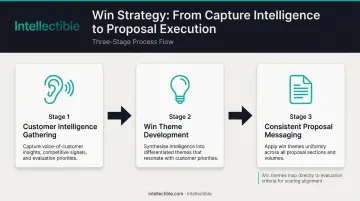
Where pipeline management keeps the machine running, win strategy determines whether it produces wins. The bidding manager translates customer intelligence gathered during capture into a differentiated position — defining win themes that directly address evaluation criteria and ensuring those themes run consistently through every proposal volume.
Without a clear win strategy, a proposal becomes a compliance exercise. Evaluators score against requirements, but they award to teams that understood what the customer actually needed.
Cross-Functional Coordination
The bidding manager rarely has direct authority over the people they depend on most. Subject matter experts, pricing analysts, legal, subcontractors, and executive sponsors all contribute to a bid — and all have competing priorities. Getting aligned results from that group without org-chart authority is where influence and process discipline matter most.
Bid Compliance and Governance
Every submission requires:
- A complete compliance checklist verified against the solicitation
- Proper certifications, representations, and required forms
- An audit trail of decisions and approvals throughout the process
- On-time delivery — late submissions are typically rejected outright
Performance Tracking
Strong bidding managers track their own results. Key metrics include:
- Win rate by agency, contract type, and bid size
- Qualified pipeline value at each stage
- On-time submission rate
- Cost of capture per opportunity
This data refines future Go/No-Go decisions and gives leadership a clear basis for resource investment.
Key Skills and Qualifications
Core Competencies
The role demands a specific combination of capabilities:
- Federal procurement knowledge — FAR fundamentals, contract types, solicitation structures
- Project management under deadline pressure — color review schedules are non-negotiable
- Stakeholder management — influencing without authority across senior levels
- Pricing acumen — understanding cost structures and competitive pricing strategy
- Written communication — producing executive-level strategy documents and bid reviews
Relevant Credentials
| Credential | What It Validates | Best For |
|---|---|---|
| APMP Foundation | 40 entry-level bid/proposal competencies; 75-question exam | Career entry and progression |
| APMP Practitioner | Application and leadership of proposal best practices | Professionals with 3+ years of experience |
| CFCM | Federal Acquisition Regulation knowledge | FAR fluency; requires degree or 5 years + 24 college credits |
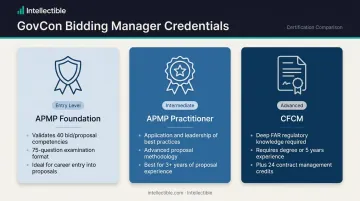
APMP's 2022/23 compensation data found certified proposal managers earned measurably higher salaries than non-certified peers, though this reflects the full association membership rather than federal GovCon exclusively.
FAC-C and DAWIA are government acquisition workforce certifications, not contractor-side requirements. Most GovCon employers prioritize a proven win record over formal credentials — and familiarity with specific agency customers, GWACs, and BPAs often matters more than academic background.
Salary Ranges
Compensation varies considerably by experience level, firm size, and pipeline value managed. Reliable starting points for benchmarks:
- Glassdoor's capture manager salary data for broad market ranges
- Firm-specific postings from large primes like Leidos, SAIC, and Booz Allen, where pipeline managed can reach hundreds of millions annually
- Industry forums and APMP peer groups for GovCon-specific compensation context
How AI and Automation Are Reshaping the GovCon Bidding Manager Role
The Opportunity Volume Problem
The federal market publishes a continuous stream of contract notices across agencies, vehicles, and set-aside categories. Manually triaging that volume — parsing each notice for NAICS alignment, incumbent risk, scope fit, and strategic relevance — can consume hours of a bidding manager's week. Those are hours that should be spent on strategy and relationships.
Deltek's 2025 Clarity Government Contracting Study found that 45% of nearly 900 GovCon respondents used AI to streamline operations and business development efforts — up 10 percentage points from the prior year. The shift is real and accelerating.
AI-Powered Opportunity Discovery and Go/No-Go Scoring
Modern GovCon platforms are automating the initial filtering and qualification layer that previously consumed analyst time. Rather than manual keyword searches, AI-powered tools apply semantic fit analysis against an organization's configured profile — matching opportunities by agency, NAICS, PSC, deal size, contract vehicle, and exclusion rules.
Intellectible's GovCon Engine converts every federal notice into a structured capture record containing agency, office, NAICS, PSC, timing, scope, fit rationale, risk signals, and recommended next actions. The platform applies semantic fit analysis and configurable capture rules — not just keyword matching — to triage the federal market at scale, then maps the contract behind each opportunity by surfacing award history, likely incumbents, expiring contracts, teaming targets, and competitive threats. The platform's Opportunity Review Desk moves teams through a Capture → Sort → Pursue → Act workflow, with daily match briefs routed to capture, BD, and leadership teams automatically.
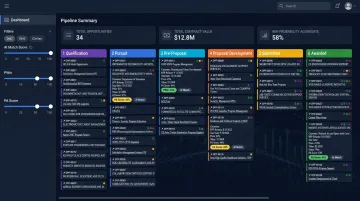
Defense contractor Oceus deployed the GovCon Engine and doubled the qualified opportunities it surfaces and reviews each month. CEO Jeff Harman noted: "Now we're looking at more than double the qualified opportunities per week — about seven to eight opportunities a month making it through our threshold." The team also developed a new pipeline relationship through an AI-generated outreach that wouldn't have existed through traditional methods.
AI in the Proposal Phase
Beyond opportunity discovery, AI is now handling:
- RFP analysis — extracting evaluation criteria, submission rules, and risk signals from solicitation documents automatically and turning solicitations into go/no-go reports, requirement summaries, and risk lists
- Pre-RFP market intelligence — building market reports for RFIs and sources-sought that support early positioning before a solicitation ever drops
- Compliance matrix automation — surfacing requirements before kickoff rather than mid-draft
The bidding manager's judgment on win strategy, customer tone, and evaluator psychology cannot be automated. AI handles mechanical triage and content drafting. Knowing what separates a winning proposal from a technically compliant also-ran is still entirely a human call.
Governance Responsibility
As AI enters the bid process, bidding managers take on a new governance function. They must establish:
- Which AI-generated content requires human verification before submission
- How proprietary client and bid data is handled within AI workflows
- Whether a specific solicitation contains any restrictions on AI use in responses
Solicitations are starting to include AI-specific instructions alongside standard formatting requirements. Intellectible's compliance extraction surfaces these provisions automatically from solicitation documents — but interpreting them and deciding how to respond is the bidding manager's call, not the platform's.
Frequently Asked Questions
What does a bidding manager do?
A GovCon bidding manager oversees the full federal opportunity lifecycle — from identifying and qualifying pursuits on SAM.gov through proposal submission and post-award debrief. They coordinate cross-functional teams, own win strategy for each bid, and make Go/No-Go decisions that determine where the firm's pursuit resources are invested.
What is the salary range for a bidding manager?
Compensation varies significantly by experience level, firm size, and pipeline value managed. Glassdoor, Indeed, and APMP's compensation research offer current benchmarks by seniority level, though GovCon-specific ranges should be verified against job market data for your target firms and roles.
What is the difference between a bidding manager and a capture manager?
A capture manager focuses on pre-RFP intelligence, relationship development, and positioning. A bidding manager owns the full pursuit lifecycle, including proposal execution. In smaller GovCon firms, one person typically holds both responsibilities under a single title.
What qualifications does a GovCon bidding manager need?
Most employers prioritize a proven win record over formal credentials. APMP Foundation and Practitioner certifications are widely valued, as is CFCM for FAR fluency. Familiarity with specific agency customers, IDIQ vehicles, and proposal color review processes often matters more than a degree.
How does a bidding manager decide which opportunities to pursue?
The Go/No-Go framework evaluates probability of win, competitive landscape, required capabilities, resource availability, and strategic fit before committing pursuit resources. Disciplined no-bids, passing on opportunities that don't meet the threshold, are as important as well-executed pursuits.
What tools does a GovCon bidding manager typically use?
Core tools include SAM.gov for opportunity monitoring, USASpending.gov for competitive intelligence, CRM platforms for pipeline tracking, and proposal management software for compliance. AI-powered platforms like Intellectible's GovCon Engine add automated opportunity triage, Go/No-Go scoring, compliance matrix generation, and content drafting from past proposal libraries.