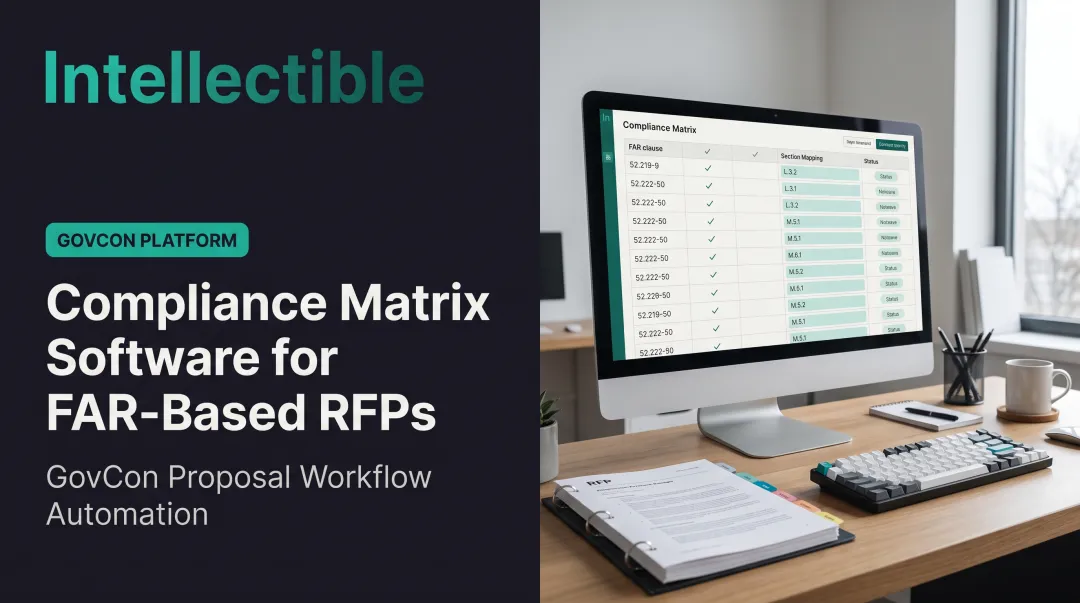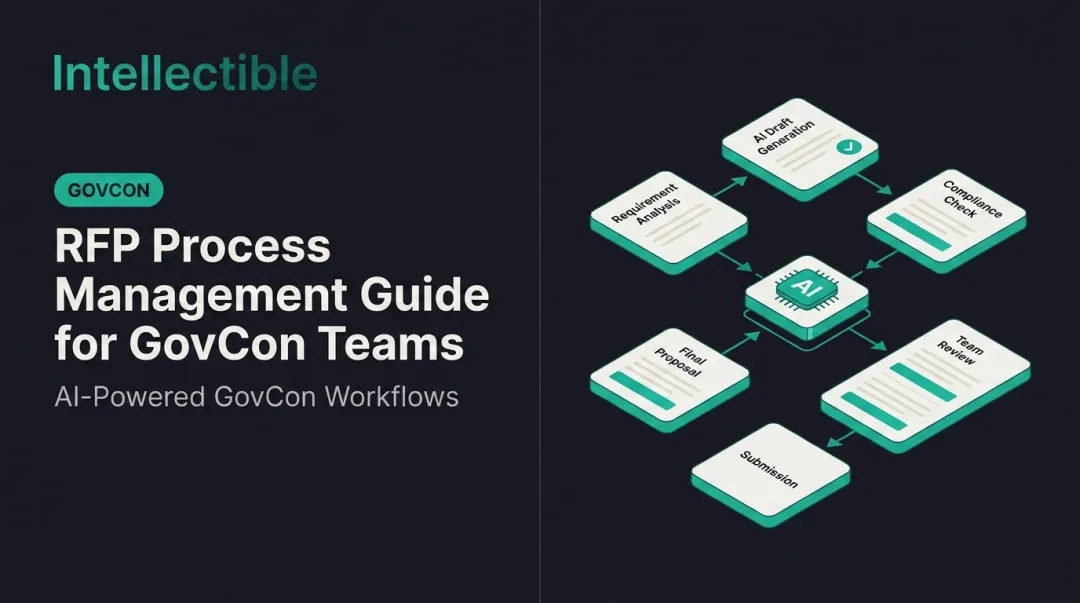
The challenge isn't theoretical. Federal solicitations routinely exceed 100 pages when you combine the base RFP, statements of work, amendments, security clauses, past-performance instructions, and required attachments. Requirements appear in Section H contract clauses, Section K certifications, attachment footnotes, and amendment Q&A. Manual tracking across this volume leaves gaps. A compliance matrix converts that scattered information into a single controlled reference that proposal managers, capture teams, compliance officers, and volume leads use from RFP shredding through final submission.
This guide explains how to build and maintain compliance matrices throughout the capture and proposal lifecycle—not as a final checklist, but as a working tool that drives strategy, team coordination, and requirement coverage from the moment the RFP drops.
Key Takeaways
- Map every RFP requirement to its proposal location and owner to prevent disqualification
- Start during RFP shredding and capture planning—not after drafting begins
- Pull requirements from Sections L, M, C, H, K, attachments, amendments, and agency Q&A
- Keep it living: update for amendments and as your proposal outline evolves
When Should GovCon Teams Use a Compliance Matrix?
Compliance matrices are standard practice for competitive federal proposals, particularly those involving multiple volumes, strict page limits, or cross-functional coordination. No FAR provision requires every contractor to build one, but complex solicitations with requirements scattered across 50+ pages and multiple document sources still need systematic tracking to avoid disqualification.
Essential scenarios include:
- Multi-volume responses (technical, management, past performance, cost) requiring cross-reference control
- IDIQ task orders where evaluation criteria reference both the parent contract and task-specific instructions
- Proposals with strict page limits where missed requirements can't be corrected in follow-on revisions
- RFPs requiring specific formats, certifications, or compliance documentation as mandatory submission elements
Some agencies treat the matrix as a submission deliverable, not just an internal checklist. A 2026 DoD solicitation required vendors to submit a completed salient-characteristics compliance matrix with pinpoint citations to supporting pages, tables, and documents.
Simplified tracking may suffice for:
- Commercial RFQs under 20 pages with single-volume responses
- Requests for Information (RFIs) asking two or three narrative questions
- Contract renewals where requirements remain unchanged from the incumbent period
The decision point isn't page count alone: it's requirement density, team size, and disqualification risk. If your proposal has multiple authors, mandatory certifications, past-performance volumes, or Section L/M subfactors, a compliance matrix cuts coordination errors. It also gives you auditable proof of coverage.
What You Need Before Building Your Compliance Matrix
Starting your matrix without the complete RFP package or team assignments produces gaps that surface late in the proposal cycle. Gather these inputs before extraction begins:
Complete RFP Package
Assemble every document the agency issued:
- Base solicitation and all numbered amendments
- Statements of work (SOW or PWS)
- Section H contract clauses and Section K representations and certifications
- Required attachments and written Q&A responses
FAR 15.206 requires agencies to amend solicitations when requirements or terms change. Amendments can add mandatory elements, revise page limits, or adjust evaluation criteria. Missing one amendment means missing binding requirements.
Understanding of Federal RFP Structure
Federal solicitations using the uniform contract format organize requirements into distinct sections:
- Section C: Performance descriptions, specifications, and the statement of work
- Section L: Instructions to offerors, including formatting rules, required content, submission deadlines, and response organization
- Section M: Evaluation factors, subfactors, and their relative importance
- Sections H, K, and attachments: Special contract requirements, required certifications, and supporting materials
Familiarity with this structure ensures you check every source, not just the obvious ones.
Proposal Team Assignments
Identify volume leads, section owners, and subject matter experts before building the matrix so you can assign responsibility during extraction. Each requirement needs a named owner, not a department, accountable for drafting the response, providing evidence, and confirming completion. Assigning accountability at build time prevents the coordination failures that create last-minute gaps.
RFP Shredding Tool or Template
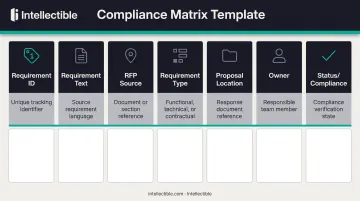
Whether working in a spreadsheet or using proposal automation software, prepare a template with standard columns:
- Requirement ID and Requirement Text
- RFP Source and Requirement Type
- Proposal Location, Owner, and Status
- Compliance
Platforms like Intellectible's GovCon engine automate extraction by parsing solicitations and attachments to generate compliance matrices, requirement summaries, and risk lists. That cuts manual shredding time while preserving source traceability.
How to Build a Compliance Matrix for GovCon Proposals (Step-by-Step)
Building a compliance matrix follows a defined sequence from requirement extraction through response mapping. Skipping steps or working out of order produces missed requirements and proposal disqualification.
Check If the RFP Mandates a Specific Format
Before creating your own template, verify whether the solicitation requires a prescribed compliance matrix format. Some federal agencies—particularly DoD and civilian agencies with highly technical acquisitions—include mandatory templates with specific columns, organization, and submission instructions.
Where to look:
- Section L (Instructions to Offerors) under "Proposal Format" or "Required Deliverables"
- Attachments labeled "Compliance Matrix Template" or "Proposal Checklist"
- Amendment documents that modify submission requirements
The 2026 DoD SpyderCrane solicitation required vendors to submit a completed salient-characteristics compliance matrix with pinpoint citations to supporting pages, tables, charts, paragraphs, or documents. Ignoring the prescribed format constituted non-compliance and risked disqualification. If the RFP provides a template, use it exactly as structured. Don't substitute your own.
Shred the RFP to Extract Every Requirement
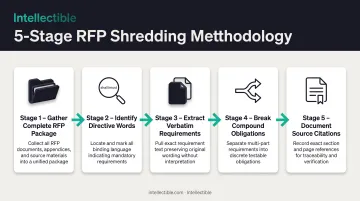
RFP shredding is the systematic line-by-line review of the solicitation to identify and document every binding instruction, evaluation criterion, deliverable, and compliance obligation. Work through each section methodically, extracting requirement language using directive words as triggers.
Key extraction signals:
- Shall and must indicate mandatory requirements (FAR 2.101 defines "shall" as imperative)
- Will often signals agency actions, but context determines whether it binds the offeror
- Provide, describe, demonstrate, include, and submit indicate required response content
High-risk locations GovCon teams commonly miss:
- Embedded requirements in past-performance instructions (e.g., "describe projects completed within the last three years that demonstrate X capability")
- Security clearance specifications in Section H clauses
- Small business subcontracting plan details and required certifications
- Page limit specifications and font/margin requirements in Section L
- Evaluation subfactors and their relative importance in Section M
Copy requirement text verbatim without paraphrasing. Rewriting "provide a staffing plan that identifies key personnel, their qualifications, and availability" as "describe your team" can obscure the three-part obligation (identification, qualifications, availability) and cause evaluators to question whether you understood the request.
When a single sentence contains multiple obligations connected by "and," break them into separate matrix rows so nothing drops out of tracking.
Build Your Matrix Structure With Standard Columns
A functional GovCon compliance matrix includes enough fields to track accountability, source traceability, and response location while remaining manageable during daily use.
Essential columns:
| Column | Purpose |
|---|---|
| Requirement ID | Unique identifier (e.g., L-001, M-003, C-012) for cross-reference and communication |
| Requirement Text | Verbatim language from the RFP, preserving directive words and compound obligations |
| RFP Source | Section, page, paragraph (e.g., "Section L, pg 12, para 3.2.1") |
| Requirement Type | Mandatory / Evaluated / Administrative / Informational |
| Proposal Location | Volume, section, page where your response appears |
| Owner | Named individual responsible for the response |
| Status | Not started / In progress / Complete |
| Compliance | Full / Partial / None |
| Notes | Rationale for partial compliance, dependencies, or reviewer comments |
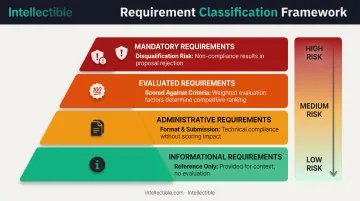
Categorize by requirement type:
- Mandatory: Disqualification risk if missing (e.g., required certifications, format compliance, submission deadlines)
- Evaluated: Scored by evaluators under Section M criteria (e.g., technical approach, management plan, past performance)
- Administrative: Formatting, page limits, font specifications, cover page requirements
- Informational: Acknowledgments or background statements without scoring impact
This structure enables filtered views during review: compliance officers focus on mandatory items, proposal managers track evaluated requirements, and final reviewers verify administrative conformance.
Map Requirements to Your Proposal Response
Populate the proposal location column as you draft—not after the full proposal is written. Recording the exact volume, section, and page number where each requirement is addressed enables real-time gap identification and prevents redundant responses across sections.
Why real-time mapping matters:
- Identifies coverage gaps while you can still adjust the outline or assign additional sections
- Prevents duplicate responses that waste precious page count
- Keeps the matrix synchronized with your evolving proposal structure
- Provides immediate status visibility for proposal managers and reviewers
When a single requirement is addressed across multiple sections—for example, a technical approach described in Volume I and supported by past-performance examples in Volume II—note all locations and designate one as the primary response. Use the Notes column to cross-reference supporting material: "Primary response Vol I, Sec 3.2; supporting examples Vol II, pp 15-17."
Platforms like Intellectible automate this synchronization by connecting compliance matrices to proposal databases and workflow stages. They track owners, deadlines, dependencies, and evidence paths while preserving source traceability and audit trails.
Update the Matrix When Amendments Are Issued
Federal agencies issue amendments to modify requirements, adjust evaluation criteria, extend deadlines, or answer vendor questions.
FAR 15.206 requires agencies to amend solicitations when requirements or terms change and to distribute amendments to everyone who received the original. FAR 52.215-1 requires offerors to acknowledge amendments by the stated deadline, and GAO has held that failure to acknowledge a material amendment can render a proposal nonresponsive.
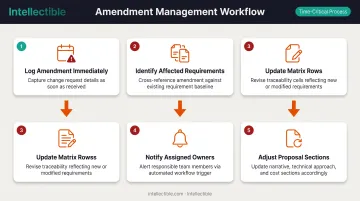
Amendment handling process:
- Log the amendment immediately - Record amendment number, issue date, and distribution confirmation
- Identify affected requirements - Compare amendment text against your existing matrix rows
- Update matrix rows - Revise Requirement Text with new language, adjust RFP Source citations, and mark rows with the amendment number
- Notify assigned owners - Alert section writers when their assigned requirements change or new requirements are added
- Adjust proposal sections - Update drafted content to reflect revised requirements, page limits, or evaluation criteria
Amendments can add entirely new requirements (extending your matrix), modify existing language (requiring proposal rewrites), or delete obsolete instructions (removing matrix rows). Treat each amendment as a mini-shredding exercise and update your matrix before communicating changes to the team.
Conduct Final Compliance Review Using the Matrix
The final compliance review—often called a Gold Team review in proposal management practice—uses the matrix as a systematic verification tool. Work row-by-row to confirm every requirement has an assigned owner, completed response, documented proposal location, and verified compliance status.
Gold Team verification checklist:
- Every matrix row shows "Complete" status with a named proposal location
- Partial compliance rows include documented rationale and risk acceptance
- No requirements lack responses or show "Not started" status
- All amendment-revised requirements reflect updated proposal language
- Mandatory requirements (certifications, formats, submissions) are 100% complete
- Cross-references between volumes are accurate and current
This review happens after color team comments are resolved and before final production. The matrix becomes your audit trail, demonstrating to leadership and compliance officers that every binding RFP element received deliberate attention and response coverage.
Where Compliance Matrices Fit in the GovCon Workflow
Compliance matrices are active management tools used continuously from RFP release through proposal submission. Integrate them into the capture and proposal lifecycle so they drive strategy and coordination instead of sitting idle until post-draft verification.
Capture Planning (Immediately After RFP Release)
The matrix starts during initial RFP shredding. Capture managers use extracted requirements to assess compliance risk, identify capability gaps, evaluate teaming needs, and inform bid/no-bid decisions. Early matrix creation answers three questions:
- Do we have the qualifications to meet mandatory requirements?
- Which evaluation factors favor our strengths?
- What teaming partners close our gaps?
Proposal Kickoff (Day 1 of Proposal Development)
The compliance matrix becomes the foundation for proposal structure and team assignments. Proposal managers map requirements to volumes and sections, assign ownership to named writers and SMEs, and establish deadlines aligned with color team reviews. The matrix transforms from a capture risk assessment into an execution roadmap.
Color Team Reviews (Throughout Drafting)
Reviewers use the matrix to verify requirement coverage during structured proposal reviews. Pink Team checks confirm that drafted sections address their assigned requirements. Red Team reviews validate that responses are complete, compliant, and competitive. The matrix provides the objective standard: Does this section address all assigned requirements from the RFP?
Final Quality Checks (Pre-Submission)
Before final production, the Gold Team conducts systematic verification using the matrix. Every row must show complete status, accurate proposal location, and full compliance. Partial compliance items receive documented risk acceptance. The matrix becomes proof that no requirement was overlooked.
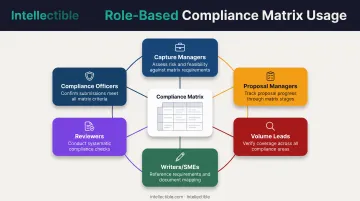
How different roles use the matrix
- Capture managers: Assess compliance risk and identify teaming needs during bid/no-bid analysis
- Proposal managers: Track progress, assign ownership, identify gaps, and coordinate color team reviews
- Volume leads: Verify that their sections collectively address all assigned requirements
- Writers and SMEs: Reference the matrix to ensure their drafts respond to specific RFP language
- Reviewers: Conduct systematic requirement checks during Pink, Red, and Gold Team reviews
- Compliance officers: Confirm mandatory elements and certifications before submission
Best Practices for Compliance Matrix Success
Effective compliance matrices require disciplined practices throughout the proposal lifecycle, not just at extraction or final review. Done well, they cut coordination errors and raise requirement coverage.
Assign One Named Owner Per Requirement
Shared ownership leads to dropped requirements. Each matrix row needs a single point of accountability: a named individual who drafts the response, gathers evidence, and confirms completion.
Multiple SMEs may contribute content, but one person owns delivery. Use "John Smith (with Jane Doe input)" rather than "Technical Team" so ownership stays clear.
Start Your Matrix During Capture Planning
Building the matrix after proposal writing begins is too late. Create it during RFP shredding so bid/no-bid calls, teaming choices, and the proposal outline track the real requirement flow.
Capture managers can surface compliance risks and capability gaps before the team commits to pursue—while strategy can still change.
Use Exact RFP Language Without Paraphrasing
Copy requirement text verbatim from the solicitation. Paraphrase hides multi-part obligations.
Rewriting "provide a staffing plan that identifies key personnel, qualifications, and availability" as "describe your team" is a common miss. Evaluators may doubt you understood the request, and internal reviews turn into debates over whether the response truly covers the requirement.
Maintain the Matrix as a Living Document
A static matrix goes stale within days. Update it when:
- Sections are renumbered during editing
- Page references shift
- Writers find embedded requirements while drafting
- Amendments arrive
Designate one proposal coordinator for version control, amendment intake, and daily updates from the team.
Integrate Your Matrix With Proposal Management Workflows
Strong GovCon teams tie the matrix to proposal schedules, assignments, content libraries, and reviews instead of parking it in a standalone spreadsheet.
Platforms like Intellectible's GovCon engine keep the matrix synced with proposal development, past-performance records, and team assignments. Teams get live visibility into requirement status, coverage gaps, and approval progress across the pursuit.
Conclusion
Compliance matrix success in government contracting comes from disciplined requirement extraction, clear ownership, and verification at every proposal stage. Tools matter less than how consistently your team uses the matrix.
Matrices that prevent disqualification are built during capture planning. Update them when amendments land. Put them in daily use so every contributor knows what the RFP requires and where the proposal responds.
Treat the matrix as a capture and proposal management tool, not a last-minute checklist. It should shape strategy, coordinate writers and reviewers, and leave an auditable trail of coverage.
Integrate it from RFP shredding through Gold Team review and it becomes the record teams actually trust. Distributed contributors stay aligned, missed shall-statements get caught early, and evaluators can see that you addressed every binding element on purpose.
Frequently Asked Questions
What is a compliance matrix in a proposal?
A compliance matrix is a table that maps each RFP requirement to the exact location in your proposal where it's addressed. Proposal teams and evaluators use it to verify complete requirement coverage, track accountability, and confirm no mandatory elements were overlooked.
What are common RFP mistakes to avoid?
The most critical compliance errors include missing requirements not extracted from all RFP sections (especially attachments and amendments), paraphrasing requirement language instead of copying it verbatim, and failing to update matrices when amendments are issued.
Is an RFP the same as a proposal?
No. An RFP (Request for Proposal) is the document issued by the government buyer stating their requirements, evaluation criteria, and submission instructions. The proposal is the vendor's response document that addresses those requirements and competes for award.
When should you create a compliance matrix?
Start your compliance matrix during initial RFP shredding, immediately after the solicitation is released—not after the proposal is drafted. Early creation lets the matrix guide proposal structure, team assignments, and strategic planning throughout capture and proposal work.
How do you handle requirements that appear in multiple RFP sections?
Create separate matrix rows for each instance with cross-references. Designate one as the primary requirement and treat others as supporting context, then address the most stringent version in your proposal. Use the Notes column to document all occurrences and confirm complete coverage.
Should you submit your compliance matrix with the proposal?
Submit your compliance matrix if Section L requires it or if doing so voluntarily helps evaluators navigate your response. Always remove internal notes, strategy comments, risk assessments, and team coordination details before external submission to avoid disclosing proprietary information or bid strategy.