Miss one FAR clause reference. Submit an hour past the deadline. Forget a required certification. Months of capture work disappear, and there's no appeal process for "we ran out of time."
That's the core challenge with GovCon bid management: it's not just proposal writing. It's coordinating capture managers, proposal writers, pricing analysts, and contracts/legal reviewers around fixed, non-negotiable federal deadlines — with regulatory compliance baked into every step.
This guide breaks down what bid management actually means in a GovCon context, walks through the seven-stage process most teams follow, and covers the failure points and best practices (including where AI now fits) that help teams win more without hiring more.
Key Takeaways
- Bid management spans opportunity identification through post-award follow-up, not just proposal writing
- A living compliance matrix mapped to Section L/M prevents most common disqualifications
- FAR/DFARS rules make GovCon bidding far more procedural than commercial bidding
- AI platforms now automate opportunity scoring, compliance mapping, and pricing audit trails
What Is Bid Management in Government Contracting?
Bid management, in a GovCon context, is the coordinated process of identifying, qualifying, developing, pricing, and submitting compliant responses to government solicitations (RFPs, RFQs, and IFBs) issued through SAM.gov and agency-specific portals.
It sounds similar to commercial bidding. It isn't.
Federal and state solicitations run on FAR and DFARS clauses. Every proposal gets evaluated strictly against Section L (instructions to offerors) and Section M (evaluation criteria), and agencies are legally required to score proposals solely on the factors they've disclosed, per FAR 15.305.
There's no room to read between the lines. If Section M says technical approach counts more than past performance, that's exactly how it gets scored.
The Three Main Types of Solicitations GovCon Teams Encounter
Not every solicitation plays by the same competitive rules. Understanding which type you're chasing shapes your entire capture strategy.
- Open/competitive solicitations: Full and open competition posted publicly on SAM.gov, where any qualified vendor can bid
- Restricted/set-aside solicitations: Limited to specific pools like small business, 8(a), SDVOSB, or WOSB set-asides, plus task orders under existing IDIQ/GWAC vehicles
- Negotiated/sole-source solicitations: Limited-competition or sole-source awards justified under specific FAR authorities, typically tied to unique capability or urgency
The set-aside path matters more than most teams realize. Per FAR Subpart 19.5, agencies must set aside acquisitions above the simplified acquisition threshold whenever at least two responsible small businesses are expected to offer competitive prices, known as the "Rule of Two."
Knowing which bucket an opportunity falls into determines whether you should even bother building a capture plan.
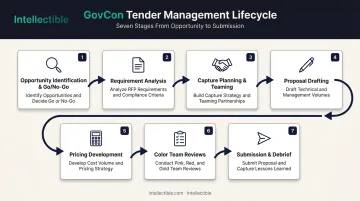
The 7-Stage Bid Management Process for GovCon Teams
Terminology varies by agency and by firm, but most GovCon proposal teams follow a repeatable lifecycle from first sighting a notice to closing out post-award actions. Here's how it typically breaks down.
Stage 1: Opportunity Identification and Go/No-Go
Teams monitor SAM.gov and agency forecast portals for relevant notices, then score each one against go/no-go criteria:
- Agency relationship strength
- Incumbent status
- Budget fit
- Internal delivery capacity
Skip this step, and teams burn proposal hours on opportunities they were never going to win.
Stage 2: Solicitation and Requirement Analysis
Before anyone drafts a sentence, someone has to dissect Section L instructions and Section M evaluation factors. This produces an initial compliance matrix, the document that governs everything else that follows.
Stage 3: Capture Planning and Teaming Strategy
This is where capture teams identify teaming partners, assess incumbent intelligence, and define competitive positioning. Waiting until after the RFP drops to find a teaming partner almost always means settling for a weaker one.
Stage 4: Proposal Development and Compliance Drafting
Volume leads (technical, management, past performance) draft directly against the compliance matrix built in Stage 2. This is the single biggest defense against compliance gaps: writing to the matrix, not to a blank page.
Stage 5: Pricing and Cost Volume Development
Teams build cost and price volumes with a clear audit trail, matching technical claims to pricing assumptions line for line. A technical volume that promises 24/7 support but a price volume that only budgets for business hours is an easy disqualification. The capture workflow maintains a full audit trail of assumptions, source evidence, and approval history so technical and cost teams work from the same assumptions instead of reconciling spreadsheets after the fact.
Stage 6: Color Team Reviews and Approval
Most mature teams run a Pink, Red, Gold review cadence:
- Pink checks compliance and win-strategy execution
- Red predicts how an evaluator will actually score the draft
- Gold confirms required changes landed and the package is submission-ready
Stage 7: Submission, Debrief, and Post-Award Actions
Confirm the submission actually landed, respond to any evaluation notices or clarification requests, request a debrief regardless of outcome, and capture lessons learned. This last step gets skipped constantly, and it's the one that reduces protest risk and improves your next bid.
Common Challenges in GovCon Bid Management
Three problems show up again and again across GovCon proposal shops, and they compound each other.
Regulatory Complexity Outpaces Team Bandwidth
FAR/DFARS clauses, CMMC cybersecurity requirements, and Section 508 accessibility rules each carry real compliance weight. The Section 508 rule alone is estimated at $79.0 million to $82.8 million annually in incremental federal-agency compliance costs, affecting roughly 22,809 ICT contractors, including 12,845 small businesses.
That's the regulatory backdrop every technical volume has to account for.
Opportunity Volume Overwhelms Manual Tracking
Teams juggle dozens of live solicitations across SAM.gov and agency-specific portals with no centralized system. Deadlines get missed simply because nobody was watching the right feed at the right moment.
Cross-Functional Bottlenecks Trigger Late-Stage Rework
Capture managers, proposal writers, pricing analysts, and contracts/legal reviewers rarely work off the same live document. That gap creates last-minute scrambles to reconcile Section L requirements.
This friction extends beyond the contractor's side too. GAO logged 1,803 bid protest cases in FY2024, with a 16% sustain rate, much of it tied to unreasonable technical or cost evaluations.
Tight, well-documented internal processes reduce your exposure on both sides of that equation.
Best Practices for Bid Management Success in GovCon Teams
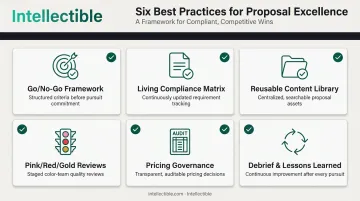
These six practices show up consistently among GovCon teams that win more without expanding headcount.
Apply a structured, data-driven Go/No-Go framework. Score opportunities on agency budget history, incumbent strength, competitive positioning, and delivery capacity, rather than gut feel. According to Deltek's 15th Annual Clarity Study, which surveyed nearly 650 contractors, opportunity identification (81%), price-to-win (77%), and teaming (71%) rank as top BD priorities, confirming that disciplined qualification deserves the most attention.
Maintain a living compliance matrix. Map it directly to Section L/M requirements, and update it in real time whenever an amendment or RFI lands. A compliance matrix built once and never touched again is a liability disguised as documentation.
Centralize a reusable content and past performance library. Standard sections (corporate capabilities, certifications, resumes) get reused accurately, while technical narratives stay tailored to each solicitation.
Institutionalize Pink, Red, Gold reviews with defined entry/exit criteria. Catch compliance and pricing issues weeks before submission, not during the final 48-hour scramble.
Build pricing governance with a full audit trail. Every cost volume assumption should tie back to the technical approach and remain traceable for contracting officer scrutiny.
Formalize debriefs and lessons-learned capture. Feed win/loss data back into your go/no-go criteria and content library so every bid decision gets sharper than the last. Intellectible's GovCon Engine can automate this loop, routing debrief insights directly into your next qualification score and proposal library.
How AI Is Transforming Bid Management for GovCon Teams
Manual opportunity tracking and spreadsheet-based pricing weren't built for the volume today's GovCon teams face. AI is closing that gap in three specific ways:
- Automated opportunity scoring pulls and ranks SAM.gov and agency forecast portal opportunities against your capture criteria, cutting the manual search and go/no-go cycle dramatically.
- Automated compliance matrix generation extracts requirements directly from solicitation documents and flags mandatory items or gaps before drafting starts, rather than a proposal lead manually parsing Section L/M line by line.
- AI-assisted pricing workflows speed up cost volume development while preserving the audit trail controls contracting officers expect to see.
This is exactly the gap Intellectible, a horizontal AI build platform based in Austin, Texas, was built to close for GovCon revenue teams.
The platform transforms every solicitation into a structured capture record covering agency, NAICS/PSC codes, scope, risk signals, and a recommended go/no-go action.
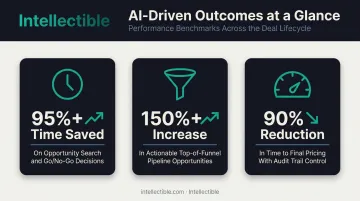
The results speak in concrete numbers:
- 95%+ time saved on opportunity search and Go/No-Go decisions
- 150%+ increase in actionable top-of-funnel pipeline opportunities
- 90% reduction in time to final pricing, with full audit trail control
Defense contractor Oceus more than doubled the qualified opportunities it surfaces and reviews each month after implementing the platform, moving from a handful to roughly seven or eight qualified opportunities monthly.
That momentum shows up in customer feedback too. John Grady, Corporate Director of Business Development at HHS, put the shift plainly: the platform is "taking the tedious, monotonous hours of RFP efforts out of human hands," freeing the team to spend time analyzing and selling instead.
The underlying philosophy is scale the process, not the headcount. Solicitation volume keeps climbing, but automating the repetitive parts of opportunity search, compliance mapping, and pricing means proposal and pricing teams can absorb that growth without adding staff.
Frequently Asked Questions
What is bid management?
Bid management is the end-to-end process of identifying, preparing, and submitting compliant responses to procurement requests. In GovCon, it carries an added emphasis on regulatory compliance under FAR/DFARS.
What are the three types of solicitations?
Open/competitive solicitations are publicly posted for any qualified bidder. Restricted/set-aside solicitations limit competition to pools like small business or 8(a). Negotiated/sole-source solicitations involve limited or single-vendor awards justified under specific FAR authorities.
What are the seven stages of a bid process?
The seven stages are: opportunity identification and go/no-go, requirement analysis, capture planning, proposal drafting, pricing development, color team reviews, and submission through post-award debrief. Each stage builds directly on the one before it.
How does bid management differ for government contractors versus commercial bidders?
GovCon adds strict FAR/DFARS compliance requirements, rigid Section L/M evaluation structures, and real protest risk that commercial bidding simply doesn't carry. Agencies must score proposals solely on disclosed factors, leaving little room for interpretation.
What compliance requirements most often derail GovCon bid submissions?
Missed FAR clauses, outdated certifications, and cybersecurity gaps under CMMC are the most common disqualifiers. Section 508 accessibility requirements also trip up teams that haven't scoped them early.
Can AI really reduce Go/No-Go and pricing time for government contract teams?
Yes. AI-driven scoring cuts opportunity research and ranking time, while automated pricing speeds cost volume drafting without sacrificing audit trail control. Intellectible clients see 95%+ faster go/no-go decisions and a 90% reduction in time to final pricing.