Introduction
Proposal management is the end-to-end process of planning, developing, coordinating, and submitting competitive proposals in response to government RFPs and RFQs. For contractors at the federal, state, and local levels, it is mission-critical.
Winning work takes more than technical capability. You need process discipline, compliance tracking, and tight coordination across capture, writing, pricing, and review teams.
Many firms still run proposals from inboxes and shared drives. Government procurement does not allow that kind of improvisation. Federal procurements alone totaled approximately $793 billion in FY2025. Strict evaluation criteria, FAR requirements, past performance, and multi-volume pricing structures punish missed steps and weak positioning.
This guide covers:
- What proposal management means in a GovCon environment
- How the process works step by step
- Key team roles and handoffs
- Success factors that separate winning submissions from near-misses
Key Takeaways
- Proposal management coordinates every activity from opportunity ID through submission and post-award debriefs
- GovCon wins depend on clear roles, documented processes, compliance rigor, and strategic planning—not writing polish alone
- Six lifecycle phases drive each pursuit: qualification, bid/no-bid, kickoff, content development, reviews, and production
- Workflow automation scales win rates without added headcount and delivers 95%+ time savings on key decisions
- Avoid late SME input, unclear compliance matrices, weak win themes, and skipped post-submission lessons learned
What Is Proposal Management for Government Contractors?
Proposal management is the discipline of organizing people, processes, content, and timelines to produce compliant, competitive proposals in response to government solicitations.
According to the Association of Proposal Management Professionals (APMP), the Bid/Proposal Manager oversees creation and submission of responses to RFPs, RFIs, and other solicitations.
The goal is higher win probability: a proposal that meets every requirement, makes the solution clear, and sets your firm apart from competitors.
Proposal management is distinct from related functions:
- Capture management focuses on pre-RFP positioning, customer engagement, and relationship-building
- Business development identifies opportunities and qualifies strategic fit
- Proposal management executes the response once the RFP is released
In GovCon, proposal management also includes compliance tracking (Section L/M crosswalks), risk mitigation (pricing reviews, teaming agreements), and adherence to procurement regulations such as FAR and DFARS.
Why Proposal Management Is Critical in Government Contracting
Government RFPs are highly structured with strict evaluation criteria, mandatory requirements, and pass/fail compliance standards. Missing a single requirement can result in disqualification regardless of technical merit. GAO decisions show that failure to follow proposal-preparation requirements can result in immediate rejection.
The competitive landscape is equally unforgiving. Evaluators use scoring matrices tied to stated solicitation factors to compare proposals methodically. Typical factors include:
- Price or cost
- Technical capability
- Past performance
- Management approach Without disciplined proposal management, teams produce generic, non-compliant, or poorly organized responses that score poorly even when the underlying solution is strong.
Resource and time pressures compound the challenge. GovCon proposal teams are often lean, managing multiple simultaneous pursuits with response windows that FAR 5.203 sets at a minimum of 30 days for many noncommercial actions and 45 days for R&D solicitations. Inefficient processes lead to burnout, missed opportunities, and lower win rates.
How the Proposal Management Process Works
Proposal management in GovCon typically follows seven core phases from opportunity identification through post-submission analysis. While every organization customizes their process, the core sequence remains consistent: qualify the opportunity, make the bid/no-bid decision, plan the response, develop content, review for quality and compliance, produce and submit, and learn from results.
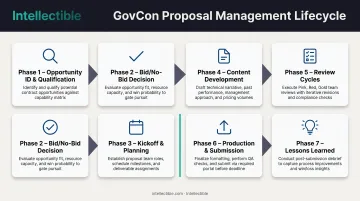
Phase 1: Opportunity Identification and Qualification
Before formal proposal work begins, the capture or BD team monitors sources like SAM.gov, agency forecast schedules, and industry days to identify potential contracts that align with the firm's capabilities and strategic priorities. Anyone can search SAM.gov opportunities without an account; an account enables saved searches and following opportunity changes.
Initial qualification involves reviewing the draft RFP or sources sought notice to assess:
- Technical fit and capability alignment
- Contract value and resource requirements
- Incumbent advantage and competitive landscape
- Teaming requirements and subcontractor availability
Intellectible's GovCon AI Engine converts opportunities and solicitation documents into structured pursuit assessments. It scores strategic fit across agency, geography, deal size, vehicles, certifications, and positive or negative signals.
Oceus CEO Jeff Harman reports the company now identifies "more than double the qualified opportunities per week," with about seven to eight opportunities per month clearing its qualification threshold.
Phase 2: Bid/No-Bid Decision
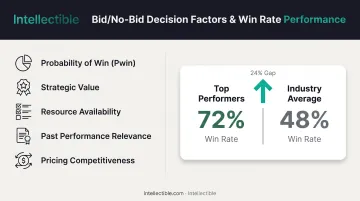
The bid/no-bid gate is a formal decision point where leadership evaluates probability of win (Pwin), strategic value, resource availability, past performance relevance, and pricing competitiveness using a documented scorecard or decision matrix.
Disciplined bid/no-bid decisions prevent wasted effort on low-probability pursuits and allow teams to focus resources on winnable opportunities. Deltek's 2026 Clarity research, based on more than 900 government contractors, reports a 72% win rate for top performers versus a 48% industry average, demonstrating that selective pursuit strategies correlate with higher success.
Automation can cut decision time by 95% by checking opportunity fit against capabilities, competitive pressure, historical awards, and RFP feasibility. Intellectible compares each pursuit to award history, agency patterns, value ranges, likely incumbents, and bidder density so leadership can see whether a market is open or incumbent-heavy.
Phase 3: Proposal Kickoff and Planning
Once the bid decision is "go," the proposal manager convenes all contributors, including technical leads, pricing, contracts, and subcontractors, to review the RFP, assign responsibilities, establish the schedule, and align on win strategy and themes.
Key planning outputs include:
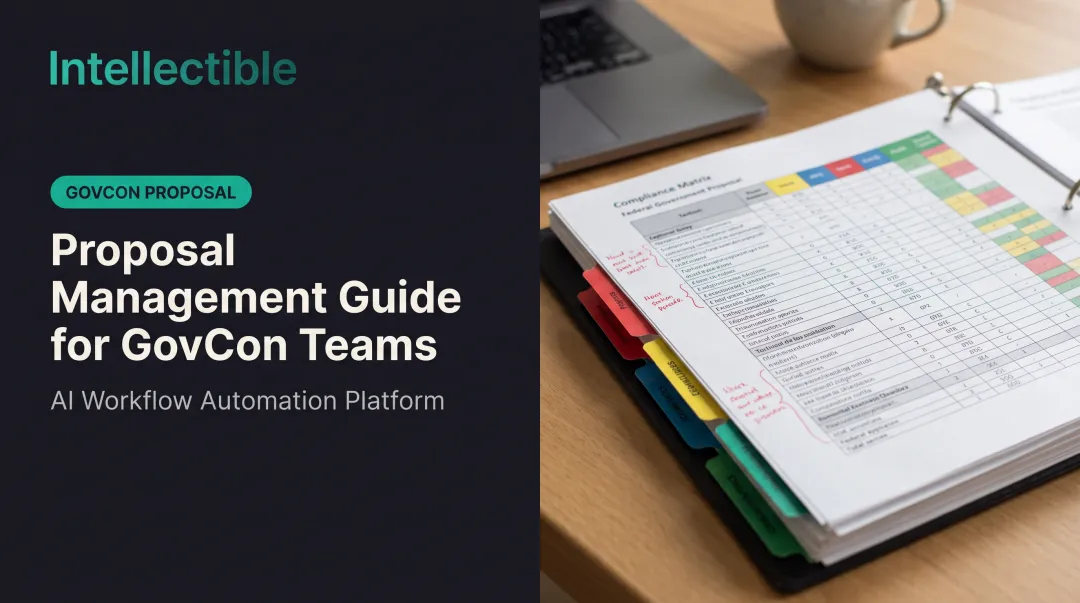
- Proposal outline and compliance matrix mapping RFP requirements to proposal sections
- Responsibility assignment matrix (who writes what by when)
- Schedule with milestones for draft submissions and reviews
- Teaming/subcontractor coordination plan
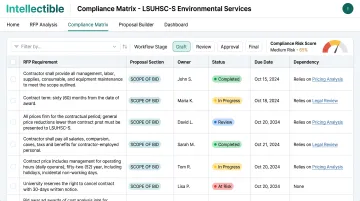
Lohfeld recommends building the compliance matrix before kickoff, with each requirement assigned a location, then extending it with writers, page limits, and notes; amendments should trigger immediate updates.
Intellectible's Proposal & Pursuit Engine structures this phase through a four-stage workflow: Upload → Compliance → Variables → Draft. It extracts key dates, submission rules, required sections, evaluation criteria, and compliance obligations, and surfaces compliance risks before kickoff.
Requirements map to sections, owners, evidence paths, statuses, due dates, and dependencies.
Phase 4: Content Development
During the writing phase, SMEs and proposal writers develop technical volumes, management approaches, past performance narratives, and resumes. Pricing teams prepare cost/price volumes. The proposal outline, win themes, and compliance matrix guide all of it.
Storyboarding or content templates accelerate development and ensure consistency across sections. Many teams maintain content libraries of reusable past performance write-ups, resumes, and boilerplate material. However, service providers can lose 30-40% of a proposal writer's or delivery lead's time searching for information in disconnected folders or chat histories.
AI-assisted drafting can reduce blank-page work by generating section drafts grounded in RFP requirements, deal variables, approved knowledge, and historical proposal language. Intellectible's Proposal Writer provides an integrated Assistant panel for compliance, missing-element, and strategy guidance, preserving proven content while keeping source material and compliance status visible.
Phase 5: Review Cycles (Color Team Reviews)
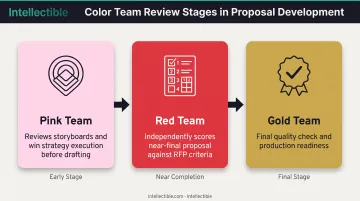
GovCon proposals typically undergo multiple structured review cycles:
- Pink Team: Reviews storyboards, mockups, or writing plans before text is drafted; checks execution of the approved win strategy
- Red Team: Independently predicts how the near-final proposal would score; recommends improvements to customer focus, completeness, communication, solution, and win strategy
- Gold Team: Final quality check and production readiness
Reviews should be conducted by individuals not involved in writing, using evaluation criteria from the RFP to simulate how the government will score the proposal. Findings are documented and authors revise accordingly.
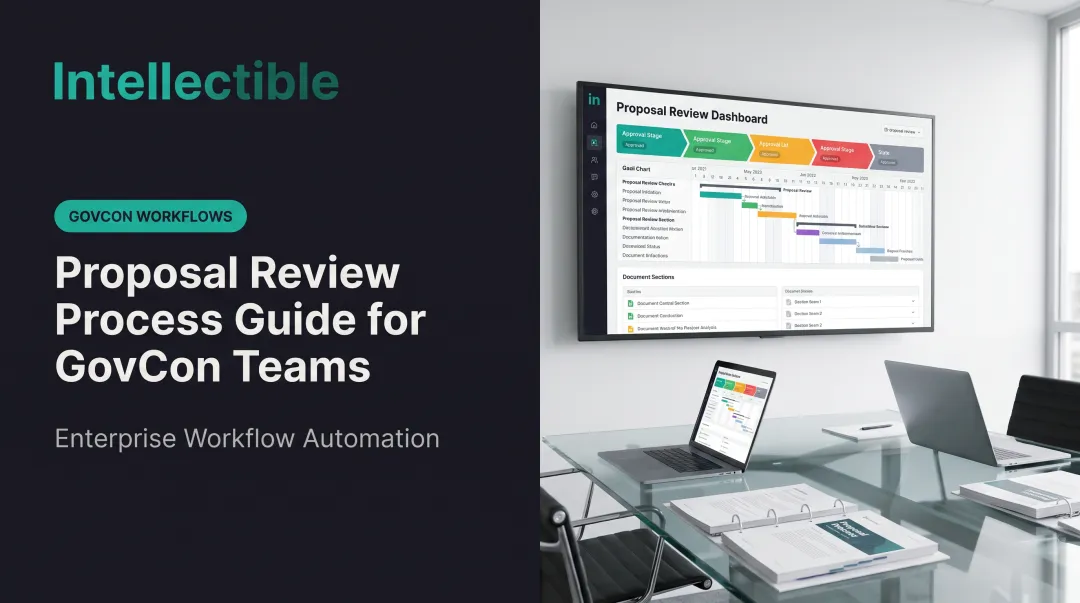
Intellectible supports review coordination with configurable routing and approvals. Drafts can move to SMEs, pricing, legal, operations, or executives without losing context, and role-specific workbenches show each person only what they need.
Phase 6: Production, Final QC, and Submission
Final production involves:
- Incorporating last review comments
- Formatting the document to RFP specifications (page limits, font, margin requirements)
- Generating required certifications and representations (for example, reps and certs in SAM.gov)
- Assembling volumes
- Conducting a final quality control check
Submission logistics include verifying the submission portal, uploading files in required formats, confirming receipt, and archiving the final submitted version and all supporting documentation. Offerors and quoters generally must be registered in SAM when the offer or quotation is submitted; registration must be renewed every 365 days to remain active.
Deltek's 2026 research states that one RFP response can require up to 84 hours, underscoring the importance of efficient processes and automation.
Phase 7: Post-Submission and Lessons Learned
The process doesn't end at submission. Proposal teams should conduct a debrief after award decisions to capture lessons learned: what worked, what didn't, and how to improve on the next pursuit. If the proposal is not selected, requesting and analyzing the government debrief provides valuable feedback on strengths, weaknesses, and areas for improvement.
Intellectible's Knowledge & Operations Engine indexes past work, SOPs, policies, and internal expertise so lessons learned stay searchable and tied to live workflows. Teams classify documents by business context and permissions before AI processing, which keeps that knowledge trusted and reusable.
Proposal Team Roles in GovCon
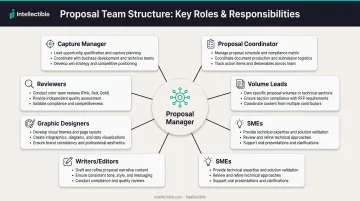
Effective proposal teams lock roles and responsibilities at kickoff. Clear ownership cuts duplication, gaps, and last-minute confusion. Core roles include:
- Proposal Manager: Owns the schedule, resources, content and design coordination, reviews, pricing handoffs, finalization, and submission
- Capture Manager: Leads pre-RFP strategy, customer engagement, win themes, teaming, and bid/no-bid calls; supports strategy during drafting, not formatting or submission
- Proposal Coordinator: Runs admin support, document control, and compliance tracking
- Volume Leads: Own technical, management, past performance, and pricing volumes
- Subject Matter Experts (SMEs): Supply technical content and solution detail
- Proposal Writers/Editors: Turn SME input into accurate, persuasive, compliant narrative and revise after reviews
- Graphic Designers: Build visuals, compliance matrices, and formatted documents
- Reviewers: Run color team reviews for completeness, compliance, and value
In smaller GovCon firms, people often wear multiple hats. The Proposal Manager may also write and coordinate. Larger firms usually staff dedicated proposal centers with specialized roles.
Use a RACI matrix (Responsible, Accountable, Consulted, Informed) so every task has a clear owner before drafting starts.
Key Factors That Affect the Proposal Process in GovCon
These factors most often drive proposal complexity and win probability in GovCon:
- RFP complexity and page limits: Highly technical solicitations with tight page caps demand concise writing and disciplined prioritization. Teams must balance completeness with brevity.
- Compliance requirements: RFPs mandate specific content, formats, certifications, and submission rules. FAR requires agencies to evaluate proposals solely against the solicitation's stated factors; non-compliance can mean elimination. Compliance matrices and checklists keep every requirement visible.
- Teaming and subcontracting: Many pursuits need joint ventures or prime-sub teams. FAR recognizes these arrangements and requires offeror disclosure of company relationships; the prime stays fully responsible for performance. Coordinating inputs, teaming agreements, and subcontractor content adds time and risk.
- Resource availability and competing priorities: Teams often juggle multiple pursuits with overlapping deadlines. Thin resourcing drives late submissions, weak quality, and burnout.
- Incumbent advantage and competitive positioning: GAO found a strong incumbent was one factor tied to competed procurements receiving a single offer. On a recompete, spell out discriminators and the risk of staying with the incumbent. Competitive intelligence should shape the win strategy.
Common Challenges and How to Overcome Them
Frequent pain points include:
- Late contributions from technical SMEs
- Weak or generic win themes
- Missed compliance requirements
- Lack of reviewer availability
- Insufficient time for quality reviews
Each of these has a practical fix:
Enforce content deadlines with real consequences. Workflow automation tracks due dates, dependencies, and submission readiness. Notifications fire when records change stage or hit rules by team, priority, or date—so late SME input surfaces before it sinks the schedule.
Build win themes in capture, not during writing. Ground them in customer needs, competitive positioning, and real discriminators. Inventing themes under deadline pressure produces generic copy evaluators ignore.
Use compliance matrices and section checklists. Lohfeld recommends mapping every RFP requirement from Section L instructions and Section M evaluation criteria to the proposal section that addresses it. Nothing gets missed, and evaluators can find responsive content quickly.
Schedule reviewers early and protect review time on the calendar. Independent reviewers who simulate government evaluation criteria give the feedback that actually improves scores.
Use proposal automation for coordination overhead. Workflow visibility, automated reminders, and centralized content libraries improve on-time delivery when contributors and reviewers are stretched thin.
HHS Corporate Director of Business Development John Grady puts it directly: "Intellectible is taking the tedious, monotonous hours of RFP efforts out of human hands. This allows us to do what we should be doing, analyzing and selling."
Writing talent matters—but documented process, trained teams, and enforced milestones are what raise win rates consistently.
When Proposal Management May Not Be Necessary
Not every government opportunity requires a full-scale proposal management process. A streamlined approach often works better for:
- Small, low-dollar task orders
- Broad Agency Announcements (BAAs) with flexible formats
- Sole-source awards
Even simplified proposals still need basic discipline:
- Understanding requirements
- Assigning responsibilities
- Conducting at least one review before submission
Skipping process entirely raises the risk of non-compliance and weak positioning.
Conclusion
In competitive GovCon, disciplined proposal management is a real differentiator. Firms that invest in documented processes, clear roles, and modern tools (including AI-powered workflow automation) win more contracts without scaling headcount.
Success takes both strategic rigor and tactical execution. Capture planning, competitive analysis, and win themes set direction. Compliance checks, quality reviews, and on-time delivery close the loop.
Deltek's 2026 research shows that 38% of surveyed government contractors identified pricing defensibility as the leading reason proposals were not selected, ahead of technical deficiencies and uncompetitive pricing. Winning requires excellence across every volume, not just the technical narrative.
Frequently Asked Questions
What does "proposal management" mean?
Proposal management is the process of planning, coordinating, and executing all activities required to produce and submit a competitive proposal in response to a government solicitation, ensuring compliance, quality, and alignment with win strategy.
What are the steps in an RFP process?
The typical steps are: (1) RFP release, (2) Questions and amendments, (3) Proposal development (planning, writing, reviewing), (4) Submission, (5) Evaluation by the government, (6) Award decision, and (7) Debriefs for unsuccessful offerors.
What are the three C's of proposal writing?
The three C's commonly referenced in proposal writing are Compliant (meets all RFP requirements), Clear (easy for evaluators to understand and score), and Compelling (differentiates your solution and persuades evaluators you offer the best value).
How long does it take to respond to a government RFP?
Response timelines vary by RFP complexity. FAR 5.203 sets minimums of at least 30 days for many noncommercial actions above the simplified acquisition threshold and 45 days for covered R&D. Teams with mature processes and content libraries meet these windows more reliably.
What is a compliance matrix and why is it important?
A compliance matrix is a cross-reference document mapping every RFP requirement (from Section L instructions and Section M evaluation criteria) to the specific proposal section where it is addressed. It ensures nothing is missed and helps evaluators quickly locate responsive content.
How can small GovCon firms improve their proposal win rates?
Even with limited resources, document a repeatable process, invest in capture planning for sharper bid/no-bid decisions, and build a library of past performance and resumes. Run at least one independent review before submission, and use proposal automation tools to scale without adding headcount.