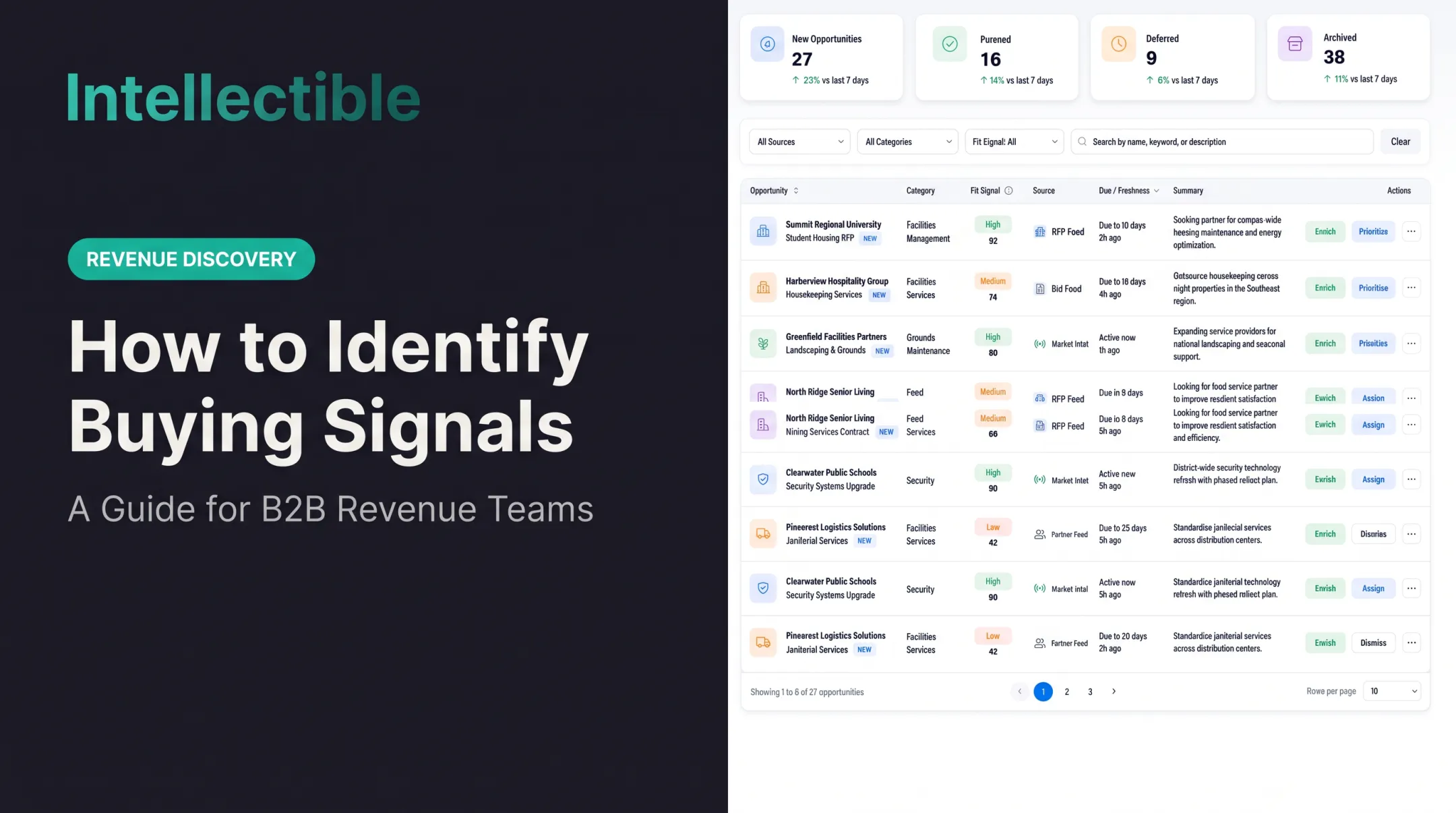
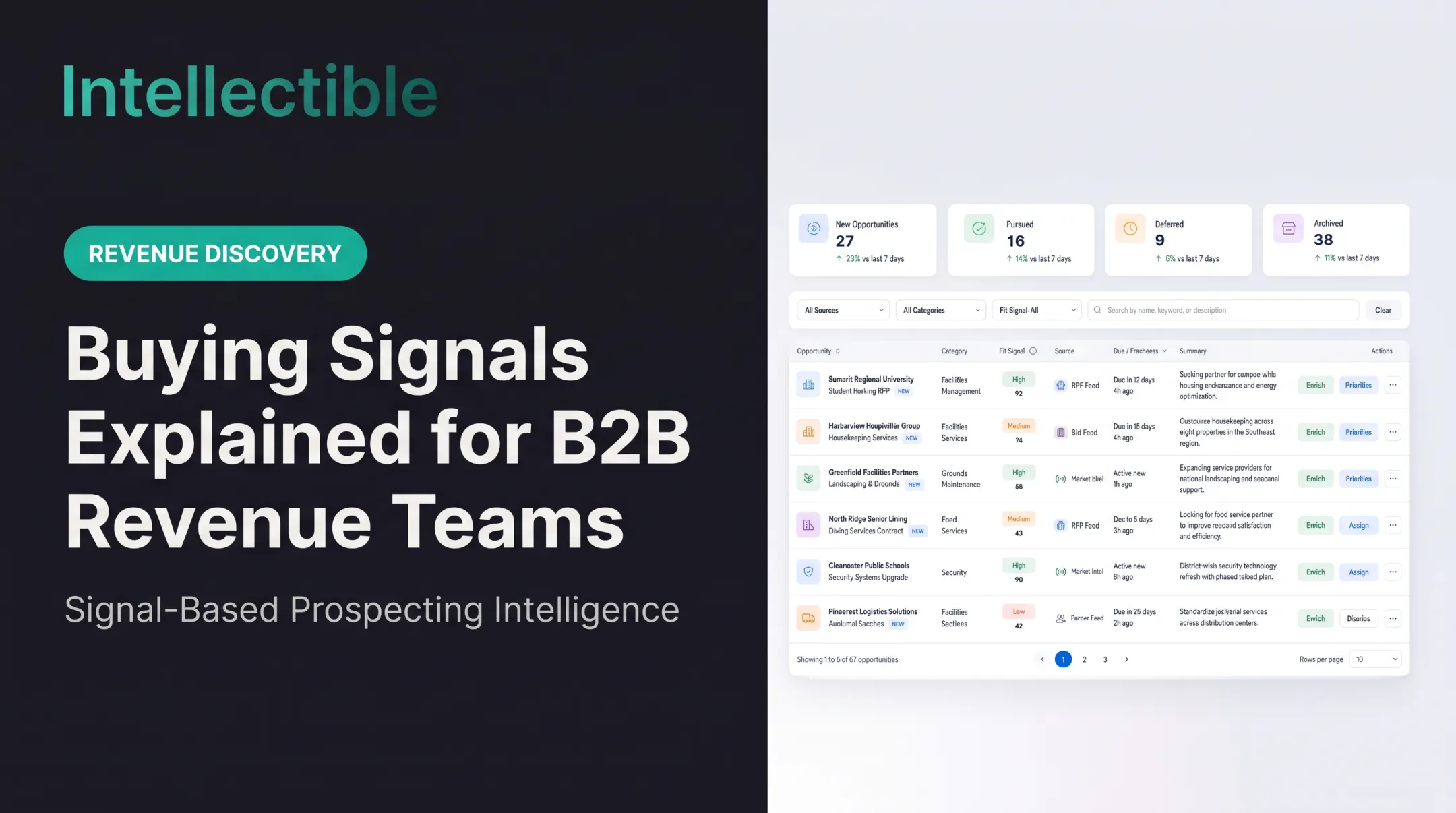
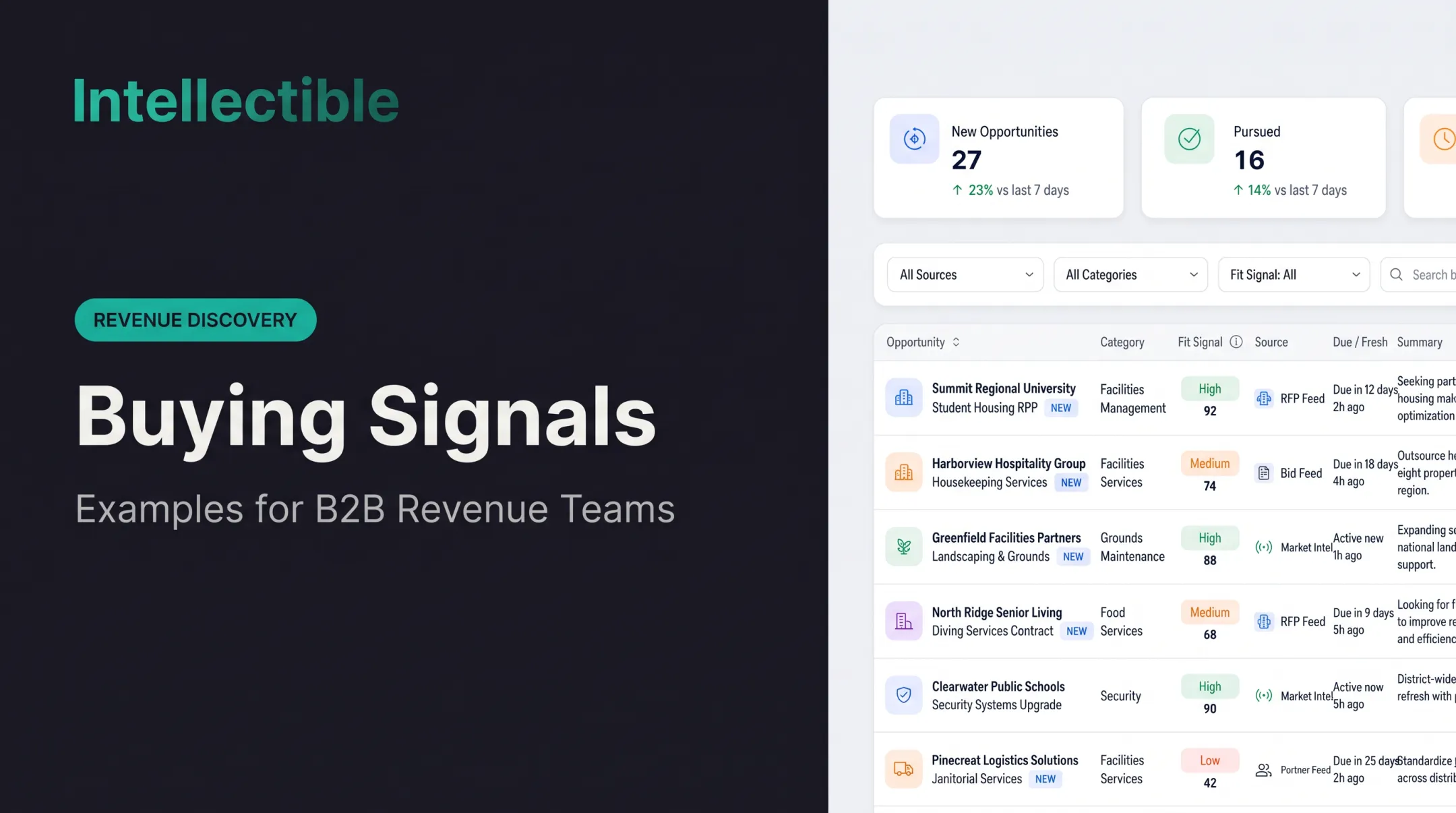
According to 6sense's 2025 report, 79% of buyers initiate first contact with a vendor themselves, and the first vendor contacted wins about 8 in 10 deals. Missing the early trace costs you the shortlist.
This guide gives you a categorized list of buying signals, a way to judge their quality, and a plan for what to do once one appears. The framework: separate fit from intent, stack signals at the account level, route them to the right owner, and measure what turns into qualified pipeline.
Key Takeaways
- Buying signals show shifting purchase likelihood, not readiness to buy.
- Strong signals combine fit, recency, specificity, and multiple stakeholders.
- Signal stacks beat isolated visits or downloads.
- Every key signal needs an owner, response, timing, CRM update, and measurement.
What Are B2B Buying Signals?
What counts as a B2B buying signal?
A buying signal is an observable action, event, or change suggesting an account is researching a problem, evaluating solutions, preparing to buy, or expanding an existing relationship. Treat it as evidence, not an assumption. What it means depends on your ICP and sales motion: a hiring surge matters to a RevOps vendor and means nothing to a hardware seller.
Explicit, implicit, fit, intent, and readiness signals
- Explicit signals: demo requests, pricing questions, direct replies.
- Implicit signals: repeat visits, hiring activity, review-site research.
- Fit signals: the account could ever become a customer, regardless of journey stage.
- Intent and readiness signals: research activity plus proof an actual buying process is underway.
A well-matched account is not automatically in-market. Demandbase's qualification model keeps fit independent of journey stage, and that separation is worth copying.
Where buying signals come from
First-party sources:
- CRM activity, website behavior, and email engagement
- Product usage, events, and sales conversations
Third-party sources:
- Review sites, job postings, and funding announcements
- Public communities, technology data, and intent providers
Account-level aggregation matters here. Five people each reading one page look like noise as contacts. Together they look like an evaluation.

Complete List of B2B Buying Signals Revenue Teams Should Track
The Six-Family Framework and Engagement Context
- Repeat visits to pricing, product, comparison, integration, or solution pages
- Form starts and demo requests
- Chat conversations
- Content downloads and webinar attendance
- Email replies and clicks
- Product trials and usage expansion
- Engagement with customer stories
Use six families to organize the trigger library: people; operations; technology; growth and capital; competitive and procurement; and relationship history. Each trigger needs a relevant commercial hypothesis, an eligible account, an original public or permitted internal source, and an owner. A generic alert without those fields is a research lead, not an action package.
Direct verbal and sales-process signals
These get stronger as the deal advances:
- Replies to outreach and requests for information
- Questions on pricing, implementation, integrations, security, or timelines
- Meeting attendance and stakeholder introductions
- Reference requests and technical validation
- Legal review, budget discussions, and contract negotiation
Company, organizational, and financial signals
- Hiring patterns, such as a cluster of RevOps or SDR roles
- New CRO or marketing leadership
- RevOps team creation
- Rapid go-to-market expansion
- Funding, acquisitions, market entry, or product launches
- Major customer wins, earnings pressure, rebrands
These show changing business conditions. They only matter when paired with ICP fit and a plausible business problem. No recent, method-disclosed study validates a specific conversion lift for hiring or funding, so treat them as context, not proof.
Technographic and trigger-event signals
- New or removed CRM, sales engagement, data, analytics, or automation tools
- Competitor technology adoption and migration projects
- Integration changes and contract renewal windows
- Fiscal-year planning and regulatory deadlines
- Competitor disruption and new contract announcements
Tie each trigger to a business consequence. "I saw you switched CRMs" is generic. "Migrations usually break lead routing for a quarter" is useful.
Relationship, community, and buying-group signals
- Mutual connections and former champions changing companies
- Shared customers or partners
- Event participation and relevant LinkedIn posts
- Public requests for recommendations
- Review-site comparisons and community questions
- New stakeholders appearing in a deal
Coordinated activity across a buying group beats one person's engagement. Gong's analysis of 1.8 million deals found won deals include twice as many buyer contacts as lost ones. That is an association, not proof of cause.
How to Separate Strong Buying Signals from Noise
Start with ICP and account-fit filters
Filter for account fit before you chase intent:
- Company size and industry
- Geography and operating model
- Existing technology and role relevance
- Ability to buy
Consider two accounts. A 15-person firm outside your market downloads three assets and requests a demo. A 400-person account in your core segment reads one integration page twice. The second deserves attention first.

Evaluate recency, specificity, and source reliability
- Recency: a signal from last week beats one from last quarter.
- Specificity: "viewed SOC 2 page" supports personalization; "visited site" doesn't.
- Reliability: separate first-party behavior from inferred third-party activity, and document data limits.
Look for signal stacks across categories
For every family, capture event date, publication date, ingestion date, and last verification date. Define visibility lag as publication date minus event date and processing lag as ingestion date minus publication date. Unknown event dates stay unknown. Do not invent a universal number of days for sources whose timing differs by jurisdiction or publisher.
Build a simple prioritization model
Weigh these factors:
- Account fit
- Signal strength
- Recency and frequency
- Number of engaged stakeholders
- Urgency
Sort accounts into high, medium, and low queues. Skip invented universal thresholds. Forrester's intent data survey found no standard false-positive or conversion rate, so calibrate against your own data.
Validate signals against pipeline outcomes
Compare closed-won, closed-lost, stalled, and disqualified accounts. Which signals preceded real conversations? Track signal-to-meeting, signal-to-opportunity, response time, conversion, and false-positive rates. Drop signals that never predict pipeline.
How Revenue Teams Turn Buying Signals Into Pipeline
Assign ownership and route the signal
| Signal type | Route to | Action |
|---|---|---|
| Demo request, procurement question | Sales rep | Immediate task |
| Multi-stakeholder topic research | Marketing/ABM | Account play |
| Hiring or funding event | SDR or RevOps | Research task, then outreach |
| Usage expansion | Customer success | Expansion review |
| Weak, early activity | Marketing | Nurture path |
Match the response to stage and signal type
High-intent actions get human follow-up. Early signals get education and problem-focused outreach. A procurement question needs a rep within hours. A hiring surge needs a useful insight, not a pitch.
Respond quickly without being intrusive
Set response windows by urgency. Reference the prospect's public problem, a relevant resource, or their question. Never imply you watched their browsing.
Personalize around the business problem
- Acknowledge a relevant trigger.
- Connect it to a likely operational problem.
- Offer an insight or resource.
- Ask for a low-friction next step.
Don't claim certainty about intent. A generic pitch fired by weak activity burns trust.
Automate the workflow while preserving human review
Automation can:
- Collect signals and enrich accounts
- Apply rules and score activity
- Notify owners and create CRM tasks
- Request approval before outreach
McKinsey calls for humans in the loop, since fragmented data can make AI automate complexity.
Intellectible, a horizontal AI build platform, shows one version of this. Its Revenue Discovery engine runs a Detect → Gate → Promote → Draft → Approve → Call → Qualified sequence with four human approval gates.
Scoring weights are editable, and an inspection-score drop can put an account in a queue with a report attached and a contact named. Outreach and Salesforce updates wait for approval. It is a workflow layer, not a standalone intent-data provider.
B2B Buying Signal Trends and Common Mistakes
Current trends in B2B buying behavior
- Self-guided research: Gartner reports 67% of buyers prefer rep-free buying, yet 69% want reps to validate AI insights.
- AI-assisted discovery: 45% of buyers used GenAI in a recent purchase (Gartner), and 6sense reports 94% LLM use. The samples differ, so don't compare them directly.
- Larger groups: Gartner puts buying groups at 5 to 16 people; Forrester says 13 on average.
- Peer research: TrustRadius found 77% of buyers check reviews.
- ROI scrutiny: 67% say business-case content influences vendor choice (DGR).
- Tracking limits: privacy rules and browser changes narrow visibility.
Most figures are global and vendor-sponsored, not US-only benchmarks.
Common mistakes that reduce signal quality
- Treating every engagement as intent wastes rep time.
- Confusing fit with readiness floods reps with cold accounts.
- Using stale data makes outreach feel off.
- Overreacting to one signal erodes trust.
- Ignoring buying-group activity misses the real deal.
- Sending irrelevant automated messages burns the domain and reputation.
- Tracking too many signals buries the useful ones.
- Not recording outcomes means you never learn.
Governance, privacy, and continuous improvement
Privacy rules apply to B2B contacts. California covers business contacts under the CCPA, while Virginia excludes people acting in a commercial context. The FTC's CAN-SPAM rules have no B2B exception.
Practical safeguards include:
- Minimize the data you collect
- Limit access by role
- Be transparent about sources
- Set retention periods
- Use person-level data responsibly
Beyond compliance, treat signal quality as an ongoing program. Review signals quarterly. RevOps and revenue leaders should drop signals that don't predict pipeline, then refine routing, scoring, and messaging from real outcomes.
Frequently Asked Questions
What are the six buying-signal families?
Use six families to organize the trigger library: people; operations; technology; growth and capital; competitive and procurement; and relationship history. Each trigger needs a relevant commercial hypothesis, an eligible account, an original public or permitted internal source, and an owner. A generic alert without those fields is a research lead, not an action package.
Where do people and operations triggers appear?
People triggers include a new plant manager, CFO, or VP Operations, evidenced through company announcements and dated role information. Operations triggers include openings, expansions, inspections, and permits in local records. Their visibility lag varies: a job advertisement may precede a project, while a permit portal may publish after the recorded event.
How should technology and capital events be verified?
Technology triggers can appear in implementation announcements or job descriptions naming systems. Growth and capital triggers can appear in SEC filings, acquisition announcements, and investor releases. Record whether a deal is announced or completed; filing publication time and transaction completion time are different facts.
Where do procurement and relationship triggers come from?
Competitive and procurement triggers include an incumbent award, amendment, expiration, RFP, or documented vendor complaint in the relevant records. Relationship triggers come from CRM loss reasons, past champions, prior evaluations, and permitted customer conversations. Keep public evidence separate from confidential relationship history and confirm the right buying entity.
How should this process be put into practice and measured?
For every family, capture event date, publication date, ingestion date, and last verification date. Define visibility lag as publication date minus event date and processing lag as ingestion date minus publication date. Unknown event dates stay unknown. Do not invent a universal number of days for sources whose timing differs by jurisdiction or publisher. Prioritize fit, source reliability, freshness, and whether a decision is still open. Start by monitoring the families most predictive of your actual service purchase, then compare acceptance and opportunity rates by family. A faster alert only helps if the evidence is relevant and a representative has a useful next action.