Key Takeaways
- Treat solicitation requirements, evaluation criteria, and FAR/DFARS rules as non-negotiable compliance gates
- Map every solution claim to evaluation criteria and back it with verifiable past performance
- Most losses come from weak compliance tracking, thin past performance, last-minute pricing errors, and rushed reviews
- Run five stages end to end: Capture Planning, Outline & Compliance Matrix, Drafting, Review, Final Submission
How to Write a Government Proposal: The 5-Stage Process
Stage 1: Capture Planning and Pre-RFP Positioning
Before the RFP drops, smart GovCon teams invest in capture planning—the structured process of deciding whether to pursue an opportunity and how to position your solution.
FAR 15.201 encourages exchanges with agencies from the earliest requirement identification through proposal receipt. That includes RFIs, market research sessions, one-on-one meetings, and draft solicitations.
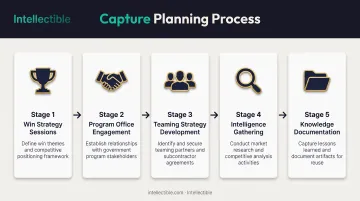
Capture planning activities include:
- Win strategy sessions that assess competitive landscape, identify discriminators, and determine whether to pursue as prime or sub
- Program office engagement (when permissible) to clarify requirements, understand evaluation priorities, and shape the solicitation
- Teaming strategy development including prime/sub decisions, key personnel identification, and preliminary pricing assumptions
- Intelligence gathering about agency pain points, incumbent weaknesses, budget constraints, and decision-maker priorities
Document everything in a capture knowledge base. This intelligence becomes the foundation for your compliance matrix, win themes, and technical approach.
When to walk away:
- Incumbents with strong CPARS ratings and customer relationships
- Unrealistic timelines that don't allow proper review cycles
- Unclear requirements or evaluation criteria
- Opportunities where you lack discriminators, key personnel, or relevant past performance
APMP recommends checking target-market fit, strategic alignment, solution and price competitiveness, available team, and customer relationship at formal bid/no-bid gates.
For capture teams reviewing high volumes of opportunities, Intellectible automates gate workflows and opportunity qualification. Oceus more than doubled the qualified opportunities reviewed per week.
Stage 2: Outline Development and Compliance Matrix
Your compliance matrix is the single most important tool for avoiding disqualification. It maps every requirement, deliverable, and evaluation criterion from the solicitation to a specific proposal section, responsible writer, and page reference.
Extract requirements from two critical sections:
- Section L (Instructions) specifies required volumes, submission format, page limits, font/margin requirements, required certifications, and proposal organization
- Section M (Evaluation Criteria) identifies significant evaluation factors, subfactors, and their relative importance
According to FAR 15.204-5, Section L contains instructions, conditions, and submission format, while Section M identifies how the agency will evaluate your proposal. Your job is to address both exactly.
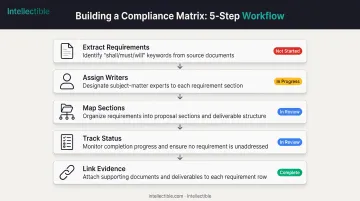
Build your compliance matrix by:
- Extracting every "shall," "must," and "will" statement from Sections L and M
- Assigning each requirement to a responsible writer
- Mapping each requirement to a specific proposal section and page limit
- Tracking status (not started, in progress, in review, complete)
- Linking supporting evidence (past performance, technical data, certifications)
Develop an annotated outline that:
- Mirrors the solicitation structure exactly
- Includes win themes, proof points, and key messages for each section
- Identifies evaluation factors and subfactors your content must address
- Sets internal deadlines allowing time for multiple review cycles before submission
Assign section owners immediately and build in buffer time. If the submission deadline is 45 days out, set internal drafting deadlines at day 25, leaving 20 days for review cycles and final production.
Stage 3: Drafting Technical, Management, and Past Performance Volumes
FAR 15.305 requires that agencies evaluate proposals solely against solicitation factors and subfactors. Generic boilerplate that doesn't answer the agency's specific questions will not score well.
Technical approach section:
- Explain your methodology step-by-step
- Map each task to a Performance Work Statement (PWS) requirement using the same terminology
- Identify deliverables with clear acceptance criteria
- Include risk mitigation strategies for each identified risk
- Provide specific, verifiable evidence supporting your claims
Management plan section:
- Describe your project management approach and organizational structure
- Include detailed key personnel qualifications with relevant experience
- Explain quality assurance/quality control procedures
- Address transition plans, knowledge transfer, and contingency procedures
Past performance section:
FAR 15.305 specifies that agencies consider currency, relevance, source, context, trends, performance problems, and corrective actions. Your past performance narrative must include:
- Contract numbers and ordering information
- Point of contact names, titles, phone numbers, and email addresses
- Contract scope and how it relates to the current requirement
- Quantifiable outcomes (cost savings, schedule adherence, quality metrics)
- CPARS ratings when available
Never:
- Use vague descriptions without contract numbers
- Provide outdated references beyond 3-5 years
- Omit customer contact information
- Make unverifiable claims about performance
Stage 4: Conduct Color Reviews (Pink, Red, Gold)
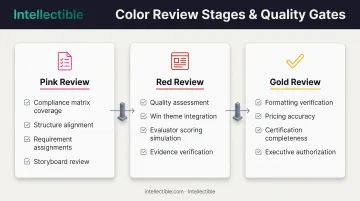
Color reviews are industry-standard quality gates that simulate the customer's evaluation before you submit. They're not FAR-mandated, but they improve proposal quality by catching gaps, weaknesses, and noncompliance issues early.
Pink Review (Outline and Compliance Check):
- Assess outline completeness and compliance matrix coverage
- Verify proposal structure aligns with evaluation criteria
- Confirm all requirements are assigned to sections and owners
- Review storyboards or writing plans before full drafting
Red Review (Content Quality Check):
- Evaluate content quality, win theme integration, and technical accuracy
- Verify each section answers the solicitation's questions specifically
- Simulate evaluator scoring against Section M criteria
- Identify weaknesses, missing evidence, and unclear explanations
Gold Review (Final Submission Readiness):
- Check formatting consistency, page limits, and required certifications
- Verify pricing accuracy and alignment with technical approach
- Confirm all required forms are included and correctly completed
- Obtain executive authorization to submit
Critical review practices:
- Assign independent reviewers who did not write the draft; a fresh read mirrors how evaluators will score you
- Debrief findings with proposal, capture, and program leaders
- Track closure of every finding before advancing to the next stage
Stage 5: Final Pricing, Quality Check, and Submission
FAR 15.208 makes the offeror responsible for ensuring receipt by the exact deadline. Late proposals are rejected except under narrow exceptions. The electronic exception generally requires receipt at the government's infrastructure by 5:00 p.m. one working day before the due date.
Finalize pricing volume:
- Ensure alignment between labor categories in the technical approach and cost volume
- Verify labor rates match your GSA Schedule or established contractor rates
- Confirm all costs are allowable under FAR Part 31
- For DoD proposals, complete DFARS 252.215-7009 Proposal Adequacy Checklist
- Include required cost breakdowns per FAR 15.408 Table 15-2
Conduct final compliance check:
- Verify all required forms are included: SF330 (for A-E contracts), past performance questionnaires, wage determinations, certifications
- Check that all amendment acknowledgments are signed and included
- Confirm page numbering, table of contents, and cross-references are accurate
- Test file accessibility, formulas, passwords, and permissions
Version control and file naming:
- Verify correct, final document versions are being submitted
- Check that files are accessible to evaluators (no password protection unless specified)
- Confirm submission method (SAM.gov, eBuy, agency portal)
- Export final PDFs and verify they display correctly
Submit early. Upload at least 2-4 hours before the deadline to account for portal issues, file size limits, or technical glitches. GSA's eBuy tutorial confirms that a quote is not submitted until you select Submit Quote. Always verify receipt confirmation.
When Should You Pursue a Government Contracting Opportunity?
Not every RFP is worth pursuing. Smart GovCon teams use formal bid/no-bid criteria to evaluate win probability, resource availability, and strategic fit before committing resources.
High-probability opportunities share these characteristics:
- Relevant past performance demonstrating your ability to execute similar scope
- Established customer relationships or program office engagement
- Competitive pricing within realistic budget constraints
- Technical capability and available key personnel to deliver
- Understanding of evaluation priorities and decision-maker needs
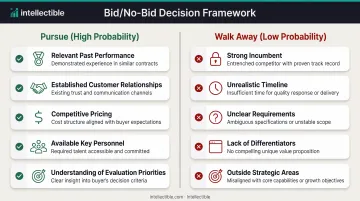
Recognize when to walk away:
- Strong incumbents with high CPARS ratings and solid customer satisfaction
- Unrealistic timelines that don't allow proper proposal development
- Unclear or poorly defined requirements
- Solicitations where you lack differentiators or key personnel
- Opportunities outside your strategic growth areas
Those criteria only help if you can apply them fast across a full pipeline. Intellectible's GovCon Engine automates opportunity qualification by comparing solicitations with award history, identifying incumbents, and assessing bidder density.
It generates go/no-bid reports with risk lists and next-step recommendations. Oceus reported reviewing seven to eight qualified opportunities per month—more than double their previous rate.
What You Need Before Starting a Government Proposal
Before you write a word of the proposal, lock down registrations, certifications, team roles, and source documents. Missing any of these stalls compliance reviews and late-stage submission.
Registration and Certifications
SAM.gov registration (FAR 52.204-7):
- Complete Core, Assertions, Representations and Certifications, and Points of Contact
- Obtain active CAGE code through SAM registration
- Maintain an active registration as required by the solicitation
Small business certifications (if required):
- 8(a) Business Development Program
- HUBZone certification
- WOSB/EDWOSB certification
- SDVOSB (Service-Disabled Veteran-Owned Small Business)
Team and Documentation
Assemble your proposal team:
- Proposal manager to coordinate compliance, reviews, and submission
- Technical writers and subject matter experts
- Pricing leads and cost analysts
- Contracts and compliance reviewers
Gather required documentation:
- Past performance references with customer contact information
- Resumes for key personnel with relevant experience
- Corporate experience narratives
- Facility clearance or security documentation (if applicable)
- SF330 (for architect-engineer contracts)
Gathering those materials is only half the job; finding the right version under deadline is where teams lose time. Proposal writers and delivery leads often spend 30-40% of their effort hunting past-performance content. Intellectible's Knowledge Engine keeps past performance libraries, resumes, corporate experience narratives, and technical docs in searchable, permission-controlled records so that search time drops instead of eating the schedule.
Key Compliance Requirements That Affect Proposal Success
Government evaluators score proposals against explicit criteria in Section M. Your job is to make it easy for them to find your answers and assign high scores.
Address solicitation instructions (Section L) precisely:
- Follow page limits exactly (excluding cover pages and tables of contents as specified)
- Meet font, margin, and line spacing requirements
- Include all required certifications and signed forms
- Use the specified ordering and formatting rules
Map your response to evaluation factors:
- Use the same language and terminology from the RFP
- Address every factor and subfactor explicitly
- Provide verifiable evidence for every claim
- Make it obvious where you've answered each evaluation criterion
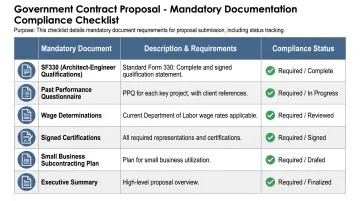
Include all mandatory documentation:
- SF330 for architect-engineer contracts
- Completed past performance questionnaires
- Wage determinations (if applicable)
- Signed representations and certifications per FAR 52.204-8
Noncompliance carries real consequences. In SOS International, LLC, B-422410 (May 28, 2024), the Army rejected a proposal because a subcontractor's pricing workbook could not be opened due to internal access controls.
GAO denied the protest, confirming that rejection for inaccessible files was reasonable and consistent with the solicitation. Even a superior technical solution will not save a noncompliant submission.
Common Mistakes in Government Proposal Writing
Strong technical solutions still lose when the proposal breaks compliance rules, sounds generic, or contradicts itself across volumes. Most low scores and quick rejects trace back to a few repeatable mistakes.
Failing to follow solicitation instructions exactly:
- Missing required certifications or forms
- Exceeding page limits
- Ignoring font, margin, or file format specifications
Any of these can mean immediate disqualification before evaluators score your content.
Writing generic, boilerplate content:
- Skips the agency's mission and stated pain points
- Fails to map responses to Performance Work Statement requirements
- Relies on marketing language instead of evidence
- Scores poorly against published evaluation criteria
Providing weak or unverifiable past performance:
- Vague write-ups without contract numbers
- Missing or outdated customer contacts
- No quantifiable outcomes or CPARS ratings
- References older than 3–5 years
Submitting pricing that doesn't align with the technical approach:
- Prices 10 FTEs while the technical volume describes work that needs 15
- Uses labor categories in the cost volume that don't match the technical narrative
- Builds pricing assumptions that conflict with the delivery approach
Involving the pricing team too late:
- Starts pricing only after the technical volume is locked
- Leaves labor hours, travel, and materials unreconciled across volumes
- Surfaces cost-realism problems only in final review
Catch these early with compliance checks, evidence-based drafting, and pricing in the room from kickoff—not at the eleventh hour.
Troubleshooting Proposal Challenges During Writing
Even strong proposal teams hit friction mid-draft. When one of these issues shows up, fix the process first—then lock it in with clear ownership and shared tools.
Problem: Multiple contributors submit conflicting or redundant content
Likely Cause: Lack of a central compliance matrix or weak section ownership assignments
What to Adjust: Stand up a shared proposal workspace, assign one owner per section, and route edits through a single approval path so duplicate drafts don’t multiply. Intellectible centralizes contributions with version control, content libraries, and tracked owners, deadlines, and evidence paths.
Problem: Proposal team misses key evaluation criteria during drafting
Likely Cause: Inadequate compliance matrix or poor traceability between RFP requirements and proposal sections
What to Adjust: Run a mid-draft compliance review against your matrix. Confirm every Section L instruction and Section M criterion maps to a proposal section and page number before you polish prose. Intellectible’s Proposal Engine extracts requirements from the solicitation and builds that compliance matrix for you.
Problem: Last-minute pricing errors or mismatches between technical and cost volumes
Likely Cause: Late involvement of pricing team or lack of coordination between technical writers and cost analysts
What to Adjust: Schedule a pricing kickoff early and keep pricing leads in technical reviews. Align labor hours, travel, and materials across volumes before final review—not the night before submission. Intellectible’s Pricing Engine cuts time to final pricing by about 90% while preserving full audit trail control.
Alternatives to Solo Proposal Writing
When bandwidth, expertise, or eligibility gaps make solo writing impractical, GovCon teams typically turn to one of three alternatives.
Teaming with prime or subcontractor partners:
FAR 9.6 recognizes partnerships, joint ventures, and prime/subcontractor arrangements when you lack the full capability set, past performance, or small business status the solicitation requires. The prime contractor remains responsible to the government.
Proposal management software and workflow automation:
For high-value opportunities, workflow platforms like Intellectible reduce compliance-tracking workload and manual coordination. The Proposal & Pursuit Engine covers intake, go/no-bid, compliance, drafting, reviews, approvals, and final response in controlled projects with defined collaborators.
External proposal consultants or capture managers:
Hire consultants when your team lacks GovCon-specific expertise or bandwidth. APEX Accelerators provide no-cost government-contracting guidance and support.
Conclusion
Government proposal writing is a structured, compliance-driven process where attention to detail, clear requirement traceability, and disciplined review cycles decide whether evaluators can score you favorably. Success comes from starting early, building a strong capture foundation, and treating the proposal as a team effort with clear roles, deadlines, and accountability.
The five-stage process provides the framework:
- Capture Planning
- Compliance Matrix Development
- Drafting
- Color Reviews
- Final Submission
Execution still depends on mapping your solution to evaluation criteria, backing claims with verifiable past performance, keeping version control tight across contributors, and submitting a response that is fully compliant and easy to evaluate. Teams that run this as a repeatable system—not a last-minute scramble—improve win probability over time.
Frequently Asked Questions
What is the format for writing a proposal?
Government proposals follow the structure outlined in Section L of the solicitation, which specifies required volumes (technical, management, past performance, pricing), page limits, and formatting rules. Always follow the solicitation's instructions exactly. There is no universal federal format.
What are the three C's of proposal writing?
The three C's are Compliant (meets all solicitation requirements), Complete (answers every question and evaluation criterion), and Compelling (differentiates your solution and convinces evaluators you're the best choice). This is an industry mnemonic, not a FAR standard.
Can you provide an example of technical proposal writing?
A strong technical section describes your methodology step-by-step, maps each task to a PWS requirement using the same terminology, and identifies deliverables with clear acceptance criteria. Include risk mitigation strategies and write in clear, evaluator-friendly language backed by verifiable evidence.
What is a color review in government proposal writing?
A color review is a staged evaluation process where independent reviewers simulate the customer's evaluation to identify gaps, weaknesses, or noncompliance before submission. Pink reviews assess outline compliance, Red reviews focus on content quality, and Gold reviews confirm final readiness.
How long does it take to write a government proposal?
Proposal timelines vary from 2-3 weeks for small, straightforward RFPs to 60-90 days for large, complex procurements. Plan to spend 30-50% of available time on reviews and revisions, not just initial drafting.
Do I need a proposal manager for small government contracts?
Even for proposals under $1M or with simple requirements, a designated lead should coordinate compliance tracking, review cycles, and submission logistics. There is no regulatory threshold, but industry practice recommends one when multiple volumes, writers, partners, or review gates need centralized ownership.