AI RFP tools promise dramatic time savings, but GovCon teams operate under unique constraints that generic commercial platforms don't address. FAR/DFARS compliance, CUI handling requirements, security clearances, and requirement traceability aren't optional features—they're mission-critical capabilities. DFARS 252.204-7012 mandates FedRAMP Moderate-equivalent protection when an external cloud provider stores, processes, or transmits covered defense information.
This guide provides a step-by-step framework for implementing AI RFP tools in government contracting environments, covering compliance requirements, team readiness, platform selection, and measurable outcomes that matter.
Key Takeaways
- Select compliance-first platforms that meet DFARS 252.204-7012 and handle CUI before evaluating features
- Prepare approved knowledge bases with validated past performance, current resumes, and technical content
- Start with security questionnaires or smaller RFPs to test workflows before tackling major procurements
- Require human review at every checkpoint; NIST warns that AI can confidently generate false citations
- Track review time and win rate to measure ROI from better decisions, not draft speed alone
How to Implement AI for GovCon RFP Responses
Step 1: Assess Compliance and Security Requirements
Before evaluating any platform, inventory what data you'll process. Federal contractors handle three categories: unclassified public information, CUI requiring NIST SP 800-171 Rev. 3 controls, and classified information governed by 32 CFR Part 117. Most proposal content falls into the first two categories, but you must classify inputs before placing them in a cloud AI system.
Determine your security posture:
- Identify whether you handle CUI and which DFARS clauses apply to your existing contracts
- Confirm whether you need FedRAMP-authorized or DoD IL-4/IL-5 compliant platforms
- Document incident reporting obligations: DFARS requires reporting within 72 hours and preserving forensic evidence for at least 90 days
Establish data handling boundaries:
- Define what content (past performance, teaming agreements, pricing, technical approaches) can be stored in cloud systems
- Identify what must remain on-premises or in government-authorized environments
- Map which contracts and proposals involve CUI versus unclassified material
Create approval workflows and governance:
- Map who must review AI-generated content before submission: contracts officer, security officer, program manager, technical leads
- Draft internal guidelines covering when AI can be used, what human oversight is required, and how to flag AI-generated content
- Establish audit trail requirements to support proposal defense if the government questions response authenticity
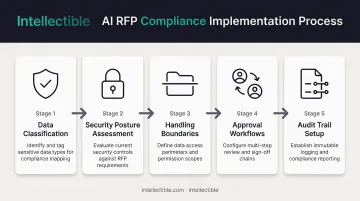
Platforms like Intellectible combine pre-built GovCon engines with configurable workflows, so you can extend AI into capture, pricing, and contract management while keeping tight control over data boundaries and approval gates.
Step 2: Prepare Your Knowledge Base and Source Materials
Service providers lose 30-40% of proposal-writing time searching for information. Your AI tool is only as good as the approved content it can retrieve.
Inventory approved content systematically:
- Catalog past performance narratives with contract numbers, customer agencies, dates, outcomes, and CPARS ratings
- Collect capability statements, technical white papers, and previously successful proposal volumes
- Gather current resumes with verified clearances and roles
- Document win themes and differentiators that align with your capture strategy
Establish content ownership and freshness protocols:
- Assign subject matter experts to maintain technical content and ensure accuracy
- Verify past performance examples fall within the 3-year CPARS window under FAR 42.1503
- Create a quarterly review cycle or post-win update process to keep material current
- Remove outdated content from closed contracts or former team members no longer with the company
Structure content for retrieval:
- Tag documents with clear metadata: contract vehicle, customer agency, NAICS code, technical domain, security classification
- Organize by information type (past performance, technical approach, pricing history, teaming agreements)
- Implement permission groups so sensitive content is only accessible to authorized roles
- Link requirements to source documents so AI tools can trace claims back to verifiable evidence
Set up live integrations:
- Connect platforms to approved repositories (SharePoint, Google Drive, Confluence) with proper authentication
- Configure webhooks or scheduled jobs to keep knowledge current without manual uploads
- Test that permissions synchronize correctly—users should only access content their roles permit
- Validate that document parsing handles your formats (PDF, DOCX, spreadsheets, technical diagrams)
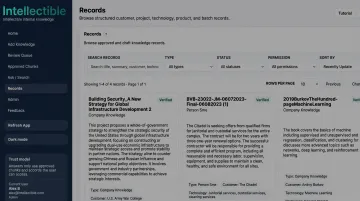
Intellectible's Knowledge Engine supports these integrations by turning documents into structured records with source references, metadata, and approval status, so AI output stays grounded in validated organizational knowledge.
Step 3: Select and Configure Your AI RFP Platform
Generic commercial AI tools don't understand Section L and Section M. GovCon teams need platforms built for federal procurement.
Evaluate platforms against GovCon-specific criteria:
- Requirement shredding accuracy: Per APMP, missing one paragraph can drop a compliance item—test Section L and Section M parsing
- Compliance matrix generation: Verify the platform maps every requirement to a response section, owner, deadline, and source
- Source attribution: Confirm the system cites which documents support each claim
- CUI handling: Check authorization status against your data classification
- GovCon tool integration: Assess connectivity with opportunity databases, CRM systems, and capture tools
Run a pilot with a real solicitation:
- Test 2-3 platforms using a recent RFP your team completed manually
- Compare first-draft accuracy, unsupported answer rates, requirement coverage, and time to produce a review-ready response
- Measure how often the AI flags missing information versus generating plausible but unverified content
- Evaluate whether the compliance matrix catches all amendments and addenda
Configure platform settings for your organization:
- Set up project templates for common solicitation types (IDIQ task orders, 8(a) set-asides, full and open competitions)
- Establish reviewer roles and permissions aligned with your governance policy
- Create custom prompts that reflect your company's differentiators, voice, and win themes
- Define capture rules, fit signals, and disqualifiers to match your strategic priorities
Test export and formatting protocols:
- GAO upheld exclusion over unauthorized fonts that created a page-limit advantage. Formatting failures can disqualify you.
- Validate required specs: page limits, margins (often 1 inch), fonts (often 12-point body), and section numbering
- Confirm export to required formats (PDF, Word, sometimes legacy formats for specific agencies)
- Run a formatting check after every AI-assisted edit to catch inadvertent changes
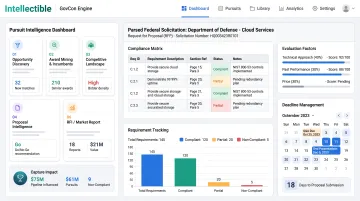
Intellectible's GovCon Engine parses federal solicitations into structured pursuit intelligence: requirements, evaluation factors, submission obligations, and deadlines, plus compliance matrices, go/no-go reports, and document Q&A with evidence audit trails.
Step 4: Implement Review Workflows and Change Management
Deltek reports that 90% of GovCon firms use AI in some capacity, but only 5% call their maturity fully developed. Governance, not the toolset, is usually the bottleneck.
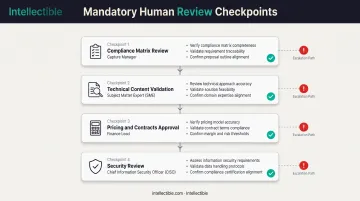
Design mandatory human review checkpoints:
- Compliance matrices must be validated line-by-line by the capture manager, confirming every requirement is addressed
- Technical content requires subject matter expert review to verify accuracy and eliminate unsupported claims
- Pricing and contractual commitments need contracts and finance approval before submission
- Security answers must be reviewed by your CISO or security officer—never let the model infer compliance status
Train your proposal team on practical usage:
- Conduct hands-on workshops showing how to prompt the AI effectively for different solicitation types
- Teach teams to interpret confidence scores and when to escalate low-confidence outputs
- Demonstrate how to trace AI-generated content back to source documents
- Establish documentation standards for audit trails—FAR 52.203-13 requires ethics codes and disclosure obligations
Create escalation paths for edge cases:
- Define who decides when AI-generated content conflicts with source material
- Establish procedures for questions the AI cannot answer from approved knowledge
- Identify when to pull in legal, security, export control, or executive reviews
- Document how to handle solicitation amendments that invalidate previously generated content
Measure and iterate based on real outcomes:
- Track review time per section (before and after AI)
- Monitor first-pass acceptance rate versus content requiring major revisions
- Flag unsupported claim rate and root causes
- Compare win rates on AI-assisted proposals versus historical baseline
- Adjust workflows, prompts, and knowledge base based on what's working
Intellectible routes work to capture, pricing, legal, operations, and executive approvers with retained context. Role-specific workbenches, permissions, version control, and human feedback loops support controlled adoption over time.
When Should GovCon Teams Use AI RFP Tools?
Not every proposal warrants AI assistance. Fit matters.
Ideal use cases:
- High-volume response workloads: Multiple solicitations per month gain the most from reusable compliance matrices and automated requirement extraction
- Recurring requirement types: Security questionnaires, past performance matrices, and company background sections are repetitive and well-suited to AI drafting
- Large proposals with review bottlenecks: AI speeds first drafts so SMEs validate instead of writing from scratch—and your team can pursue more opportunities
- Clear evaluation criteria: Section M factors that map cleanly to your past performance and technical capabilities
When AI is not the right fit:
- Highly specialized technical proposals: Novel engineering approaches requiring custom designs that your knowledge base doesn't cover
- Relationship-dependent wins: Proposals where win themes depend on nuances the AI cannot capture from documents alone
- Insufficient approved content: When your knowledge base lacks validated source material to ground responses
- Classified proposals: Most commercial platforms aren't authorized for classified content—government-cloud or on-premises instances may be required
Consider the break-even point:
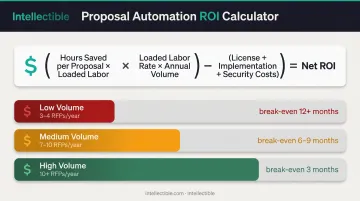
- Teams submitting fewer than 3-4 RFPs per year may not recoup implementation investment
- Teams handling 10+ solicitations annually typically see ROI within the first quarter
- Internal check: (hours saved per proposal × loaded labor rate × annual volume) − license, implementation, and security costs
What You Need Before Implementing AI RFP Software
Preparation decides whether AI RFP software sticks or stalls. Teams that curate a knowledge base, set approval workflows, and secure stakeholder buy-in before choosing a platform adopt faster and with fewer rework cycles than teams that buy first and organize later.
Compliance and Security Readiness
Obtain leadership and security officer buy-in early:
- Secure written approval from your facility security officer (FSO) for cloud tool usage
- Confirm IT has reviewed data handling practices and authorized the platform's security boundary
- Ensure contracts leadership understands that AI-generated content remains subject to FAR 52.203-13 contractor code of conduct and disclosure requirements
Establish audit trail requirements:
- Document the AI usage records you'll keep: prompts, sources cited, human review decisions, and approval history
- Prepare to support proposal defense if the government questions response authenticity or requests source verification
- Retain validation history and incident review documentation as NIST recommends for generative AI systems
Knowledge Base and Content Requirements
Compile a minimum viable library:
- Gather recent proposal volumes covering your core technical domains and contract vehicles
- Collect 20-30 past performance narratives with verified outcomes, CPARS ratings, and customer contacts
- Assemble current resumes for key personnel reflecting roles, clearances, and recent experience
- Include technical white papers, capability statements, and marketing collateral that reflect your current offerings
Validate content accuracy and currency:
- Remove past performance from contracts that closed beyond the 3-year CPARS availability window
- Update technical content to reflect current product versions, certifications, and team capabilities
- Verify all resumes reflect current roles, clearances, and contact information
- Tag content with metadata: customer, contract vehicle, NAICS code, technical domain, security classification, approval status
Team and Process Requirements
Identify your AI champions:
- Designate 1-2 proposal professionals who will become power users and train the broader team
- Confirm they understand proposal development and enough technical detail to validate AI outputs
- Protect time in their first 30-60 days to configure workflows, build playbooks, and coach peers
Define roles and responsibilities clearly:
- Clarify who inputs the RFP and verifies completeness of solicitation documents and amendments
- Assign who reviews AI-generated compliance matrices and validates requirement coverage
- Designate who validates technical content, approves pricing, and authorizes final submissions
- Establish who maintains the knowledge base going forward and how often content is refreshed
Common Mistakes When Adopting AI RFP Tools in GovCon
Most AI RFP failures in GovCon come from process gaps, not the model itself. Avoid these four mistakes before you lock in a platform.
Skipping the compliance review up front
Choosing a commercial AI RFP platform without verifying it meets DFARS 252.204-7012 (safeguarding CUI) or other applicable security requirements results in contract violations or failed audits. Classify your data first, then select the platform.
Treating AI output as final content
Submitting AI-generated responses without human review leads to unsupported claims, factual errors, or boilerplate that misses specific solicitation requirements. NIST identifies confabulation (confidently stated false content and fabricated citations) as a core generative AI risk.
Neglecting knowledge base maintenance
Loading initial content but never updating it causes the AI to draft from outdated past performance, old technical capabilities, or former team members no longer with the company. Establish quarterly reviews or post-win update cycles.
Over-relying on generic platforms
Selecting a tool built for commercial RFPs without requirement shredding, compliance matrix generation, or Section L/M parsing leaves your team doing the slowest parts of proposal work by hand. That wipes out the efficiency gains you expected.
Frequently Asked Questions
What is an AI-based RFP response?
An AI-based RFP response uses AI to read solicitation requirements, retrieve approved company content, draft answers with source citations, and generate compliance artifacts. Human reviewers still validate accuracy and confirm the response meets federal requirements before submission.
What does a good RFP response look like in government contracting?
A strong GovCon RFP response maps every Section L requirement in a compliance matrix and backs claims with verifiable past performance. It also shows technical understanding and highlights discriminators tied to Section M evaluation criteria.
What are common RFP mistakes to avoid when using AI tools?
Never submit AI-generated content without human review, and never ship generic boilerplate—customize to the agency and solicitation. Attribute sources for every claim, and confirm all compliance items have clear cross-references before you submit.
Can AI RFP tools handle classified or CUI content?
Most commercial AI RFP platforms are not authorized for classified content. Some offer FedRAMP High or DoD IL-4/IL-5 authorized environments for CUI. Many GovCon teams maintain separate on-premises or government cloud instances for sensitive content while using commercial tools for unclassified proposal development.
How do you measure ROI on AI RFP software for government contractors?
Track hours saved per proposal, bids pursued with the same headcount, win rate versus your historical baseline, and cost per proposal (labor hours × loaded rate). Draft speed alone is not ROI—measure better bid decisions and outcomes.
What's the difference between building a custom AI workflow versus buying an AI RFP platform?
Purpose-built AI RFP platforms like Loopio or Responsive deploy quickly with pre-built compliance and review workflows. Platforms like Intellectible support deeper integration with proprietary systems, custom workflow automation, and extension into capture, pricing, and contract management. That path fits teams with unique requirements or several linked business processes.