Introduction
Federal RFP process management is the end-to-end system that moves a government contractor from spotting an opportunity on SAM.gov to submitting a compliant proposal on a procurement portal. Unlike commercial RFP responses, federal contracting carries real consequences: strict FAR/DFARS compliance, evaluation criteria locked inside solicitation Sections L and M, and submission rules under FAR 15.208 that bar late proposals with almost no exceptions.
The problem most GovCon teams face isn't a lack of talent — it's treating each RFP as an isolated fire drill. Without a repeatable structure, effort piles up at the wrong moments:
- SMEs unavailable when writers need input
- Pricing assembled the night before submission
- Past performance sections recycled from old proposals that miss the actual performance work statement
- Compliance matrices built reactively instead of driving the outline from day one
What follows is a phase-by-phase breakdown of the GovCon RFP process — where the work actually happens, what separates winning proposals from compliant-but-losing ones, and where teams most consistently leave points on the table.
Key Takeaways
- Federal RFPs are evaluated against published criteria in Sections L and M — full compliance is required to stay in the running, not a way to stand out
- Go/No-Go decisions made early protect team bandwidth and keep effort focused on winnable bids
- Win rates are primarily determined before the proposal is written, during capture
- The most common failure points are weak capture, last-minute pricing, and boilerplate content — not writing quality
- Teams with a systematic RFP process handle more bids at higher quality without expanding headcount
What Is RFP Process Management in Government Contracting?
RFP process management in GovCon is the structured system a contractor uses to receive, evaluate, organize, respond to, and track federal or state solicitations. It covers the full lifecycle: from opportunity monitoring on SAM.gov to final submission and post-award debrief.
How Federal RFPs Differ From Commercial Ones
Federal RFPs are fundamentally different from commercial solicitations in three ways:
- Volume structure: Responses are organized into distinct volumes — Technical, Management, Past Performance, and Price/Cost — each with defined content requirements
- Explicit evaluation criteria: Every proposal is scored against factors published in Section M of the solicitation, making the evaluation framework transparent but unforgiving
- FAR/DFARS compliance: Formatting rules, certification requirements, and submission instructions under FAR 15.203 are mandatory — not guidelines — and non-compliance disqualifies a proposal before it's ever scored
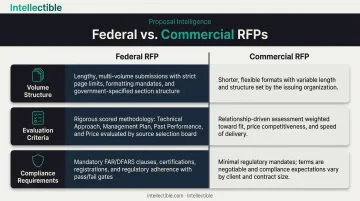
A technically strong solution packaged in a non-compliant proposal doesn't get evaluated — process discipline is the differentiator before scoring even begins.
Why GovCon Teams Need a Structured RFP Process
The Volume and Velocity Problem
GovCon business development teams routinely monitor dozens of active opportunities while managing live proposal cycles simultaneously. Under FAR 5.203, competitive solicitations above the simplified acquisition threshold must allow at least 30 days for response — and R&D acquisitions require at least 45 days. That sounds adequate until you're managing five simultaneous bids, each with its own compliance matrix, SME dependencies, and pricing model.
Without a structured process, teams chase whichever bid is most urgent rather than most winnable — and the distinction costs them.
The Compliance Risk
Non-compliant proposals are disqualified outright — not scored low. Federal solicitations require specific:
- Volume organization and page limits
- Font sizes, margin specifications, and file formats
- Mandatory certifications and representations
- Submission portal formatting and upload requirements
A single missed certification or misformatted file can eliminate a technically superior proposal before any evaluator reads it.
What Goes Wrong Without Process Structure
- Subject matter experts get pulled in at the last minute with no context, no time to contribute meaningfully
- Pricing gets assembled too late for competitive analysis, IGCE comparison, or subcontractor cost validation
- Past performance narratives get recycled without addressing the actual performance work statement in the new solicitation
- Writers working from different drafts produce inconsistent content across volumes
How the GovCon RFP Process Works: Phase-by-Phase Breakdown
The GovCon RFP process runs in five interconnected phases. Each has defined inputs, outputs, and decision gates.
Step 1: Opportunity Identification and Pipeline Qualification
Effective teams monitor procurement portals — SAM.gov, FPDS, USASpending.gov — using structured criteria: NAICS codes, contract vehicle fit, agency relationships, and competitive positioning. The goal is building a strategic bid calendar, not reacting to whatever drops.
The challenge is volume. Federal procurement data spans presolicitations, solicitations, awards, and sole-source notices — filtering signal from noise manually isn't sustainable at scale. Platforms like Intellectible's Proposal & Pursuit Engine address this by transforming every federal notice into a structured capture record with agency details, NAICS/PSC codes, fit rationale, and risk signals — and then running a governed go/no-go covering fit, urgency, risk, contract terms, and capability match before committing proposal resources.
For defense contractor Oceus, that meant more than doubling the qualified opportunities reviewed each month, with approximately seven to eight per month clearing their threshold, according to CEO Jeff Harman.
Key inputs at this stage:
- NAICS codes and PSC classifications
- Agency relationship history
- Contract vehicle eligibility
- Competitive positioning and incumbent data
Step 2: Capture Planning and Go/No-Go Decision
Capture planning happens before the RFP drops. This is where teams build the intelligence that makes a proposal competitive:
- Customer requirements and priorities
- Incumbent analysis and competitive landscape
- Teaming options and partner fit
- Win probability based on past performance alignment
The formal Go/No-Go decision uses a scoring framework against factors like technical fit, resource availability, and price-to-win viability. The Shipley framework identifies three decision gates here: pursuit decision, bid decision, and bid-validation decision — each testing a increasingly specific set of readiness criteria.
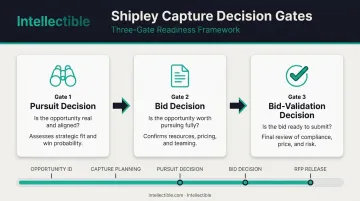
Teams that skip formal capture and wait for the RFP are already behind. They're building win themes with no customer intimacy and writing around requirements they never helped shape.
Step 3: Solicitation Analysis and Compliance Matrix
Once an RFP is released, the first task is a thorough breakdown of the solicitation. This means:
- Cataloging every requirement from Section L (Instructions to Offerors) and Section M (Evaluation Criteria)
- Building a compliance matrix that maps each requirement to its corresponding proposal section, owner, and evidence path
- Flagging ambiguities that warrant formal clarification questions via the amendment process
The compliance matrix is the proposal team's blueprint. It's also the primary control against technical non-compliance, and it should be reviewed at every draft stage, not just at kickoff.
Step 4: Volume Development, SME Coordination, and Internal Reviews
This is where the proposal gets built. Writers and SMEs develop content for each volume, governed by the compliance matrix and evaluated against win themes established during capture.
Structured review cycles separate organized teams from chaotic ones:
| Review Gate | Purpose | Participants |
|---|---|---|
| Pink Team | Review storyboards before drafting; test win strategy execution | Independent lead, capture/program managers, section leads |
| Red Team | Score near-final proposal as the customer would; test completeness | Senior leadership, industry SMEs, earlier reviewers |
| Green Team | Reconcile pricing with technical and management volumes | Proposal, pricing, estimating, finance teams |
| Gold Team | Final sign-off and authorization to submit | Executive leadership |
(Source: Shipley color team review framework)
Each gate serves a distinct QA purpose. Running them sequentially without compressing them is the difference between catching a compliance gap in Red Team versus discovering it an hour before submission.
Step 5: Pricing, Final Review, and Compliant Submission
Pricing is the phase with the least runway and the highest stakes.
The cost/price volume must reflect:
- An understanding of the government's Independent Government Cost Estimate (IGCE) — used as a price analysis technique under FAR 15.404-1
- Competitive market rates relative to the evaluated award range
- Cost realism analysis requirements for cost-reimbursement contracts, which require the government to assess each offeror's probable cost
Pricing should run parallel to technical development, not after it. Teams that hand pricing to one person after all volumes are complete create an unmanageable bottleneck with no time for IGCE alignment or subcontractor cost validation.
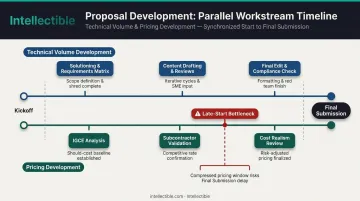
Final submission checklist:
- File format compliance (PDF specs, file naming conventions)
- Upload to correct procurement portal and section
- Confirmation of receipt
- Submit at least 24 hours before the deadline — FAR 15.208 bars late proposals with very narrow exceptions, and portal failures are not grounds for an extension
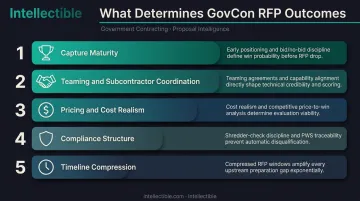
Key Factors That Affect RFP Outcomes in GovCon
- Capture maturity: The earlier capture begins before RFP release, the stronger the proposal's win themes, customer intimacy, and teaming structure. Teams that start capture after RFP release are already disadvantaged on all three
- Teaming and subcontractor coordination: Under FAR 19.702, other-than-small-business contractors on contracts above $900,000 must submit a small business subcontracting plan — late teaming decisions leave gaps in past performance coverage that can't be patched at submission
- Pricing and cost realism: Proposals that price too low without a documented basis, or too high relative to the IGCE, risk elimination — every number needs a defensible, auditable rationale
- Compliance structure: Page count, font size, volume organization, and required certifications must all be correct — a compliance matrix reviewed at every gate is the primary control
- Timeline compression: Solicitation windows frequently run 15–30 days — teams without pre-positioned content, templates, and clear role assignments consistently run out of time before the proposal is ready
Common Mistakes in GovCon RFP Management
Conflating Proposal Writing Quality With Process Quality
This is the most expensive misconception in GovCon business development. Teams invest in better writers but skip capture planning — so even polished proposals lose because they don't reflect customer intimacy or real competitive positioning. Capture quality, competitive positioning, and customer relationships built months earlier are what actually move the win probability needle.
The Boilerplate Trap
Recycling technical and management volumes from previous proposals assumes evaluators won't notice. They will. Federal evaluators score against specific PWS/SOW requirements. Generic content that doesn't address the actual performance work statement receives the lowest technical scores — the evaluator's job is to check compliance, and boilerplate rarely checks those boxes.
The Over-Response Problem
Responding to every solicitation in your NAICS codes spreads resources across too many simultaneous bids, producing shallow proposals across the board. The teams with the highest win rates have the most disciplined bid/no-bid process. They pursue fewer opportunities — and pursue them better.
Last-Minute Pricing Failure
Treating pricing as the final step — handed off to one person after all other volumes are complete — leaves no time for competitive analysis, IGCE alignment, or subcontractor cost validation. Run pricing in parallel with technical development. Bottlenecking it at the end is where competitive proposals become losing ones.
When Not to Bid: The Go/No-Go Decision Framework
Every bid consumes the proposal team's time and capacity. A structured Go/No-Go framework forces an honest probability-of-win assessment before resources are committed.
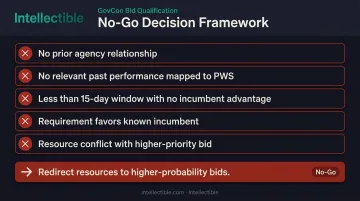
Triggers for a "no-go" decision:
- No prior relationship with the agency
- No relevant past performance that maps to the PWS
- Less than 15-day response window with no incumbent advantage
- A requirement that clearly favors a known incumbent competitor
- Resource conflict with a higher-priority, higher-probability bid
What happens without a formal framework: Teams respond out of habit or fear of missing out. The result: thin proposals that don't score competitively, and time sacrificed from bids that actually had a shot. The cost isn't just the losing proposal — it's the proposal that didn't get the attention it deserved.
Platforms like Intellectible's Go/No-Go system address this by generating structured reports that score fit, urgency, risk, contract terms, and capability match, with an audit trail documenting the reasoning behind each pursuit decision. Leadership can defend resource allocation calls, and the proposal team gets a clear, evidence-backed mandate before a single word is written.
HHS implemented Intellectible's bid operations platform for exactly this reason. As John Grady, HHS Corporate Director of Business Development, put it, the platform takes "the tedious, monotonous hours of RFP efforts out of human hands," freeing the team to focus on "analyzing and selling."
Frequently Asked Questions
What is an RFP checklist?
An RFP checklist (or compliance matrix) maps every requirement from the solicitation — formatting rules, required certifications, volume content requirements, submission instructions — to its corresponding location in the proposal. In GovCon, this is the primary tool for preventing technical non-compliance and should be reviewed at every draft stage.
How long should an RFP process take?
Solicitation windows typically range from 30 to 60 days for competitive RFPs under FAR minimums, but effective GovCon teams begin the process weeks or months earlier through capture planning. The actual proposal production phase should consume no more than 60–70% of the available window, leaving adequate time for structured reviews and compliant submission.
What is the difference between an RFP and an RFQ?
An RFP solicits a full technical, management, and price proposal scored against multiple evaluation factors. An RFQ applies to simpler, well-defined acquisitions where price is the primary driver — common under GSA schedules governed by FAR Part 8. RFPs are reserved for complex, best-value acquisitions.
What is a go/no-go decision in government contracting?
A Go/No-Go decision is a structured evaluation GovCon teams run before committing proposal resources. It scores the opportunity against past performance alignment, competitive positioning, agency relationships, and resource availability to determine whether the pursuit is worth the investment.
What is the difference between capture management and proposal management?
Capture management is the pre-RFP phase — building customer knowledge, shaping requirements, and positioning the company to win. Proposal management is the execution phase that turns that positioning into a compliant written response. Win rates are primarily determined during capture, not during proposal writing.
What are the most common reasons GovCon teams miss RFP deadlines?
The leading causes are SME unavailability late in the production cycle, pricing assembled without enough lead time for competitive analysis, and last-minute discovery of formatting or certification gaps. Teams avoid these failures by building reverse timelines from the submission deadline, assigning section owners at kickoff, and running a compliance matrix review at every draft gate.