Introduction
Capture management is the strategic process of positioning your company to win a government contract before the RFP is released. For GovCon teams—business development pros, capture managers, proposal writers, and executives—it is what separates reactive bidding from deliberate pursuit.
Too many teams still scramble when a solicitation drops, then write a proposal with little pre-work and a thin shot at winning. That scramble is the pain capture management is built to remove.
Federal teams talk about capture constantly, yet often confuse it with proposal writing (post-RFP) or last-minute opportunity screening. Real capture starts 9–24 months before solicitation, while agencies research requirements, engage industry, and shape acquisition strategy.
By the time the RFP hits SAM.gov, buying preferences are often already set. Late positioning rarely changes the outcome.
This article covers what capture management is, why GovCon teams need it, how the process works step-by-step, what a capture manager does, and when the discipline delivers measurable ROI.
Key Takeaways
- Capture management positions your company to win a specific government contract long before the RFP is issued
- Capture work centers on customer engagement, competitive intelligence, and solution shaping rather than proposal writing
- GovCon teams with disciplined capture processes see higher win rates and better-qualified pipelines
- A capture manager aligns research, strategy, and the pursuit team so the bid is shaped before the RFP drops
What Is Capture Management?
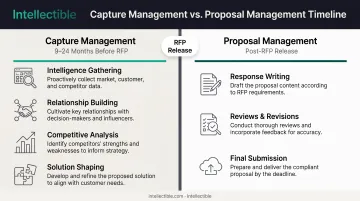
Capture management is the structured, proactive process of gathering intelligence, building relationships, and strategically positioning your organization to win a specific government contract opportunity before the RFP is formally released. The goal: move from an unknown or unfavorable position to becoming the customer’s preferred solution provider before proposals are even submitted.
It differs from related GovCon disciplines in two clear ways:
- Opportunity-specific, unlike account planning, which covers the full customer relationship
- Pre-RFP focused, unlike proposal management, which starts after solicitation release
According to FAR 15.201, agencies are encouraged to engage industry from the earliest requirement identification through proposal receipt. That creates lawful windows for contractors to shape requirements and buying decisions early.
Capture management turns informal, gut-feel pursuit into a research-driven process built around those windows.
Why Capture Management Matters for GovCon Teams
Federal procurement is intensely competitive. In FY2018, agencies obligated more than $550 billion, with approximately $350 billion (63%) awarded competitively. In that market, early positioning often matters as much as the proposal itself.
GovCon teams need capture management because:
- Buying decisions form early—market research, draft RFPs, and industry days shape requirements long before solicitation
- Late proposals rarely close positioning gaps if the customer does not know you or trust your approach
- Incumbent status, competitor teaming, and clear differentiators should drive your win strategy
Without capture management, teams burn bid budget on unwinnable work and send reactive proposals that never quite land. They also miss the pre-solicitation window when requirements can still be shaped.
Disciplined capture improves qualification, focuses resources on winnable pursuits, and puts you into proposal with relationships and insight already in place.
How the Capture Management Process Works
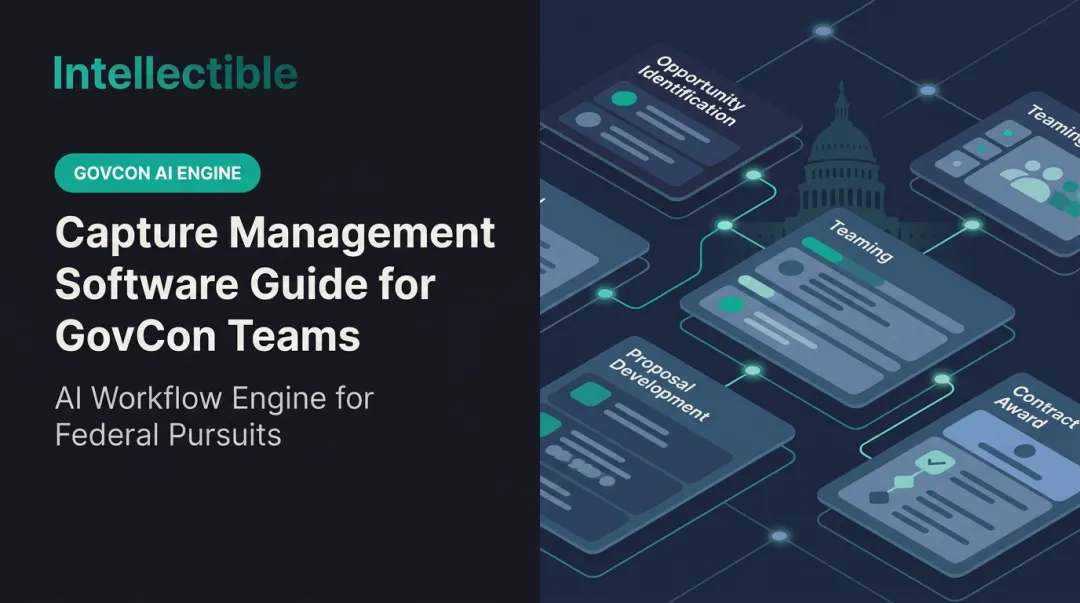
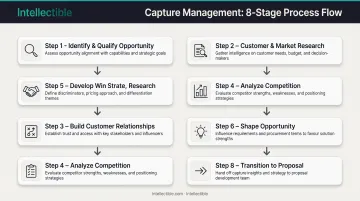
Capture management is a multi-phase process that starts with opportunity identification and ends at proposal handoff. Along the way, teams handle market research, customer engagement, competitive analysis, teaming, pricing intelligence, risk assessment, and stakeholder mapping.
During capture, teams build relationships with decision-makers, surface customer pain points, analyze competitor positioning, develop preliminary solutions, and ethically shape requirements when the rules allow. Discipline comes from a few control points:
- Capture plans and regular reviews
- Go/no-go gates
- Cross-functional coordination
- Executive sponsorship
Done well, capture moves you from unknown to trusted. Your solution tracks both stated and unstated needs, so you enter the proposal phase with real advantages instead of a cold start.
Step 1: Identify and Qualify the Opportunity
Capture begins by monitoring federal forecasts, agency procurement plans, SAM.gov, industry intelligence, and pre-solicitation notices. Early identification allows time to position before competitors mobilize.
Initial qualification asks:
- Does this opportunity align with your capabilities and past performance?
- Can you realistically win?
- Does it fit your strategic growth goals?
Decline unqualified opportunities early so you preserve resources for pursuits you can win.
Step 2: Conduct Deep Customer and Market Research
Once qualified, capture managers gather intelligence on the agency's mission, budget pressures, pain points, procurement history, and key stakeholders. They analyze the likely acquisition strategy, potential contract vehicles, and expected evaluation criteria.
This research answers:
- What problem is the customer trying to solve?
- Who are the decision-makers and influencers?
- What past performance or technical approach will resonate?
- What constraints (budget, schedule, compliance) will shape the solicitation?
Step 3: Build and Maintain Customer Relationships
Capture teams engage program managers, end users, contracting officers, and technical leads through meetings, industry days, capability briefings, and one-on-one discussions. The goal is to establish trust, demonstrate understanding, and position your company as a credible solution provider.
FAR permits these exchanges, provided they comply with integrity and equal-disclosure safeguards. Information shared with one potential offeror must be made public promptly.
Step 4: Analyze the Competitive Landscape
Understanding the competition is critical. Capture managers research likely competitors, incumbent performance, teaming landscapes, and competitor strengths and weaknesses.
Key questions include:
- Who is the incumbent, and how are they performing?
- Which competitors have relevant past performance or customer relationships?
- What teaming arrangements are likely?
- How can we differentiate our solution?
This intelligence shapes your win strategy and informs pricing decisions.
Step 5: Develop Your Solution and Win Strategy
Capture teams work with technical experts and pricing analysts to develop a preliminary solution framework that addresses customer priorities. Win themes, discriminators, and value propositions are crafted based on customer insights and competitive analysis.
At this stage, the team defines:
- What you will propose (technical approach, teaming, pricing model)
- Why you will win (discriminators, past performance, value)
- How you will differentiate from competitors
Step 6: Shape the Opportunity (Where Appropriate)
Ethical opportunity shaping means providing market research input, offering relevant insights, and helping the customer refine their understanding of what's possible. FAR Part 10 requires agencies to conduct market research before developing new requirements, creating lawful opportunities for contractor input.
Shaping is about education and collaboration, not improper influence. It's most effective when you bring genuine expertise that helps the customer make better decisions.
Step 7: Create and Execute the Capture Plan
A capture plan documents customer intelligence, competitive assessment, solution summary, team roles, action items, risks, and pricing strategy. It's a living document updated regularly as intelligence evolves.
The capture plan answers:
- What do you know about the customer, competition, and opportunity?
- What's your win strategy?
- Who owns which capture activities?
- What risks must you mitigate?
Capture plans keep teams aligned and accountable throughout the pursuit.
Step 8: Transition to Proposal Development
Capture managers brief proposal teams on customer priorities, win themes, competitive positioning, and solution details to ensure continuity. A strong handoff carries customer intel and win themes into the proposal so that work isn’t rediscovered under deadline pressure.
The Role of a Capture Manager
A capture manager is the quarterback of the pursuit. In large GovCon firms, this is often a dedicated role; in smaller companies, it may be fulfilled by a business development (BD) manager, proposal manager, or consultant.
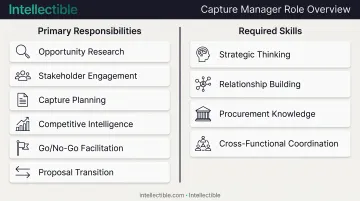
Primary responsibilities include:
- Leading opportunity research and qualification
- Coordinating stakeholder engagement and customer intelligence
- Developing capture plans and win strategies
- Managing competitive intelligence and teaming discussions
- Facilitating go/no-go decisions
- Transitioning insights to proposal teams
Required skills:
- Strategic thinking and analytical judgment
- Relationship building and cross-functional leadership
- Deep knowledge of federal procurement processes
- Coordination across SMEs, pricing, partners, executives, and writers
The capture manager maintains discipline and accountability, so the team follows a structured process instead of instinct or last-minute scrambling.
When to Use Capture Management (And When Not To)
Capture management delivers the highest ROI on high-value contracts, typically $5 million and above. It also pays off for complex procurements with long timelines, competitive recompetes, and strategic growth opportunities where winning is critical.
Full capture is most appropriate when:
- Contract value and complexity justify the investment
- At least 9 months remain before RFP release
- Multiple competitors are likely
- Customer relationships need to be built or strengthened
Abbreviated capture may be sufficient when:
- The pursuit is a routine task order under an existing vehicle
- Contract value is relatively low
- You already hold a strong incumbent advantage
Capture may not be appropriate when:
- Short-turnaround RFPs leave no time for pre-RFP work
- Opportunities clearly fall outside your capabilities
- Capture cost outweighs the potential benefit
Common Capture Management Mistakes
Even capable GovCon teams lose winnable work when capture discipline slips. These patterns show up most often.
Starting too late: Waiting until the RFP drops is the costliest error. By then, customer preferences are often set, and your chance to shape requirements is gone.
Organizational failures:
- Lack of executive sponsorship
- Insufficient resources dedicated to capture
- Intelligence scattered in silos instead of centralized
- Poor handoff between capture and proposal teams
Strategic errors:
- Inadequate competitive intelligence
- Weak customer relationships
- Generic solution development
- Skipped or undisciplined go/no-go reviews
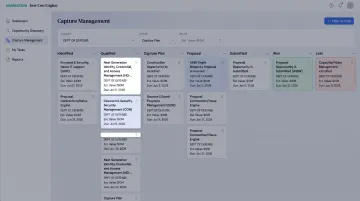
Avoiding these mistakes takes centralized intelligence and a repeatable process—not more headcount. Intellectible's GovCon Engine helps teams organize capture research in visual workflows, automate go/no-go analysis, and cut the overhead that causes skipped discipline. Teams using the platform have reported 150%+ gains in actionable pipeline opportunities while keeping capture rigor intact.
Conclusion
Capture management is how GovCon teams win high-value work before the RFP drops: build relationships, gather intelligence, and shape the opportunity early. Reactive bidding keeps win rates low. Disciplined capture raises them.
Effective capture takes commitment, structure, and supporting tools across the full pursuit lifecycle. Done well, it delivers higher win rates, more predictable revenue, and stronger long-term customer relationships.
Frequently Asked Questions
What is capture management?
Capture management is the strategic process of positioning to win a specific government contract before the RFP is released. It involves intelligence gathering, relationship building, solution development, and competitive positioning to move your company from unknown to preferred provider.
What are the responsibilities of a capture manager?
A capture manager leads opportunity research and qualification, customer engagement, and intelligence gathering. They also develop capture plans and win strategies, run competitive analysis, facilitate go/no-go decisions, and hand insights off to proposal teams.
When should a company start the capture management process?
Capture should ideally begin 9–24 months before the expected RFP release, as soon as you identify a qualified opportunity. This allows time for relationship building, intelligence gathering, and strategic positioning before the solicitation drops.
How long does the capture management process take?
Typical capture cycles run 9–18 months for major procurements, though this varies based on agency procurement timelines, opportunity complexity, and your existing customer relationships. Shorter cycles may be appropriate for routine task orders or lower-value opportunities.
What's the difference between capture management and proposal management?
Capture management happens before the RFP and focuses on positioning and strategy: building relationships, gathering intelligence, and shaping requirements. Proposal management happens after the RFP release and focuses on compliant, persuasive response execution, including writing, reviews, and submission.
Do small businesses need capture management?
Yes. While small businesses may use abbreviated capture processes for routine opportunities, they benefit from disciplined capture for high-value contracts where relationship building and strategic positioning make the difference between winning and losing.