Introduction
A capture strategy is the systematic approach GovCon teams use to position themselves as the preferred contractor before an RFP is released. Federal buyers often lock in vendor preferences long before formal proposals arrive.
Research from Shipley Associates indicates that customers prefer a supplier 40-60% of the time before proposals are submitted. Early positioning shapes that preference more than proposal polish alone.
Start capture after the RFP drops and you compete against decisions already made. Successful GovCon teams engage 12-24 months before contract award, shaping requirements and building relationships while competitors wait for solicitations on SAM.gov.
This guide covers how to build a capture strategy, when to start, and which activities separate preferred contractors from late entrants.
Key Takeaways
- Capture strategy positions your company as the obvious choice through pre-RFP engagement and competitive intelligence
- Most successful pursuits begin 12-24 months before release, not when the RFP appears
- Mission insight, stakeholder maps, competitor intel, win themes, and requirement shaping form the core of a winnable pursuit
- Early capture raises probability of win and reduces wasted proposal effort
What Is a Capture Strategy in Government Contracting?
A capture strategy is the disciplined process of researching, positioning, and influencing an opportunity before the solicitation drops. Done well, it raises your probability of win (Pwin) and shifts you from "unknown vendor" to "preferred contractor" in the customer's mind before competitors engage.
Capture differs from related GovCon activities in timing and purpose:
- Business development identifies opportunities across accounts and decides what to pursue
- Capture starts after that decision and focuses on one specific opportunity
- Proposal development responds to released RFPs using the intelligence and positioning capture built
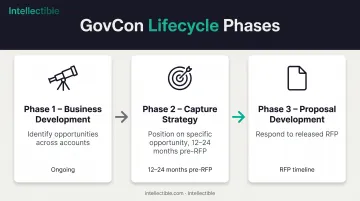
How a Capture Strategy Works: The Complete Process
Capture is an intelligence-gathering and positioning campaign that runs for months, pulls in cross-functional teams, and ends in a formal capture plan that guides the proposal. Teams collect intelligence across several fronts:
- Opportunity details and evaluation criteria
- Customer pain points and budget cycles
- Incumbent weaknesses and procurement history
- Technical requirements
During core capture work, teams build relationships with government stakeholders, shape requirement conversations, identify teaming partners, develop solutions, and position competitively. Governance typically includes:
- A dedicated capture manager leading the pursuit
- A cross-functional capture team contributing expertise
- Regular gate reviews that reassess probability of win
- A formal capture plan document
Step 1: Qualify the Opportunity and Conduct Go/No-Go Assessment
Evaluate whether the opportunity aligns with your capabilities, capacity, and strategic priorities using formal bid/no-bid criteria before investing capture resources.
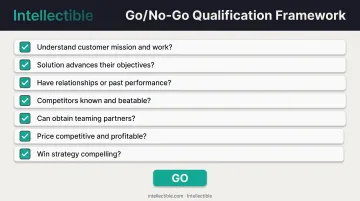
Washington Technology identifies seven critical qualification questions:
- Do you understand the customer's mission and required work?
- Does your solution advance their mission and contract objectives?
- Do you have customer relationships or relevant past performance?
- Are your competitors known and beatable?
- Can you obtain required teaming partners?
- Is your price-to-win both competitive and profitable?
- Is your win strategy compelling?
Deltek's 2025 Clarity study of nearly 900 GovCon firms found that finding opportunities too late remains the top business development challenge. Structured qualification criteria help teams focus resources on winnable pursuits rather than chasing every posted solicitation.
Workflow automation platforms help capture managers apply qualification rules consistently, route high-fit pursuits to review queues, and record clear go/no-go rationale.
Step 2: Understand the Customer's Mission and Pain Points
Research the agency's strategic goals, budget pressures, past performance issues with incumbents, and what "success" means to key stakeholders through public sources and direct engagement.
Start with publicly available intelligence:
- USAspending.gov for historical award data by agency and location
- Agency strategic plans and budget justifications
- Congressional testimony and GAO reports
- Industry day presentations and presolicitation notices
- SAM.gov for incumbent contract details
Then supplement with direct customer engagement through authorized channels. FAR 15.201 explicitly encourages early exchanges among potential offerors, end users, program managers, and contracting officers through industry conferences, market research, one-on-one meetings, draft RFPs, RFIs, and site visits.
Map where the incumbent is failing, which mission outcomes matter most, and which stakeholders drive decisions. That picture is what lets you position your solution against the evaluation criteria that actually score.
Step 3: Map Stakeholders and Build Relationships
Identify decision-makers, technical evaluators, end users, and budget holders; create an engagement plan to build trust and credibility with each through meetings, industry days, and capability briefings.
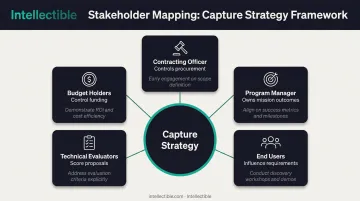
Key stakeholder categories to map:
- Contracting Officer: Controls procurement process and final award decision
- Program Manager: Owns mission outcomes and technical direction
- End Users: Experience incumbent performance daily and influence requirements
- Technical Evaluators: Score proposals and provide source selection input
- Budget Holders: Control funding and influence contract structure
Build relationships systematically through permitted exchanges. Share relevant past performance examples, offer technical white papers that demonstrate your approach, participate in RFI processes, and attend industry days. Each interaction should demonstrate competence and build confidence that you can deliver mission success.
Federal buyers award on confidence as well as compliance. The contractor they trust most often wins, and that trust comes from repeated, value-adding engagements long before the RFP drops.
Step 4: Analyze the Competitive Landscape and Develop Differentiators
Research likely competitors, especially incumbents, identify their strengths and vulnerabilities, and determine how to position your solution as superior on criteria that matter most to the customer.
Competitive intelligence includes:
- Incumbent analysis: Contract history, past performance ratings, known weaknesses, upcoming recompete exposure
- Likely competitors: Other contractors with relevant experience, agency relationships, or recent similar wins
- Teaming landscape: Which partners bring complementary capabilities, small-business status, or customer relationships you lack
- Pricing dynamics: Historical award values, incumbent burn rate, agency budget constraints
Use USAspending.gov and SAM.gov to research competitor contracts. Monitor industry news for teaming announcements and new hires. Identify where your technical approach, past performance, or teaming strategy creates meaningful differentiation.
Your win themes must address three questions: Why you? Why not the incumbent? Why not other competitors? Without clear, evidence-based answers, you're hoping evaluators notice your strengths rather than deliberately positioning them.
Step 5: Shape Requirements and Influence the Procurement
Ethically influence how the customer thinks about requirements through RFI responses, white papers, and capability discussions that highlight your unique approaches without writing the RFP for them.
FAR 15.201 permits and encourages presolicitation exchanges to improve government understanding of industry capabilities and commercial practices. Permitted shaping activities include:
- Responding to RFIs with detailed technical approaches
- Providing white papers on innovative solutions
- Offering capability briefings that demonstrate your methodology
- Sharing lessons learned from similar programs at other agencies
- Participating in draft RFP reviews with constructive feedback
Effective shaping makes your unique strengths appear essential to mission success. If you excel at agile development, shape conversations toward iterative delivery. If you bring specialized security clearances, emphasize the risks of cleared-personnel transitions.
Critical boundary: FAR 3.104 prohibits knowingly obtaining protected bid information or source selection data. Shape requirements through public channels—never through improper access to evaluation criteria, competitor pricing, or internal agency deliberations.
Step 6: Create the Capture Plan and Assemble the Win Team
Document all intelligence, competitive analysis, win themes, pricing strategy, teaming approach, and proposal strategy in a formal capture plan; assign roles and responsibilities to capture and proposal teams.
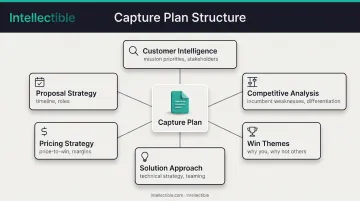
A capture plan consolidates:
- Customer intelligence: Mission priorities, pain points, stakeholder map, budget pressures
- Competitive analysis: Incumbent strengths/weaknesses, likely competitors, differentiation strategy
- Win themes: Why you, why not competitors, ghost strategies against incumbents
- Solution approach: Technical strategy, teaming structure, key personnel, past performance
- Pricing strategy: Price-to-win estimate, basis of estimate, margin targets
- Proposal strategy: Compliance matrix, responsibility assignment, timeline, review gates
Shipley Associates defines roles in complex bids to include capture manager, proposal manager, solution architect, pricing analyst, and executive sponsor. One person may hold multiple roles on smaller pursuits, but accountability must be clear.
The capture manager owns intelligence gathering, relationship building, and competitive positioning. Once the RFP drops, the proposal manager executes the response on that foundation and turns strategy into compliant, compelling proposal content.
Key Factors That Affect Capture Strategy Success
A few variables decide whether capture work turns into wins or stalled pursuits:
- Timing and early engagement: Lohfeld Consulting recommends starting capture 12-24 months before RFP release, longer for major procurements. Waiting until the draft RFP leaves little room to shape requirements or build stakeholder confidence.
- Customer access and relationships: Direct engagement with government stakeholders yields intelligence public sources miss. Competitors with real access already know unstated priorities, incumbent weaknesses, and evaluation hot buttons. Without it, you're operating blind.
- Competitive intelligence depth: Go beyond a competitor list. Map likely pricing, teaming strategies, past performance edges, and technical approaches so you can position with intent. Shallow analysis yields generic win themes that don't differentiate.
- Resource allocation and team quality: Capture needs dedicated time from BD, technical experts, pricing analysts, and executives, not leftover hours. Shipley's benchmarking shows organizations with defined processes achieve 51-80% win rates, versus below 35% for ad hoc approaches.
Tools don't replace those fundamentals, but they keep teams from drowning in admin while they work them. Workflow automation helps GovCon teams track opportunities, gather competitive intelligence, and run capture plans with less manual portal monitoring.
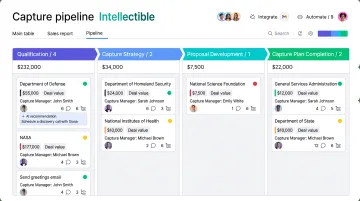
Intellectible's GovCon Engine converts federal notices into structured capture records, flags likely incumbents from historical award data, and routes qualified opportunities to capture owners so managers spend time on relationships instead of copy-paste research.
Common Capture Strategy Mistakes and How to Avoid Them
Starting capture too late: Most GovCon teams wait until the draft RFP to begin capture work, missing the critical shaping window. Deltek's 2025 study identified late opportunity discovery as the top BD challenge across nearly 900 firms. Start tracking and engaging on opportunities 12-24 months out, even if requirements remain unclear.
Confusing capture with proposal work: Capture is about positioning and intelligence gathering before the RFP. Proposal work is about executing the response after release. APMP clearly separates these phases: capture ends at RFP release, and proposal begins. Conflating the two results in rushed, reactive proposals without a strategic foundation.
When capture managers also write proposals, neither function receives proper attention. Assign clear ownership:
- Capture managers own pre-RFP intelligence and positioning
- Proposal managers own post-RFP response execution
Failing to conduct honest competitive assessments: Many capture teams overestimate their position and underestimate competitors, especially strong incumbents. Optimism bias wastes resources on unwinnable opportunities. Develop objective probability-of-win scoring criteria using the seven qualification questions above. Calibrate them against past bid outcomes, and walk away from opportunities where you're not truly competitive.
Washington Technology notes that long-shot indicators include:
- Customers who don't know you
- Knowledge limited to the RFP
- No technical solution
- Unknown competitors
If you check multiple boxes, redirect resources to stronger opportunities rather than chasing low-probability wins.
Conclusion
Capture strategy transforms GovCon contract pursuit from reactive RFP response to proactive customer engagement and competitive positioning that improves win rates. Federal buyers largely decide on preferred vendors before proposals arrive. Capture puts your company in position to shape those decisions rather than overcome them.
Without disciplined capture, you're hoping to win through superior proposal writing alone. With systematic capture, you've already demonstrated competence, built stakeholder confidence, shaped requirements toward your strengths, and positioned competitors' weaknesses before the first proposal page is written.
Frequently Asked Questions
What is capture planning?
Capture planning is the process of creating a formal document that consolidates opportunity intelligence, competitive analysis, customer insights, win themes, and pursuit strategy. The capture plan guides both pre-RFP positioning activities and post-RFP proposal development.
What is capture management?
Capture management is the discipline of leading and executing capture strategy. A dedicated capture manager coordinates intelligence gathering, stakeholder engagement, competitive analysis, and capture plan development, then hands that foundation to the proposal team at RFP release.
What are the responsibilities of a capture manager?
Key responsibilities include qualifying opportunities, researching customers and competitors, building relationships with government stakeholders, developing win themes and pricing strategy, writing the capture plan, and handing intelligence to the proposal team.
What are the main capture strategies?
Common approaches include incumbent displacement (attacking weaknesses of the current contractor), incumbent defense (protecting your existing contracts from competitors), and greenfield pursuit (competing for new requirements where no incumbent exists). Strategy depends on your position and competitive dynamics.
What does capture mean in business?
In general business, capture refers to acquiring customers or market share. In B2B sales, it means pre-sales activities to position your company favorably before formal procurement begins: building relationships and demonstrating value ahead of competitive evaluation.
What does capture mean in government contracting?
In GovCon, capture specifically refers to the pre-RFP process of gathering intelligence, building relationships with government buyers, shaping requirements, and positioning your company as the preferred contractor before the solicitation is released. Early engagement raises your probability of win.