Introduction
GovCon teams face a compounding problem: RFP volumes keep climbing while response windows stay short, and every lost bid has a direct revenue consequence.
The bottleneck isn't just bandwidth. Most teams are stitching together disconnected tools across each phase of the pursuit cycle — rebuilding context as they move from opportunity discovery through Go/No-Go, pricing, and final drafting.
Not all proposal software is built for this. Generic tools like Google Docs or PandaDoc weren't designed around FAR/DFARS compliance, Section L and M requirement tracing, CUI handling, or institutional knowledge reuse. Using them for government work means manual workarounds at every step.
This guide covers the best government proposal writing software for GovCon teams in 2025–2026 — what each platform does well, where it falls short, and how to match the right tool to where your current process breaks down.
Key Takeaways
- The best platforms go beyond drafting — they connect qualification, Go/No-Go decisions, compliance matrix extraction, pricing, and content reuse
- FAR/DFARS alignment, Section L/M tracing, and CUI handling matter more than raw AI writing speed
- Generic AI tools lack the GovCon-specific guardrails and institutional memory that proposal teams need
- Security certifications vary widely — always verify vendor claims directly before relying on them
- Match the tool to your bottleneck: upstream (qualification, pricing) or downstream (drafting, review, submission)
What Is Government Proposal Writing Software?
Government proposal writing software covers the full spectrum of tools built to help GovCon teams respond to federal, state, and local solicitations — from opportunity discovery and Go/No-Go analysis through compliance matrix extraction, proposal drafting, content reuse, and team review workflows.
The distinction from general proposal tools matters. GovCon-specific platforms are built around:
- FAR Part 15 compliance — Section L (instructions to offerors) and Section M (evaluation factors)
- DFARS requirements, including CUI handling under NIST SP 800-171 for covered contractor systems
- Audit trails, past performance management, and structured requirement tracing
- Tight submission deadlines with no room for version-control failures
None of that is baked into commercial tools. Miss a single "shall" statement in the RFP and the proposal is non-compliant — prose quality doesn't matter.
The most effective platforms in 2025–2026 address this by connecting the entire pursuit lifecycle: opportunity qualification, compliance tracking, content reuse, and review workflows inside one system. Teams stop rebuilding context between disconnected tools and spend that time on win strategy instead.
Best Government Proposal Writing Software for GovCon Teams
Tools on this list were evaluated across six dimensions: GovCon-specific workflow coverage, AI capability, compliance support, content reuse, security posture, and team-size fit. Coverage spans opportunity qualification through final submission.
Intellectible
Intellectible is a horizontal AI build platform headquartered in Austin, TX, designed to help GovCon teams grow revenue without adding headcount. Where most proposal tools address one phase of the pursuit cycle, Intellectible connects the full lifecycle — opportunity discovery, Go/No-Go decisions, compliance matrix generation, proposal drafting, pricing, and internal approvals — inside one platform.
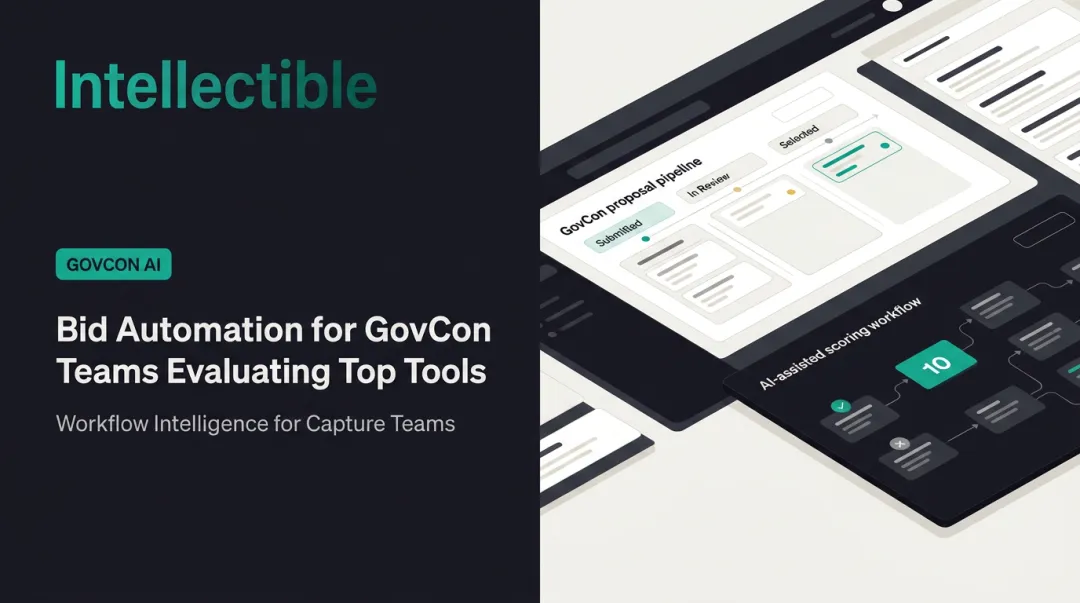
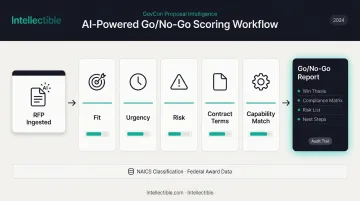
The Go/No-Go workflow shows how this works in practice. When an RFP is ingested, the platform automatically scores the opportunity across five dimensions — fit, urgency, risk, contract terms, and capability match — using NAICS codes and federal award history from live data sources.
The output isn't just a score. It's a structured Go/No-Go report with a win thesis, compliance matrix, risk list, and assigned next steps. Decisions are documented with a full audit trail before any proposal resources are committed.
Defense contractor Oceus used Intellectible's pursuit platform to more than double its qualified opportunity pipeline. CEO Jeff Harman noted: "Now we're looking at more than double the qualified opportunities per week — about seven to eight opportunities a month making it through our threshold."
HHS selected Intellectible to automate bid revenue operations. Corporate Director of Business Development John Grady stated: "Intellectible is taking the tedious, monotonous hours of RFP efforts out of human hands. This allows us to do what we should be doing, analyzing and selling."
Important note on security posture: Intellectible's Terms of Service indicate the platform is not currently tailored to comply with FISMA regulations. GovCon teams with CUI obligations under DFARS 252.204-7012 should confirm current security documentation directly with Intellectible before deploying for sensitive workloads. Contact jesse@intellectible.com or visit intellectible.com/book-demo for details.
| Intellectible | |
|---|---|
| Key Capabilities | AI opportunity qualification, Go/No-Go decision workflows, compliance matrix extraction, proposal content workflows, pricing automation with audit trail, visual workflow builder, PostgreSQL databases, React-supported interfaces |
| Best For | GovCon revenue operations teams that need to automate the full pursuit lifecycle — from opportunity evaluation to pricing to proposal — without rebuilding infrastructure for each workflow |
| Security / Deployment | Managed cloud SaaS; verify current FISMA, CMMC, and FedRAMP posture directly with Intellectible for CUI requirements |
Sweetspot
Sweetspot runs the proposal response process end to end — breaking solicitations into compliance matrices, assigning requirements to owners, routing color-team reviews (Pink, Red, Gold), and surfacing reusable content from past proposals, all inside a Word-like editor.
A notable differentiator is native federal market intelligence: each SAM.gov solicitation links to its FPDS award record and USAspending history, giving teams incumbent context and recompete tracking without leaving the platform.
Sweetspot claims a C3PAO-issued product-level CMMC Level 2 certification and SOC 2 Type II. One important caveat from independent research: DoD's CMMC model assesses organizations' information systems or enclaves, not software products in isolation — no named C3PAO or public audit report was located for Sweetspot in available public registries. Verify current FedRAMP authorization status directly with the vendor.
| Sweetspot | |
|---|---|
| Key Capabilities | Compliance matrix extraction, color-team review gates, version control, institutional memory, pipeline management, federal market intelligence (SAM.gov, FPDS, USAspending) |
| Best For | GovCon teams of any size that need to manage the full proposal response process in one system with compliance and color-team workflows built in |
| Security / Compliance | Claims C3PAO CMMC Level 2 and SOC 2 Type II; verify FedRAMP authorization status with vendor |
VisibleThread
Founded in 2008, VisibleThread is built on deterministic NLP for compliance and readability analysis. It breaks RFPs into requirement matrices, performs line-level document comparison between draft and final solicitations, and flags risky clauses, watchwords, and passive voice across proposal content.
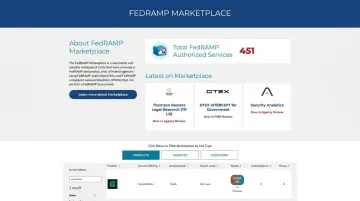
VisibleThread holds FedRAMP Ready status (Class C, Moderate, ID FR2620739750) — the only tool on this list with a confirmed public FedRAMP Marketplace entry. Note that FedRAMP Ready is a pre-authorization status, not full authorization; no FedRAMP authorizations are currently listed for the product.
VisibleThread is best suited for large proposal centers that need explainable, auditable quality control. It does not cover upstream capture or pricing, and has no native opportunity discovery — plan for separate tooling at the front of the pursuit cycle.
| VisibleThread | |
|---|---|
| Key Capabilities | Deterministic compliance matrix, document compare, risk and clause analysis, readability and acronym QA, centralized content library, bid/no-bid analysis |
| Best For | Established primes and large proposal centers running rigorous, auditable compliance and readability QA on high-stakes solicitations |
| Security / Compliance | FedRAMP Ready (confirmed in public Marketplace); verify CMMC Level 2 and SOC 2 Type II posture directly with vendor |
GovEagle
GovEagle is a YC-backed AI proposal tool built around native Microsoft 365 integration. It breaks RFPs down and generates Pink Team–ready drafts inside Word, Excel, and SharePoint, and supports bid matching against SAM.gov and GSA eBuy opportunities.
It's strongest for defense and M365-centric teams that want proposal acceleration without a platform migration. It also offers on-premise and portable hardware deployment for air-gapped environments — a genuine differentiator for classified-adjacent programs. That said, opportunity discovery is narrower than dedicated platforms (SAM.gov and GSA eBuy only), and award intelligence is limited by comparison.
GovEagle describes its security posture as "FedRAMP Moderate Equivalent" and "CMMC Level 2 aligned." No matched FedRAMP Marketplace entry or public C3PAO assessment was located in independent research. Verify all security claims directly with the vendor before relying on them.
| GovEagle | |
|---|---|
| Key Capabilities | sentence-level requirement extraction and proposal drafting inside Microsoft 365, SAM.gov and GSA eBuy bid matching, recompete tracking, cloud/on-premise/portable hardware deployment |
| Best For | Defense contractors deeply invested in Microsoft 365 who need RFP-to-draft speed without leaving their existing toolchain, or teams requiring air-gapped deployment |
| Security / Compliance | Claims FedRAMP Moderate Equivalent and CMMC Level 2 alignment; verify against current vendor documentation |
pWin.ai
pWin.ai is co-developed with Shipley Associates and applies Shipley capture and proposal methodology to drafting workflows. It includes a knowledge repository for past RFPs, CPARS, and capability statements, an RFI response module, a Readiness Report for capability-gap analysis, and a Microsoft Word plugin.
pWin.ai works best for teams trained on Shipley methodology who want structured capture planning and attribution reporting built directly into their drafting workflow. Opportunity discovery requires a third-party integration rather than native discovery — plan accordingly. Security certifications are vendor-reported; no public audit report or FedRAMP authorization was located in independent research.
| pWin.ai | |
|---|---|
| Key Capabilities | Shipley-aligned capture and drafting workflow, knowledge repository, completeness and attribution reports, Readiness Report, Word plugin, RFI response support |
| Best For | Shipley-trained capture and proposal teams that want structured methodology enforcement and capability-gap analysis built into their drafting process |
| Security / Compliance | Vendor claims CMMC Level 2 and FedRAMP Moderate Equivalent; verify current posture directly with pWin.ai |
How We Chose These Tools
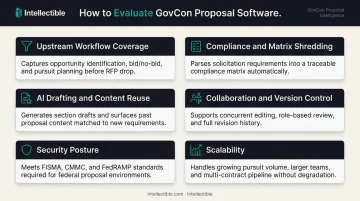
Tools were assessed across six dimensions:
- Upstream workflow coverage — does it handle opportunity qualification and Go/No-Go, or only downstream drafting?
- Compliance and matrix extraction — Section L/M tracing, requirement mapping, deficiency flagging
- AI drafting and content reuse — quality of AI assistance and access to institutional knowledge from past proposals
- Collaboration and version control — color-team routing, review gates, audit trails
- Security posture — independently verifiable certifications versus vendor self-attestation
- Scalability — fit for teams ranging from small set-aside firms to large proposal centers
A common mistake is choosing based on drafting speed alone. A tool that accelerates prose but doesn't connect to upstream capture decisions or downstream pricing shifts the bottleneck rather than eliminating it.
Security posture deserves its own scrutiny. Terms like "CMMC Level 2," "FedRAMP Moderate Equivalent," and "SOC 2 compliant" carry very different levels of assurance depending on whether they reflect a third-party audit, a C3PAO (Certified Third-Party Assessor Organization) product-level assessment, or self-attestation. Of the tools reviewed, only VisibleThread has a confirmed entry in the public FedRAMP Marketplace. Always confirm security posture directly with vendors before processing CUI on any platform.
Conclusion
The right government proposal writing software isn't the one with the most features — it's the one that addresses where your process actually breaks down.
Match the tool to your actual bottleneck:
- Go/No-Go and pricing slowdowns: Intellectible's full pursuit cycle automation delivers different value than tools focused only on compliance extraction or M365 drafting.
- Downstream quality control at scale: VisibleThread's deterministic compliance analysis addresses something Intellectible doesn't prioritize.
- Air-gapped Microsoft 365 environments: GovEagle solves a deployment problem the other platforms don't touch.
Evaluate tools against your actual proposal volume, team size, security requirements, and bottleneck location. Test platforms on a real solicitation rather than relying on feature lists — the difference between how a tool performs in a demo and how it handles a 200-page DoD solicitation at 11pm on a Friday is where the real assessment happens.
GovCon teams looking to scale their revenue process without adding headcount can explore how Intellectible's Proposal & Pursuit Engine — a governed proposal workflow covering solicitation intake, go/no-go, compliance matrix generation, section drafting, and final review — connects the full pursuit lifecycle in one platform. Reach out to jesse@intellectible.com or visit intellectible.com/book-demo to learn more.
Frequently Asked Questions
What is the best software for writing government proposals?
The best tool depends on where your team's bottleneck sits. Intellectible covers the full pursuit lifecycle from opportunity qualification through pricing and proposal; Sweetspot excels at compliance matrix management and color-team review workflows; VisibleThread specializes in deterministic, auditable compliance QA. No single platform is universally best without matching it to your workflow and team size.
Can I use ChatGPT or other AI platforms to write government proposals?
General AI tools like ChatGPT can accelerate first-draft prose, but they lack GovCon-specific compliance guardrails, Section L/M requirement tracing, FAR/DFARS awareness, and institutional memory from past proposals. NIST's AI Risk Management Framework flags confabulation and sensitive-data leakage as core generative AI risks — purpose-built platforms reduce both by grounding responses in structured solicitation data.
What features should I look for in government proposal writing software?
Prioritize: compliance matrix extraction (Section L/M tracing), Go/No-Go decision support, content reuse from past proposals, version control and color-team review routing, pricing integration, and security posture appropriate for CUI or DoD work. Don't evaluate based on prose quality alone.
How is GovCon proposal software different from general proposal tools?
GovCon tools are built around FAR/DFARS compliance, structured RFP requirement tracing, CUI handling, audit trails, past performance management, and federal opportunity data. Commercial tools like PandaDoc or Google Docs lack all of these — meaning you'd rebuild compliance infrastructure manually for every bid.
Can small government contracting firms benefit from proposal writing software?
Yes — resource-constrained firms and set-aside businesses (SDVOSB, 8(a), HUBZone) often see the fastest ROI because these tools replace manual processes that would otherwise require additional headcount. Small businesses received $183.27B — 28.8% of eligible federal contract dollars in FY2024, and several platforms on this list serve teams under 10 people.
How does AI help with Go/No-Go decisions in government contracting?
AI-powered Go/No-Go tools score opportunities against a firm's target agencies, NAICS codes, deal parameters, incumbent history, and fit signals — cutting hours of manual research to minutes. Platforms like Intellectible generate structured reports with a win thesis, compliance matrix, and next-step assignments. That gives teams the data to pursue high-probability bids rather than defaulting to "bid everything."