Introduction
Picture two proposals landing on the same evaluator's desk. The first opens with a vague problem statement, buries key details in dense paragraphs, and leaves the evaluator hunting for budget justifications.
The second immediately demonstrates understanding of the problem, maps solutions to specific evaluation criteria, and presents a clear path from approval to results. The first gets shelved. The second gets funded.
Proposals are persuasive documents used across business, government, academic, and nonprofit contexts to secure buy-in, funding, or partnerships. They convince decision-makers that your project deserves their resources and turn a plan into funded work.
This guide covers what proposals are, the main types, a step-by-step writing process, essential components, common mistakes, and practical tips that work across industries.
Key Takeaways
- Win approval by framing a clear problem, a feasible solution, and measurable value for decision-makers
- RFPs, unsolicited pitches, sales proposals, government contracts, and grants share core structure but need tailored approaches
- Match your audience's evaluation criteria and prove value, feasibility, and capability
- Weak problem statements, vague solutions, unrealistic budgets, and missed compliance requirements sink most proposals
What Is a Proposal and Why Does It Matter?
A proposal is a persuasive document that outlines a project, service, or initiative and explains why it deserves approval, funding, or resources. Its job is to turn an idea into an approved plan by proving value, feasibility, and fit with what decision-makers care about.
Proposals differ from related documents:
- Business plans describe internal operations and long-term strategy
- Project plans guide execution after approval has been secured
- Proposals sell the idea upfront and convince evaluators to say yes
When Proposals Are Required
Organizations request or require proposals in specific situations:
- Responding to RFPs when government agencies, corporations, or nonprofits issue formal solicitations
- Seeking grant funding from foundations, federal agencies, or philanthropic organizations
- Pitching new projects internally to secure executive approval and resource allocation
- Pursuing client contracts in competitive sales environments
- Requesting budget increases or additional staffing for existing initiatives
A strong proposal can unlock contracts worth millions, multi-year funding, strategic partnerships, or career-defining projects. A weak one wastes time, damages credibility, and costs you the win.
In the 2024 CohnReznick/Unanet government contracting survey, 69% of firms reported difficulty winning new contracts. In that environment, proposal quality often decides who gets the work.
Types of Proposals You Need to Know
Understanding the type of proposal you're writing shapes your approach, tone, and level of detail. Each category carries different expectations and requirements.
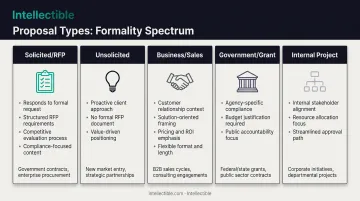
Solicited Proposals and RFP Responses
These respond to formal Requests for Proposals (RFPs) or Requests for Information (RFIs). Requirements are specified, and you're competing against others. The solicitation defines the problem, sets evaluation criteria, and establishes submission rules.
Solicited proposals demand strict compliance with:
- Format and page limits
- Stated evaluation criteria
- Submission deadlines and packaging rules
Federal procurement rules require RFPs to describe the requirement, proposal information required, evaluation factors and subfactors, and their relative importance. Miss a rule and you can be thrown out before scoring starts. In a 2025 GAO case, Horizons Youth Services was excluded after using Arial Narrow instead of standard Arial, which pushed the response at least three pages past the 50-page limit.
Unsolicited Proposals
Unsolicited proposals are proactive pitches sent without a formal request. You have to prove both the problem and why your solution belongs in the conversation, so the persuasion bar sits higher.
Federal unsolicited proposals must present an independently originated, innovative and unique idea with enough detail to assess value. Expect to include:
- A short abstract (about 200 words)
- Technical approach
- Personnel qualifications
- Detailed cost
- Relevant past performance
Business and Sales Proposals
These aim to win client contracts or sales by showing how your product or service solves the client's problem better than alternatives. Business proposals emphasize ROI, implementation timelines, pricing models, and competitive differentiation. They're typically shorter and more flexible than government proposals, but still need a clear problem statement, a concrete solution, and proof you can deliver.
Government and Grant Proposals
Government proposals pursue public-sector contracts, while grant proposals seek philanthropic or federal research funding. Both require detailed compliance documentation, budget justifications, and alignment with specific funding priorities.
Grant success rates vary widely by agency and mechanism. NIH reported an 18.5% success rate for Research Project Grants in FY2024 (10,265 awards from 55,518 applications). NSF reported a 28% funding rate in FY2022 (10,969 awards from 39,140 competitive proposals).
With odds like those, vague alignment and soft budgets rarely survive review.
Project Proposals (Internal)
Internal proposals seek approval and resources for new initiatives inside an organization. They need stakeholder buy-in, a clear ROI case, and a fit with strategic priorities. They're usually shorter and less formal than external bids, yet they still fail without defined outcomes, resource asks, and a path to measure results.
How to Write a Proposal: Step-by-Step Guide
This core process applies across proposal types, with adjustments based on specific requirements.
Step 1: Understand Your Audience and Evaluation Criteria
Research who will evaluate your proposal (selection committee, program officer, procurement official, or internal stakeholders) and what criteria they'll use. Federal procurement rules require evaluators to use only the stated evaluation factors, and those factors must be documented in the solicitation.
Key actions:
- Identify the evaluators' expertise level and priorities
- Locate scoring rubrics, must-have requirements, and budget constraints
- Note whether price is more important than, equal to, or less important than technical factors
- Tailor language and technical detail to match audience expectations
For grants, learn the specific review framework. Under NIH's simplified peer review, Importance of Research and Rigor/Feasibility are scored on a 1-9 scale, while Expertise/Resources is rated sufficient or not.
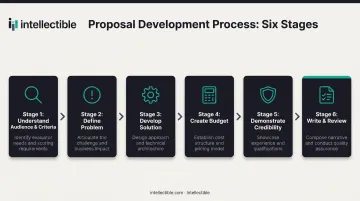
Step 2: Define the Problem or Opportunity
Clearly articulate the problem your proposal addresses using specific data, context, and evidence. Decision-makers need to see that you understand the problem deeply and that it's significant enough to warrant the requested resources.
Effective problem statements:
- Use quantifiable metrics (costs, time lost, affected populations)
- Reference industry research, internal data, or stakeholder interviews
- Explain current gaps and why existing solutions fall short
- Demonstrate urgency without exaggeration
Avoid generic claims like "many organizations struggle with inefficiency." Instead, cite specific examples: "The current manual review process requires 40 staff hours per solicitation, delaying responses by an average of 12 days and resulting in three missed deadlines per quarter."
Step 3: Develop Your Solution and Approach
Outline your proposed solution with enough detail to demonstrate feasibility without overwhelming readers with jargon. Describe your methodology, timeline, key activities, and how your approach differs from or improves upon existing solutions.
Strong solution descriptions include:
- Clear explanation of what you will do
- Why this approach is best suited to the problem
- Specific deliverables and milestones
- How you'll measure success
- Risk mitigation strategies
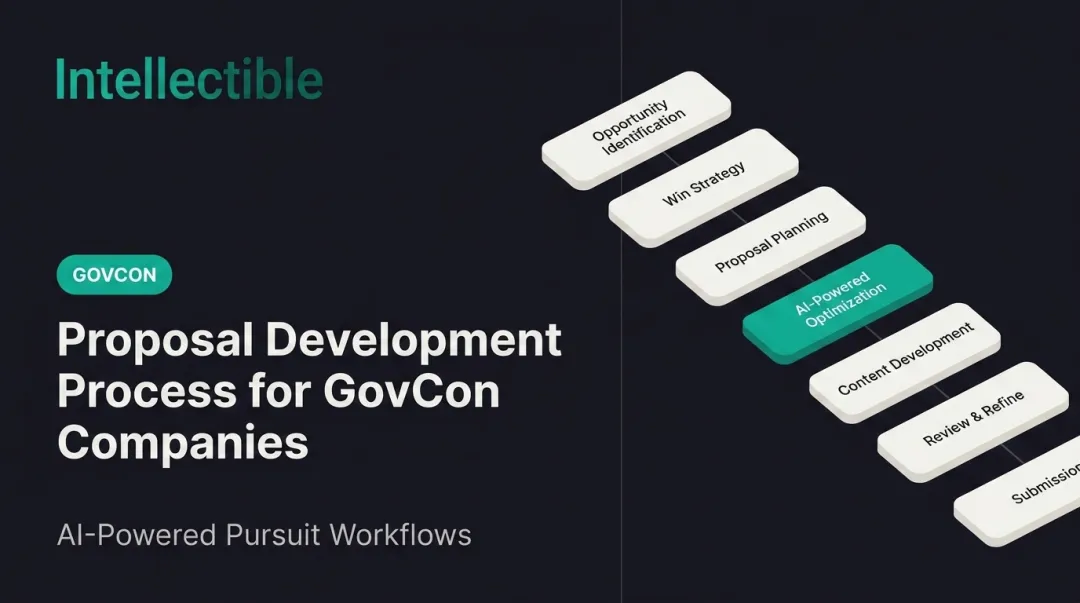
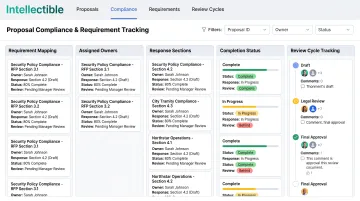
For workflow-intensive proposal work, teams often use platforms that automate compliance tracking, requirement mapping, and review cycles. Intellectible's Proposal & Pursuit Engine, for example, turns RFP documents into structured workflows that pull out deadlines, submission rules, evaluation criteria, and compliance obligations, then assign each requirement to an owner, evidence path, and due date.
That structure cuts the administrative load HHS Corporate Director John Grady described as "tedious, monotonous hours" that pull teams away from analysis and selling.
Step 4: Create a Realistic Budget and Resource Plan
Develop a detailed, justified budget that accounts for all project costs (personnel, materials, travel, overhead) and explains why each line item is necessary. GAO's cost estimating guide calls for a technical baseline, work breakdown structure, documented assumptions and data, sound estimating methods, and risk analysis updated with actual costs.
Budget best practices:
- Break costs into clear categories
- Show calculations for each line item
- Explain staffing levels and hourly rates
- Include contingencies for identified risks
- Align budget with scope and timeline
- Provide a narrative that justifies each expense
Government and grant proposals face particular scrutiny. Federal cost-reimbursement proposals receive cost-realism analysis that evaluates realistic expected cost, understanding of requirements, and ability to perform.
Step 5: Demonstrate Credibility and Capability
Present your qualifications, relevant experience, past performance, team expertise, and any partnerships that strengthen your capability to deliver. Federal procurement requires past-performance evaluation in negotiated competitive acquisitions above the simplified acquisition threshold, assessing recency, relevance, source, context, and trends.
Ways to build credibility:
- Cite similar projects you've completed successfully
- Highlight relevant certifications, awards, or recognitions
- Introduce key team members with relevant expertise
- Reference partnerships that fill capability gaps
- Include letters of support from stakeholders or clients
If you lack certain experience, consider partnerships or subcontracting arrangements. Federal procurement rules recognize that contractor teams can complement unique capabilities and offer better combinations of performance, cost, and delivery.
Step 6: Write, Review, and Refine
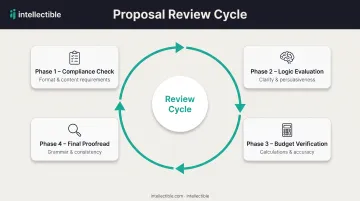
Draft your proposal following the required structure, then conduct multiple review cycles focusing on clarity, compliance, persuasiveness, and error elimination.
Effective review strategies:
- First pass: Check compliance with all format and content requirements
- Second pass: Evaluate clarity, logic, and persuasiveness
- Third pass: Verify budget calculations and technical accuracy
- Final pass: Proofread for grammar, spelling, and consistency
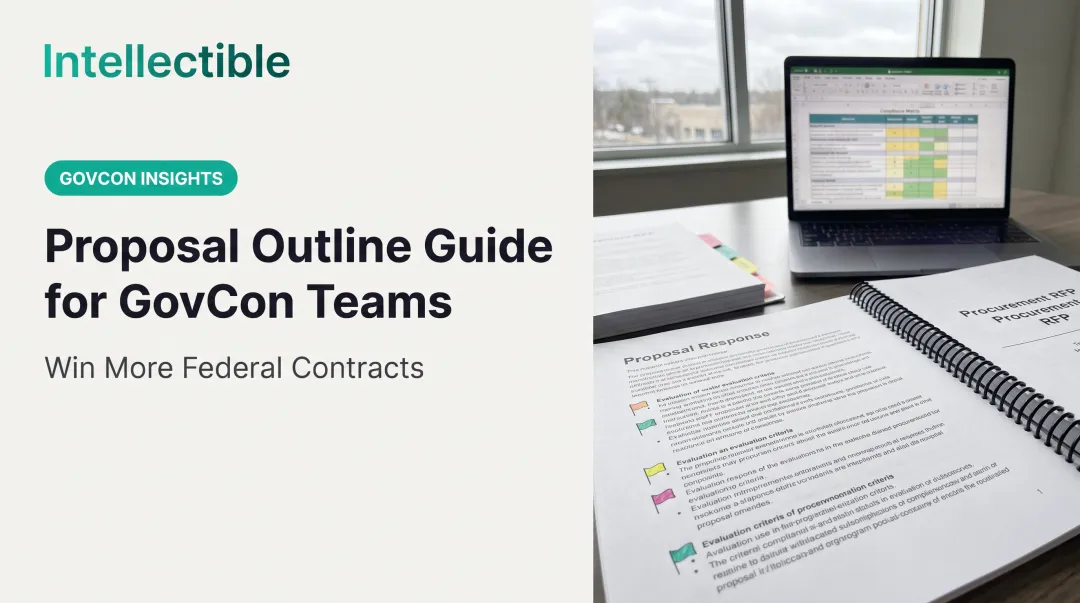
Use a compliance matrix to track every requirement against your response. It catches omissions before submission and shows evaluators you addressed the full solicitation.
Essential Components Every Proposal Must Include
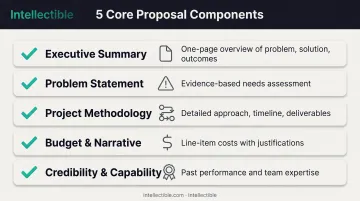
Most winning proposals share the same core sections. Build each one with enough evidence and clarity that a reviewer can decide without hunting for answers.
Executive Summary
This standalone overview is often the only section some reviewers read carefully. It must concisely present the problem, solution, outcomes, and resource request. APMP guidance describes the executive summary as the most widely read section and the first, most closely scrutinized part of a proposal.
Effective executive summaries:
- Open with the core problem or opportunity
- State your solution in 2-3 sentences
- Highlight 3-4 key benefits or outcomes
- Mention your unique qualifications
- State the total investment required
- Keep it to one page or less
Problem Statement and Needs Assessment
Document the problem with evidence, name the current gaps, and show why action can't wait. Your goal is simple: leave no doubt the issue is real and urgent.
Use specific data, stakeholder input, industry benchmarks, or research findings. Don't rely on assumptions. Prove the problem exists and that solving it is worth the investment.
Project Description and Methodology
Spell out your approach, activities, timeline, deliverables, and success metrics. Break complex work into phases with clear milestones, and show how each activity drives the outcome.
Cover in this section:
- Work breakdown structure
- Timeline with key milestones
- Deliverables at each phase
- Quality assurance methods
- Performance metrics
- Roles and responsibilities
Budget and Budget Narrative
Give reviewers a detailed line-item budget plus a short narrative that justifies each expense and shows how you calculated it.
The budget must map to your project description. Every activity needs a matching cost, and every cost should support work you already described.
Budget components:
- Personnel (salaries, benefits, hourly rates)
- Materials and supplies
- Equipment and technology
- Travel and meetings
- Indirect costs (overhead, facilities)
- Contingency (if allowed)
In the narrative, state why each expense is necessary and show the math. For example: "The project manager role requires 20 hours per week for 12 months at $85/hour, totaling $88,400. That effort covers coordination across five workstreams and ongoing stakeholder communications."
Common Mistakes and How to Avoid Them
Even experienced proposal writers make preventable errors that sink otherwise strong submissions.
Frequent Errors
Weak problem statements fail to establish need with specific evidence. Skip vague openers like "Many organizations face challenges."
Write something concrete instead: "Internal audit data from Q4 2024 shows that 67% of processing delays stem from manual data entry, costing an estimated $340,000 annually in staff time and error correction."
Vague or unrealistic solutions promise outcomes without explaining how you'll achieve them. Every claim requires supporting detail and logic.
Budget errors include math mistakes, insufficient justification, or misalignment with project scope. A single calculation error can undermine credibility across the entire proposal.
Missing compliance requirements result in automatic disqualification. NSF states that conformance is strictly enforced and may return inconsistent proposals without review. Requirements include at least 1-inch margins, specific page limits for each section, and detailed budget justifications.
Generic content that doesn't address specific evaluation criteria fails to demonstrate fit. Every proposal should feel custom-written for that opportunity, not repurposed from a template.
Prevention Strategies
Create a compliance matrix before you start writing. List every requirement: format, content, structure, and submission method. Check off each one as you address it.
Have multiple reviewers examine the proposal with different lenses:
- One checks compliance and formatting
- One evaluates logic and persuasiveness
- One verifies budget calculations
- One proofreads for clarity and errors
Tailor content specifically to the opportunity rather than relying on boilerplate. Reference the evaluator's stated priorities, use their terminology, and organize your response around their evaluation criteria.
If your team runs several pursuits at once, the same compliance and review gaps get harder to catch manually. Workflow automation platforms help by turning the process into a tracked system:
- Convert solicitation documents into structured requirement lists
- Map each requirement to response sections and owners
- Manage review cycles with clear status visibility
- Flag coverage gaps before submission
Frequently Asked Questions
How long should a proposal be?
Length depends on type and requirements. RFPs often set limits from 5 to 50+ pages; internal proposals usually run 2-10 pages. Follow stated limits and prioritize clarity over padding. Reviewers reward concise, well-organized content.
What's the difference between a solicited and unsolicited proposal?
Solicited proposals respond to a formal RFP with defined requirements and scoring criteria, so you know what evaluators want and how they'll score you. Unsolicited proposals are proactive pitches: you must establish the need and prove value without that guidance.
Should I include pricing in every proposal?
Most proposals need a detailed budget, though some RFPs request pricing separately or on specific forms. Follow those instructions and keep costs realistic, itemized, and justified with a short narrative for each category.
How do I make my proposal stand out from competitors?
Show deep understanding of the problem with specific evidence, and prove your solution uniquely fits the evaluator's needs. Back claims with past performance and team expertise, stay fully compliant, and write clearly so reviewers can score you quickly.
What if I don't have all the required experience or resources?
Partner or subcontract to fill gaps, and highlight transferable experience from related work. Be honest about limits and present concrete mitigation plans such as added oversight, training, or expert support. Evaluators respect transparency paired with a clear fix.
How much time should I allow for proposal development?
Complex RFP responses often need 4-8 weeks for research, drafting, reviews, and production. Simple business proposals may take 1-2 weeks; internal ones can finish in days. Work backward from the deadline and leave room for multiple review cycles.