Introduction
A list of 10,000 contacts looks like pipeline. It usually isn't. A defensible list is smaller: accounts with demonstrated fit, a relevant business problem, identifiable stakeholders, and a timely reason to engage.
Evidence-based prospecting is the disciplined use of verifiable data and documented signals to decide which accounts to pursue, whom to contact, what to say, and when to act. Enterprise deals make this matter more. Forrester's 2024 research found the average purchase involves 13 buying stakeholders, so one enthusiastic contact proves very little.
Evidence-based prospecting distinguishes an observable account event from a model’s estimate of intent. For enterprise revenue teams, the practical question is whether the rep can show what changed, where the fact came from, and why it may matter to the purchase. That standard belongs ahead of activity volume or a warm-account score.
Key Takeaways
- Prioritize account quality, buying-group coverage, and timing over activity volume.
- Attach a source, date, context, and confidence level to every important decision.
- Let AI gather and summarize evidence; let people settle ambiguous or high-impact calls.
- Treat the process as continuous, because accounts and stakeholders keep changing.
Why Enterprise Prospecting Needs Evidence, Not Activity Volume
Topic-based intent data infers interest from patterns of online research and commonly reports it as an account-level score. It can suggest where to investigate, but it does not identify a confirmed purchase, a budget owner, or the reason an account must change suppliers. Keep that inference separate from the underlying observations.
The account, not the contact, is the unit of prospecting
A contact record shows that a person exists. It says nothing about account fit, purchase intent, decision authority, or timing.
Enterprise deals add a crowd. Typical participants include:
- Economic buyers who own the budget
- Champions who push internally
- Technical evaluators and end users who assess fit
- Procurement teams that control vendor access
- Legal and security reviewers who gate risk and terms
Each group worries about something different. Reach only one and the deal stalls quietly. Forrester reports that 91% of purchases stall at some point, though a stall is not the same as a lost deal.
What counts as usable evidence
Not all evidence weighs the same. Sort it into four buckets:
- Verified facts: a filing, a press release, a confirmed org chart
- Behavioral signals: content engagement, page visits, prior conversations
- Sales hypotheses: your theory about the problem
- Unsupported assumptions: things someone "just knows"
Facts and signals can drive action. Hypotheses need validation. Assumptions should not drive anything.
Set a minimum standard: every piece of evidence needs a source, a date, a link to the specific account, and a sentence explaining how it supports the next action. If it can't meet that, it stays out of the qualification record.
Evidence decays
A strong signal in January can be wrong by June. Champions change jobs, reorganizations move budgets, new initiatives replace old ones, and CRM records go stale.
ZoomInfo, a data vendor, estimates annual email decay near 22.5% and job-title changes of 25% to 35%. That is a vendor figure, not an enterprise-only rate, but the direction is clear.

Set refresh rules for high-value accounts:
- Re-verify stakeholders before every major outreach push
- Re-check triggers when the evidence is older than your sales-cycle checkpoint
- Flag any record with no activity or update in a set window
Build an Evidence Framework for Target Accounts
Define ICP fit before collecting contacts
A buying signal in this comparison is an observable company event: a named employer hired a new operations leader, a facility received a permit, a business completed an acquisition, or a public contract reached a documented renewal point. Store the original source, event date, publication date, and company identity so a representative can inspect the fact.
Then write explicit inclusion and exclusion rules covering:
- Industry and organization size
- Operating model and technology environment
- Procurement complexity and geography
- The business problem your solution addresses
Exclusions matter as much as inclusions. An account that fails a rule shouldn't get contacts pulled for it.
Map the buying committee
For each account, capture:
- Role and influence
- Likely business concern
- Relationships to other stakeholders
- Current status
- Unknowns still needing validation
That last field is the honest one. A map full of guesses presented as facts is worse than a map with visible gaps.
Capture intent and trigger evidence without overstating it
Use two families of signals:
- First-party: content engagement, product-page activity, prior conversations, CRM history
- External: hiring, leadership changes, funding, acquisitions, contract activity, public initiatives
Intent data is easy to over-read. Bombora, an intent-data vendor, warns that keyword-scraping methods can produce false positives. Before treating activity as buying intent, check:
- How recent the signal is
- Source quality
- Whether other signals agree
- Relevance to your specific offer
Create an evidence-backed qualification record
Keep the account brief concise. Fields to include:
- ICP fit
- Business hypothesis
- Evidence, sources, and dates
- Buying-group map
- Confidence level
- Risks or disqualifiers
- Recommended next action
- Owner and review date
One page, one owner, one review date.
Turn Evidence Into a Repeatable Enterprise Prospecting Workflow
Research and prioritize consistently
Use a standard research brief so every rep documents business context, likely initiative, relevant stakeholders, current evidence, unknowns, and why the account is prioritized.
Tier accounts with explicit decision rules and stated confidence levels, not an opaque score. A score of 87 implies precision the data rarely supports. A rule like "Tier 1: ICP match, two fresh signals, one mapped stakeholder" can be audited and argued with.
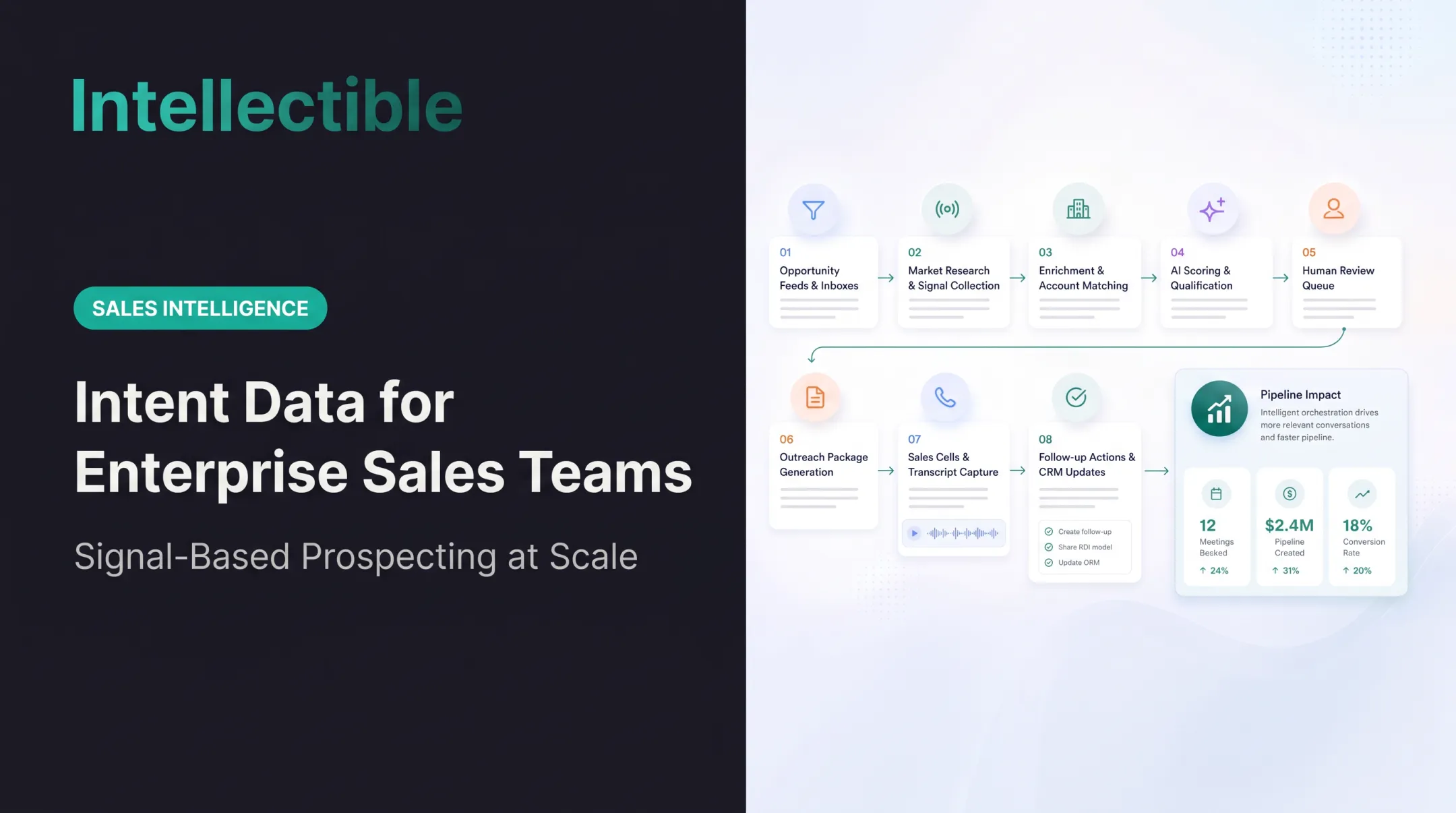
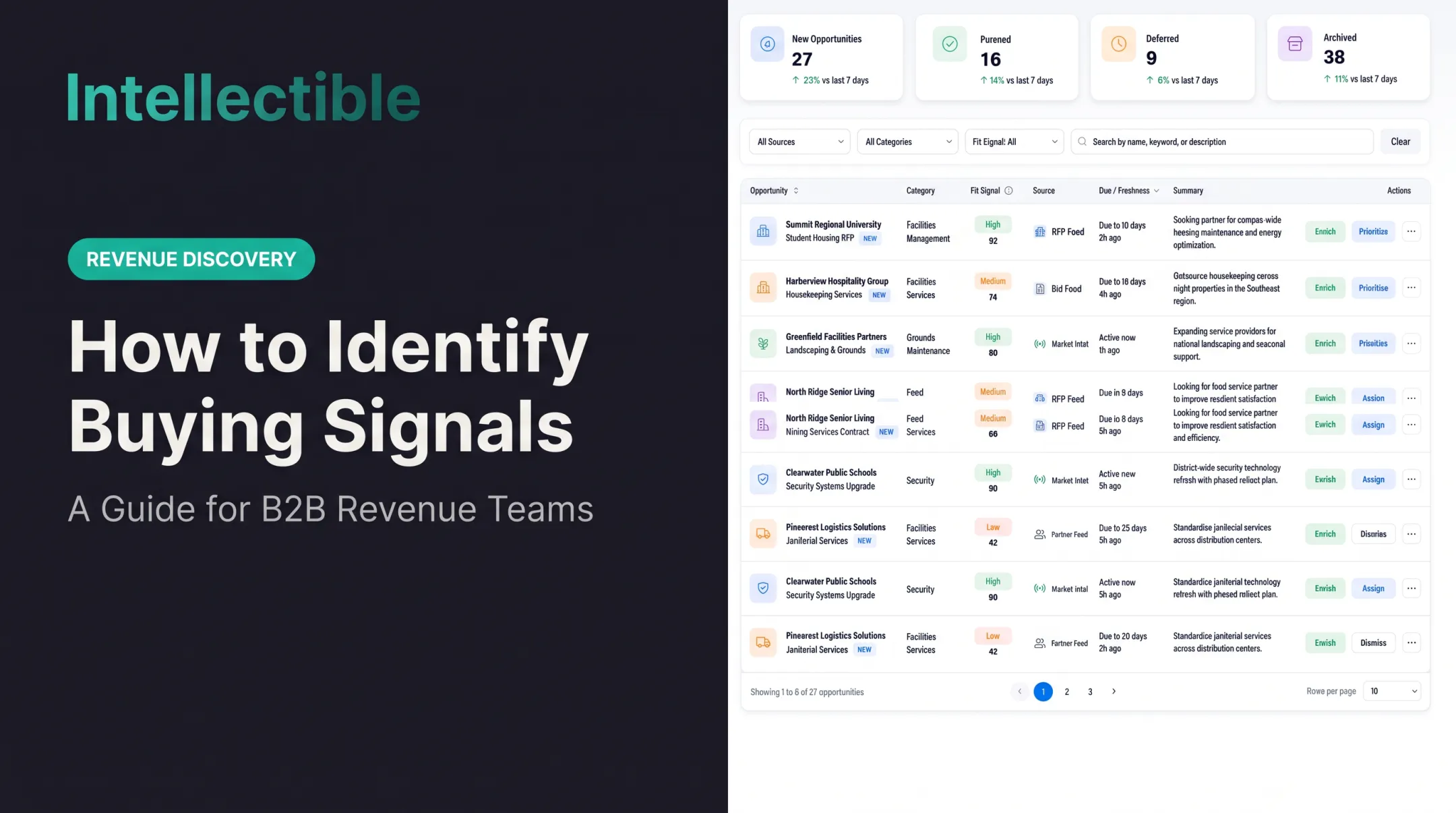
If an account has fit but thin evidence, research it further before any outreach. Intellectible's Account Prioritization and Sales Guidance, for instance, sorts accounts into contact-now, research-needed, nurture, and qualified-for-costing queues.
Translate evidence into role-specific messaging
Turn the evidence into a problem hypothesis for each stakeholder, tied to a documented business event or operational issue. "Saw you're expanding to three new sites" beats "loved your recent post."
Good outreach:
- Leads with a relevant outcome or question
- Uses evidence responsibly
- Avoids implying knowledge you don't have
- Offers value even if the prospect isn't ready to buy
Use conversations to validate and expand coverage
Discovery calls should confirm, refine, or disprove the hypothesis. Require reps to record what was validated, what changed, and which new stakeholders or objections surfaced.
Then multi-thread. Gong's analysis found closed-won deals involved 67% more contacts than closed-lost ones. That is observational, not proof that adding contacts causes wins, but it supports broad coverage.
Keep SDR, AE, marketing, RevOps, and account-owner activity in one shared account record so the buyer doesn't get five uncoordinated emails.
Set pause, nurture, and disqualification rules
Define the conditions up front:
- Continue: fit is confirmed and evidence is current
- Pause: fit is good, timing is wrong
- Nurture: a plausible problem exists but no active initiative
- Disqualify: fit fails or evidence stays insufficient after research
Attach a review trigger to every non-active status, such as a new hire, a funding event, or a contract renewal, so promising accounts can re-enter the queue.

Use AI and Automation to Increase Evidence Quality, Not Just Volume
Automate collection and synthesis, with provenance
Automation is well suited to pulling CRM history, engagement activity, public account information, documents, and stakeholder changes into one place. Always preserve the original source, timestamp, and confidence context. A summary with no trail back to its source is just a confident-sounding claim.
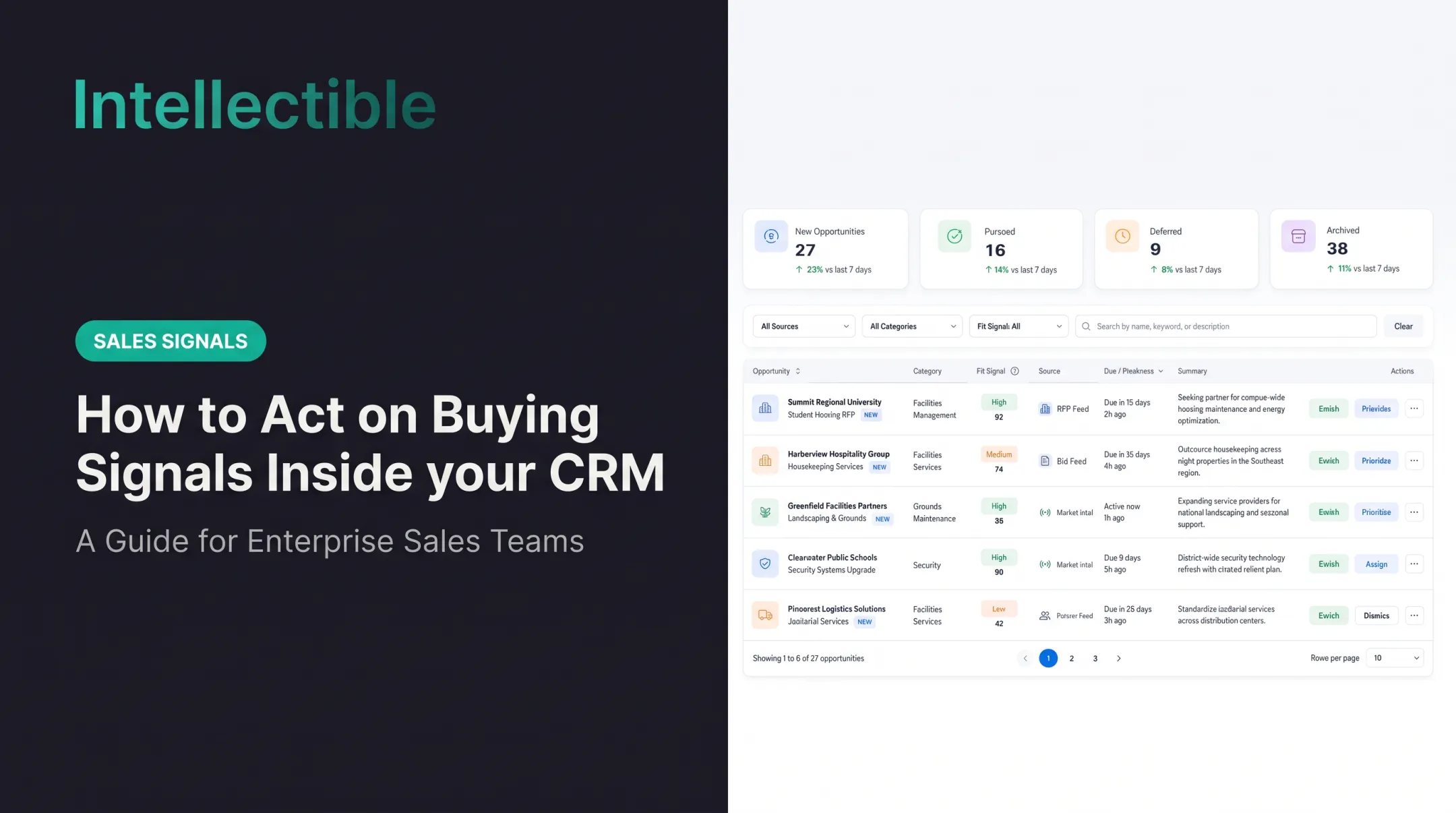
Intellectible's Revenue Discovery is built for this. It monitors funding, hiring, expansion, M&A, and company-defined signals, and places an account in a queue with the evidence attached when a signal holds up.
Keep human judgment in the loop
Require human review for:
- Ambiguous signals
- Sensitive claims
- Low-confidence account matches
- Important disqualification decisions
- Outreach touching strategic relationships
NIST's generative AI profile describes confabulation as confidently stated false content, and recommends testing against known ground truth and tracking data provenance. In prospecting, that means never letting a model's guess become an asserted fact in an email.
Revenue Discovery uses four approval gates, all human.
Connect evidence across the revenue workflow
Evidence capture breaks down when data, documents, and decisions live in separate tools. Intellectible is a horizontal AI build platform whose visual workflow builder connects data, documents, APIs, AI steps, business logic, decisions, and human review.
Two-way connections to systems such as Salesforce and Outlook let teams build a repeatable capture process around their own rules. The platform supports that process; the rep or manager still decides whether the evidence is good enough.

Measure, Govern, and Improve the Prospecting Motion
Measure evidence quality and outcomes together
Track leading indicators:
- Evidence completeness and source freshness
- Account acceptance by sellers
- Stakeholder coverage and contact accuracy
- Hypothesis validation rate
Pair those with downstream measures:
- Qualified conversations
- Opportunity progression
- Pipeline contribution
- Win rate and cycle efficiency
Benchmarks are thin. 6sense reports an average 10.1-month buying cycle for 2025, but that is a broad B2B figure, not an enterprise one. Comparable enterprise-only targets for win rate or contact accuracy aren't reliably published. Baseline your own numbers first and improve against those.
Run a structured learning loop
Each quarter:
- Compare hypotheses against what discovery calls found
- Review wins, losses, and no-decision outcomes
- Audit which signals preceded real opportunities
- Update ICP, evidence rules, messaging, and account tiers
Most teams track win rate but skip the why. Do the why.
Govern data quality, privacy, and auditability
Lock in basic data controls:
- Assign every account record an owner
- Set access controls and document sources
- Define retention rules and stale-data reviews
- Keep an audit trail for why an account was prioritized or contacted
Outreach rules also apply. CAN-SPAM covers B2B email, requiring a working opt-out honored within 10 business days. Calling and texting rules under the TCPA are stricter, and state privacy laws vary. Have counsel confirm what applies to you.
Frequently Asked Questions
How is research intent different from a buying signal?
Topic-based intent data infers interest from patterns of online research and commonly reports it as an account-level score. It can suggest where to investigate, but it does not identify a confirmed purchase, a budget owner, or the reason an account must change suppliers. Keep that inference separate from the underlying observations.
What makes an observable signal verifiable?
A buying signal in this comparison is an observable company event: a named employer hired a new operations leader, a facility received a permit, a business completed an acquisition, or a public contract reached a documented renewal point. Store the original source, event date, publication date, and company identity so a representative can inspect the fact.
Does an expansion signal prove that an account will buy?
Consider a logistics business adding a warehouse. A permit or a dated job posting can establish that expansion activity occurred; the belief that it needs a new transport provider remains a sales hypothesis. Compare that evidence with a research-intent score, which can flag topic interest without establishing the operational change or identifying the decision-maker.
What should the account evidence record contain?
Make the distinction visible in the account record: observed event, source, date, matched legal entity, inferred commercial need, decision owner, and next verification step. Record observed versus inferred explicitly. A rep should be able to challenge the interpretation without losing the source evidence.
How should sales teams prioritize the resulting accounts?
Use fit criteria before timing signals. Route eligible accounts into contact-now, research-needed, nurture, or monitor queues according to evidence quality and whether the buying window is still open. Contact-now means there is a defensible reason for a conversation; it never means a purchase has been proved.
Can intent data and evidence-based signals work together?
The two approaches can complement each other. Research intent may help rank investigation, while evidence from public records, account activity, and CRM history supplies an explainable outreach reason. Measure accepted accounts and sales-accepted opportunities rather than treating a higher score or a larger alert count as success.