Introduction
Government RFPs drive revenue across the federal marketplace, but they also drain time and headcount. Agencies post thousands of notices on SAM.gov each year—pre-solicitations, combined synopsis/solicitations, and formal RFPs among them.
Win rates show how uneven the field is. Deltek's 2021 industry study reported a 40% average win rate (35% median); by its 2026 study, top performers reached 72% against a 48% industry average.
GovCon teams still hit the same bottlenecks on every pursuit:
- Tight response deadlines
- Dense compliance and evaluation requirements
- Limited proposal and pricing bandwidth
- Multiple live opportunities competing for the same people
Deltek's 2026 research found a single RFP response can take up to 84 hours, and 38% of contractors cited pricing defensibility as the top reason they lost. Stronger templates, cleaner compliance checks, and tighter workflows raise response quality without a matching increase in staff.
This guide breaks down a practical RFP template structure for GovCon teams—what to standardize, what to customize per solicitation, and how to keep submissions compliant under deadline pressure.
Key Takeaways
- Government RFPs demand FAR/DFARS compliance, past performance proof, and evaluation criteria commercial bids rarely face
- Go/No-Go gates, content libraries, and workflow automation can cut RFP response time by 95%+ and lift win rates
- Winning packages pair technical approach, past performance, pricing, and a compliance matrix to evaluation criteria
- Reusable content libraries and automated workflows scale proposal capacity without adding headcount
Understanding RFPs in Government Contracting
What Is an RFP in the GovCon Context?
An RFP is a formal solicitation document issued by federal, state, or local government agencies that outlines project requirements, evaluation criteria, and submission guidelines. According to FAR 15.203, an RFP must describe the requirement and terms, specify the proposal information required, identify evaluation factors, and state their relative importance.
Key differences between government and commercial RFPs:
- Mandatory compliance under the FAR, plus DFARS for Department of Defense contracts
- Past performance evaluation required above the simplified acquisition threshold unless documented as inappropriate
- Socioeconomic set-asides for small business, 8(a), HUBZone, WOSB/EDWOSB, and SDVOSB (FAR 19.502-2)
- Strict format and submission rules where even minor violations can trigger rejection
- Evaluation against disclosed factors only—evaluators may score only what the solicitation states
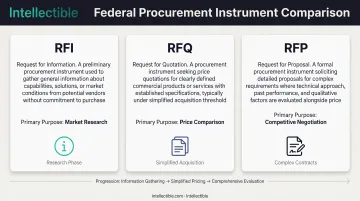
RFP vs. RFI vs. RFQ: Understanding the Difference
| Instrument | Federal Definition | Purpose |
|---|---|---|
| RFI | Market, price, delivery, or capability info when no award is intended | Pre-solicitation research; responses are not offers |
| RFQ | A quotation is not an offer; the Government order is (FAR 13.004) | Simplified acquisitions; not equivalent to an RFP |
| RFP | Technical approach, past performance, and pricing under disclosed factors | Primary vehicle for complex negotiated contracts |
The Government RFP Lifecycle
Pre-solicitation phase:
- Synopsis posted on SAM.gov, generally at least 15 days before solicitation release
- Permitted exchanges include draft RFPs, industry conferences, site visits, and one-on-one meetings (FAR 15.201)
Solicitation phase:
- Noncommercial acquisitions above the simplified acquisition threshold generally receive at least 30 days to respond
- Research and development actions receive at least 45 days (FAR 5.203)
Evaluation and award:
- Agencies evaluate proposals against disclosed factors only
- Unsuccessful offeror notifications follow FAR 15.503
- Entitled offerors must request a debriefing within 3 days; agencies provide it within 5 days when practicable
Common Evaluation Criteria
While FAR requires acquisition-specific factors rather than universal weights, government RFPs typically evaluate:
- Technical approach: How well your solution meets requirements, mitigates risks, and demonstrates innovation
- Past performance: Recent, relevant projects with verifiable outcomes and client references
- Price/cost: Evaluated for realism, reasonableness, and completeness
- Other factors: Management approach, key personnel qualifications, transition plans
Each solicitation defines its own evaluation approach and relative importance. Read Section M carefully to understand how your proposal will be scored.
When Should GovCon Teams Respond to an RFP?
The Cost of Saying Yes to Everything
Deltek's research shows that speculative bids waste business development resources and reduce win rates, while bidding only "safe" opportunities limits growth.
A single RFP response can consume up to 84 hours of team effort, and Deltek reports a 5.9% average bid and proposal cost rate across the industry. Selectivity matters.
Go/No-Go Decision Framework
Evaluate opportunities against these criteria before committing resources:
Strategic fit:
- Does this opportunity align with your core capabilities and growth strategy?
- Will winning this contract open doors to additional work or new customers?
- Does the contract vehicle, ceiling, and period of performance match your capacity?
Win probability assessment:
- Do you have relevant, verifiable past performance within the last 3–5 years?
- Have you engaged with the customer before the RFP release?
- Do evaluation criteria favor your strengths, or are they written around an incumbent?
Resource capacity:
- Can you dedicate sufficient SMEs, pricing staff, and proposal writers without disrupting ongoing work?
- Do you have time to execute multiple review cycles before the deadline?
- Are teaming partners identified, qualified, and committed?
Compliance and risk:
- Can you meet all mandatory eligibility requirements, certifications, and set-aside criteria?
- Are security clearances, facility requirements, and technical qualifications already in place?
- Does the schedule allow adequate time to prepare a quality response?
Red Flags That Should Trigger a No-Go Decision
- Unrealistic compliance requirements your company cannot meet (clearances, certifications, facilities)
- Evaluation criteria heavily favoring incumbents with little room to differentiate
- Insufficient response time that prevents quality proposal development and review cycles
- No relevant past performance for similar scope, complexity, and dollar value
- No customer engagement before RFP release, so you lack insight into real evaluation priorities
Teams that enforce Go/No-Go discipline typically see higher win rates and leaner use of BD resources.
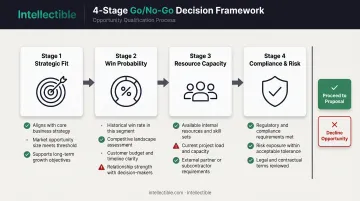
Intellectible's GovCon Engine supports that process with Go/No-Go reports, compliance matrices, requirement summaries, and risk lists—so teams can cut time spent on opportunity search and Go/No-Go decisions by 95%+.
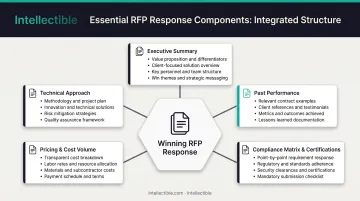
Essential Components of a Winning Government RFP Response
Executive Summary
The executive summary is often the first (and sometimes only) section evaluators read in detail. It must concisely communicate your understanding of requirements, proposed solution, key differentiators, and why your team offers the best value.
Structure your executive summary to:
- Mirror the evaluation criteria from Section M
- Highlight your top 3-5 win themes and discriminators in the first 2-3 pages
- Reference specific technical approaches, past performance examples, and pricing strategies
- Use headers and formatting that make it easy for evaluators to scan and extract key information
Technical Approach
Your technical approach must directly address each requirement in the Performance Work Statement (PWS) or Statement of Work (SOW). FAR 37.602 calls for required results, measurable performance standards, and an assessment method.
How to structure your technical approach:
- Create a compliance matrix showing where you address each PWS requirement
- Describe your methodology, staffing, deliverables, and quality controls for each task
- Provide innovative solutions that go beyond minimum requirements
- Demonstrate how you'll mitigate risks and ensure successful project delivery
- Include specific examples, diagrams, and process flows that make your approach tangible
Past Performance
Government agencies evaluate past performance based on currency, relevance, source, context, and trends. According to FAR 15.305, agencies must consider recent and relevant contracts, and offerors may explain problems and corrective actions. Offerors without a relevant past performance record may not be evaluated favorably or unfavorably on that factor.
What agencies look for:
- Recent projects: Within the last 3-5 years (check the solicitation for specific recency requirements)
- Relevant scope: Similar complexity, dollar value, and technical requirements
- Verifiable references: Client contact information and performance documentation
- Demonstrated success: Quantifiable outcomes, on-time delivery, and positive client feedback
Structure past performance examples with:
- Project description and scope
- Your role (prime contractor, subcontractor, teaming partner)
- Contract value and performance period
- Specific outcomes and metrics (cost savings, schedule performance, quality improvements)
- Client reference contact information
Pricing and Cost Volume
Government contract pricing requires complete transparency and detailed breakdowns. The contract type determines your pricing structure and documentation requirements.
| Contract Type | Pricing Structure | Contractor Risk |
|---|---|---|
| Firm Fixed Price (FFP) | Fixed price not adjusted for cost experience (FAR 16.202-1) | Contractor bears maximum cost risk |
| Time & Materials (T&M) | Fixed hourly labor rates plus materials at cost; requires ceiling price (FAR 16.601) | Moderate risk; Government surveillance required |
| Cost Plus Fixed Fee (CPFF) | Allowable incurred costs plus fixed fee that normally does not vary (FAR 16.306) | Minimal risk; requires detailed cost support |
Critical pricing requirements:
- Detailed breakdowns by labor category, materials, travel, and other direct costs
- Complete audit trails for all pricing assumptions, labor rates, and cost buildups
- When FAR 15.403-4 applies (currently $2.5M threshold), certified cost or pricing data with indexed revisions, estimating methods, and supporting analysis
Building those breakdowns and audit trails by hand slows pricing teams down. Intellectible's Pricing Engine cuts time to final pricing by 90% while preserving full audit trail control. It converts RFP and opportunity data into structured pricing records, models labor, rates, and cost drivers, and routes packages for approval with complete traceability.
Compliance Matrix and Certifications
A compliance matrix is a section-by-section table showing exactly where in your proposal you address each RFP requirement. While not universally required by FAR, it serves as essential internal traceability and may be required by the solicitation.
Common certifications and representations:
- FAR 52.204-8 Annual Representations and Certifications applies when invoked and requires verification/update with the offer
- System for Award Management (SAM) registration, generally required when submitting an offer and must remain active through award (FAR 4.1102)
- Socioeconomic representations (small business status, 8(a), HUBZone, WOSB, SDVOSB)
- Organizational conflict of interest disclosures when required by FAR Subpart 9.5
Complete all Section K certifications exactly as required. Even minor omissions can result in proposal rejection.
Step-by-Step Guide to Managing the RFP Response Process
Capture Planning and Opportunity Qualification
Successful proposals start weeks or months before the RFP release. FAR 15.201 explicitly supports pre-proposal industry exchanges, subject to procurement-integrity limits.
Capture activities include:
- Customer engagement to understand requirements, priorities, and evaluation approach
- Competitive intelligence gathering to assess incumbents and likely competitors
- Teaming partner identification and teaming agreement negotiation
- Solution design and validation with customer input
- Draft RFP review and comment submission
Immediate Go/No-Go review upon RFP release:
- Score opportunities against strategic fit, win probability, resource capacity, and compliance risk
- Document your win thesis, data gaps, and response plan
- Assign owners and next actions before committing to respond
Kickoff and Assign Responsibilities
Organize a proposal kickoff meeting within 24-48 hours of RFP release. Clarify roles, establish the schedule, and review the compliance matrix.
Key proposal roles:
- Proposal Manager: Owns schedule, compliance, and final submission
- Technical Writers: Draft technical approach, management plan, and past performance sections
- Subject Matter Experts: Provide technical content, review drafts, and validate approaches
- Pricing Team: Develop cost models, labor rates, and pricing narratives
- Contracts Team: Review terms and conditions, identify risks, and draft compliance language
- Quality Reviewer: Conduct compliance checks and final production review
Critical kickoff outputs:
- Compliance matrix mapping RFP requirements to proposal sections and owners
- Internal deadlines building in review cycles (outline review, pink team, red team)
- Communication protocols for questions, decisions, and escalations
Content Development and Review Cycles
Run staged review cycles so gaps surface before the deadline:
Outline review (Day 3-5):
- Verify compliance with RFP structure and requirements
- Confirm section assignments, page allocations, and key messages
- Identify missing content or evidence gaps
Pink team review (Midpoint):
- Focus on technical soundness, win themes, and differentiators
- Assess whether the proposal tells a compelling, cohesive story
- Identify sections needing strengthening or additional SME input
Red team review (3-5 days before deadline):
- Evaluate the proposal from the customer's perspective
- Score against evaluation criteria
- Check formatting, page limits, and final compliance
Content library benefits:
- Pre-approved modules (capabilities, past performance, resumes, standard processes) cut drafting time
- Keeps language consistent across volumes and pursuits
- APMP-NCA guidance: retire stale content, tailor reuse per opportunity, and track whether reused material helps you win
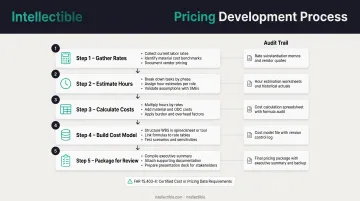
Pricing Development and Audit Trail
Government proposal pricing needs a defensible process and a complete audit trail.
Pricing development steps:
- Gather labor rates, overhead rates, and G&A rates from accounting
- Estimate hours by task, deliverable, and labor category based on the SOW
- Calculate indirect costs, profit/fee, and total price
- Build a complete cost model with assumptions, sources, and calculations documented
- Package for finance review with risk flags and approval routing
When FAR 15.408 and Table 15-2 apply, maintain an indexed data set including estimating methods, judgment factors, line-item crosswalks, incurred-cost history, and subcontract analyses.
Final Production and Submission
Miss a formatting or delivery rule and the agency can reject your proposal without evaluating it.
Final production checklist:
- Verify formatting requirements: fonts, margins, page limits, headers/footers
- Confirm required volumes, copies, and organization (technical, past performance, cost)
- Include all required certifications, attachments, and forms
- Follow electronic submission instructions exactly (SAM.gov, agency portal, email)
Submission best practices:
- Submit at least 2-4 hours before the deadline to account for technical issues
- Verify receipt confirmation immediately after submission
- Understand that FAR 15.208 places responsibility for timely receipt on the offeror; late exceptions are narrow
- Note that GAO has upheld rejection where unauthorized narrow fonts effectively added pages beyond the limit
Best Practices for GovCon RFP Success
Build a Centralized Content Library
Organize approved content by category: corporate capabilities, past performance, processes, resumes, and compliance statements. Keep version control tight, update assets after wins and debriefs, and make every item searchable and easy to tailor to a specific RFP.
Library organization tips:
- Assign owners, review dates, and retirement criteria for each content asset
- Tag content with relevant keywords, contract types, and technical domains
- Track reuse frequency and correlation with win outcomes
- Challenge stale content and remove outdated material
APMP-NCA cautions that saved time does not necessarily raise win probability. Tailor reused content to each opportunity's requirements and evaluation criteria.
Implement Workflow Automation
Manually managing the full proposal process, from opportunity tracking and Go/No-Go decisions through assignments, reviews, pricing, and submission, creates bottlenecks and caps how many pursuits a team can run.
GovCon teams using horizontal AI workflow platforms can cut time spent on opportunity decisions and expand actionable pipeline without rebuilding tooling for every step. Intellectible clients, for example, have reported 95%+ time savings on opportunity decisions and 150%+ increases in actionable pipeline, using production-ready GovCon and Proposal engines plus a visual workflow builder to scale capacity without adding headcount.
Workflow automation benefits:
- Automated opportunity intake from SAM.gov and other sources
- Structured Go/No-Go scoring with configurable decision rules
- Requirement extraction and compliance matrix generation
- Automated routing for reviews, approvals, and final submission checklists
- CRM integration to eliminate duplicate data entry and maintain pipeline visibility
Conduct Continuous Improvement
Automation helps you submit more cleanly; debriefs tell you what still lost. FAR 15.506 debriefings cover significant weaknesses, evaluated price and technical rating, past performance assessment, ranking (when developed), and award rationale. Entitled offerors must request debriefings in writing within 3 days.
Post-submission debrief process:
- Request debriefing within 3 days of receiving notice (if entitled)
- Document feedback on technical weaknesses, pricing issues, and past performance gaps
- Compare winning proposal approaches (when disclosed) to your submission
- Update templates, processes, and content library based on lessons learned
- Invest in proposal training for your team to steadily improve win rates
Track metrics including bid rate, win rate, average proposal cost, cycle time, and win rate by contract type or customer. Use these metrics to identify improvement opportunities and measure the impact of process changes.
Conclusion
Success in government contracting takes a disciplined approach to RFPs. Pair deep knowledge of government requirements with efficient processes and the right tools so you can scale without adding proportional headcount.
Top-performing contractors achieve 72% win rates versus the 48% industry average. They respond strategically, stay strictly compliant, and keep improving how they build proposals.
Treat RFP response capability as a competitive edge. Teams that move faster, write more accurately, and choose pursuits with intent outperform competitors and grow government revenue.
Build that edge by:
- Applying Go/No-Go discipline on every opportunity
- Maintaining reusable content libraries
- Automating proposal workflow where it counts
- Reviewing every submission for what to improve next
Do those four things consistently, and your team wins more work without growing headcount at the same pace.
Frequently Asked Questions
What is the difference between an RFP, RFI, and RFQ in government contracting?
An RFI gathers information early in procurement when no award is intended. An RFQ asks for pricing on well-defined requirements (the quote is not an offer). An RFP requests full proposals—technical approach, past performance, and pricing—evaluated against disclosed factors, and is the usual vehicle for complex contracts.
How long should a government contractor spend preparing an RFP response?
Most teams spend 2–8 weeks, depending on complexity. FAR generally allows at least 30 days for noncommercial buys above the simplified acquisition threshold and 45 days for R&D. Large proposals need 4–6 weeks minimum for reviews, SME input, pricing, and QA.
What are the most common mistakes in government RFP responses?
Late submission, wrong delivery channel, and format violations (page limits, fonts, margins) are common automatic disqualifiers. Other frequent misses include:
- Ignoring Section L instructions or compliance requirements
- Not mapping content to evaluation criteria
- Weak past performance, pricing errors, or poor organization
How can small businesses compete with larger contractors on government RFPs?
Use small business set-asides under FAR 19.502-2, team with complementary partners, and compete on agility, technical fit, and relevant past performance—not price alone. SBA programs (8(a), HUBZone, WOSB/EDWOSB, SDVOSB) and qualifying mentor-protégé JVs add real competitive edge.
What compliance requirements must be included in federal RFP responses?
Expect active SAM registration, completed Section K reps and certs (including FAR 52.204-8 when invoked), socioeconomic documentation, and any COI disclosures under FAR Subpart 9.5. Certified cost or pricing data applies when FAR 15.403-4 is triggered (currently $2.5M, with exceptions). Exact needs vary by agency and solicitation.
How do you build a reusable content library for government proposals?
Organize by category—capabilities, past performance, processes, resumes, and compliance—with owners, review dates, and version control. Keep content searchable, update it after wins and debriefs, and retire stale material. Always tailor reused content to each RFP’s evaluation criteria.