Contractors chasing FAR-based RFPs know the grind: Section C requirements buried in a statement of work, Section L instructions scattered across a 40-page solicitation, Section M evaluation factors that don't quite match either. Add spreadsheets, email threads, and multiple amendments, and manual tracking becomes a liability.
This guide covers what a compliance matrix actually is, why FAR-based RFPs are uniquely tricky, the features worth paying for, and how automation platforms like Intellectible cut down the manual grind.
Key Takeaways
- Map every FAR RFP requirement (Sections L, M, and C) to a response location, owner, and status so nothing is missed
- FAR-based RFPs need matrices that track regulatory clauses and mandatory submission instructions, not just generic requirements
- Software automates extraction, cross-referencing, and status tracking so teams spend less time on manual review
- Choose a platform built for FAR-specific extraction, audit trails, and proposal workflow integration
What Belongs in a FAR-Based Compliance Matrix
The matrix earns its place by surviving contact with a live solicitation: every requirement traced to the section answering it, with an owner and a status a reviewer can audit. Where teams get caught out is coverage — a row per requirement is easy, but proving no requirement was silently dropped as the solicitation changed is the harder discipline.
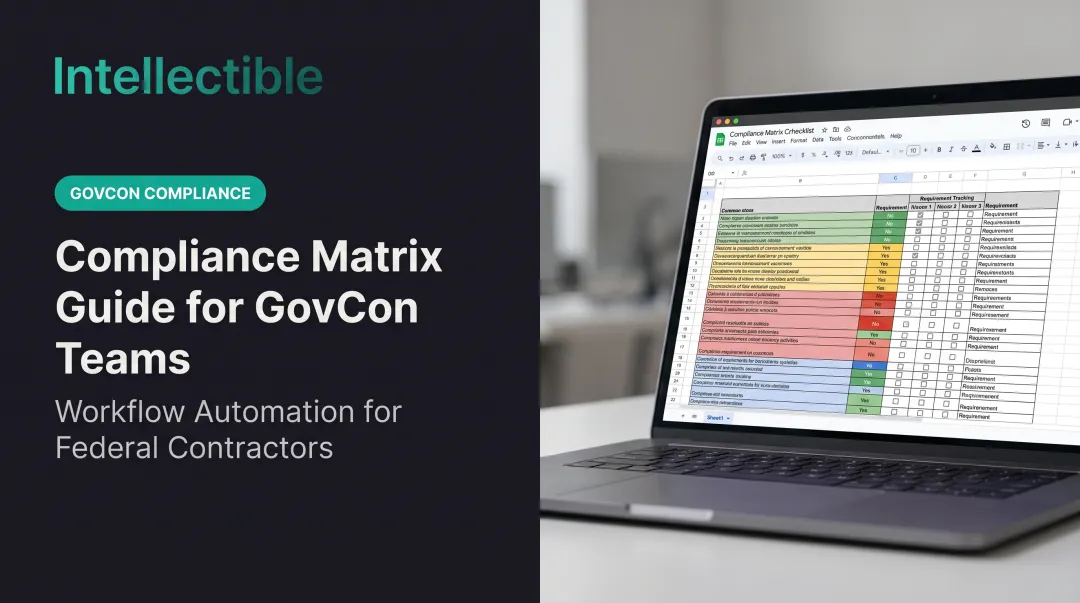
Standard matrix columns include:
- Requirement reference (section/paragraph number)
- Requirement description (verbatim or near-verbatim)
- Proposal section/page addressing it
- Compliance status (met, partial, gap)
- Assigned owner
- Supporting evidence
Why Sections C, L, and M Matter Most
Under the Uniform Contract Format, three sections drive what your matrix must cover:
- Section C — statement of work (what you're delivering)
- Section L — instructions to offerors (how you must submit)
- Section M — evaluation factors for award (how you'll be scored)
A proposal compliance matrix has to capture all three. Evaluators use it as proof of responsiveness, not only as your internal tracker. Reviewers scanning your proposal against Section M criteria will notice if the matrix (and by extension, the proposal) skips a factor.

Compliance Matrix vs. Requirements Verification Matrix
These get confused often, but they're not the same thing:
| Tool | Purpose | When Used |
|---|---|---|
| Compliance matrix | Verifies proposal responsiveness to RFP requirements | Pre-award |
| Requirements verification matrix (RVM) | Confirms technical/functional requirements are met | Post-award, systems engineering |
An RVM asks "how will this be tested?" A compliance matrix asks "where in our proposal did we address this?" Don't let your team conflate the two.
Why FAR Compliance Is Uniquely Complex
Generic RFP matrices miss things FAR-based solicitations require. That's the core problem contractors run into when they try to reuse commercial-proposal templates. FAR clauses create hidden obligations. FAR 52.209-5, for example, requires a certification regarding debarment, suspension, and tax delinquency. It's a material representation, meaning an inaccurate answer can trigger termination. FAR 52.204-24 requires a reasonable-inquiry-based representation about covered telecommunications equipment. Neither reads like a typical "requirement," but both belong in your matrix. Amendments shift requirements mid-cycle. FAR 15.206 requires the government to distribute amendments to every solicitation recipient, and FAR 52.215-1 requires offerors to acknowledge each one by its stated deadline. Miss an acknowledgment, and your proposal can be rejected as nonresponsive, no matter how strong your technical approach is. Agency supplements add another layer. DFARS provisions use four-digit 7000-series numbers and stack additional requirements on top of the FAR baseline:
- DFARS 252.204-7012 requires NIST SP 800-171 implementation and 72-hour cyber incident reporting
- DFARS 252.204-7020 covers DoD security assessments and SPRS scoring
- DFARS 252.204-7021 requires a current CMMC status and annual affirmation The stakes are real. In one GAO decision, a contractor's proposal was rejected after an unsigned SF 33, unacknowledged amendments, and an incomplete DD Form 254—administrative issues, not technical shortcomings (GAO's decision in Distributed Solutions, Inc.). A separate GAO case rejected a bid simply because the bidder never acknowledged an amendment that changed contractor responsibilities. The government isn't required to give you the benefit of the doubt.

Must-Have Features in Compliance Matrix Software
Not every "compliance matrix tool" is built for FAR-based RFPs. Here's what actually matters.
Requirement Extraction That Understands FAR Language
Your software needs to parse FAR clauses, Section L/M language, and embedded "shall/must/will" statements directly from PDFs and Word documents—including attachments and amendments. Manual copy-paste from a 200-page RFP is where errors creep in.
Strong extraction should pull:
- Submission rules and instructions from Section L
- Evaluation factors from Section M
- Compliance obligations tied to FAR clauses and SOW language
- Deadlines, page limits, and amendment-driven changes
Intellectible's GovCon Engine processes PDF and DOCX solicitations—including attachments and addenda—and extracts those rules, criteria, and obligations automatically so teams can assign and track them without rekeying.
Real-Time Status Tracking Across Teams
Proposal, pricing, and contracts teams often work in separate systems. Your matrix needs:
- Live status updates visible to everyone touching the proposal
- Owner assignment down to the requirement level
- Deadline and dependency tracking so nothing slips through
Audit Trail and Version Control
When an amendment lands, the matrix has to update—and someone needs to prove it did. That record matters in a protest or debrief.
Look for platforms that log:
- Who changed each requirement mapping
- When the change occurred
- Why it changed (amendment, clarification, internal decision)
Cross-Referencing Across Volumes
FAR requirements rarely sit in one place. A single Section M factor might connect to your technical volume, your management approach, and your cost volume. Software should let you:
- Link one requirement to multiple volume responses
- Reuse the same compliance evidence without copy-paste
- Spot gaps where a Section M factor has no mapped content
Integration With Proposal Workflows
A compliance matrix shouldn't live in isolation. It should connect to your CRM, document generation, and pricing tools.
Intellectible's visual workflow builder connects document parsing, structured databases, and human-review checkpoints in one pipeline. The matrix feeds the proposal draft instead of sitting beside it as another spreadsheet to maintain.

Manual Spreadsheets vs. Compliance Matrix Software
Excel still dominates a lot of proposal shops. It's cheap, familiar, and everyone knows how to use it. But it comes with real costs at FAR-based RFP scale.
Manual spreadsheets create:
- Version conflicts when multiple people edit simultaneously
- No native audit trail for defending compliance decisions
- Missed amendment updates that don't propagate to every volume
- Hours of manual extraction work per RFP, repeated for every pursuit
Software-driven matrices offer:
- Live collaboration without file-version chaos
- Native audit trails for defending compliance decisions
- Automated updates when requirements change
- Scalability across multiple concurrent pursuits without adding headcount
That last point matters most for growing GovCon shops. Chasing three or four FAR opportunities simultaneously with spreadsheets usually means hiring more analysts. Software lets you scale the process, not the headcount.

Best Practices for Implementing Compliance Matrix Software
A compliance matrix only protects the bid if the team runs it the same way on every FAR pursuit. These practices keep mapping early, accurate, and owned.
- Build the matrix right after Go/No-Go, not mid-draft. Starting early gives your team maximum planning time and avoids retroactive gap-filling.
- Preserve exact FAR and RFP language. Paraphrasing invites evaluator misinterpretation. Copy the solicitation's own wording into requirement descriptions.
- Assign a compliance lead. Give one person ownership of amendments and of pushing every update into all proposal volumes—not only the volume that changed.
- Treat the matrix as a repeatable workflow, not a one-off document. Intellectible's Proposal & Pursuit Engine uses a four-stage pattern (Upload, Compliance, Variables, Draft) so every FAR pursuit follows the same auditable path.
Frequently Asked Questions
How do you keep a compliance matrix accurate through amendments?
The matrix links each RFP requirement to a section, owner, and status, but its risk is drift: amendments and Q&A responses change requirements after the matrix is built. Re-baselining against each amendment, rather than patching individual rows, is what keeps the cross-reference trustworthy at submission.
How is a proposal compliance matrix used in an RFP?
It maps every requirement to a response location, tracks ownership and status, and lets reviewers verify full coverage before submission. Evaluators often use a similar structure when scoring responsiveness.
When does a requirements verification matrix get confused with a compliance matrix?
Teams inherit the wrong template. A requirements verification matrix proves technical requirements are met post-award in systems engineering; a compliance matrix governs pre-award responsiveness to Section L and M. Using the former during a pursuit produces a document that does not demonstrate responsiveness.
What sections of a FAR-based RFP should be captured in a compliance matrix?
Sections C, L, and M form the core, but amendments, attachments, and pricing instructions all need to be captured too. Missing any of these can leave gaps evaluators will notice.
Can compliance matrix software integrate with existing proposal workflows?
Yes. Modern platforms connect to CRM, document generation, and pricing tools rather than sitting as standalone trackers. Intellectible integrates with Salesforce and HubSpot alongside its native drafting and pricing capabilities.
How much time can automation save on compliance matrix creation?
Automated extraction and tracking can cut matrix build and upkeep from days of manual parsing to hours, depending on solicitation size. Matrix-specific gains vary, while Intellectible reports 95%+ time savings on related opportunity search and Go/No-Go decisions.