Introduction
Federal contracting is unforgiving. Miss a page limit, submit a proposal 10 minutes late, or skip a required certification — and an otherwise strong response gets disqualified automatically. No appeal, no second chance.
GovCon proposal teams operate under conditions that would stress any organization: rolling solicitation deadlines, FAR/DFARS compliance requirements that shift by contract type, and competition from firms that have been cultivating agency relationships for years.
According to a 2026 GAUGE survey reported by Washington Technology, 37% of GovCon firms report win rates of 25% or less. Most teams aren't just losing occasionally — they're losing structurally.
The difference between a 20% win rate and a 45% win rate almost never comes down to technical capability alone. It comes down to process: how early a team engages with an opportunity, how rigorously they decide which bids to pursue, and how consistently they build compliant, tailored proposals.
This guide covers the full bid proposal management lifecycle for GovCon teams, including:
- Procurement vehicle types and when each applies
- The go/no-go decision framework
- Proposal team structure and role responsibilities
- Mistakes that steadily erode win rates over time
Key Takeaways
- Structured bid management separates high-win-rate GovCon teams from reactive, scrambling ones
- The go/no-go decision is as critical as the proposal itself; chasing the wrong bids is expensive
- Compliance failures disqualify technically strong proposals — a compliance matrix at kickoff is non-negotiable
- Capture planning before the RFP drops is what makes proposals competitive — reactive writing rarely wins
- AI tools can compress opportunity evaluation and pricing cycles without adding headcount
What Is Bid Proposal Management in Government Contracting?
Bid proposal management in GovCon is the end-to-end process of identifying federal and state contract opportunities, deciding which ones to pursue, developing compliant and competitive responses, and extracting lessons from each submission to improve future win rates.
That definition sounds similar to commercial B2B proposal management, but the operating environment is different in ways that matter. Federal procurements are governed by the Federal Acquisition Regulation (FAR Part 15) and, for DoD work, the Defense Federal Acquisition Regulation Supplement (DFARS).
Proposals are evaluated against published criteria that agencies are legally required to follow. Evaluators cannot consider factors that weren't stated in the solicitation. The rules are specific, enforceable, and non-negotiable.
Bids vs. Proposals: Why the Distinction Matters
Government procurement uses both terms, and they aren't interchangeable:
- Bids are price-focused. Under Lowest Price Technically Acceptable (LPTA) source selection (FAR 15.101-2), the lowest-priced technically acceptable offer wins. Tradeoffs are prohibited.
- Proposals are evaluated holistically. Under the tradeoff process (FAR 15.101-1), the government can select a higher-priced offer when documented benefits justify it — meaning technical approach, management, and past performance all carry real weight.
Knowing which source selection method applies to a given opportunity shapes how a team allocates effort. Spending 200 hours crafting a differentiated technical narrative for an LPTA contract is wasted work.
Core Roles in the GovCon Proposal Process
| Role | Primary Responsibility |
|---|---|
| Capture Manager | Pre-RFP intelligence, relationship building, win strategy |
| Proposal Manager | Development schedule, compliance, review cycle management |
| Volume Leads | Section ownership and SME coordination |
| Pricing Analyst | Cost model, rate structures, pricing narrative |
| Compliance Reviewer | Matrix validation, requirement coverage verification |
| Subject Matter Experts | Technical content and methodology |
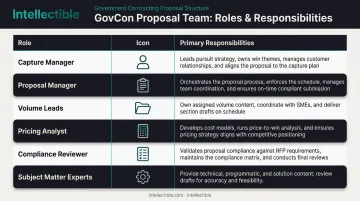
In smaller GovCon firms, one person routinely covers three or four of these roles simultaneously. That's workable, but only when ownership is clearly assigned rather than assumed.
Types of Government Bids GovCon Teams Respond To
Government procurement comes in several formats, and each requires a different response strategy and level of effort. Treating every solicitation type the same wastes resources and produces generic responses.
RFPs (Requests for Proposal)
RFPs are the most complex procurement vehicle and the most common for significant contracts. Under FAR Part 15, RFPs support negotiated source selection — meaning agencies evaluate technical approach, management plan, past performance, and price/cost against explicitly stated evaluation factors.
Section L of the solicitation tells you how to respond. Section M tells you how you'll be scored. Both documents should be read before a single word of content is written.
RFQs, RFIs, and Sources Sought
According to GSA's official procurement guidance:
- RFQs are used when the agency knows what it needs and is seeking pricing or quotation information — typically for simpler or lower-dollar requirements
- RFIs are market research tools, not solicitations. Responding doesn't put you in line for an award
- Sources Sought notices on SAM.gov are similarly market-research instruments — the government is gathering information about the competitive landscape before a formal solicitation is drafted
Dismissing RFIs and Sources Sought as low-priority is a mistake agencies count on. These notices are how agencies shape requirements before committing to a formal solicitation. Teams that respond thoughtfully — and build relationships during this phase — have a real head start when the RFP eventually drops.
IDIQ Vehicles, GWACs, and Set-Asides
IDIQs (FAR 16.501-2) are indefinite-delivery contracts under which the government places task orders during a fixed period. Once you're on an IDIQ vehicle, the barrier to each individual task order drops significantly.
GWACs — Government-Wide Acquisition Contracts — extend this model across agencies, providing pre-competed access to IT solutions (GSA GWAC overview).
Set-aside designations determine which vehicles and open-market solicitations a firm is eligible to compete for:
- 8(a) — Socially and economically disadvantaged small businesses (SBA)
- SDVOSB — Service-disabled veteran-owned small businesses; federal target is at least 5% of contracting dollars annually (SBA)
- HUBZone — Small businesses in historically underutilized business zones; federal target is 3% of contracting dollars (SBA)
- WOSB — Women-owned small businesses (SBA)
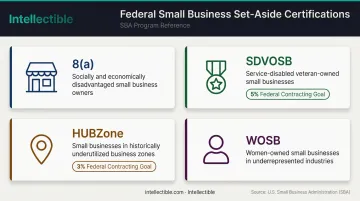
A firm's set-aside certifications directly determine which competitions it can enter. Pursuing the right certifications before a major solicitation drops can open doors that would otherwise require competing on price alone.
The GovCon Bid Proposal Lifecycle: Stage-by-Stage
The most competitive GovCon teams don't scramble when an RFP drops. They've already been working the opportunity for weeks or months. Here's how a structured bid lifecycle is built.
Opportunity Identification and Pipeline Building
SAM.gov publishes federal contract opportunities daily — presolicitation notices, solicitations, awards, and sole-source notices. But watching SAM.gov for posted RFPs is reactive pipeline management.
High-performing teams layer in additional intelligence sources:
- Agency acquisition forecasts and procurement plans
- Industry days and pre-proposal conferences
- Relationships with contracting officers and program managers
- RFI and Sources Sought responses that build visibility before formal competition
The goal is to understand the opportunity and the customer's priorities well before the formal solicitation is released. That lead time is what enables meaningful capture work.
The platform reports a 150%+ increase in actionable top-of-funnel opportunities for clients. Oceus CEO Jeff Harman noted that his team went from roughly three to four qualified opportunities reviewed monthly to seven to eight per month after implementing the platform.
Capture Planning
Capture planning is the intelligence and relationship-building phase that happens before any proposal writing begins. It answers the questions that determine whether a proposal can win, not just whether it will be submitted.
Key capture activities include:
- Assessing whether an incumbent is entrenched and how strong their position is
- Identifying the agency customer's top priorities and unstated preferences
- Mapping the competitive landscape and anticipated bidder pool
- Developing a preliminary win strategy and discriminators
Teams that skip capture and jump straight to the RFP response produce generic proposals. They describe capabilities instead of solutions. They respond to what the solicitation says, not what the customer actually needs.
Proposal Development and Compliance
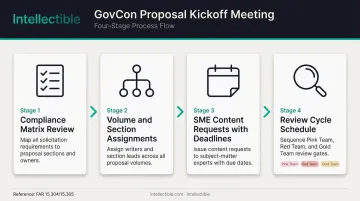
Once the RFP drops, structured development begins with a kickoff meeting that covers:
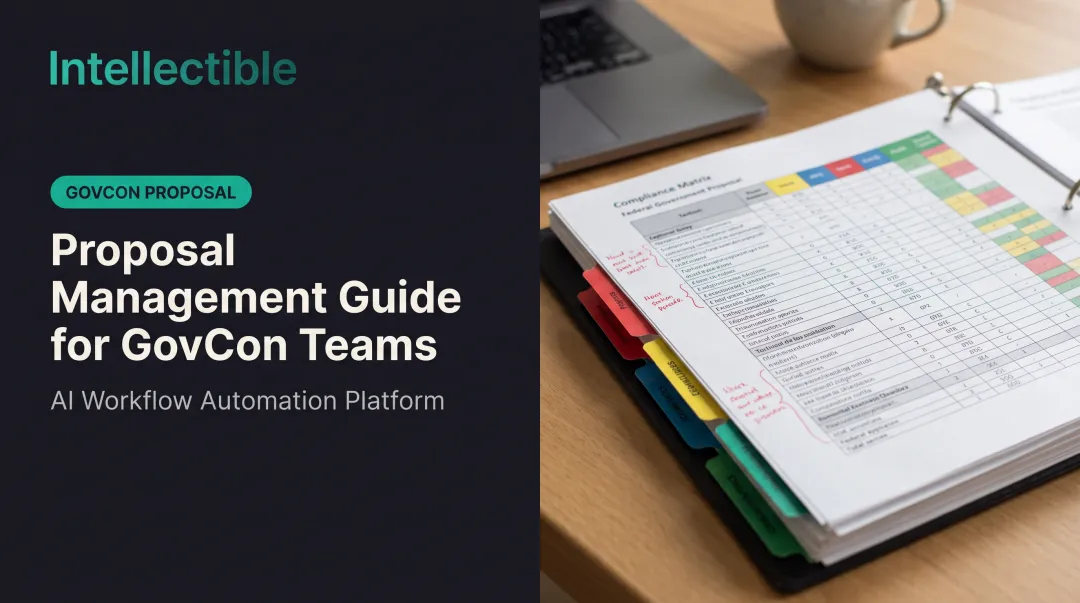
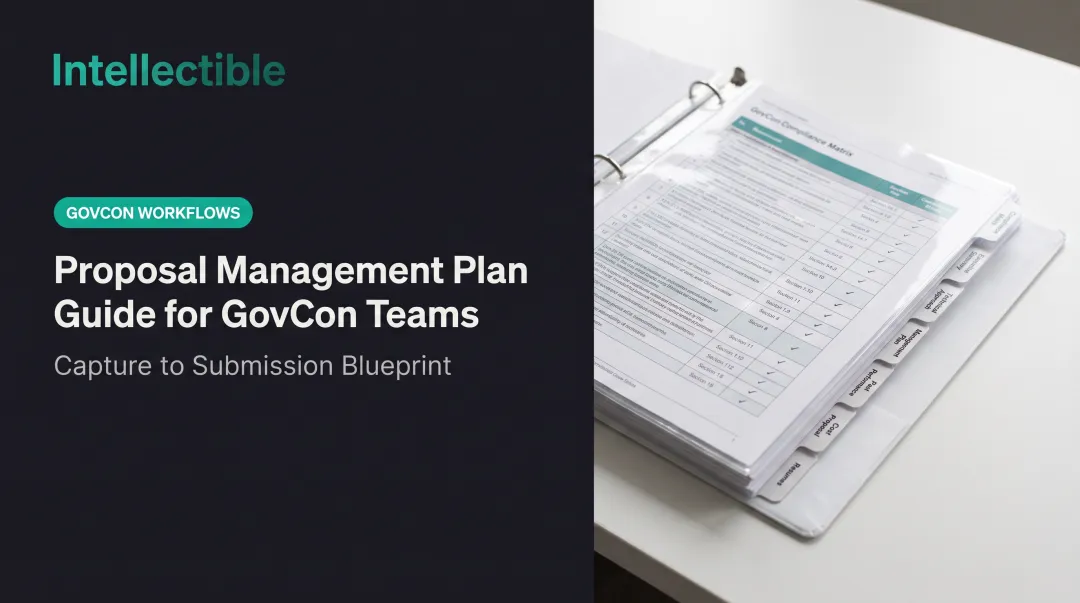
- Compliance matrix review — mapping every solicitation requirement to a proposal section
- Volume and section assignments with named owners
- SME content request packages with deadlines
- Review cycle schedule (Pink Team, Red Team, Gold Team)
Per FAR 15.304, agencies must state evaluation factors and their relative importance. Per FAR 15.305, proposals are evaluated only on those stated factors. The compliance matrix isn't a formality. It's the framework that ensures every scored factor gets addressed directly.
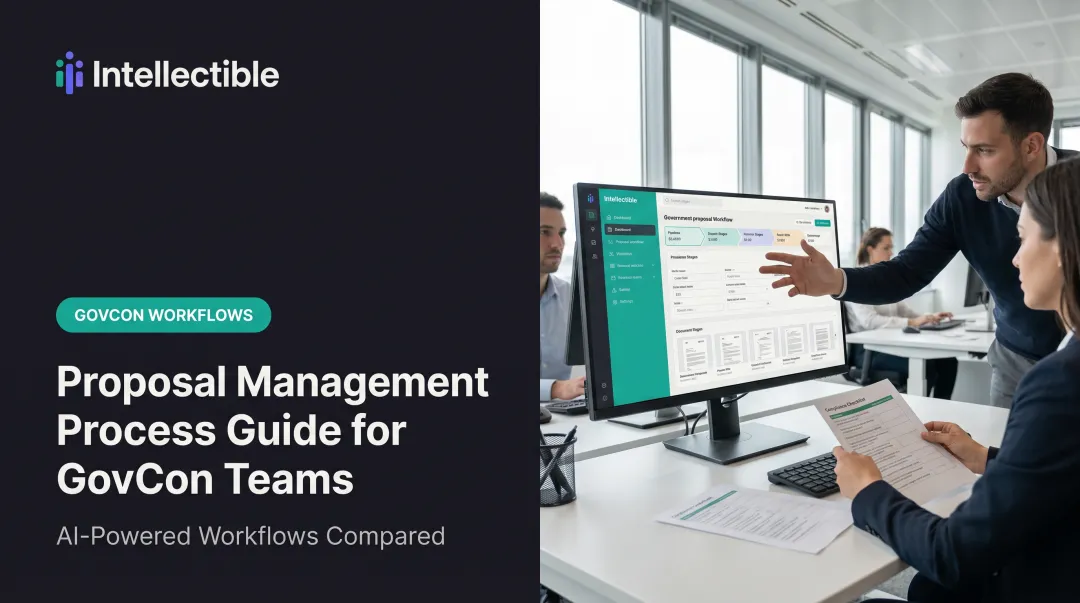
Intellectible's Proposal & Pursuit Engine automates compliance matrix generation from uploaded solicitation documents — reading the RFP, attachments, and addenda to extract key dates, submission rules, required sections, and evaluation criteria. It surfaces compliance risks before kickoff, maps requirements to sections with owner assignments and deadline tracking, and keeps coverage gaps visible throughout drafting rather than catching them at final review. This removes one of the most error-prone manual steps in the process.
Pricing and Final Review
The pricing volume is consequential and consistently underestimated. A competitive price that can't be defended by a clear cost narrative and audit trail creates problems, both during evaluation and in post-award audits.
Common pricing bottlenecks:
- Spreadsheet models that break when assumptions change
- Rate cards stored in disconnected files
- Approval chains managed through email with no audit record
- Last-minute scrambles to reconcile internal economics with customer-facing pricing
The platform reports a 90% reduction in time to final pricing through structured, governed workflows with a full audit trail.
Submission and Post-Submission
Before submitting, run a final checklist:
- File naming conventions match solicitation requirements
- All required attachments and certification forms are included
- Portal submission is tested (don't wait until 30 minutes before deadline)
- Page limits verified by volume
Post-submission, the work continues:
- Track the procurement administrative lead time (PALT)
- Prepare for discussions or oral presentations if the solicitation allows them
- Request a debrief regardless of outcome — debriefs are one of the highest-ROI activities in GovCon proposal management
The Go/No-Go Decision Framework for GovCon Teams
One of the most undervalued disciplines in GovCon proposal management is knowing when not to bid. Teams that chase every opportunity spread effort across too many pursuits, produce weaker proposals across the board, and burn out the people doing the work.
The go/no-go decision is a structured evaluation that every qualified opportunity should pass before resources are committed.
Core Go/No-Go Evaluation Criteria
Score each opportunity against these dimensions before committing:
| Criterion | Questions to Ask |
|---|---|
| Strategic fit | Does this align with our NAICS codes, capabilities, and target agencies? |
| Probability of win (Pwin) | Realistically, where do we stand in this competition? |
| Customer access | Have we had prior contact with the program office? |
| Incumbent status | Are we the incumbent? Is the incumbent entrenched? |
| Competitive differentiation | Can we articulate a clear advantage over likely competitors? |
| Staff availability | Do we have the right people available to respond well? |
| B&P budget | Can we fund a competitive pursuit without cannibalizing other bids? |
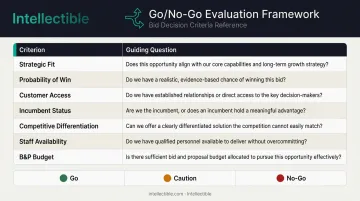
A scored decision matrix (not a gut-check conversation) forces the team to confront trade-offs explicitly and gives leadership a defensible record of why a pursuit was approved or declined.
The Cost of Skipping This Step
Bidding without a filter doesn't just lower win rates on individual pursuits. It degrades proposal quality across the entire pipeline. When teams are spread thin, no single proposal gets the attention it deserves:
- The compliance matrix gets a cursory review
- The technical approach is reused from a previous submission
- Pricing gets assembled the night before the deadline
Intellectible's pursuit platform applies this logic at scale, automatically scoring opportunities against an organization's capture profile (target agencies, certifications, deal-size thresholds, fit signals) before a human ever reviews them. The platform delivers 95%+ time savings on opportunity evaluation and go/no-go decisions, compressing what was a multi-day manual process into near-instant structured outputs.
HHS Corporate Director of Business Development John Grady described the impact directly: "Intellectible is taking the tedious, monotonous hours of RFP efforts out of human hands. This allows us to do what we should be doing, analyzing and selling."
Common Bid Proposal Mistakes GovCon Teams Make
Chasing the RFP
Starting proposal development only after the solicitation drops — with no prior capture work, no customer access, and no win strategy — is the single most common reason technically capable firms lose. Without capture context, proposals describe what the company does rather than how it solves this customer's specific problem. Evaluators notice the difference.
The fix is starting earlier — ideally weeks before the RFP drops, when shaping the opportunity is still possible.
Non-Compliance Failures
Evaluators are required to apply the solicitation's evaluation criteria. A proposal that misses a mandatory requirement — omits a required certification, exceeds a page limit, or fails to address an evaluation factor — creates an automatic problem that no amount of technical excellence can overcome.
The most common compliance failures are preventable:
- Missing page or formatting limits
- Omitted certifications or representations
- Evaluation factors addressed incompletely or out of order
- Attachments named incorrectly or missing entirely
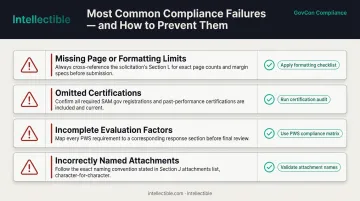
A compliance matrix reviewed at kickoff — before a word of content is written — is the safeguard. Teams that track requirement coverage throughout drafting, not just at final review, catch gaps while there's still time to close them.
The Copy-Paste Proposal
Generic proposals are easy to spot. When executive summaries and technical approaches recycle language from prior submissions without reflecting the current solicitation's priorities, evaluators notice — they read enough proposals to recognize the pattern immediately.
The executive summary and technical approach are where scoring differentiation happens. That's where the proposal should demonstrate that the team read the solicitation carefully, understood the agency's priorities, and built a solution around them — not where a prior proposal was lightly edited and resubmitted.
Frequently Asked Questions
What is bid and proposal management?
Bid and proposal management covers the full cycle from identifying contract opportunities to developing compliant responses and refining the process after each award. In government contracting, FAR/DFARS regulations, formal evaluation criteria, and mandatory compliance structures make this process substantially more demanding than commercial procurement.
What should be included in a bid proposal?
A federal proposal typically includes an executive summary, technical approach, management plan, past performance narrative, pricing volume, and compliance documentation. The solicitation's Section L defines which volumes are required; Section M defines how each will be evaluated and weighted.
What is the difference between a bid manager and a proposal manager?
A bid manager owns the full bid lifecycle from opportunity identification through contract award. A proposal manager focuses specifically on developing and managing the written proposal document. In GovCon, the capture manager typically handles strategic pre-RFP work while the proposal manager drives tactical execution once the solicitation is released.
What is the Go/No-Go decision in government contracting?
A Go/No-Go decision is a structured evaluation GovCon teams conduct before committing resources to a pursuit. It assesses factors like probability of win, past performance alignment, customer access, staff availability, and competitive differentiation — producing a documented decision rather than an intuitive one.
How long does a federal bid proposal process typically take?
Per FAR 5.203, agencies must generally allow at least 30 days from solicitation issuance for bids or proposals above the simplified acquisition threshold — with at least 45 days for R&D actions. These are regulatory minimums, not typical windows. Competitive teams begin capture activities months before formal solicitation release, making the actual pursuit timeline far longer than the official response window.
How can AI improve the government bid proposal process?
AI tools cut the manual hours behind opportunity screening, Go/No-Go scoring, compliance matrix builds, pricing analysis, and content reuse. Intellectible applies this across the full pursuit cycle — helping GovCon teams work larger pipelines, tighten proposal quality, and close pricing faster without expanding headcount.