This guide is written for the people who actually respond to these solicitations: proposal managers, capture leads, pricing analysts, and RevOps teams inside GovCon organizations. Getting the response process right matters because government cloud procurement carries strict security, compliance, and evaluation requirements that don't exist in commercial sales.
Many GovCon teams treat a Cloud RFP like a standard commercial proposal. That's a mistake. It's a distinct, compliance-heavy process that's often poorly understood at the operational level, even by experienced contractors. Below, we cover what a Cloud RFP is, why it matters for GovCon growth, how the response process actually works, what determines success, and when walking away is the smarter call.
Key Takeaways
- A Cloud RFP binds vendors to cloud hosting, IaaS/PaaS/SaaS, or managed services under a specific contract vehicle
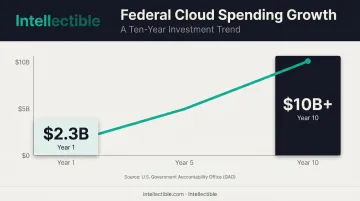
- Federal cloud spending grew from $2.3 billion to over $10 billion in a decade, per GAO
- Winning proposals follow six stages: discovery, qualification, compliance, design, submission, and negotiation
- Eligibility hinges on compliance certifications, pricing accuracy, and contract fit, not writing quality
- Disciplined Go/No-Go screening protects capture resources from unwinnable pursuits
What Is a Cloud RFP in Government Contracting?
A Cloud RFP is a structured solicitation document requesting proposals for cloud hosting, IaaS/PaaS/SaaS, migration, security, or managed services. It's always tied to a specific contract vehicle, whether that's a GSA Schedule, an IDIQ, or an agency-specific procurement instrument.
Beyond specifying the vehicle, a Cloud RFP is built to produce a scored, ranked evaluation of competing vendor proposals that results in a negotiated award, complete with defined SLAs, pricing structures, and compliance terms baked into the final contract.
That distinguishes it sharply from other pre-award notices:
- RFI (Request for Information): Market research only, no commitment to award
- Sources Sought: Pre-solicitation research to gauge capable vendors, often to inform set-aside decisions
- RFQ (Request for Quotation): Used when requirements are already defined and the agency just wants pricing
- RFP: Used for complex requirements, evaluating technical approach, experience, and price together
Where Cloud RFPs Appear Across the GovCon Opportunity Lifecycle
Cloud RFPs surface through several channels, and teams need to monitor all of them:
- SAM.gov for federal contract opportunities
- GSA eBuy for RFQs, RFPs, and RFIs issued under GSA acquisition vehicles
- State and local procurement portals, including county-level solicitation sites
- Agency-specific portals tied to individual departments or offices
Knowing where to look only helps if you also understand what triggers a posting. Recurring triggers include new cloud-first mandates, contract expirations that force recompetes, and infrastructure modernization pushes.
Some Cloud RFPs are one-time system buildouts. Others are recurring multi-year hosting or managed services renewals, which means the same opportunity can resurface every three to five years under a new solicitation number.
Why Cloud RFPs Are Central to Winning Government Cloud Business
Federal and state "Cloud Smart" policies are pushing more IT spend through formal Cloud RFPs rather than informal purchasing. The numbers back this up: federal spending on cloud service contracts grew from $2.3 billion to more than $10 billion over a ten-year period, according to a 2026 GAO report.
That's not a niche category anymore. It's a materially larger slice of federal IT spend, and agencies are formalizing how they buy into it.
Government buyers use structured Cloud RFPs specifically because they need:
- Verifiable security compliance, not vendor claims
- Cost transparency across multi-year terms
- SLA accountability built into contract language
- Reliability over three-, five-, or ten-year performance periods
What Goes Wrong Without a Disciplined Process
Teams without a repeatable RFP response process tend to fail in predictable ways:
- Missing a mandatory compliance requirement buried in an attachment
- Scrambling to assemble past-performance data instead of having it ready
- Getting disqualified on formatting technicalities that have nothing to do with technical merit
The process is also regulatory, not just a best practice. FAR Part 39 governs federal IT acquisitions broadly, while DFARS Subpart 239.76 and clause 252.239-7010 add DoD-specific cloud requirements. Agency-specific supplements, like the Department of Transportation's cloud computing rules, layer on top of that.
Not every solicitation is written the same way. AWS's public-sector procurement guidance recommends agencies write outcome-focused, non-prescriptive requirements centered on workloads rather than dictating server counts or specific infrastructure.
Contractors should read a solicitation and immediately recognize which type they're dealing with. A well-written, outcome-based RFP invites cloud-native solutioning, while an overly prescriptive one signals a buyer locked into legacy assumptions your response needs to account for.
How the Cloud RFP Process Works for GovCon Teams
At a high level, the process runs through seven phases: opportunity discovery, qualification, compliance mapping, solution and pricing design, proposal development, submission, and negotiation. Each phase draws on different inputs, including the solicitation itself, the SOW or PWS, evaluation criteria, incumbent intelligence, and internal capability data.
Output quality comes down to discipline at each stage:
- Compliance matrices that catch every mandatory requirement
- Color-team reviews that stress-test the draft before submission
- Pricing-to-win strategies grounded in real cost data, not guesswork
Teams that execute consistently win more often, spend less per bid, and keep a defensible audit trail behind every pricing decision.
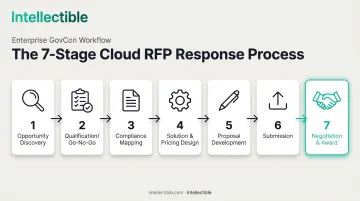
Step 1: Opportunity Identification and Search
GovCon teams monitor SAM.gov, GSA eBuy, and state or local portals continuously for relevant postings. Screening that volume for genuine fits, not finding postings in the first place, is the real bottleneck. Manually reviewing hundreds of postings a week to find the handful worth pursuing burns hours that could go toward writing proposals instead. Teams that spend the week screening solicitations often fall behind competitors who spotted the same opportunity days earlier and started building relationships with the program office.
Step 2: Go/No-Go Decision
This is where teams weigh compliance fit, internal capacity, incumbent strength, and estimated probability of win to decide whether to commit resources. Intellectible's Proposal & Pursuit Engine is built to compress this evaluation dramatically — running a structured go/no-go that scores fit, urgency, risk, contract terms, and capability match directly from the solicitation document and captures the win thesis, so teams focus capture time only on genuinely winnable pursuits.
Step 3: RFP Analysis and Compliance Mapping
Teams extract every mandatory requirement, SOW/PWS detail, and evaluation criterion into a compliance matrix. This step exists specifically to prevent disqualification. Missing one required certification reference or submission format rule can knock an otherwise strong proposal out before evaluators even read the technical volume.
Step 4: Solution Design, Teaming, and Pricing
Technical solutioning, teaming decisions, and cost volume development happen in parallel, not sequentially. Automated pricing workflows can cut the time needed to finalize pricing substantially, sometimes reducing timelines by as much as 90%, while still preserving a full audit trail of assumptions, rate builds, and approvals for every pricing decision.
Step 5: Proposal Development, Review, and Submission
Drafting runs alongside compliance review, often structured as formal color-team passes (pink, red, gold) before submission. Government solicitations frequently require both a digital upload and a hard-copy submission, so teams need to plan mailing and printing timelines alongside the writing schedule, not as an afterthought.
Step 6: Clarifications, Negotiation, and Award
Agencies routinely issue extensive Q&A rounds before award. This isn't a formality. A 2023 Nebraska DHHS cloud-hosting solicitation produced 214 separately numbered vendor questions covering hosting, migration, interfaces, security, staffing, and pricing terms. That level of technical scrutiny is common for cloud solicitations, and teams need contracts, security, and pricing staff available throughout the clarification window, not just during initial drafting.
Key Factors That Affect Cloud RFP Success in GovCon
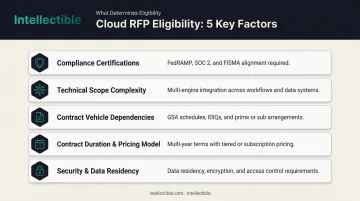
Several variables determine whether a Cloud RFP response even gets evaluated on merit:
- Compliance frameworks and certifications: FedRAMP, StateRAMP (now GovRAMP), CJIS, CMMC, and DoD Impact Levels 4/5 gate eligibility before scoring begins, each tied to a specific buyer type and data sensitivity level.
- Technical scope complexity: Backup and disaster recovery requirements, network architecture demands, and data volume directly shape both proposal depth and pricing accuracy.
- Contract vehicle dependencies: Whether the opportunity runs through a GSA Schedule, an IDIQ, or an agency-specific vehicle determines allowable pricing structures and contract terms.
- Contract duration and pricing model: Multi-year terms often carry escalation clauses and volume discounts that need to be modeled correctly from the start.
- Security and data residency constraints: Government buyers impose regulatory requirements around data location and handling that shape technical architecture and pricing simultaneously.
Common Mistakes, Misconceptions, and When to Pass on a Cloud RFP
A persistent misconception: a Cloud RFP can be answered like a commercial proposal. It can't. Ignoring FAR compliance clauses, set-aside eligibility rules, or agency-specific formatting requirements is one of the fastest ways to get disqualified before evaluators reach the technical merit of your solution.
Beyond compliance formatting, teams also chronically underestimate how deep clarification rounds get. Budget real staff time for the Q&A stage, since evaluators use it as a genuine technical stress test before award.
Another common mix-up: confusing SLA compliance with security or certification status. A vendor can promise 99.9% uptime in an SLA and still fail to hold the FedRAMP authorization the solicitation requires. These are separate gates, and conflating them leads to proposals that look strong on paper but fail eligibility review.
Signals It's Time to Walk Away
Not every opportunity deserves a bid. Consider passing when you see:
- A strong, entrenched incumbent with deep customer relationships
- Unrealistic response or performance timelines
- Poor technical fit with your existing capabilities
- Low estimated probability of win based on competitive density
AI-driven Go/No-Go tools like Intellectible help teams spot these signals faster, using award history, bidder concentration data, and compliance fit scoring. Capture resources then shift toward higher-probability pursuits, instead of chasing everything that lands in the inbox.
Long-term Cloud RFP win rates come down to disciplined process and correct application of compliance and pricing rigor, not just speed. Teams that build repeatable systems for qualification, compliance mapping, and pricing consistently outperform teams that treat every RFP as a one-off scramble.
Frequently Asked Questions
What is an RFP in SaaS?
In a SaaS context, an RFP is a solicitation requesting vendors to propose subscription-based software services, including pricing tiers, security posture, and SLA terms. It's often issued as part of a broader cloud procurement effort.
What is an RFP and an SLA?
An RFP is the solicitation document requesting proposals from vendors. An SLA is the service level agreement defining uptime, performance, and support commitments that eventually gets written into the awarded contract.
What is the difference between an RFP and an RFI in government cloud procurement?
An RFI gathers market information without any commitment to award. An RFP solicits binding, evaluable proposals that lead directly to a contract award decision.
How long does a typical government Cloud RFP response process take?
Timelines vary based on solicitation complexity and clarification rounds. Federal rules require at least 30 days for response, though that floor rarely reflects real drafting time. Structured processes for Go/No-Go screening, compliance mapping, and pricing cut turnaround time considerably.
What certifications do government contractors need to bid on Cloud RFPs?
Commonly required certifications include FedRAMP, StateRAMP/GovRAMP, CJIS, and CMMC, depending on the agency and data sensitivity level. DoD solicitations may also require specific Impact Level authorizations like IL4 or IL5.
How can GovCon teams improve their Cloud RFP win rate?
Disciplined Go/No-Go screening, strong compliance matrices, and accurate pricing-to-win strategy all matter. AI-driven platforms like Intellectible reduce manual overhead so teams can focus effort on the pursuits most likely to convert.