This guide examines AI proposal software purpose-built for government contracting teams. You'll learn which features actually matter for FAR/DFARS compliance, how AI-native platforms differ from legacy content libraries, what security certifications protect proprietary bid information, and how workflow automation addresses bottlenecks beyond document generation—from opportunity qualification through final submission.
Key Takeaways
- AI proposal software cuts GovCon proposal development from 25+ hours to under 10 while improving compliance accuracy
- Purpose-built tools handle Section L/M tracking, past performance docs, SF-forms, and federal formatting standards
- Small teams benefit most from AI-native platforms that learn from existing documents rather than requiring weeks of manual content library setup
- Success balances AI efficiency (compliance checks, content retrieval, requirement mapping) with human expertise (strategy, innovation, pricing)
- Top platforms connect opportunity databases, CRM, pricing tools, and document repos for end-to-end workflow automation
What is AI Proposal Software for Government Contractors?
AI proposal software uses artificial intelligence to automate creation, compliance checking, and quality control of government contract proposals and RFP responses. These platforms parse solicitation documents, extract requirements, map them to proposal sections, generate compliant drafts from your institutional knowledge, and flag gaps before submission.
GovCon-specific AI proposal tools differ from generic proposal software:
- Section M evaluation criteria: structured scoring factors agencies use to rate your proposal
- Section L compliance tracking: mandatory submission requirements and how you must deliver them
- Federal forms support: SF330 for architect-engineer qualifications, SF1449 for commercial product solicitations
- Federal formatting standards that differ from commercial RFP responses
- Past performance documentation formatted for CPARS data and agency evaluation requirements
According to the Federal Acquisition Regulation (FAR), agencies evaluate proposals solely on solicitation factors. Army AFARS guidance defines Section L as submission instructions and Section M as evaluation methodology. Generic proposal tools lack this federal context, treating government RFPs like commercial sales responses.
Three types of tools serve this market:
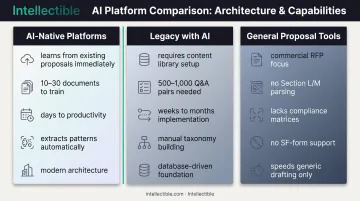
- AI-native platforms: Learn from your existing proposals, project documents, and company materials. Upload past submissions and they extract patterns, technical approaches, and institutional voice right away.
- Legacy platforms with bolted-on AI: Need extensive content libraries before they help—weeks of manual Q&A entry, taxonomy building, and content tagging. The AI layer sits on architecture built for human-managed databases.
- General proposal tools: Aimed at commercial RFP responses without government compliance complexity. They may speed generic drafting but will not auto-build compliance matrices, track Section L across addenda, or format past performance for federal evaluation.
Setup time is what determines when you start winning more contracts, not when configuration is finally done.
Why Government Contracting Teams Need AI Proposal Software
Time and Resource Efficiency
Cross-industry research from Loopio's 2026 benchmark covering 1,500+ participants reports an average of 33 hours per RFP response. Government proposals often exceed that baseline because of technical volumes, past performance narratives, pricing coordination, and multi-section compliance work.
Small GovCon teams juggling several opportunities at once hit an unsustainable workload. They decline winnable bids or burn out proposal staff.
AI proposal tools address this constraint directly. A 2025 Responsive/APMP survey of 726 cross-industry respondents found that 52% of early AI adopters credited the technology with freeing expert time, while 35% reported increased response volume. For GovCon teams, that means pursuing 2-3x more opportunities without adding headcount: scale the process, not the headcount. That imperative often decides whether a small firm stays competitive.
Compliance and Accuracy
AI tools reduce the disqualification risk that costs GovCon firms their strongest opportunities. They can:
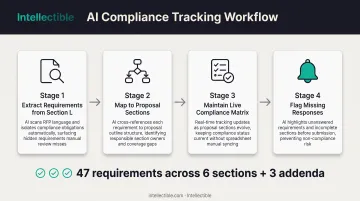
- Extract requirements from Section L
- Map each requirement to proposal sections
- Maintain live compliance matrices
- Flag missing responses before submission
Manual requirement tracking breaks down as complexity increases. When an RFP contains 47 discrete requirements across six sections plus three addenda, human reviewers miss 3-5 requirements on average. Each miss is a potential disqualification. AI tools stay more consistent: they parse documents in full, update matrices when addenda arrive, and cross-reference every requirement against draft content.
FAR 15.305 confirms that evaluation follows the solicitation's stated factors and subfactors. Meeting every mandatory requirement isn't proposal excellence—it's the minimum threshold for consideration.
Institutional Knowledge Management
Small GovCon teams lose critical knowledge when proposal managers leave, past performance details get buried in old files, and winning technical approaches aren't systematically captured for reuse. The next RFP requiring similar capabilities starts from zero, recreating content that already exists somewhere in email archives or completed proposals.
AI proposal tools build a persistent knowledge base you can query on every new pursuit. Upload your best 10-20 proposals and the system learns your voice, technical patterns, compliance language, and differentiators. It can surface:
- Past projects and performance write-ups
- Certifications and key personnel qualifications
- Winning technical approaches worth reusing
When a new solicitation needs network security experience, the AI can pull relevant past performance from three years ago that a manual search would miss.
This addresses the 30-40% of proposal-writer time typically spent searching for information—time that could focus on win strategy instead of content archaeology.
Win Rate Improvement
The 2025 Responsive/APMP study found that 30% of early AI adopters credited the technology with lifted win rates. That figure reflects association, not a fixed percentage lift. The path is still clear:
- Stronger compliance lowers disqualification risk
- More consistent quality improves how evaluators read the response
- Faster turnaround leaves room for real capture work
- Hours saved go back into discriminators that win contracts
AI tools that learn from your wins and losses create an institutional learning loop. If your team consistently wins when proposals emphasize specific past-performance patterns or technical approaches, the AI recognizes and replicates those elements in future bids.
The compounding advantage matters more than any single proposal. Over 12-24 months, teams using AI build separation from competitors still manually tracking requirements in spreadsheets.
Competitive Advantage for Small Teams
AI proposal software levels the playing field between small GovCon firms (5-50 employees) and large primes (500+ employees with dedicated proposal centers). Smaller teams can now produce enterprise-quality compliance matrices, polished technical volumes, and comprehensive past-performance sections without enterprise resources.
The 2025 Responsive/APMP research found nearly two-thirds of surveyed proposal teams were piloting or had embedded AI. This creates a competitive inflection point: teams without AI tools increasingly compete at a disadvantage in quality, speed, and consistency. The gap widens as AI-enabled competitors build institutional knowledge bases that improve with every bid while manual teams start fresh each time.
For small GovCon firms, AI is moving from optional edge to baseline capability. As adoption becomes standard practice, competing without it gets harder to justify.
Key Features for Government Contracting Teams
Requirement Extraction and Compliance Tracking
The best tools parse Section L (submission instructions) and Section M (evaluation criteria) from government RFPs. They extract every discrete requirement and evaluation factor, build a trackable compliance matrix, and map each item to specific proposal sections.
Missing even one mandatory requirement usually means disqualification. RFPs often pack 40–100 requirements across the solicitation, attachments, and multiple addenda. Human reviewers under deadline pressure miss items; AI parsing keeps coverage systematic.
Advanced platforms also offer addendum tracking: they detect new requirements mid-bid and flag affected proposal sections. When an amendment adds a cybersecurity certification three weeks into development, the system alerts the compliance owner and updates the matrix instead of relying on emails buried in busy inboxes.
Verify this capability by uploading a real RFP during vendor demonstrations. Generic "compliance checking" claims don't prove the tool can parse federal solicitation structure.
Past Performance and SF-Form Management
GovCon-specific tools maintain libraries of past performance examples, automatically format them for Section C (Past Performance), and can integrate with CPARS data to pull verified contract performance ratings. FAR 42.1501 identifies CPARS as the official source for past-performance information used in source-selection decisions.
SF-form handling separates purpose-built GovCon tools from generic proposal software:
- SF330 (Architect-Engineer Qualifications, GSA revision 07/2021) prescribed by FAR 53.236-2(b) for A-E selection
- SF1449 (Solicitation/Contract/Order for Commercial Products and Commercial Services, revision 11/2021) prescribed by FAR 53.212
Tools should auto-populate these forms from your knowledge base without manual re-entry. If you've documented a project engineer's qualifications once, that information should flow automatically into SF330 Section E whenever that person appears on a new bid.
Generic proposal tools lack these federal form templates. Verify SF-form automation by requesting live demonstrations with your actual team data, not vendor-prepared examples.
Knowledge Management and Content Libraries
AI-native knowledge management learns from your existing proposals, project documents, and company materials immediately—upload content and start generating drafts. Legacy content library approaches require weeks of manual Q&A entry, taxonomy building, and content tagging before AI becomes useful.
For small GovCon teams, the gap shows up fast:
- AI-native tools typically need 10-30 past proposals to learn your voice and technical approach
- Legacy tools require 500-1,000 pre-written Q&A pairs before delivering value
- Document-based learning starts producing results in days, not months
The ideal system ingests Word docs, PDFs, CVs, past proposals, and technical white papers, then automatically extracts relevant content with source attribution when generating new proposals. When the AI drafts a network-architecture section, it should cite which previous proposal and page number the content originates from—supporting both reuse and verification.
Collaboration and Workflow Management
Multi-user capabilities worth requiring:
- Section assignment and ownership tracking so everyone knows their responsibilities
- Version control for distributed teams working simultaneously on different volumes
- Review and approval workflows that route drafts to subject-matter experts, pricing teams, and executives
- Comment and annotation tools for technical review without disrupting source documents
RACI (Responsible, Accountable, Consulted, Informed) roles matter when 5–15 people touch one proposal across technical volumes, pricing, past performance, management approach, and quality review. Many AI proposal tools target solo users or small sales teams. GovCon work needs multi-contributor workflows with clear handoffs and approval gates.
The platform should maintain audit trails showing who wrote, reviewed, approved, and modified each section—essential for post-submission lessons learned and quality control.
Integration with GovCon Tech Stack
Integrations that cut re-entry and errors:
- Opportunity databases (GovWin IQ, SAM.gov) for pulling solicitation details, agency information, and contract requirements
- Financial systems (Deltek Costpoint, JAMIS) for cost/pricing data that flows into pricing volumes
- CRM platforms (Salesforce, HubSpot) for pipeline tracking, pursuit status, and capture intelligence
Integration eliminates manual data re-entry and reduces errors. When opportunity details, customer requirements, and preliminary pricing live in your existing systems, AI proposal tools should pull that information automatically rather than requiring duplicate input.
Workflow automation can also tie proposal generation into broader revenue operations: opportunity qualification, bid/no-bid frameworks, capture planning, team coordination, and CRM updates. That extends value past document drafting into the bottlenecks around it.
Verify integration claims by requesting demonstrations that connect to your actual systems, not generic API capabilities.
Security, Compliance, and Data Protection
Minimum security bar for GovCon proposal software:
- SOC 2 Type 2 certification as minimum baseline—AICPA attestation reporting on controls relevant to security, availability, processing integrity, confidentiality, or privacy
- FedRAMP authorization for handling Controlled Unclassified Information (CUI) or classified bid information—standardized federal assessment and authorization of cloud services used by agencies
- Clear policies on AI training data usage—whether your proprietary proposal content trains the vendor's models or remains isolated
Proposals hold proprietary pricing, technical approaches, teaming partner data, and past-performance details. That content must not leak to competitors or train public AI models.
SOC 2, FedRAMP, FAR 52.204-21 (Basic Safeguarding of Covered Contractor Information Systems), and DFARS 252.204-7012 (Safeguarding Covered Defense Information) are not interchangeable. Each covers a different assurance or safeguarding requirement.
Critical vendor questions:
- "Do you train your AI models on my proposal content?"
- "Where is my data stored and who has access?"
- "What certifications cover the specific product I'll use, not your parent company?"
Verify answers against the vendor's published security documentation, not sales claims. Check whether "FedRAMP Ready" (preparing for authorization) differs from "FedRAMP Authorized" (actively approved).
Challenges and Considerations When Implementing AI Proposal Software
Setup Time and Content Requirements
Implementation timelines vary widely. AI-native tools can start generating proposals in hours or days. Legacy platforms often need 2-8 weeks of content library building, training, and configuration before you get usable output.
Realistic expectations: Even with AI-native tools, first drafts require 20-30% editing time to refine technical accuracy, adjust tone, and add proposal-specific win themes. AI accelerates work but does not replace human expertise. It handles compliance structure, requirement mapping, and content retrieval so experts can focus on strategy and discriminators.
Start with 2-3 less critical proposals to train the AI and your team before using it on highest-priority opportunities. This builds confidence in output quality, identifies workflow adjustments, and lets you refine prompts and knowledge-base organization before high-stakes bids.
Data Quality and Institutional Knowledge
The "garbage in, garbage out" reality applies directly: if your past proposals are poorly written, non-compliant, or inconsistent, AI tools learn and replicate those problems. NIST AI 600-1 recommends documenting training-data curation, examining data quality and representativeness, testing outputs, and assigning human oversight.
The most successful implementations curate your best 10-20 proposals as training data, ensuring the AI learns from wins, not losses. If a past proposal received "good" ratings but didn't win, teaching the AI those patterns won't improve future outcomes.
Teams with minimal documentation or very new GovCon practices will see slower AI adoption than teams with 5+ years of institutional knowledge to draw from. If you lack strong historical proposals, consider starting with compliance and requirement-tracking features before expecting sophisticated content generation.
Balancing AI Efficiency with Human Expertise
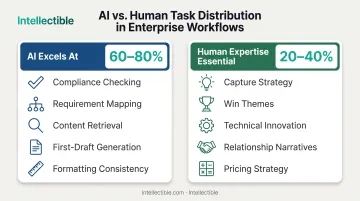
AI proposal tools excel at:
- Compliance checking and requirement mapping
- Content retrieval from past proposals
- First-draft generation following templates
- Formatting and consistency enforcement
Human expertise remains essential for:
- Capture strategy and customer intelligence
- Win themes and discriminators
- Technical innovation and solution design
- Relationship-based past-performance narratives
- Pricing strategy and risk assessment
A practical division of labor puts AI on 60-80% of proposal content: compliance sections, standard technical responses, and boilerplate management volumes. Your team then focuses on the 20-40% that decides wins: executive summary, technical approach differentiators, proof points, and pricing justification.
The "AI will do everything" myth hurts GovCon teams. The best teams use AI to clear low-value proposal work such as formatting, content search, and compliance checking. That frees time for capture and strategy work that influences evaluator decisions.
Top AI Proposal Software Tools for Government Contractors
These tools were selected based on official government-contracting positioning, compliance-tracking features, past-performance management capabilities, and proven use by federal contractors. This is not a comprehensive market analysis of all 20+ proposal platforms, but a focused evaluation of tools most relevant to small and mid-market GovCon teams.
Important note: None of the reviewed vendor pages published list pricing. Contact vendors directly for quotes. Verify specific SF-form automation, security certifications, and integration capabilities through live demonstrations with your actual RFPs and systems, not marketing materials.
GovDash
Purpose-built for government contractors, GovDash provides solicitation analysis, amendment-aware compliance matrices, outline generation, AI-assisted drafting, review workflows, and past-performance matching. The platform serves small businesses through large prime contractors.
GovCon-specific features:
- Automatic Section L/M parsing and requirement extraction
- Compliance matrices that update when amendments arrive
- Proposal outlines structured around federal evaluation criteria
- Past-performance library matched to solicitation requirements
- Review workflows supporting multi-contributor teams
Security and integration: GovDash states "FedRAMP Moderate Equivalent & Ready" with NIST 800-53 alignment and DFARS 252.204-7012 support. Note this wording differs from "FedRAMP Authorized"—verify current authorization status if your work involves CUI. Named integrations include Word, Excel, PowerPoint, SharePoint, and GSA eBuy.
Pricing: Not publicly disclosed; contact vendor.
Unanet ProposalAI
Built specifically for government proposals, Unanet ProposalAI shreds solicitations, maps requirements, builds compliant outlines, and drafts content from your prior proposals and company documents.
GovCon-specific features:
- Solicitation "shredding" that extracts instructions and evaluation criteria
- Requirement mapping to proposal sections
- Compliant outline generation following Section L structure
- AI drafting using your historical proposal content
- Integration with Unanet's CRM and ERP products for GovCon teams
Security and integration: Unanet describes private cloud deployment, encryption in transit and at rest, no customer-content training for AI models, and alignment around federal requirements. No specific certification (SOC 2, FedRAMP) is stated on reviewed pages. The platform integrates with Unanet's broader GovCon suite for CRM and financial management.
Pricing: Not publicly disclosed; contact vendor.
Awarded AI by Procurement Sciences
Officially positioned as an all-in-one AI platform for government contracting, Awarded AI handles RFP analysis, compliance matrices, proposal drafting, resume evaluation, and pricing workflows. Case studies document customers ranging from small businesses to large contractors.
GovCon-specific features:
- RFP analysis extracting requirements and evaluation factors
- Compliance matrix generation and tracking
- Proposal content drafting from institutional knowledge
- Resume and personnel evaluation for staffing requirements
- Pricing support for cost/labor proposals
Performance note: Cutting Edge Communications reported 90% time savings on RFP shredding using Awarded AI. This is a vendor-published, task-specific case result for one workflow step, not end-to-end proposal development savings.
Security and pricing: No specific certifications or list pricing stated on reviewed pages. Training and onboarding are documented but no standard implementation timeline provided.
GovEagle
GovEagle positions itself as proposal and capture AI for government contractors, turning call notes, capture strategy documents, and past content into proposal-ready material. The platform emphasizes both pre-RFP capture and post-release proposal development.
GovCon-specific features:
- Capture intelligence conversion into proposal content
- Integration of call notes and customer conversations
- Past-content reuse across bids
- Proposal preparation workflows
Performance note: A federal team case study reported 30-40% RFI preparation savings using GovEagle. This is a single-customer, task-specific result, not a general proposal benchmark.
Security: GovEagle's homepage states CMMC L2, FedRAMP Authorized, and ITAR ready. Verify current FedRAMP authorization status against the official FedRAMP Marketplace for the specific product you'll use.
Pricing: Not publicly disclosed; contact vendor.
AutogenAI
AutogenAI provides government-contracting modules covering qualification/extraction, requirement management, content writing, research, review workflows, and system integrations. The customer page includes Serco, an established government-services contractor.
GovCon-specific features:
- Solicitation qualification and requirement extraction
- Requirement management across proposal lifecycle
- AI-assisted writing and content generation
- Research and intelligence gathering
- Review and approval workflows
Security and pricing: No certifications or list pricing found on reviewed pages. Verify SF-form capabilities and security authorizations through product-specific documentation, not generic compliance claims.
Intellectible
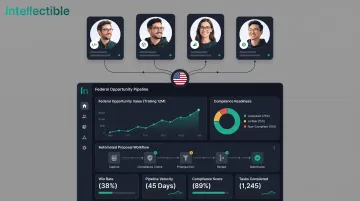
Intellectible takes a different approach from proposal-only tools. It provides a horizontal AI build platform that automates the full GovCon revenue workflow: opportunity qualification, pipeline management, proposal coordination, and pricing.
GovCon-specific features:
- Opportunity discovery and qualification via federal portal parsing and configurable go/no-go rules
- Pipeline records with agency details, NAICS/PSC codes, risk signals, and next actions
- RFP analysis that builds compliance matrices, requirement summaries, and go/no-go reports
- Proposal coordination across intake, drafting, reviews, and approvals in project workspaces
- Pricing workflows with cost scenarios, approval routing, and full audit trails
- CRM and operations handoffs that keep pursuit status and ownership visible
Performance note: Reported results include 95%+ time savings on search and go/no-go decisions, a 150%+ increase in actionable opportunities, and 90% reduction in time to final pricing. Oceus, a defense and technology contractor, reported more than double the qualified opportunities per month (about 7–8 reaching threshold versus prior manual processes).
Platform approach: A visual node-based builder connects AI, federal data sources, CRM systems, document generation, and approvals without custom development. Production infrastructure includes PostgreSQL databases, document libraries, React interfaces, API/webhook integrations, role-based workspaces, and USA-based implementation support.
Security and pricing: Specific certifications not documented in available materials; contact vendor for current security authorizations and data-handling policies. Pricing not publicly disclosed; contact vendor.
Best fit: Small to mid-market GovCon teams (1–100 employees) constrained across the full revenue process, not drafting alone. Strongest match when the problem is too few pursuits or a broken capture handoff.
How to Choose the Right AI Proposal Software for Your GovCon Team
Assess Your Team Size, Bid Volume, and Proposal Complexity
Self-assessment framework:
Small teams (1-20 people, 5-15 proposals/year) should prioritize speed and simplicity over deep workflow features. If you're pursuing mostly qualifications-based bids (SF330 style) with straightforward past-performance requirements, focused tools that accelerate those specific documents deliver fastest ROI. Avoid enterprise platforms with multi-week setup cycles.
Mid-market teams (20-100 people, 15-50 proposals/year) need collaboration and knowledge management. Multiple simultaneous proposals require clear section ownership, version control, and approval workflows. Institutional knowledge becomes critical. You can't afford to lose capability when a key proposal manager leaves. Platforms that balance power with reasonable implementation timelines fit this profile.
Large teams (100+ people, 50+ proposals/year) require enterprise workflow and governance. Dedicated proposal centers justify complex tools with extensive integration, advanced reporting, and sophisticated access controls. Multi-week implementations become acceptable because volume justifies the investment.
Proposal complexity affects tool choice: Simple past-performance or qualifications bids need different capabilities than complex technical volumes requiring original solution design, architecture diagrams, and innovation narratives. If your proposals primarily reuse existing content, content-library tools suffice. If you're solving new problems in every bid, AI-native generation tools provide more value.
Bid/no-bid considerations: If your real bottleneck is deciding which opportunities to pursue—not just writing faster—full-funnel workflow platforms often beat proposal-only tools. Spending 80% less time on opportunity qualification can matter more than spending 60% less time drafting.
Define Your Must-Have Features vs. Nice-to-Haves
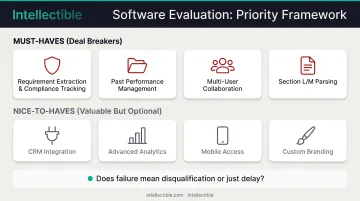
Prioritization approach:
Create a weighted scorecard: assign points to features based on your team's pain points, then score each tool against those criteria. Focus on 3-5 deal-breaker features rather than optimizing everything. Tools that excel at your top priorities beat tools that are mediocre across the board.
Typical must-haves for GovCon:
- Requirement extraction and compliance tracking (prevents disqualification)
- Past performance management (handles core proposal content)
- Multi-user collaboration (supports distributed teams)
- Section L/M parsing (addresses federal structure)
Typical nice-to-haves:
- CRM integration (valuable but can be manual)
- Advanced analytics (interesting but not urgent)
- Mobile access (rarely needed for proposal work)
- Customizable branding (cosmetic)
Ask: "If this feature doesn't work perfectly, does our proposal fail or just take longer?" Features in the first category are must-haves; features in the second category are nice-to-haves.
Evaluate Your Existing Tech Stack and Integration Needs
If your team already uses GovWin IQ for opportunity tracking and Deltek for pricing, choosing a proposal tool with native integrations eliminates double data entry and reduces errors. Data flows automatically from opportunity identification through proposal drafting to pricing coordination.
Workflow automation consideration: If your bottleneck spans opportunity qualification, capture planning, and proposal coordination—not just document drafting—platforms like Intellectible that provide workflow design and system integration may solve multiple problems in one implementation versus stitching together point solutions.
Integration guidance:
- Small teams should prioritize tools with pre-built integrations to existing systems. You lack technical resources for custom API work
- Larger teams with technical staff can consider tools with robust APIs for custom workflow automation
- Verify integrations work with your specific system versions, not just generic compatibility claims
Request live demonstrations showing data flow between your actual systems, not hypothetical examples.
Consider Total Cost of Ownership and Implementation Time
True cost breakdown beyond sticker price:
- Subscription fees (monthly or annual)
- Setup/onboarding fees (one-time)
- Training costs (time and consulting)
- Per-seat charges (compound as team grows)
- Integration costs (API work or consultants)
- Ongoing maintenance (updates, troubleshooting)
Time-to-value tradeoff: Tools with low monthly fees but 6-8 week setup cycles cost more in delayed productivity than tools with higher subscription prices but same-day usability. Judge ROI by how quickly you can start winning more bids, not by the monthly subscription line item alone.
If a tool helps you win one additional $500K contract per year by improving proposal quality or allowing you to bid more opportunities, even a $10K annual software investment delivers 50x return. Anchor value to contract wins, not subscription savings.
When pain spans the full bid lifecycle (qualification, capture, and proposal coordination), one workflow platform can cost less than separate point solutions for each stage.
Recommendation: Request trial access or pilot projects. The best way to assess any tool is running one real GovCon proposal through it before committing to annual contracts. Look for vendors offering free trials, demo environments accepting your own RFP uploads, or pilot pricing for first 1-3 proposals.
Frequently Asked Questions
How can I use AI to create a proposal?
Upload past proposals and company documents so the AI learns your voice and technical approach. Then upload the RFP to extract requirements, build a compliance matrix, and generate section drafts you review and customize with win themes before submission.
What are the three C's of proposal writing?
The three C's are Clear (easy to evaluate), Compliant (meets every mandatory requirement), and Compelling (differentiates your solution). AI proposal software supports all three by catching gaps, enforcing consistent structure, and reusing your strongest past content.
What are the key features to look for in AI proposal software for government contracting?
Prioritize requirement extraction and compliance tracking, past performance and SF-form management, knowledge management from your existing documents, multi-user collaboration, GovCon tech-stack integrations, and security certifications. Validate each capability in a live demo with your actual RFPs, not vendor marketing claims.
How does AI proposal software handle compliance requirements for federal contracts?
AI tools parse Section L and Section M, extract every discrete requirement, map them to proposal sections in a compliance matrix, and flag gaps before submission. They also track addenda and update affected sections when requirements change mid-bid, which cuts disqualification risk for small GovCon teams.
Can AI proposal software improve win rates for government contractors?
Responsive/APMP research found that 30% of early AI adopters credited the technology with higher win rates through better compliance, more consistent quality, and capacity to bid more opportunities. AI amplifies strong proposal practices but will not fix weak past performance, non-competitive pricing, or poor capture strategy.
How much does AI proposal software typically cost for small GovCon teams?
Purpose-built GovCon AI platforms rarely publish pricing and usually require vendor quotes. Broader-market tools without deep GovCon features start around $49–299/month. Judge cost by ROI: one extra win per year typically outweighs the software investment.