The 2021 Deltek Clarity Government Contracting Industry Study puts average new-bid win rates at 40% for contractors under $20M and 34% for mid-market firms — meaning most teams lose more bids than they win. Without a disciplined qualification process, that ratio compounds into wasted B&P spend, demoralized proposal teams, and a crowded pipeline full of long shots.
This guide covers how to systematically assess a government RFP before committing to a bid: what criteria to apply, how to structure a repeatable Go/No-Go process, and how to use that process to protect pipeline quality rather than just manage volume.
Key Takeaways
- RFP assessment weighs a solicitation against internal capabilities and competitive factors before committing proposal resources
- Structured bid qualification beats gut instinct: consistent criteria produce faster, more defensible decisions
- Core assessment criteria: scope fit, eligibility, competitive landscape, past performance requirements, and strategic value
- A six-step process from initial screen to documented Go/No-Go reduces wasted bid effort and raises win rates
- AI-powered tools can compress RFP assessment from hours to minutes while generating a full audit trail
What Is RFP Assessment — and Why It Matters in GovCon?
RFP assessment is the structured process a contractor uses to analyze an incoming solicitation and decide whether it's worth pursuing. It's distinct from proposal writing (what you do after a Go decision) and from RFP evaluation (what the agency does to score your response).
What Makes GovCon Assessment Different
Commercial bid qualification is relatively forgiving — you can adjust scope, negotiate terms, or reposition mid-pursuit. Government solicitations don't work that way. Federal RFPs include hard eligibility gates:
- NAICS code alignment — the assigned code determines your size standard eligibility
- Set-aside designations — 8(a), SDVOSB, HUBZone, WOSB each carry separate certification requirements under FAR Part 19
- Past performance thresholds — recency, relevance, and dollar value are specified and scored
- Compliance requirements — CMMC levels, security clearances, geographic performance restrictions
Fail any mandatory item and the proposal is disqualified regardless of technical merit. That's not a nuance — it's the defining feature of GovCon procurement.
The Cost of Skipping Assessment
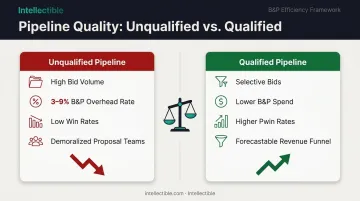
Every submitted proposal represents real B&P cost. Deltek's data shows B&P indirect rates ranging from 3% to 9% of annual revenue depending on contractor size — overhead that scales directly with bid volume and inversely with selectivity.
The strategic cost runs deeper. Chasing unqualified bids consumes the bandwidth your team needs for opportunities it can actually win. A qualified pipeline — fewer bids, better fit — produces measurably higher pwin rates and a revenue funnel you can forecast against. Without disciplined assessment up front, volume becomes the enemy of performance.
Key Criteria for Qualifying a Government RFP
Think of this as your bid qualification scorecard. Most high-performing GovCon teams use a weighted scoring approach — modeled on how agencies evaluate proposals — so that bid decisions reflect the same rigor as the responses themselves.
Scope and Technical Fit
Does your core capability match the Statement of Work or Performance Work Statement? Gaps that require significant teaming, unplanned subcontracting, or skill acquisition you haven't budgeted for are disqualifying factors that compound during proposal development.
Strong technical fit signals:
- Directly applicable past contracts in the same functional area
- Certified personnel matching the required labor categories
- Existing tools or methodologies the SOW explicitly names or describes
Eligibility and Compliance Requirements
These are automatic disqualifiers — there's no partial credit. Before any deeper analysis, verify:
- NAICS code: Does your firm qualify as small under the size standard tied to the solicitation's assigned code? (You have 10 calendar days to appeal a NAICS designation to SBA's Office of Hearings and Appeals.)
- Set-aside designation: Is your certification current and SBA-verified? SDVOSB self-certification ended January 1, 2024 — if you haven't completed SBA certification, you're ineligible for SDVOSB set-asides.
- CMMC requirements: For DoD contracts involving FCI or CUI, verify the level stated in the solicitation against your current assessment status. (Note: Phase II was suspended in July 2026; Phase I self-assessment requirements remain active.)
- Geographic or clearance requirements: Can you perform where and how the government requires?
Competitive Landscape and Incumbent Risk
Two questions drive this assessment: Is there a known incumbent? And is this solicitation written to favor them?
Signals of incumbent-friendly solicitations:
- Very specific past performance requirements that mirror one contractor's portfolio
- Short response timelines that disadvantage challengers
- SOW language that closely mirrors existing task order language
Use SAM.gov Contract Award Data and USASpending.gov to identify prior awardees. A prior awardee isn't automatically the incumbent. Match the agency, scope, vehicle, and contract identifiers carefully before drawing conclusions.
Past Performance Requirements
Government RFPs specify recency, relevance, and contract value thresholds — all three matter. If you can't cite two to three closely relevant contracts meeting the size and scope requirements, the proposal will score poorly in this category regardless of your technical approach.
Check the solicitation's past performance section before anything else. Qualification bars vary significantly. For example:
- A $15M IDIQ may require three contracts of $2M+ within the past five years
- A smaller service contract may only require general domain experience
- Some solicitations specify a minimum contract value per reference — missing that threshold by even a small margin disqualifies the citation
Strategic and Financial Fit
Even winnable contracts aren't always worth pursuing. Ask:
- Does the bid-cost-to-contract-value ratio make sense?
- Does winning this contract support agency relationships, vehicle access, or growth objectives you've committed to?
- Is the period of performance something your team can staff given current backlog?
If a contract fails more than one of these tests, document why before committing resources — that reasoning shapes smarter bid decisions on the next similar opportunity.
How to Assess a Government RFP: Step-by-Step
Teams that win consistently don't make ad hoc decisions under deadline pressure. They follow a repeatable process. The most common failure mode isn't skipping Go/No-Go entirely — it's treating it as a single conversation rather than a structured workflow.
Step 1 – Initial RFP Screen
Pull the key facts in the first pass — this should take under 30 minutes:
- Agency and contracting office
- NAICS code and set-aside type
- Submission deadline and response window
- Estimated contract value and ceiling
- Period of performance and place of performance
This screen filters immediate disqualifiers before any deeper analysis. If the set-aside doesn't match your certification or the NAICS code is wrong, stop here.
Step 2 – Gather Internal Inputs
Assess internal readiness before going further:
- Available technical staff with relevant qualifications
- Past performance citations that match scope and dollar thresholds
- Current backlog and capacity to execute if awarded
- Whether teaming partners are needed — and available
Identify who within the organization needs to weigh in. A Go/No-Go made without ops and finance input is incomplete — and likely wrong.
Step 3 – Analyze Competition and Market Position
Research the competitive environment:
- Search SAM.gov for prior awards on the same vehicle or agency
- Identify the likely incumbent via USASpending.gov award history
- Estimate price-to-win range using publicly available contract data
- Assess whether your team has a credible path to differentiation
If the market analysis shows a deeply entrenched incumbent and a solicitation written to their strengths, document it and factor it into the score.
Step 4 – Score Against Qualification Criteria
Apply your Go/No-Go scorecard across each dimension and assign weighted scores:
- Scope fit — does the requirement align with your core capabilities?
- Eligibility — certifications, set-aside type, NAICS match
- Competition — incumbent strength and differentiation path
- Past performance — relevant citations at matching dollar thresholds
- Strategic value — pipeline priority, relationship-building, or contract vehicle access
Document the rationale for each score, not just the total. The reasoning is what makes the decision defensible and repeatable across your team.
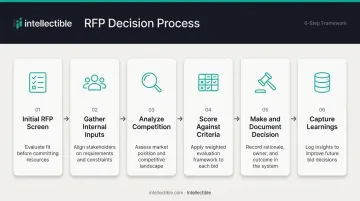
Step 5 – Make and Document the Go/No-Go Decision
Bring together the BD lead, capture manager, and an ops or finance stakeholder to review the scored assessment and issue a formal recommendation with written rationale.
Documentation serves three functions:
- Creates an audit trail for compliance and review
- Accelerates learning across similar future opportunities
- Builds institutional memory that doesn't walk out the door with personnel changes
Step 6 – Capture Learnings and Update Pipeline
Whether Go or No-Go, log the decision and reasoning into your opportunity pipeline. No-Go decisions that capture disqualifying factors let you screen similar RFPs faster next time. Go decisions should feed directly into the capture and proposal plan — the scored assessment, competitive notes, and internal readiness findings become the foundation for your proposal strategy.
RFP Assessment in Action: A GovCon Walkthrough
Consider a mid-sized IT services contractor that receives a federal RFP for a cybersecurity operations support contract — a 5-year IDIQ with a $15M ceiling, set aside for SDVOSBs, with a 21-day response window.
Initial Screen: Two Flags Surface Immediately
The contractor holds a current SBA-verified SDVOSB designation — eligibility pass. But the NAICS code listed is adjacent to their primary code, not an exact match. Easily missed under time pressure, but it requires a size standard compliance check before proceeding.
Timeline Flag: 21 Days vs. the FAR Baseline
For a noncommercial services IDIQ of this value, FAR 5.203 establishes a 30-day baseline response period. A 21-day window is shorter than that baseline — the team should verify whether the acquisition is classified as commercial services before treating the deadline as compliant.
Competitive Analysis: Incumbent Identified, Past Performance Thin
The team identifies a known incumbent via USASpending.gov award history and estimates four to six other SDVOSBs are likely to compete, based on bidder density in this NAICS/PSC combination. The past performance requirement — three contracts of $2M+ in the past five years — is a threshold their portfolio barely clears, with one citation that's borderline on recency.
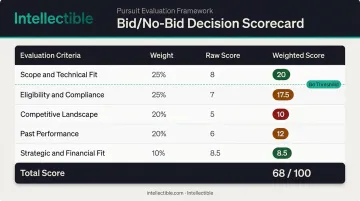
Scorecard output (sample):
| Criterion | Weight | Score (1–10) | Weighted Score |
|---|---|---|---|
| Scope and Technical Fit | 25% | 8 | 20 |
| Eligibility and Compliance | 25% | 7 | 17.5 |
| Competitive Landscape | 20% | 5 | 10 |
| Past Performance | 20% | 6 | 12 |
| Strategic and Financial Fit | 10% | 8.5 | 8.5 |
| Total | 68/100 |
The Go/No-Go Decision: Conditional Approval at 68
The team threshold is 70. At 68, the BD lead uses the documented assessment to make a conditional Go — contingent on securing a teaming partner with stronger past performance by day 7. Without a documented threshold and scoring rationale, that decision becomes a subjective conversation. With it, the team has a defensible, time-boxed commitment with a clear contingency.
How Intellectible Can Help Automate RFP Assessment
Intellectible is an AI capture system built for GovCon teams that want to systematize bid qualification without adding headcount. Its GovCon Engine automates the assessment workflow from opportunity intake through Go/No-Go decision — replacing hours of manual analysis with structured, auditable output. Rather than functioning as a federal data dashboard, the GovCon Engine finds the best-fit opportunities for your firm, explains the fit, and maps incumbents — applying semantic fit analysis and configurable capture rules to triage the federal market at scale.
What the Platform Does in Practice
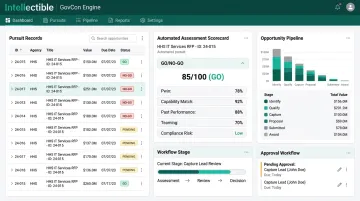
When a solicitation enters the platform, the GovCon Engine automatically extracts:
- Key dates, deadlines, and submission rules
- NAICS and PSC codes for opportunity classification
- Evaluation criteria and scoring methodology
- Compliance obligations and regulatory requirements
- Risk signals, data gaps, and fit rationale matched against the organization's capture profile
Each solicitation produces a structured pursuit record — a Go/No-Go report that scores fit, urgency, risk, contract terms, and capability match. The platform routes a pre-populated assessment summary to the right stakeholder (BD lead, capture manager, finance) with:
- Approval workflows tied to each decision stage
- An activity log that timestamps every action
- Role-based delivery so the right person reviews the right data
Competitive Intelligence Built In
The platform maps the contract behind each opportunity — surfacing award history, likely incumbents, expiring contracts, teaming targets, and competitive threats — and delivers market and competitive intelligence including bidder density, vendor concentration, past performance profiles, and vehicle access, all drawn from federal award data. It also builds pre-RFP market reports for RFIs and sources-sought notices, giving capture teams structured intelligence before a formal solicitation ever drops. At scale, the platform has processed 3,217 opportunities in a single 24-hour period — demonstrating the throughput that automated qualification makes possible where manual triage cannot.
Results in GovCon Contexts
Oceus, a defense contractor, used the Intellectible GovCon Engine to more than double the qualified opportunities it surfaces and reviews each month — moving from a manual triage process to a structured capture pipeline that clears their internal threshold consistently. HHS's Corporate Director of Business Development noted that the platform removes "the tedious, monotonous hours of RFP efforts out of human hands."
GovCon teams ready to move from reactive bid-chasing to a qualified, prioritized pipeline can see the GovCon Engine in action at intellectible.com/book-demo.
Frequently Asked Questions
What is an RFP assessment?
An RFP assessment is the process a contractor uses to evaluate a government solicitation against internal capabilities and external competitive factors before deciding whether to submit a proposal. It's distinct from proposal writing and from the agency's own evaluation of submitted bids.
What are the criteria for RFP assessment?
GovCon bid qualification comes down to five core criteria:
- Scope and technical fit
- Eligibility and compliance (NAICS code, set-aside designation, certifications)
- Competitive landscape and incumbent risk
- Past performance requirements
- Strategic and financial fit
What is the difference between an RFP and a questionnaire?
An RFP (Request for Proposal) is a formal government solicitation inviting contractors to submit proposals for a contract award. A questionnaire — or RFI/Sources Sought — is a pre-solicitation market research tool. No contract award results from an RFI or Sources Sought response alone.
What is a Go/No-Go decision in government contracting?
A Go/No-Go decision is a formal internal review where a contractor evaluates a specific RFP against qualification criteria and decides whether to invest proposal resources. A scored framework makes the decision consistent and defensible rather than subjective.
What makes a government RFP not worth pursuing?
Several factors can make a bid not worth pursuing:
- Missing eligibility requirements (wrong set-aside, NAICS mismatch, lapsed certification)
- Insufficient past performance citations
- A strong entrenched incumbent
- An unrealistically short response window
- Contract value that doesn't justify bid cost given current capacity
How long does it take to assess a government RFP?
A thorough manual assessment typically takes several hours to a full day, depending on solicitation complexity. Automated qualification workflows can cut initial screening and scoring to under 30 minutes while generating a documented decision record.