Introduction
Missed requirements, slipped color reviews, and page-limit overruns sink federal proposals—even when the technical solution is strong. A Proposal Management Plan (PMP) stops that. It allocates effort, structures the work, and sets timelines so your team ships a compliant, competitive response on schedule.
For GovCon teams pursuing federal and state opportunities, the PMP is the control layer for the pursuit. Every RFP requirement gets covered. Contributors know their assignments. Color review milestones stay on track. The final submission hits the deadline without running even one page over the limit.
This guide covers what a PMP is, how to structure it for federal proposals, which components drive compliance and win positioning, and when different approaches fit based on proposal complexity and opportunity scale.
Key Takeaways
- Map roles, schedules, and deliverables from RFP release through federal proposal submission
- Stop missed requirements, duplicated effort, blown deadlines, and compliance kills before evaluation
- Cover compliance matrices, RACI assignments, color reviews, content workflows, and risk plans
- Scale detail to proposal complexity—systematic planning beats ad hoc approaches in competitive procurements
What Is a Proposal Management Plan?
The Association of Proposal Management Professionals (APMP) defines a PMP as the document that allocates effort, structures the work, and implements proposal-development timelines. In federal contracting, this means establishing the strategy, structure, processes, and accountability mechanisms that turn an RFP into a winning submission.
A solid PMP keeps the effort on track by making sure:
- Every proposal requirement is addressed
- Every contributor knows their assignments
- Every deadline is met
- The final submission is compliant and persuasive
How the PMP Differs from Related Documents
PMP vs. Capture Plan:
The Capture Plan is created before RFP release to develop win strategy and position your company as the preferred bidder. The PMP is created after RFP release to organize the tactical execution of proposal development. They should be linked (capture intelligence feeds PMP strategy) but serve different purposes at different lifecycle stages.
PMP vs. Proposal Schedule:
A schedule shows milestones for writing, reviews, and submission. The PMP includes that schedule plus compliance mapping, responsibility assignments, review criteria, quality assurance procedures, and risk management. A schedule alone isn't a full PMP.
PMP vs. the Proposal Itself:
The PMP is the planning document; the proposal is the actual response document submitted to the government.
When the PMP Is Created
Create your PMP within 24-48 hours of RFP release, right after your bid/no-bid decision and before the proposal kickoff meeting. As Shipley Associates recommends, complete and review the PMP before kickoff, then distribute it to all contributors at that meeting.
The PMP is a living document. Update it as conditions change, resources shift, or the agency issues amendments. Assign an owner to revise it after every amendment and major review so the team always works from the same plan.
Why GovCon Teams Use PMPs
Federal Proposals Are Complex by Design
Government RFPs demand systematic management. Agencies require:
- Compliance with dozens to hundreds of specific requirements across multiple volumes
- Strict page limits where even a one-page overrun can render your proposal unacceptable
- Responses to detailed evaluation criteria that determine scoring
- Submission by exact deadlines. Late proposals are generally excluded
Without a PMP, teams hit the same failure modes:
- Missed requirements and duplicated effort
- Inconsistent messaging across volumes
- Blown deadlines and contributor confusion
- Compliance gaps that knock proposals out before technical evaluation
PMPs Reduce Risk and Improve Outcomes
APMP's proposal framework treats the PMP as the control mechanism for the proposal lifecycle. It coordinates requirements analysis, compliance matrices, milestone tracking, assigned responsibilities, color reviews, quality assurance, and instruction-compliant submission. That coordination is what separates proposals that clear compliance gates from those that never reach technical evaluation.
PMPs reduce proposal risk by:
- Identifying resource gaps and conflicts early in the cycle
- Establishing backup plans and decision-making authority
- Creating accountability for every deliverable
- Catching compliance issues before submission
Real Consequences of Poor Planning
In Benaka Inc., B-418639, the contractor's required organization chart appeared on page 36 of a volume limited to 35 pages. The agency excluded that page, found a deficiency, rated the proposal unacceptable, and GAO denied the protest. Page control belongs in the PMP.
In Perimeter Security Partners, LLC, B-422666.4, ambiguous page-limit instructions led the agency to exclude required charts and rate the quotation unacceptable. GAO later found the solicitation latently ambiguous and recommended clarification, but the offeror had already lost. Documenting how your team reads page limits and other instructions in the PMP is how you avoid that outcome.
How the PMP Works in Federal Proposals
The PMP is the central organizing document proposal managers use to coordinate contributors across technical, pricing, past performance, and management volumes. Most federal proposal cycles run 2–8 weeks.
What Feeds the PMP
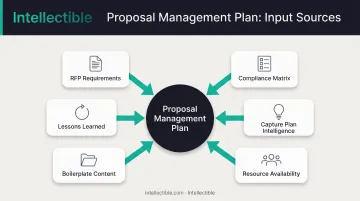
Your PMP integrates inputs from:
- RFP requirements, evaluation criteria, and submission instructions
- Compliance matrix mapping requirements to proposal sections
- Capture plan intelligence on win themes and competitive positioning
- Available resources and contributor time commitments
- Company boilerplate content and past performance examples
- Lessons learned from previous proposals
RFP Analysis and Compliance Mapping
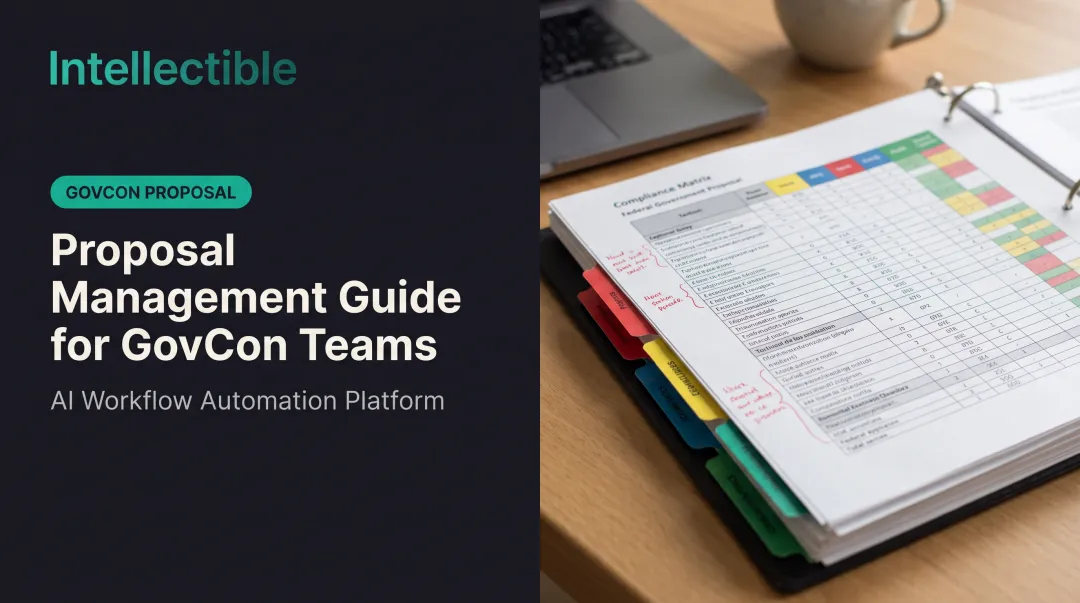
The proposal manager extracts all requirements, evaluation criteria, page limits, and submission instructions from the RFP and amendments, then maps each to specific proposal sections and responsible authors. This compliance matrix is a core APMP practice and becomes the accountability backbone of the PMP.
Responsibility Assignment Matrix
Define who drafts, reviews, approves, and is informed for each proposal section. The Responsibility Assignment Matrix (RAM) specifies:
- Primary authors for each section
- Subject matter experts providing input
- Reviewers at each color team stage
- Final approvers with sign-off authority
- Estimated time commitments for each role
This eliminates the "I thought you were doing that" failures that plague ad hoc proposals.
Color Review Schedule
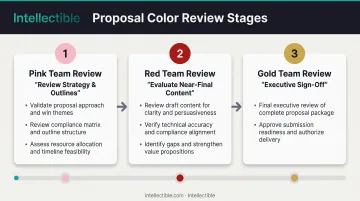
The PMP establishes review gates that catch issues before they become submission failures. Shipley defines the standard sequence:
- Pink Team: Reviews storyboards, outlines, or writing plans before drafting to check strategy execution and approach
- Red Team: Reviews near-final content from the customer's perspective for focus, completeness, solution strength, and strategy alignment
- Gold Team: Final executive authorization to submit, often with a page-turn verification
Organizations vary in terminology and may combine reviews, but the principle remains: scheduled review gates with defined entry criteria, reviewer assignments, and exit standards prevent last-minute chaos.
Content and Knowledge Management Process
Establish procedures for:
- Accessing and updating reusable content libraries
- Maintaining version control throughout development
- Managing proposal repository access and permissions
- Ensuring contributors use current approved boilerplate
Without these controls, teams waste hours reconciling conflicting versions or recreating content that already exists.
Risk Management and Contingency Planning
Your PMP should name proposal risks and assign each a risk owner with a mitigation plan. Common risks include:
- Resource availability constraints
- Technical solution challenges
- Pricing complexity
- Dependency on third-party inputs
Define decision triggers up front: when you escalate to leadership, activate backup resources, or adjust proposal scope.
Progress Tracking and Status Reporting
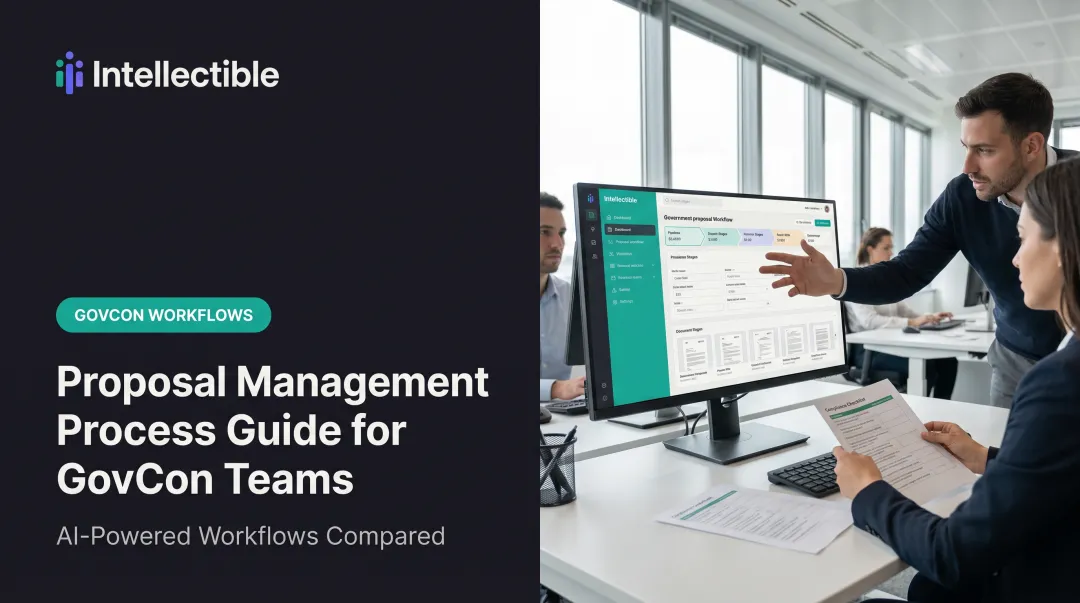
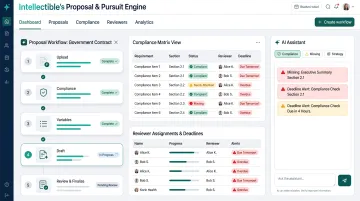
Proposal managers use the PMP to track section completion, identify bottlenecks, conduct daily standups, and report status to leadership. Modern workflow automation cuts much of that overhead. Intellectible's visual workflow builder and Proposal & Pursuit Engine can reduce tracking time by up to 90% and give real-time visibility into section status, reviewer assignments, compliance gaps, and deadline risk across distributed teams.
The platform maps each RFP requirement to a proposal section, owner, evidence path, status, due date, and dependencies. Coverage gaps and coordination issues surface automatically instead of waiting on manual status checks.
Key Components of an Effective PMP
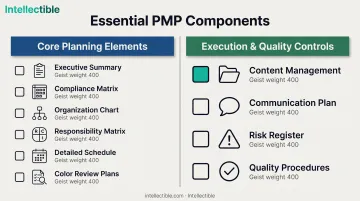
Every federal proposal PMP should include:
Core Planning Elements:
These pieces set strategy, map compliance, and make ownership and timing explicit:
- Executive summary of the opportunity and proposal strategy overview
- Compliance matrix mapping all RFP requirements to proposal sections and owners
- Organization chart showing team structure and reporting relationships
- Responsibility assignment matrix with drafters, reviewers, and approvers
- Detailed schedule with milestones, interim deliverables, and review gates
- Color review plans specifying dates, criteria, and reviewer assignments
Execution and Quality Controls:
These controls keep work coordinated and submission-ready as the draft moves:
- Content management process for accessing and version-controlling reusable material
- Communication plan defining standup cadence, status reporting, and escalation paths
- Risk register identifying proposal risks, owners, and mitigation plans
- Quality control procedures ensuring compliance checking and final verification
Format and Detail Considerations
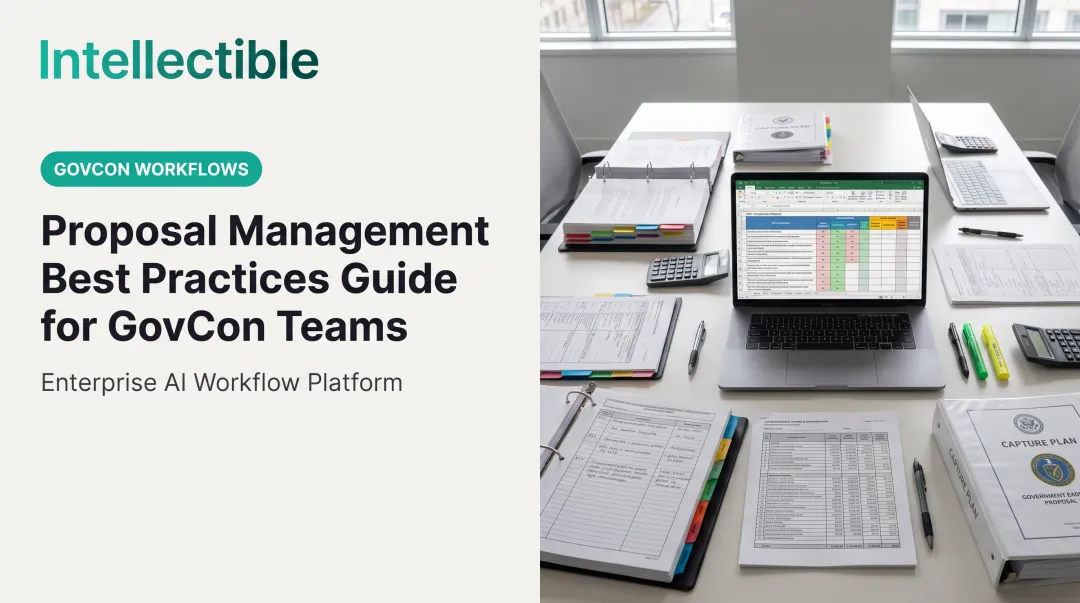
Most federal proposal PMPs live in Excel or project management software so teams can track and update them easily; simpler pursuits often use Word or PowerPoint. According to Shipley, a PMP may be one document or a set of files on a secure shared site for virtual teams.
Aim for enough detail that any team member knows what to do and when, without making the plan so rigid it is hard to maintain. Each section needs a clear owner, a specific deadline, and a concrete deliverable description.
Start from organizational templates adapted to your environment, and update the PMP as conditions change so it stays a working tool—not a one-time file no one reopens.
Common Issues and Misconceptions
"We Don't Have Time to Create a PMP"
This is the most expensive misconception in federal proposals. Spending 2-4 hours upfront creating a structured PMP prevents 10-20+ hours of rework, confusion, and missed requirements during proposal development.
Shipley observes that early planning participation eliminates waste and expensive rewriting. The PMP is what enables that early coordination.
Oversimplifying to Schedule-Only Documents
Many teams create a schedule-only document and call it a PMP. That approach skips critical elements:
- Compliance mapping
- Responsibility assignments
- Review criteria
- Risk management
A timeline without accountability mechanisms doesn't prevent failures.
Over-Investing in Elaborate Documentation
Some teams create elaborate multi-tab PMP documents with excessive process detail when that time would be better spent on proposal content. The PMP should provide "just enough" planning to enable effective execution, not become a proposal development project in itself.
When a Simplified PMP May Be Appropriate
Not every pursuit needs a full-scale proposal management plan. A condensed PMP can work when risk is low and the team already knows the drill.
Situations where a condensed PMP works:
- Small task order proposals under $500,000 with established teams
- Simple services procurements with minimal technical requirements
- Proposals with page limits under 20 pages
- Re-competes where the team and process are well-known
What "Simplified" Means
A streamlined PMP might fold several components into a single page: sections, authors, deadlines, and review dates. Skip lengthy process detail the team already knows.
Even simplified PMPs must address:
- Compliance with all RFP requirements (no exceptions)
- Clear assignment of responsibilities
- Defined review process with dates
- Deadline tracking to ensure nothing falls through the cracks
The FAR simplified acquisition threshold of $350,000 governs agency procurement procedures, not contractor PMP requirements. Scale your PMP to solicitation complexity and team familiarity, not to an arbitrary dollar threshold.
Conclusion
A Proposal Management Plan is the organizing document federal proposal teams use to coordinate contributors, ensure compliance, track progress, and deliver winning proposals on deadline. In competitive federal procurements, agencies score dozens of proposals against strict compliance criteria. Systematic planning is what separates proposals that advance from those that fail.
A solid PMP pays off across the full proposal cycle:
- Prevents role confusion and last-minute scrambles
- Catches compliance gaps early and cuts rework
- Keeps writers focused on evaluation criteria and discriminators
Match the plan's sophistication to the opportunity's complexity. In federal contracting, structured planning consistently beats ad hoc approaches.
Frequently Asked Questions
What is the difference between a Proposal Management Plan and a Capture Plan?
A Capture Plan is created pre-RFP to develop win strategy and position your company as the preferred bidder. The PMP is created post-RFP to organize the tactical execution of proposal development. They should be linked so capture intelligence feeds PMP strategy, but each serves a different purpose at a different lifecycle stage.
How detailed should a PMP be for a small federal task order proposal?
Even small proposals need basic PMP elements: compliance matrix, section assignments, review schedule, and deadlines. You can condense these into a single-page tracker rather than elaborate multi-tab documents, but eliminate none of them. The compliance consequences of missed requirements don't scale down with proposal size.
Who is responsible for creating and maintaining the Proposal Management Plan?
The Proposal Manager owns PMP creation and maintenance, with input from the capture manager, technical leads, and pricing team during kickoff. The PM updates the PMP as conditions change throughout development—including when amendments are issued, resources shift, or risks materialize.
What software tools are best for managing a Proposal Management Plan?
Common tools include Excel (most flexible for custom tracking), Microsoft Project or Smartsheet (for schedule-heavy PMPs), SharePoint (for team access and version control), and integrated proposal platforms like Intellectible (for compliance tracking and workflow coordination). Tool choice matters less than consistent use and disciplined updates throughout the proposal cycle.
When should the Proposal Management Plan be finalized after RFP release?
Complete your initial PMP within 24-48 hours after RFP release and before the kickoff meeting. However, the PMP remains a living document that gets refined as the team better understands requirements and as the agency issues amendments. Treat version control and change communication as ongoing responsibilities.
How do you handle changes to the PMP during proposal development?
Use version control with dated updates, communicate changes to all affected contributors via email or standup meetings, and maintain a change log tracking what was modified and why. This change history becomes valuable lessons-learned material for future proposals and helps teams understand how planning evolved under real conditions.