Introduction
Hundreds of federal solicitations hit SAM.gov every week. Most government contracting teams don't have the bandwidth to read them all carefully — so they either chase too many opportunities blindly, or they miss the ones they could actually win.
The uncomfortable truth: most teams lose bids not because their solution is weak, but because they misread what the agency actually wanted. They allocated writing effort to the wrong sections, missed a compliance requirement, or discovered a capability gap after the proposal was already drafted.
This guide covers a structured approach to RFP analysis: how to make smarter Go/No-Go decisions, decode evaluation criteria, and write proposals that align with how agencies actually score submissions.
Whether you're reviewing your first federal solicitation or standardizing a process your team runs weekly, the framework here is repeatable and built around how federal procurement evaluation panels actually operate.
Key Takeaways
- RFP analysis is a systematic review of a solicitation to identify eligibility requirements, evaluation criteria, scope of work, and compliance obligations — before writing begins
- Deltek's 2026 Clarity GovCon study of 917 contractors found an industry-average win rate of 48%, versus 72% for top performers — analysis discipline is the gap
- Every RFP requires analysis across five areas: eligibility, scope of work, evaluation criteria, submission format, and contractual terms
- A structured Go/No-Go screen run early prevents teams from investing proposal resources in bids they were never positioned to win
- Building a compliance matrix from Section L before drafting is the most reliable safeguard against disqualification for non-compliance
What Is RFP Analysis in Government Contracting?
RFP analysis, in the government context, is the process of systematically reviewing a federal or state solicitation to determine three things: whether the opportunity is pursuable, what the agency truly values, and how to position a proposal for the highest possible evaluation score.
This is different from what buyers do when they write an RFP. Bidder-side analysis is a structured reading exercise — the document to understand the agency's real priorities, not just what's printed on the page.
Solicitation Types That Require Different Analysis Approaches
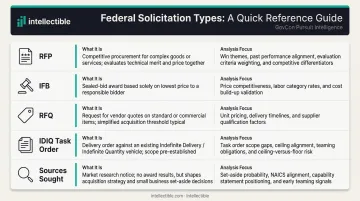
Not all government solicitations work the same way:
| Type | What It Is | Analysis Focus |
|---|---|---|
| RFP | Negotiated procurement; evaluated on technical merit and price | Section M evaluation weights, win strategy |
| IFB (Sealed Bid) | Lowest-responsive bidder wins; no tradeoffs permitted | Compliance, pricing accuracy |
| RFQ | Simplified acquisition; quotation is not an offer | Price competitiveness, scope alignment |
| IDIQ Task Order | Work placed against an established contract vehicle | Scope fit, vehicle eligibility |
| Sources Sought | Market research notice; not a bid vehicle | Capability positioning for future solicitations |
Why Government RFP Analysis Is More Complex
Federal solicitations carry compliance requirements that commercial proposals don't. Before any technical evaluation begins, bidders must clear several eligibility gates:
- SAM.gov registration: FAR 4.1102 requires active registration at submission and at award
- Set-aside eligibility: Designations like 8(a), SDVOSB, HUBZone, and WOSB impose ownership, certification, and size standard requirements
- Certification timing: Lapsed or pending certifications can disqualify an otherwise strong proposal
The formal evaluation scoring structure agencies must follow actually makes analysis more actionable, not less. Section M tells you exactly how submissions will be scored — specific detail that commercial RFPs rarely provide.
The 5 Critical Elements of Every Government RFP Analysis
Missing any one of these five areas costs real money — either wasted proposal budgets on bids you weren't eligible to win, or technically excellent submissions rejected on compliance grounds before scoring begins.
Eligibility and Compliance Requirements
Start with the hard gates — the requirements that disqualify a proposal regardless of proposal quality:
- SAM.gov active registration — a UEI alone is not sufficient; active registration must be in place at submission and at award
- NAICS code alignment — the contracting officer assigns the solicitation NAICS and corresponding SBA size standard; check your average annual receipts or employee count including affiliates
- Set-aside designation — 8(a), SDVOSB, HUBZone, and WOSB each carry distinct ownership, certification, and principal-office requirements from SBA
- Past performance thresholds — minimum contract size or recency requirements stated in the solicitation
- Security clearances and facility certifications — if the PWS implies classified work, verify clearance levels before investing in the bid
Build a compliance document checklist before any writing starts: representations and certifications, insurance certificates, teaming agreements if needed, and any agency-specific portal registrations.
Scope of Work and Deliverables
Reading the Performance Work Statement (PWS) or Statement of Work (SOW) is not a passive exercise. Look for what's implied as much as what's stated:
- References to specific technology platforms or systems already in use
- Delivery timelines that suggest familiarity with a particular approach
- Language that mirrors incumbent contract structures
Treat scope review as a gap analysis. Map every deliverable against your actual capabilities and flag anything that would require teaming, hiring, or capability development before award. Those gaps drive your teaming strategy — and they need to be resolved before your proposal goes out the door.
Evaluation Criteria and Weighting
Section M is the most strategically important section in any federal RFP. It defines exactly how the agency will score submissions — and many contractors underweight it in their analysis.
Key structures to understand:
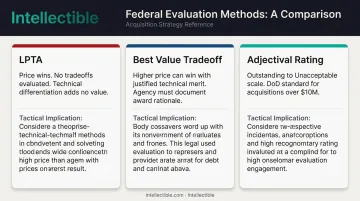
- LPTA (Lowest Price Technically Acceptable): Price wins — period. Non-price factors are not ranked; tradeoffs are prohibited. Differentiation beyond minimum acceptability adds no scoring value, so don't invest proposal resources in it.
- Best Value Tradeoff: A higher-priced offer can win if the technical or management value justifies the premium. The agency must document that rationale — which means your proposal must give them language to use in that justification.
- Adjectival rating systems: DoD uses Outstanding/Good/Acceptable/Marginal/Unacceptable for acquisitions over $10M. Know exactly what "Outstanding" requires for each evaluated factor — that's the bar your proposal must clear, not "Acceptable."
Allocate proposal writing effort proportionally to evaluation weights. If past performance carries 40% of the score, it deserves 40% of the team's energy.
Submission Format and Instructions
Section L is the compliance map for the entire proposal. GAO has upheld agencies' rights to reject proposals that violate material formatting instructions — including page limits, font requirements, and file naming conventions.
GAO case QED Systems (2022) confirmed that a noncompliant cost proposal structure made an offeror ineligible for award. The Futron (2022) case upheld rejection of a proposal missing required key-personnel information.
After reading Section L, build a compliance matrix immediately:
- List every required element from Section L
- Assign each element to a responsible person or team
- Map submission deadline milestones working backwards from the due date
- Track status as the proposal develops
Legal and Contractual Terms
Legal review needs to happen at the analysis stage — not after contract award. Focus on Sections H and I:
- IP ownership provisions — under FAR 52.227-14, unmarked delivered data can be treated as furnished with unlimited rights to the government
- Liquidated damages clauses — must be reviewed as a real financial exposure, not a formality
- Key personnel requirements — agencies like HHS require written contracting officer consent before replacing named personnel
- Contract type — FFP places maximum cost risk on the contractor; T&M requires surveillance and includes a ceiling; cost-reimbursement shifts risk to the government but requires rigorous accounting systems
Contract type, period of performance, and payment terms feed directly into your pricing model. If the margin math doesn't work under the contract structure, document that finding and bring it to the Go/No-Go decision — before the bid investment grows any larger.
How to Analyze a Government RFP: Step by Step
This is a repeatable workflow, not a one-time read-through. Running the same structured process on every solicitation means quality stays consistent regardless of who's leading the effort.
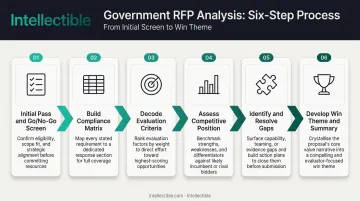
Step 1 – Conduct the Initial Pass and Go/No-Go Screen
In the first 30–60 minutes, extract the key hard-stop data points:
- Solicitation number and due date
- NAICS code and set-aside type
- Estimated contract value and period of performance
- Place of performance and any travel or clearance requirements
Run a rapid Go/No-Go screen before investing any deeper analysis time. Most government contractors pursue too many bids, not too few. Failing fast on the wrong opportunities preserves resources for the right ones.
Step 2 – Build the Compliance and Requirements Matrix
Map every mandatory requirement from Sections L and M into a compliance matrix. Columns should include:
- Requirement description
- Source section (e.g., Section L, paragraph 4.2)
- Response location in the proposal
- Responsible owner
- Status and completion date
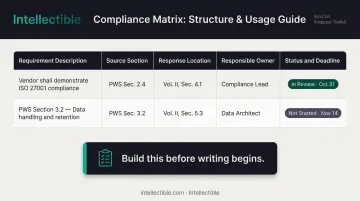
Assign owners and deadlines at this stage — the matrix runs the proposal effort from here forward.
Step 3 – Decode the Evaluation Criteria
Re-read Section M with a specific question: What does an Outstanding rating look like for each factor?
Research any prior award debriefs available through FOIA or public contract databases. Check SAM.gov for prior solicitation versions and award notices. Understanding how this agency has scored similar work before is the most underused advantage in competitive GovCon.
Step 4 – Assess Competitive Position
Review available intel on the incumbent through USASpending.gov and contract award search on SAM.gov. Look at contract timing, agency patterns, prior award values, and scope similarity.
This is where Go/No-Go decisions shift from "can we bid?" to "should we bid?" Honestly assess where your past performance, technical approach, and pricing position you relative to the likely competitive field.
Step 5 – Identify and Resolve Gaps
That honest assessment surfaces the gaps. Document every one identified across Steps 1–4:
- Capability gaps
- Past performance gaps (recency, relevance, size)
- Compliance gaps (certifications, registrations)
- Resourcing gaps (staffing, clearances)
Determine whether each gap is closable before submission through teaming, subcontracting, or certification pursuit — or whether it represents a disqualifying risk. This step generates action items with owners and deadlines.
Step 6 – Develop the Win Theme and Analysis Summary
Translate the analysis into a one-page capture summary:
- The agency's core problem or mission need
- Evaluation priorities (in weight order)
- Your team's competitive differentiators
- Gaps being addressed and how
- The proposed win theme
This document guides every downstream writing decision. When the writing starts, the team works from what the agency scores — not from internal assumptions about what sounds impressive.
Government RFP Analysis in Practice: A Scenario Walkthrough
Consider a mid-size IT services firm that receives a federal RFP for a cloud migration project: 30-day response window, Best Value tradeoff evaluation, small business set-aside designation.
1. Initial Compliance Check
The team spends under an hour confirming active SAM.gov registration, verifying the NAICS code matches their SBA size standard, and checking small business eligibility. No hard disqualifiers surface. The opportunity is pursuable.
2. Decoding the Evaluation Criteria
Past performance carries 40% of the evaluation score, with three recent, relevant federal cloud migration projects required as references. That single data point tells the team exactly where to concentrate proposal effort. Past performance isn't a box to check — it's the primary scoring driver.
3. Gap Analysis
The analysis surfaces a problem early: the firm has two qualifying past performance references, not three. Rather than submitting with a weak third reference, the team initiates a teaming conversation with a partner firm. The gap becomes a documented strength — a formal teaming arrangement that brings the required third reference into the proposal before a word is written.
4. Building the Win Theme
The win theme flows directly from Section M language: "proven federal cloud migration with zero-downtime delivery." That phrase runs through every proposal section — the technical approach, the management plan, the past performance narratives. Section M told the team what the agency would score. The win theme simply answers it.
How Intellectible Can Help
For government contractors managing high volumes of solicitations, the manual process of triaging SAM.gov, scoring opportunities, and building compliance matrices is the bottleneck — not proposal writing ability.
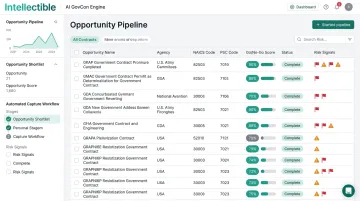
Intellectible's AI GovCon Engine automates the opportunity intake, Go/No-Go scoring, and pipeline tracking workflow that teams currently manage in spreadsheets. It is an AI capture system built for capture teams — not a federal data dashboard. Every federal notice becomes a structured capture record pre-populated with agency, office, NAICS, PSC, timing, scope, fit rationale, risk signals, and recommended action — using semantic fit analysis and configurable capture rules — before an analyst ever opens it. The platform also maps the contract behind each opportunity, surfacing award history, likely incumbents, expiring contracts, teaming targets, and competitive threats, and delivers market and competitive intelligence including bidder density, vendor concentration, past performance profiles, and vehicle access.
What this means in practice:
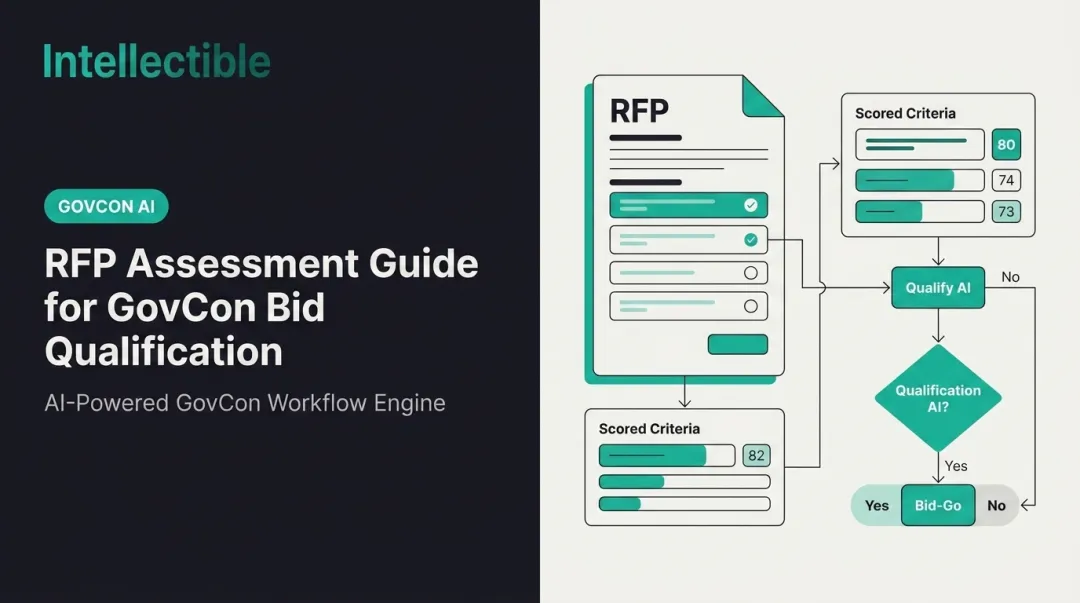
- Analysts receive shortlisted opportunities with Go/No-Go scores already generated across fit, urgency, risk, contract terms, and capability match
- Compliance matrices are automatically generated from solicitation documents — no manual extraction required
- Competitive and incumbent analysis pulls from federal award data to surface bidder density, contract timing, and comparable past performance
- In single-week spans, the platform has processed 3,217 opportunities and analyzed 37 RFPs — volume that no manual team can sustain
Clients including Oceus and HHS have used the platform to change how their teams work. Oceus CEO Jeff Harman noted: "Now we're looking at more than double the qualified opportunities per week — about seven to eight opportunities a month making it through our threshold." HHS Corporate Director of Business Development John Grady put it directly: "Intellectible is taking the tedious, monotonous hours of RFP efforts out of human hands. This allows us to do what we should be doing, analyzing and selling."
The result: analysts spend their time on deep RFP analysis for the right bids, not on triage — without adding headcount to get there.
Frequently Asked Questions
What is RFP analysis?
RFP analysis is the structured review of a solicitation document to assess eligibility, decode evaluation criteria, map compliance requirements, and determine whether and how to bid. In government contracting, the goal is to understand what the agency will actually score, not just what the document says on the surface.
RFP analysis is the structured review of a solicitation document to assess eligibility, decode evaluation criteria, map compliance requirements, and determine whether and how to bid. In government contracting, the goal is to understand what the agency will actually score, not just what the document says on the surface.
What does a good RFP look like?
From a bidder's perspective, a well-structured government RFP clearly separates instructions (Section L) from evaluation factors (Section M), provides a clear scope of work, and includes realistic timelines. When those elements align, bidders produce stronger proposals and agencies receive more responsive submissions.
What is RFP vs. RFQ vs. RFT?
An RFP invites vendors to propose a solution and is evaluated on technical merit and price. An RFQ (Request for Quote) is used when requirements are already defined and price is the primary differentiator; unlike an RFP response, a quotation cannot be accepted to form a binding contract. An RFT is common in public sector contexts outside the US and functions similarly to a formal competitive bid process.
How do you make a Go/No-Go decision on a government RFP?
The key factors are eligibility compliance, NAICS and set-aside fit, realistic competitive position based on past performance, available proposal resources, and estimated probability of win. Contractors with strong win rates apply this discipline consistently — skipping it leads to wasted resources on bids that were never winnable.
What are the most common reasons government bids are disqualified?
The most common compliance failures are missing or expired SAM.gov registration, responding to a set-aside the company doesn't qualify for, violating Section L formatting and page limit rules, and omitting required attachments or certifications. Most of these are entirely preventable with a compliance matrix built during the analysis phase, before proposal writing begins.