Introduction
The six signal families are a starting taxonomy for a market-specific sales library. RevOps needs more than names: each signal must have a relevant source, evidence standard, freshness rule, owner, and test. This guide turns the taxonomy into a library the sales team can review and improve.
Most teams struggle to act on that evidence. A Bombora-sponsored 2021 intent survey found 56% of B2B marketers saw data quality as a major challenge, and about half had trouble making intent data actionable.
This article groups signals into six families: hiring, funding, leadership change, launch or expansion, technology motion, and behavioral intent. Each differs in evidential value, freshness, and the sales action it calls for.
Key Takeaways
- The six families show a need emerging, budget appearing, ownership changing, an initiative launching, a tech shift, or a buyer engaging.
- A signal must be real, dated, source-linked, and tied to a good-fit account.
- Map each signal to a message, channel, urgency, owner, and next step, not one unexplained score.
What Are Buying Signals and Why Use Families?
A signal library is a set of documented reasons an account could need your service, not a menu of every event a tool can detect. Organize it into people, operations, technology, growth and capital, competitive and procurement, and relationship history. Retain only signals tied to the market and offer.
Buying signal families improve interpretation because each answers a different question:
- Hiring: what problem has someone been authorized to solve?
- Funding: is there capacity to spend?
- Leadership: who owns decisions now?
- Launch or expansion: what new requirements exist?
- Technology: what is changing in the stack?
- Behavior: who is engaging right now?
External events versus first-party engagement
These families show up in two places. Public events, such as a job posting or an award, help you find accounts before any outreach. First-party signals, such as website visits, content engagement, replies, and pricing questions, tell you what to do once engagement begins.
Terminology is messy. Forrester's 2022 report notes that vendors use "intent data" as a catch-all, and recommends assessing each data type individually and alongside other insights.

The Six Buying Signal Families Explained
Hiring and role-specific staffing changes
A new role shows a problem the company has funded someone to solve. The job description matters most. A posting for a proposal manager, pricing analyst, revenue operations lead, or compliance specialist says far more than "company is growing 20%."
Distinguish specific hiring from generic headcount growth:
- Ten new roles in a function related to your offering is a signal
- Ten scattered openings is noise
- Route outreach to the manager who will own the function
Funding and budget events
Funding rounds, contract awards, budget approvals, and acquisitions show increased capacity to spend. They do not prove the account wants your category.
Verify the event and work out what initiative it might support. Skip the generic congratulatory email.
A federal contract award in SAM.gov award data is history, not a future requirement. GSA warns that its forecasts may be revised or canceled.
Leadership and decision-maker changes
A new executive, department head, program owner, or a former champion landing at a new company can unsettle existing processes and vendor choices. Wait until the new leader has enough context to own priorities. Then tailor outreach to the workflow or roadmap they inherited.
No authoritative benchmark supports a magic "first 90 days" window, so treat timing as something to test.
Launches, expansions, and new initiatives
Product launches, new programs, geographic expansion, contract starts, and facility growth create operational requirements. Connect the event to a likely workflow gap, such as a new region needing localized pricing or a new contract needing a proposal process.
The event alone doesn't establish budget, authority, or category intent. Keep the claim qualitative unless you can document the account's actual initiative.
Technology motion
Adopting, expanding, replacing, or visibly dropping a tool can point to an operational change, an integration need, or dissatisfaction. Use it mainly for qualification and relevance.
Verify the source. Website fingerprinting tools match patterns in HTML and scripts, and Wappalyzer's documentation warns that short or generic patterns can misidentify technology.
Having a tool doesn't mean a replacement is coming.
Behavioral intent
Behavioral intent covers pricing or product page visits, content engagement, category research, evaluation questions, and replies to outreach. It's often the freshest family and the quickest to decay.
It becomes meaningful when tied to ICP fit, a named person or role, and a related account event. A pricing-page visit from a poor-fit company is still a poor-fit company.
How to Evaluate and Act on Buying Signals
Define Signal Evidence Alongside Account Fit
Give each signal a repeatable record: definition, target segment, original source, legal-entity matching rule, event date, publication lag, freshness limit, evidence standard, owner, and disqualifiers. Record the observed event separately from the inferred business need and proposed next action.
Verify the event, date, source, and freshness
Apply the "real, dated, source-linked" test: what happened, when, and where can it be verified? Then set cadence by decay rate. Behavioral activity needs faster attention than technology or leadership changes.
Speed matters for inbound. A Harvard Business Review study of 1.25 million leads found that firms responding within an hour were nearly seven times as likely to qualify the lead as those responding later. The sample mixed B2B and B2C companies, so treat it as directional.

Map each family to a specific sales play
Every signal record should state the likely business implication, relevant buyer or department, message angle, channel, urgency, and owner. A role-specific hiring signal goes to the manager of that function, with a message about the function, not about an intent score.
Combine independent signals without double-counting
A new initiative plus relevant hiring strengthens a case. Three articles about the same funding round count as one signal. Keep the underlying evidence visible so outreach can reference the real event.
Treat signals as evidence, not automatic qualification
Watch for common false positives:
- Funding with no relevant initiative
- Engagement from a non-buyer, such as a student or competitor
- A technology change unrelated to your offering
- A public announcement that's already stale
Require human review before a signal changes opportunity status, forecast assumptions, or a major pursuit decision.
How to Operationalize Signal-Based Revenue Workflows
Build a shared signal record and ownership process
Capture these fields for every signal:
- Account and signal family
- Event description and source link
- Event date and detection date
- Freshness
- Affected function and likely buyer
- Recommended action and owner
- Outcome
A shared record stops sales, marketing, proposal, pricing, and operations teams from reading the same event differently.
Use automation for collection and routing, human review for decisions
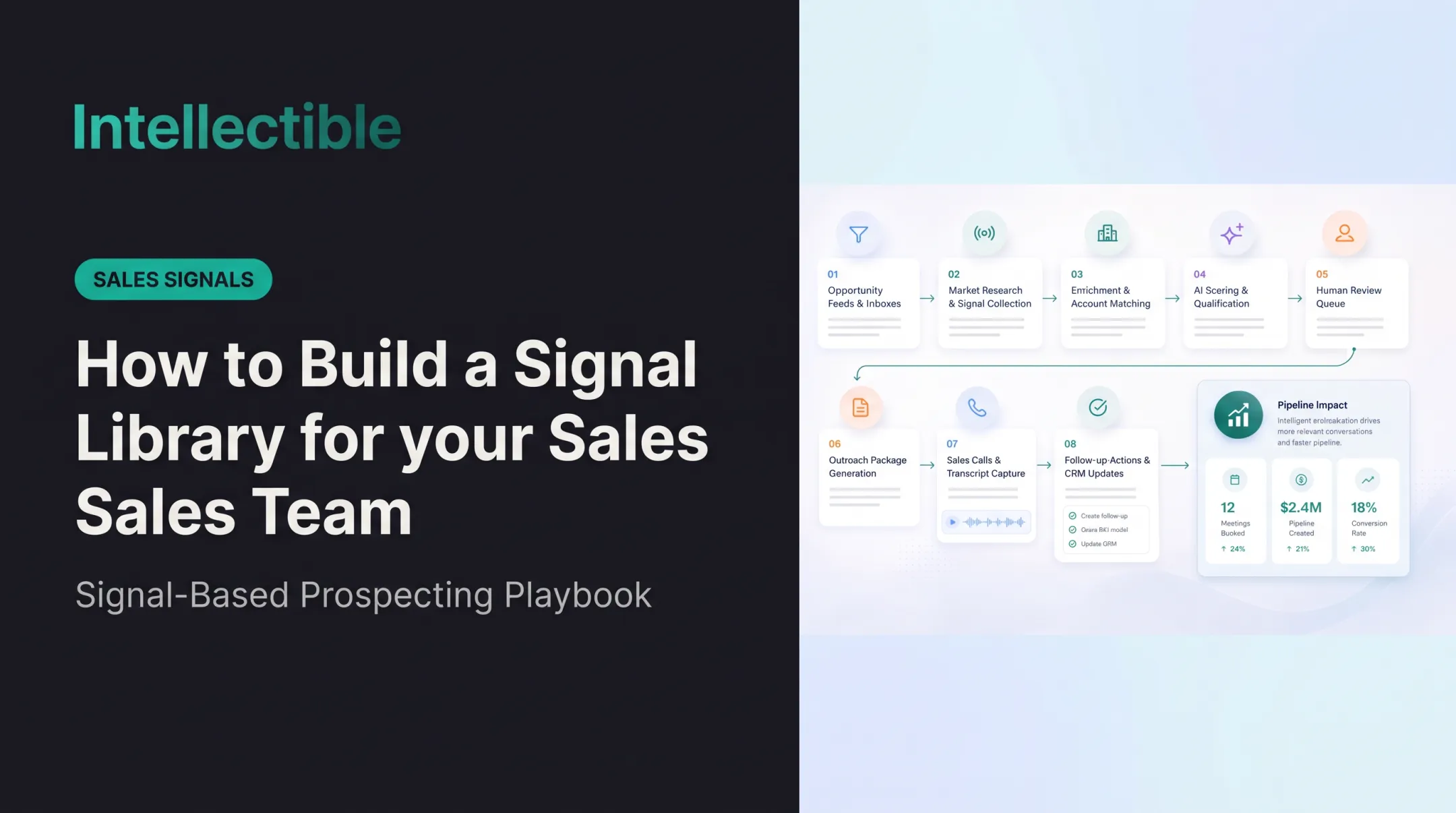
Connect public sources, CRM data, documents, APIs, website activity, and conversation records. Then route results through fit checks, deduplication, freshness rules, and human approval.

A simple flow looks like this:
- Detect a hiring posting for a pricing analyst at a good-fit account.
- Check fit, confirm the source and date, and dedupe against existing records.
- Draft outreach aimed at the pricing lead.
- A human approves before anything is sent or the CRM is updated.
Intellectible is one example of infrastructure for this. Its visual workflow builder connects AI, data, APIs, documents, business logic, decisions, and human review nodes, so teams can scale the process without adding headcount.
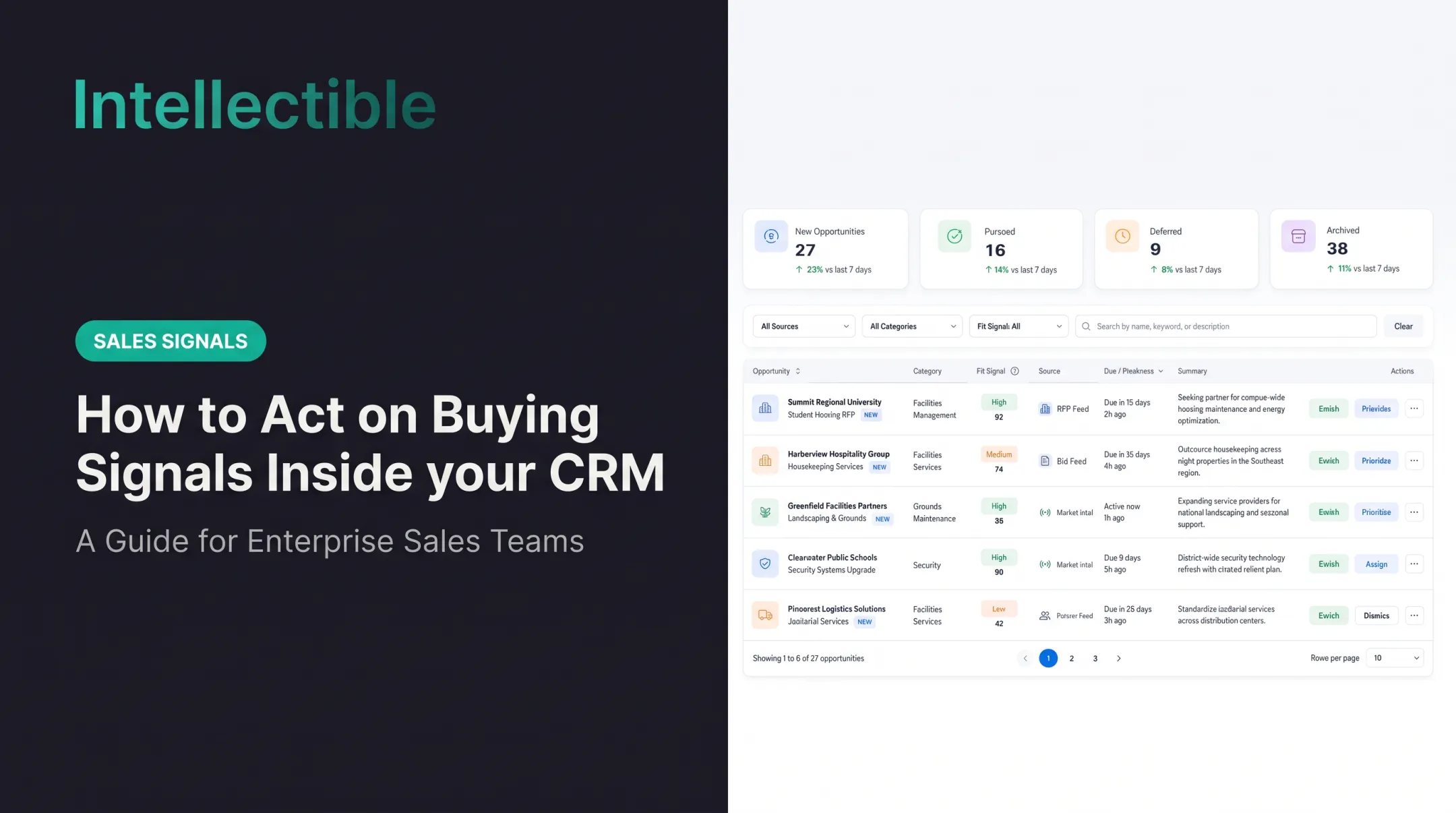
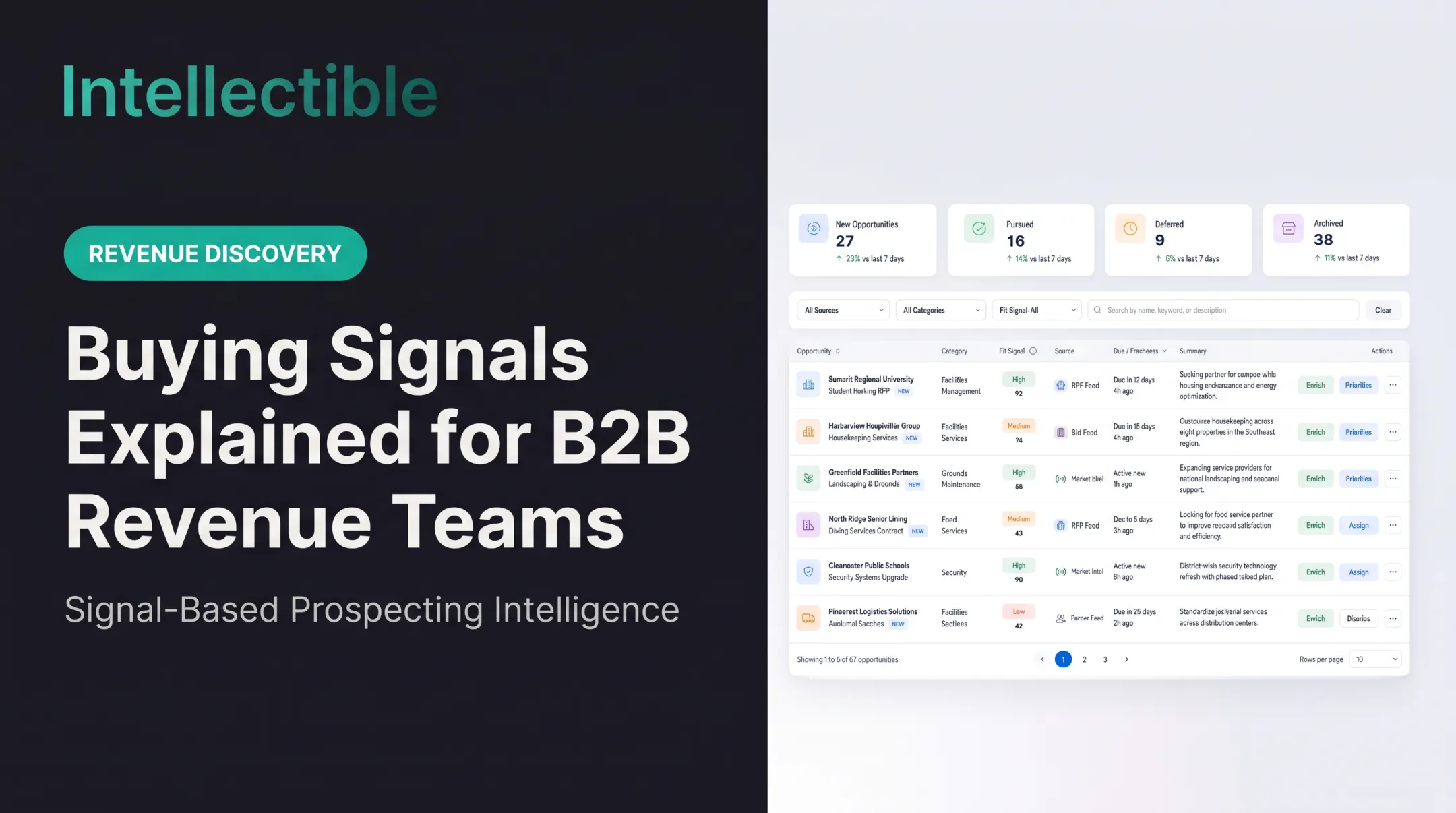
The Revenue Discovery engine monitors signals such as hiring pressure, funding rounds, leadership change, and expansion, attaches evidence, and queues accounts. It drafts outreach but sends nothing automatically, and four approval gates stay human.
Measure signal quality by downstream outcomes
Don't count alerts. Review which families lead to qualified conversations, opportunities, proposal activity, pricing requests, or disqualification.
No reliable public benchmark compares signal-triggered outreach with non-signal outreach. Forrester's 2025 report notes that organizations struggle to show business impact, so calibrate decay and prioritization rules against your own results.
Frequently Asked Questions
What makes a signal library useful?
A signal library is a set of documented reasons an account could need your service, not a menu of every event a tool can detect. Organize it into people, operations, technology, growth and capital, competitive and procurement, and relationship history. Retain only signals tied to the market and offer.
Which fields should every signal have?
Give each signal a repeatable record: definition, target segment, original source, legal-entity matching rule, event date, publication lag, freshness limit, evidence standard, owner, and disqualifiers. Record the observed event separately from the inferred business need and proposed next action.
How should the source set be chosen?
Choose sources that fit the purchase. A staffing team might inspect relevant awards and hiring patterns; healthcare services may depend on provider ownership and facility changes; logistics may depend on warehouses and operating expansion. A signal that works for software buying cannot be assumed to work for every services market.
How should a signal be tested before rollout?
Test a small historical sample before rollout. Ask reviewers to identify what actually happened, whether the entity is correct, whether the buying window remains open, and whether the evidence justifies contact. Record false-positive reasons, uncertain observations, and missing sources rather than tuning only for a high alert count.
How does the library connect to seller queues?
For every approved signal, define eligibility gates, contact-now versus research-needed rules, the evidence package, and the owner who accepts or rejects the account. Keep the library versioned so teams know which criteria produced a recommendation and can review changes.
How should the library improve over time?
Review rep acceptance, meetings, sales-accepted opportunities, and pipeline by signal type. Retire rules that produce noise, refresh stale sources, and add signals only when the market evidence supports them. The library should improve as the sales process learns.