Introduction
Federal procurement demands fluency in FAR regulations, agency-specific compliance requirements, and competitive bidding processes, all while scaling revenue. Many teams struggle to navigate System for Award Management (SAM) registration, socio-economic certifications, proposal compliance matrices, and DCAA audit readiness without specialized help.
According to a 2024 CohnReznick-Unanet survey of 1,255 government contractors, 69% reported difficulty winning new contracts and 45% lacked business-development resources. Government contract consultants have traditionally filled these gaps with expertise across registrations, capture, proposal development, and compliance.
The landscape is shifting. AI-powered platforms now automate opportunity identification, pipeline management, and proposal intelligence, delivering consultant-like outcomes through software rather than labor. This guide covers when consultants still make sense, what they deliver, how to evaluate them, and where software can replace or extend that support.
Key Takeaways
- Consultants supply FAR, registration, certification, and proposal expertise, but cost and ROI hinge on scope
- Use consultants for one-time or surge work; keep knowledge in-house; scale repetitive processes with AI
- AI platforms can deliver 95%+ time savings on Go/No-Go decisions and 150%+ pipeline growth with no added headcount
- Judge consultants on agency-specific wins, clear deliverables, and knowledge transfer, not credentials alone
What Is a Government Contract Consultant?
Government contract consultants are specialists who support federal contracting across the full lifecycle. That span covers market entry and SAM registration, proposal development, award, and ongoing compliance.
Most bring deep knowledge of the Federal Acquisition Regulation (FAR), agency-specific procurement processes, and prior experience as contracting officers or acquisition professionals.
Typical consultant backgrounds include:
- Former contracting officers with FAR warrant authority
- Acquisition professionals who managed government programs
- Proposal managers with APMP certification
- Contract specialists holding NCMA credentials (CFCM, CPCM)
- Industry veterans with agency or vertical-specific expertise
According to APMP's Winning Business Ecosystem, a proposal development consultant may lead, advise, or supplement high-priority or complex pursuits. Typical services include:
- Opportunity intelligence and pursuit strategy
- Win-theme development and proposal management
- Writing, compliance reviews, and debriefs
- Knowledge transfer to internal teams
Engagement Models
| Model | Best For | Scope Control |
|---|---|---|
| Project-based | SAM registration, one-time certification application, single proposal | Deliverables, review rounds, acceptance criteria, fixed deadline |
| Retainer | Ongoing capture guidance, compliance questions, recurring proposal support | Included hours, response time, rollover rules, named staff |
| Program-based | Embedded lifecycle support, multi-pursuit coverage, sustained revenue growth | Governance, pipeline coverage, metrics, knowledge transfer, exit plan |
Types of Government Contract Consultants
- Registration specialists — SAM, CAGE, UEI, and DSBS profile setup and optimization
- Socio-economic certification consultants — 8(a), WOSB/EDWOSB, VOSB/SDVOSB, and HUBZone applications
- Business development consultants — market research, opportunity identification, and agency relationships
- Proposal writing consultants — compliant responses, past-performance narratives, and win themes
- Compliance advisors — DCAA audit prep and FAR/DFARS requirements
- Full-service firms — all of the above under one engagement
What Consultants Do NOT Provide
Consultants guide and advise; they rarely replace internal capture and proposal functions. Your team still needs subject-matter experts, executive decision authority, technical writers, and delivery staff who understand the solution being proposed.
Key Services Government Contract Consultants Provide
Registration and Foundation Services
SAM registration is the entry point for federal contracting. GSA's SAM.gov requires a Unique Entity ID (UEI), which replaced the DUNS number on April 4, 2022. Activation can take up to 10 business days, and you must renew every 365 days.
Consultants verify data accuracy, select NAICS codes, strengthen capability narratives, and manage annual renewals so your registration stays active.
A strong DSBS profile raises visibility with contracting officers and primes searching SBA's Dynamic Small Business Search. Consultants build out capabilities, past performance, and contact details so you show up in the right searches.
CAGE codes are facility-specific identifiers created through SAM. The Defense Logistics Agency defines CAGE as the commercial and government entity code required for many contracts.
Socio-Economic Certification Assistance
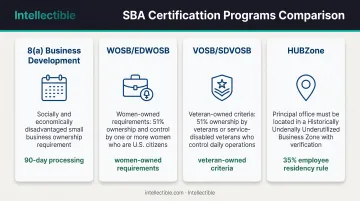
SBA certification programs open access to set-aside opportunities. Consultants prepare applications, gather documentation, and respond to SBA questions for:
- 8(a) Business Development – 51%+ owned and controlled by socially and economically disadvantaged U.S. citizens; SBA targets 90 days once the application is complete
- WOSB/EDWOSB – Women-owned small businesses; EDWOSB adds economic-disadvantage rules
- VOSB/SDVOSB – Veteran-owned and service-disabled veteran-owned firms via SBA VetCert
- HUBZone – Principal office in a HUBZone and at least 35% of employees living in a HUBZone
- State and local certifications (MBE, WBE, DBE, SBE) for non-federal set-asides
Market Intelligence and Opportunity Identification
Consultants map who buys what you sell and where the next awards are likely to land. Typical work includes:
- Identifying target agencies and primes, plus procurement patterns and recompetes
- Monitoring SAM.gov, agency forecasts, RFIs, sources sought notices, and draft RFPs
- Building a pursuit pipeline with pre-award tracking and competitive analysis
- Flagging teaming partners that fill capability or past-performance gaps
Proposal Development and Capture Support
Proposal services range from full writing to strategic guidance, including:
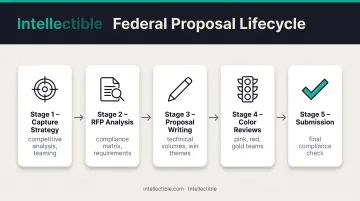
- Compliance matrices ensuring every requirement is addressed
- Win themes that differentiate your solution
- Past-performance narratives with quantified results
- Technical volume development and editing
- Proposal reviews (pink, red, gold teams)
Capture support sits upstream of the proposal. It covers competitive analysis, teaming strategy, and price-to-win work before the RFP drops. APMP frames consultant scope around opportunity intelligence, pursuit strategy, resource-gap analysis, volume writing and coaching, color reviews, debriefs, and knowledge transfer.
Compliance and Audit Preparation
Consultants help you stand up and maintain the controls federal buyers expect:
- FAR/DFARS requirement mapping and process design
- Accounting system adequacy and cost proposal support
- DCAA audit readiness
- Ongoing invoicing, labor tracking, and subcontractor reporting
- Contract closeout procedures
Strategic Marketing and Relationship Building
Your capability statement is the federal resume. Consultants shape a one- or two-page brief for contracting officers and primes—capabilities, past performance, certifications, and differentiators in one place.
Outreach goes beyond the PDF. Consultants run targeted email, warm introductions to contracting officers, industry-day presence, and pre-RFP relationship work so you are a known option when the solicitation hits the street.
When Your GovCon Team Needs Consultant Support
Consultant support pays off at clear inflection points—not as a permanent stand-in for internal capability.
Key Trigger Points
Bring in outside help when you hit these gaps:
- Initial market entry with no government contracting experience
- First major federal bid that demands complex compliance work
- Rapid scale after early wins without matching internal capacity
- Compliance audit concerns or DCAA readiness gaps
- Persistently low win rates despite active pursuit
Resource Constraint Scenarios
Consultants also fill capacity and expertise holes:
- Capture and delivery teams stretched too thin to run both well
- No in-house depth in proposal writing or pricing strategy
- Leadership without prior GovCon experience who need strategic guidance
High-Value Situations
ROI is highest in these pursuits:
- Contract vehicles (GSA Schedule, IDIQ) that need specialized knowledge
- Complex technical proposals under tight deadlines
- New agency markets where relationships start from zero
- Surge capacity during peak proposal seasons
Evaluating Consultant vs. In-House vs. Technology Solutions
Traditional Consultant Model
Pros:
- Immediate expertise access without hiring overhead
- Flexible engagement for specific needs
- No long-term employment commitment
Cons:
- Ongoing costs for recurring work
- Dependency on external resources
- Knowledge transfer challenges
- Consultant availability during peak periods
In-House Capability Building
Pros:
- Institutional knowledge retention
- Dedicated focus on your pipeline
- Long-term cost efficiency at scale
- Control over priorities and timelines
Cons:
- Time to hire and train qualified staff
- Higher fixed costs regardless of workload
- Difficulty finding experienced GovCon talent
- Turnover risk in competitive labor markets
Technology-Enabled Approach
AI-powered platforms now automate opportunity identification, pipeline management, proposal intelligence, and workflow orchestration. Teams get consultant-like outcomes through software instead of added labor—especially for repetitive capture and triage work that does not need a senior advisor every time.
Intellectible's horizontal AI build platform provides production-ready engines for government contracting workflows:
- Opportunity search and qualification: 95%+ time savings on Go/No-Go by turning federal notices into structured capture records
- Pipeline development: 150%+ more actionable opportunities via semantic matching, award mining, and competitive intelligence
- Proposal intelligence: Automated RFP parsing, compliance matrices, and requirement extraction
- Pricing automation: 90% faster pricing with audit trails, cost modeling, and approval workflows
Oceus reported reviewing more than twice the qualified opportunities per month, with about seven to eight clearing its threshold.
John Grady, Corporate Director of Business Development at HHS, said Intellectible removes "the tedious, monotonous hours of RFP efforts," so teams can focus on analyzing and selling.
Decision Framework
| Situation | Best Approach |
|---|---|
| One-time registrations or certifications | Consultant (project-based) |
| Specialized proposal surge capacity | Consultant (project or retainer) |
| Core capture and BD as you scale | In-house team |
| Repetitive opportunity triage and pipeline management | Technology platform |
| Complex strategic guidance or novel situations | Consultant or experienced in-house leader |
| Automating compliant processes at scale | Technology platform with human oversight |
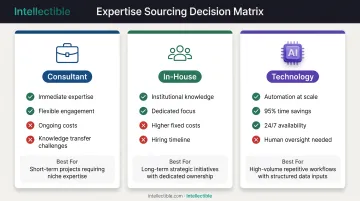
Hybrid model: Use consultants for foundational needs and specialized gaps. Build in-house for core strategic functions, and adopt AI platforms to automate repetitive work and augment both consultant and internal teams.
How to Select and Work with a Government Contract Consultant
The right consultant accelerates wins. The wrong engagement creates dependency, unclear ownership, and little lasting capability. Vet fit hard, set operating rules before kickoff, and plan the handoff from day one.
Key Selection Criteria
Hire for proof, not promises. Score candidates on relevant experience, credentials, samples, and a scope you can enforce.
Verify specific experience:
- Industry and target agency alignment
- Comparable pursuits with documented outcomes
- Client references and win-rate data
- Understanding of your business model and value proposition
Assess credentials:
- APMP Foundation certification (CF APMP) signals proposal-process knowledge
- NCMA CFCM demonstrates FAR and contract-management expertise
- NCMA CPCM covers broader contract-management competencies
- Former contracting officer experience (verify agency, warrant authority, duties, and recency)
Evaluate work samples and references:
- Request sanitized proposal excerpts or capability statements
- Check references with verifiable wins
- Ask for win/loss data with clear definitions
- Assess cultural fit and communication style
Define scope and deliverables:
- Clear service descriptions and acceptance criteria
- Review rounds and revision limits
- Schedule and milestones
- Knowledge transfer and documentation requirements
Best Practices for Effective Consultant Relationships
After you hire, treat the engagement like any other critical pursuit workstream: measurable, time-boxed, and owned.
Establish clear metrics upfront:
- Number of bids supported
- Submission quality scores
- Win/loss tracking with attribution rules
- Schedule adherence
- Compliance defect rates
Maintain regular communication:
- Weekly status calls during active pursuits
- Structured review and feedback cycles
- Escalation paths for issues
- Stakeholder alignment on priorities
Ensure knowledge transfer:
- Document processes and lessons learned
- Train your internal team on methodologies
- Build reusable templates and content libraries
- Record rationale for key decisions
Define decision-making authority:
- Who approves strategy and positioning
- Who makes final compliance calls
- Who owns technical content
- Who manages executive review cycles
Transition Planning
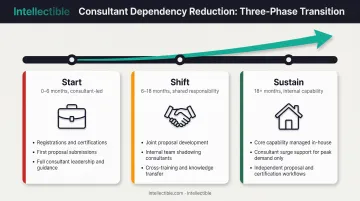
Plan the exit when you sign. Strong teams phase down dependency so core capture and proposal muscle stays in-house:
- Start: Consultant-led support for foundations—registrations, certifications, and first proposals
- Shift: Consultant-as-advisor through shadowing, joint proposals, and targeted training
- Sustain: Bring consultants in only for complex vehicles or surge capacity; keep core work internal
Frequently Asked Questions
What does a government consultant do?
Government contract consultants help businesses navigate federal procurement across registrations, certifications, opportunity identification, proposal development, and compliance. They fill knowledge gaps and add surge capacity for teams pursuing federal revenue.
How much do government contract consultants typically cost?
Costs vary by scope, experience, and engagement model, and no authoritative post-2020 fee benchmarks exist. Weigh proposal volume, writing vs. review, turnaround, and staff seniority against free options like APEX Accelerators before you commit.
When should a GovCon team hire a consultant vs. building in-house expertise?
Hire for market entry, one-time needs (certifications, GSA Schedule), or peak capacity overflow. Build in-house when sustained growth needs dedicated capture, proposal, and BD resources. A CohnReznick-Unanet survey found 45% of contractors lacked BD resources, so capacity often drives the choice more than capability.
What credentials or experience should we look for in a government contract consultant?
Prioritize prior government acquisition experience (former CO or program manager ideal), industry expertise that matches your offerings, verifiable wins, and credentials like APMP or NCMA. Confirm FAR/DFARS knowledge, and verify duties, warrant authority, and recency—not just titles—for former government personnel.
Can technology replace the need for a government contract consultant?
AI platforms can automate opportunity identification, pipeline management, compliance tracking, and proposal intelligence at scale. Human expertise still matters for strategy, relationships, and novel situations. A 2024 Washington Technology experiment found that GenAI output still needs human review, so technology augments expert judgment rather than replacing it.
How long does it typically take to see ROI from working with a consultant?
Registrations and certifications deliver immediate eligibility, but revenue impact usually takes 6–18 months given government sales cycles. GAO's 2024 DOD data shows median solicitation-to-award times of 32 days for contracts above $250K, excluding pre-solicitation work. Best ROI test: consultant cost versus the fully loaded cost of equivalent internal expertise.