Introduction
An enterprise signal-based selling playbook connects market research to a seller decision. It defines the library, eligibility gates, observed-versus-inferred evidence, account queues, action packages, and measurement. The aim is a repeatable process for a sales organization, not another collection of alerts.
Enterprise deals make that gap expensive. 6sense's 2025 buyer report puts the average buying journey at 10.1 months, and buyers often shortlist vendors before a rep ever reaches them.
Buying groups span five to 16 people, and priorities shift while the deal is open.
Signal-based selling uses observable business changes and buyer context to prioritize accounts, pick stakeholders, and time sales actions. This playbook covers signal architecture, scoring, routing, messaging, execution, measurement, and governance.
Key Takeaways
- A signal becomes actionable only when it is relevant, recent, tied to a business problem, and corroborated.
- Stacked signals beat isolated events as a basis for outreach.
- SDRs, AEs, RevOps, and marketing need shared routing, not rep-by-rep alerts.
- Measure signal quality, response speed, and pipeline outcomes, not outreach volume.
What Is Signal-Based Selling for Enterprise Sales Teams?
Signal-based selling is a team process. For a $20M–$500M company with a sales organization, begin with the market, service offer, buying roles, and six signal families. Give each signal a definition, source, evidence standard, freshness rule, disqualifier, and owner. A tool cannot compensate for unclear eligibility or an unowned follow-up process.
How It Differs From Intent Data and Trigger Events
The terms get blurred, so separate them:
- Firmographic fit: company attributes such as industry, headcount, locations, and revenue, per Salesforce's sales intelligence guide.
- Intent data: behavior ranging from specific purchase research to vague topic interest. Sources aren't interchangeable.
- Trigger event: a point-in-time change, such as funding, a hire, layoffs, or M&A.
- Signal-based selling: the system that weighs all of these together rather than treating one source as conclusive.
Why Enterprise Needs a Different Approach
One contact's job change means little if the committee never moves. Challenger research reports that 38% of purchase attempts end in no decision, and buying groups average more than 11 stakeholders. Procurement, security review, and consensus-building all extend the timeline.
Your champion or budget owner may also change mid-deal. No verified benchmark exists for how often that happens, so track it in your own CRM.
Build an Enterprise Signal Architecture That Prioritizes Buying Readiness
Start With ICP, Outcomes, and Buying Committees
Pick signal sources after you know your best segments, use cases, and historical wins. Then map each priority to the functions and seniority levels that influence the purchase.
Build a signal-to-action map with four lanes:
- Signals that inform account research
- Signals that trigger direct outreach
- Signals that justify multi-threading
- Signals that only feed nurture or monitoring
Build a Practical Signal Taxonomy
Organize signals into categories your team can act on:
- Contact movement and leadership change
- Hiring and organizational growth
- Funding, M&A, or strategic change
- Technology adoption
- Regulatory pressure
- Digital engagement
- Customer or competitor dissatisfaction
- Existing-account expansion
For each category, document:
- Source and business interpretation
- Affected persona
- Freshness requirement and decay period
- Owner and next action
Separate leading indicators from direct triggers and contextual evidence.
Public filings add useful context. SEC 10-Ks describe business risks and results, and 8-Ks report major events, generally within four business days. Treat them as disclosures, not proof of intent.
Score on Fit, Strength, Recency, and Corroboration
Score each signal on ICP fit, source reliability, urgency, stakeholder relevance, business impact, and supporting signals. No verified universal weights or thresholds exist, so calibrate against your own closed-won, closed-lost, and no-decision history.
Forrester notes that intent doesn't replace qualification. Corroboration is what separates a real buying window from noise.
Use four tiers:
- Immediate action: high fit, fresh, corroborated
- Researched outreach: strong fit, one solid signal
- Monitored account: fit without timing
- Nurture: weak or decayed signals
Govern for Quality, Privacy, and Trust
Cover source validation, duplicate events, stale data, false positives, and conflicting signals. Signals should open relevant business conversations, never speculative or intrusive ones.
Compliance basics:
- CAN-SPAM has no B2B exception, and opt-outs must be honored within 10 business days.
- California privacy rules can cover business contacts, since the B2B exemption expired in 2022.
- The NIST AI RMF offers a voluntary structure for oversight and testing.
Add human review for high-impact actions. Give sellers a documented way to reject, correct, or reclassify a signal so the system improves.
Operationalize the Signal-to-Opportunity Workflow
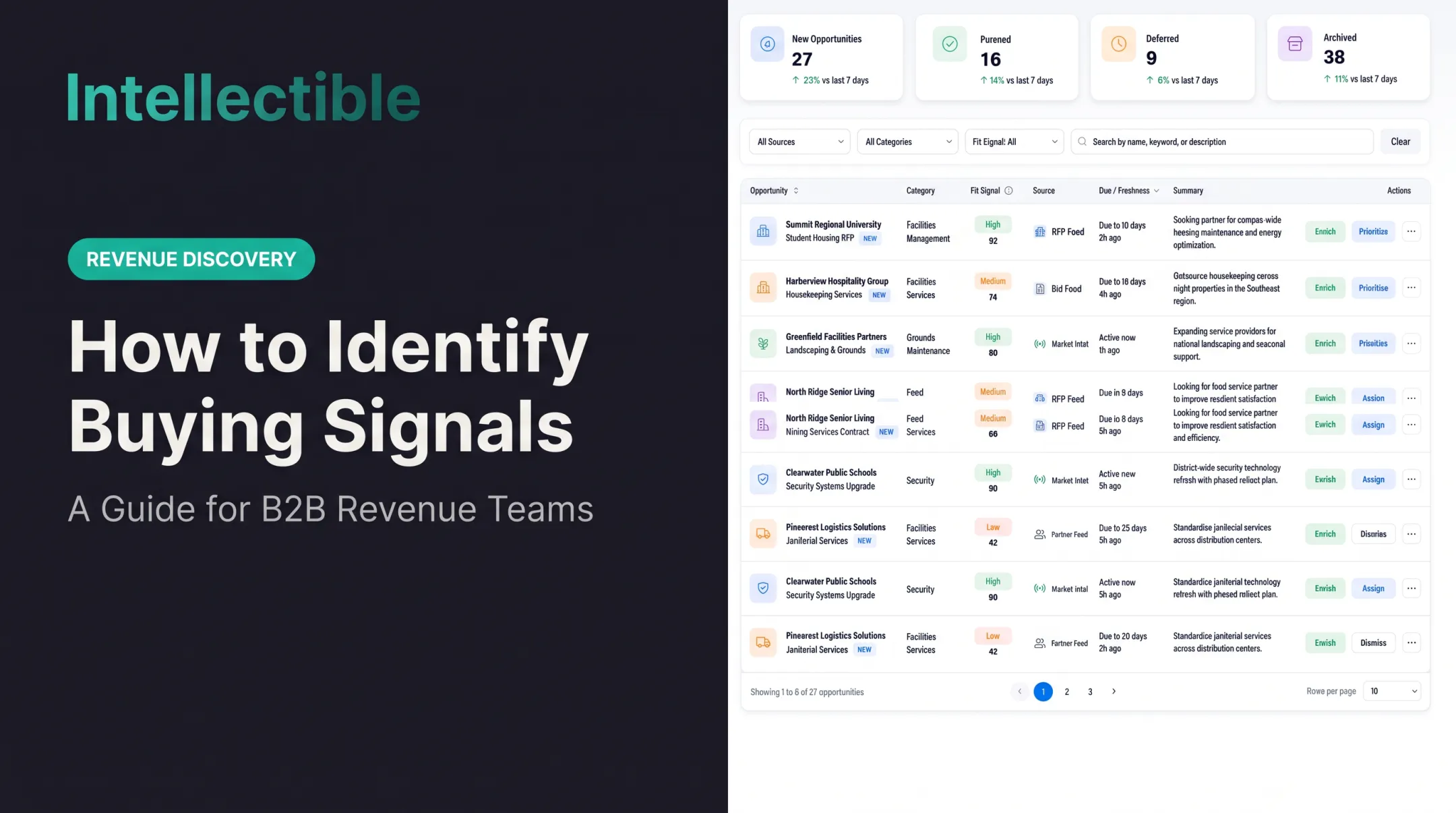
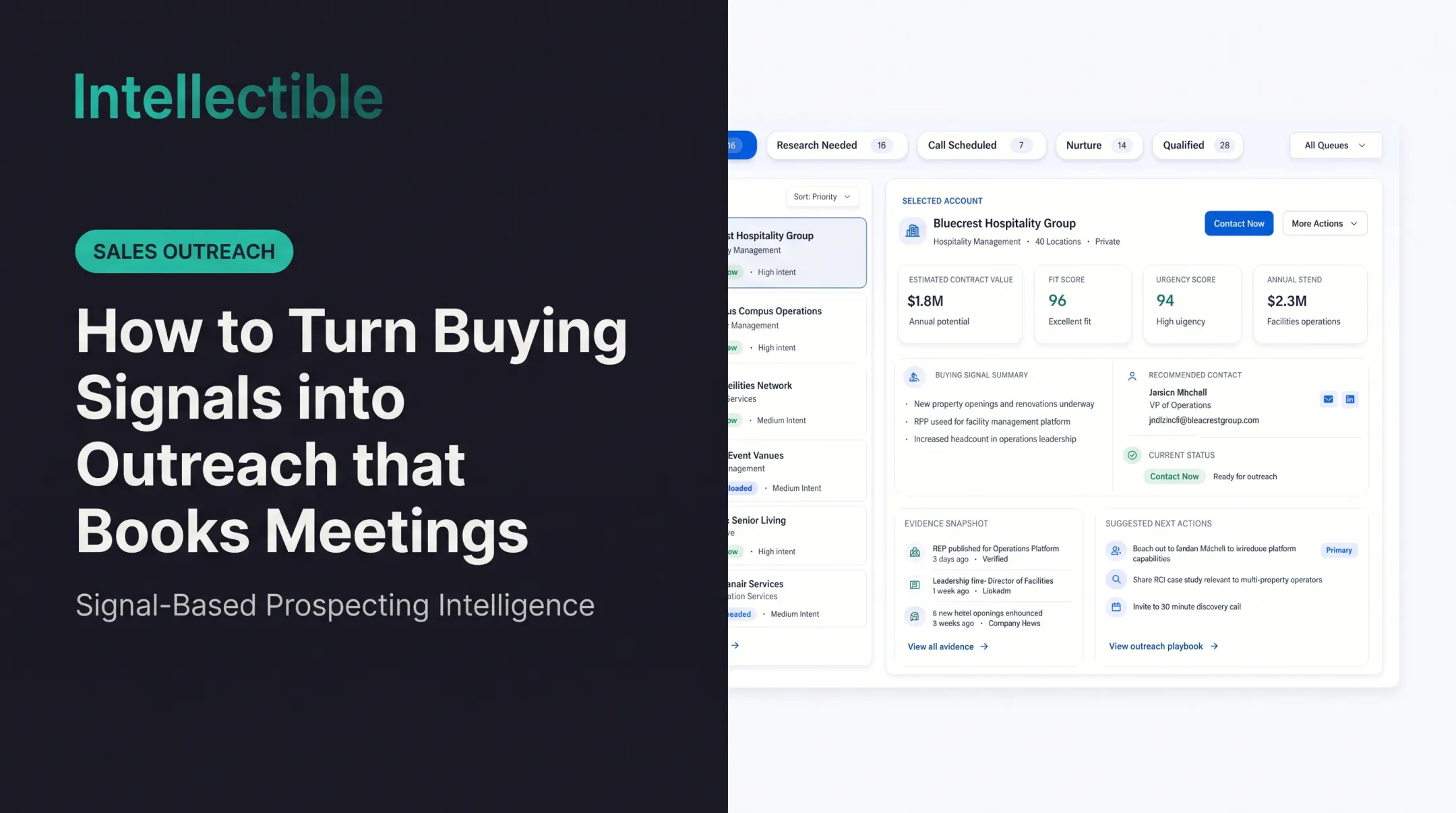
Separate the work into contact-now, research-needed, nurture, and monitor queues. Define what moves an account between queues and who approves the decision. Uncertain entity matches, missing dates, and unclear commercial relevance belong in research, not automatically in a sales sequence.
Detect, Enrich, and Route Signals
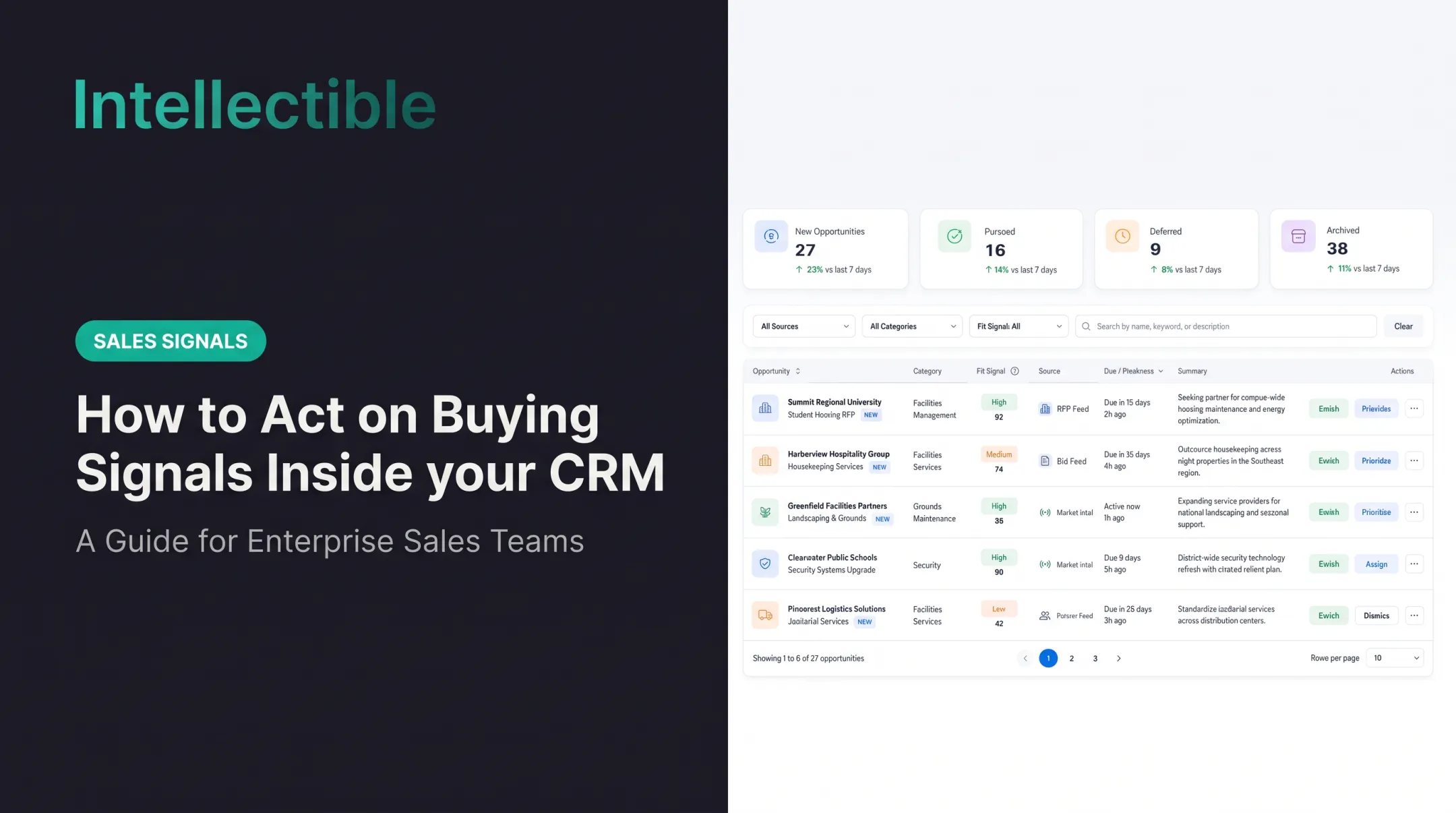
Signals should land in the CRM or account workspace with the account, contact, source, timestamp, evidence, and confidence attached. Enrich before a rep sees it:
- Account history and open opportunities
- Installed technologies
- Relevant stakeholders and prior interactions
- Territory owner and customer status
Route by account ownership, segment, territory, role, opportunity stage, and signal type. Make one owner accountable so three people don't email the same VP about the same funding round.
Set service levels by urgency and decay. The best-known response-time study found that a five-minute callback versus 30 minutes was associated with 100x contact odds, but it covered inbound web leads from 2007.
Treat that finding as direction, not an enterprise outbound benchmark. Test your own SLAs, and move missed windows into monitoring or nurture.
Map the Committee and Attach a Play
A contact-level signal should start broader research across champions, economic buyers, technical evaluators, users, procurement, security, legal, and executive sponsors. Form a role-specific hypothesis for each. Not everyone shares the same need or authority.
Each play defines research, contacts, message angle, channel sequence, internal prep, follow-up timing, and exit criteria. Examples:
- New executive: research priorities, then a role-relevant note after corroboration
- Strategic investment: connect it to likely process or capacity needs
- Hiring surge: target the function that is scaling
- Technology change: engage the technical evaluator first
- Regulatory deadline: lead with compliance workload
- Competitor problem: diagnose before pitching
- Customer expansion: loop in the customer success owner
Close the Feedback Loop in the CRM
Have sellers mark each signal as accurate, relevant, acted on, ignored, converted, or disproved in discovery. Preserve the original signal so attribution stays possible. RevOps then reviews outcomes regularly, prunes low-value alerts, and adjusts scoring and routing.

Use Signals to Create Relevant Enterprise Conversations
Turn a Signal Into a Hypothesis First
Structure outreach around five parts:
- Verified signal
- Likely business implication
- Relevant outcome
- Credible proof
- Low-friction next step
Separate what you observed from what you assume.
Weak personalization says, "Congrats on the funding." Useful personalization explains why that funding may strain a specific workflow for the recipient's role. Gartner's 2025 survey found 73% of B2B buyers avoid suppliers who send irrelevant outreach.
One Account Narrative, Role-Specific Versions
Write one shared narrative for the buying group, then adapt it:
- Executives: strategic outcomes
- Operators: workflow impact
- Evaluators: technical implications
- Procurement: risk and commercial evidence
SDRs, AEs, marketing, solutions consultants, and customer success should work from the same signal record so messages don't repeat or contradict.
Scenarios That Guide Execution
- New revenue leader plus hiring or tech signals: supports a warm, role-relevant conversation, but discovery still has to confirm priorities.
- Acquisition, expansion, or regulatory initiative plus operational change: connect it to likely process, data, integration, or capacity needs.
- Competitor dissatisfaction or expansion signal: lead with diagnosis and business impact. Don't attack the incumbent or assume an upsell is guaranteed.
Orchestrate Channels With Judgment
Sequence email, phone, professional networks, executive outreach, content, events, and partners so each touch adds context. McKinsey's B2B Pulse found buyers use an average of 10 channels, which describes the journey, not a proven sequence.
Automation can assist research, drafting, reminders, and routing. A seller must review claims, choose stakeholders, and pause when a signal is ambiguous or sensitive.
Carry the Signal Through Discovery and the Deal
Discovery should test the hypothesis: is this an active initiative, a future priority, or nothing? Then update the account plan, mutual action plan, business case, stakeholder map, and forecast as signals change.

Build the Operating System: Technology, Governance, Metrics, and Rollout
Design a Connected Architecture With Human Review
You need these layers:
- Trusted data sources
- Detection, enrichment, and scoring
- CRM or account intelligence
- Routing and seller interfaces
- Engagement tools and analytics
- Permissions and audit history
Build versus buy depends on data coverage, integration effort, custom logic, security, ownership, and maintenance.
BCG's 2024 study of European firms found more than half fail to unlock enough value from commercial tech, with better results from off-the-shelf products plus process redesign. The bigger risk is another disconnected alert tool.
Intellectible is one optional example: a horizontal AI build platform with a visual workflow builder, PostgreSQL databases, integrations, human review gates, and React interfaces.
Its Revenue Discovery engine follows a Detect, Gate, Promote, Draft, Approve, Call, Qualified flow with four human approval gates. It does not send bulk email or write to the CRM automatically.
Measure Performance and Attribution
Track by signal type and combination:
- Signal coverage and verified-signal rate
- Response time
- Signal-to-conversation and signal-to-opportunity rates
- Pipeline influence and stage progression
- Sales-cycle movement, win rate, and revenue contribution
Compare against your existing prospecting motion using holdout groups. Incrementality testing assigns random controls so you can estimate the true treatment effect. Won deals that had signals do not prove the signals caused the win.

Pilot, Then Refine
Start narrow:
- One enterprise segment
- One or two high-confidence signal categories
- A small seller group
- Clear owners and a feedback process
Watch for common failures:
- Signal overload
- Generic messaging
- Weak CRM attribution
- Poor data quality
- Isolated seller adoption
- Automation without governance
Run a recurring review of signals, plays, scoring, and enablement. Judge adoption by utility and outcomes, not logins.
Conclusion: Turn Market Signals Into a Repeatable Revenue Advantage
Signal-based selling is an operating model that links market change to account priority, stakeholder strategy, relevant conversations, and measurable pipeline.
Start small:
- Audit recent wins
- Pick one signal hypothesis
- Define the owners and actions it triggers
- Run a controlled pilot
- Let the evidence shape your playbook
Frequently Asked Questions
What belongs in a signal-based selling process?
Signal-based selling is a team process. For a $20M–$500M company with a sales organization, begin with the market, service offer, buying roles, and six signal families. Give each signal a definition, source, evidence standard, freshness rule, disqualifier, and owner. A tool cannot compensate for unclear eligibility or an unowned follow-up process.
Which eligibility gates come before outreach?
Apply eligibility gates before priority: serviceable geography, correct entity, relevant need, delivery fit, account ownership, and an open decision window. Distinguish observed facts from inferred needs. A company announcement can establish a new site; whether that site needs your service remains a hypothesis for qualification.
How should account queues work?
Separate the work into contact-now, research-needed, nurture, and monitor queues. Define what moves an account between queues and who approves the decision. Uncertain entity matches, missing dates, and unclear commercial relevance belong in research, not automatically in a sales sequence.
What should a seller action package include?
Prepare an action package for every promoted account: evidence links, event date, fit rationale, likely decision-maker, what remains unknown, a suggested outreach angle, and a next step. Draft the email or call brief around the account change, then require human review rather than treating an automated draft as permission to send.
How should signals connect to CRM work?
Use CRM ownership, duplicate checks, task deadlines, and feedback to coordinate the team. A signal record should retain its source and decision history when promoted to an account, meeting, or opportunity. Rejected and deferred accounts also need reasons, so the research process learns from seller decisions.
How should the program be measured?
Measure the full chain: signals reviewed, eligible accounts, rep acceptance, time to first touch, meetings, sales-accepted opportunities, and sourced pipeline. Compare by signal family and segment. This operating loop is the playbook; alert volume, automated emails, and a new platform licence are inputs rather than business outcomes.