The stakes are real. One flawed assumption in a competitive bid can underprice a contract and erode margin for years post-award, or overprice it and lose the work outright. Get the pricing methodology wrong, and you're not just risking the bid, you're risking a contracting officer's clarification request or a compliance review you didn't see coming.
This guide breaks down what scenario modeling actually means for GovCon pricing, why legacy spreadsheet tools fall apart under bid pressure, what capabilities modern pricing software needs, and how AI-powered platforms like Intellectible are changing how pricing teams work.
Key Takeaways
- Scenario modeling replaces single estimates with multiple cost and staffing outcomes before submission
- Spreadsheet pricing models carry version control risks that threaten both compliance and competitiveness
- Effective software combines live cost data, side-by-side comparisons, and automated audit trails
- Intellectible lets existing pricing teams scale scenario modeling without adding headcount
What Is Scenario Modeling in GovCon Pricing and Bids?
Scenario modeling means exploring a range of plausible outcomes (best-case, most-likely, worst-case) by varying your inputs, rather than producing one static forecast. Instead of asking "what's the number," you ask "what happens to the number under each set of assumptions."
In GovCon pricing, that translates into modeling different combinations of:
- Labor category mixes across direct hires and contract staff
- Indirect and wrap rates applied to base labor costs
- Subcontractor ratios and their pricing terms
- Profit and fee assumptions tied to contract type
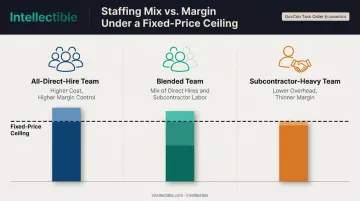
A concrete example: A bid team is pricing a fixed-price ceiling task order. They build three staffing scenarios: an all-direct-hire team, a blended team, and a subcontractor-heavy team. Then they run each against the ceiling to see which preserves margin while staying competitive. That comparison is scenario modeling in action.
This process also connects technical volume decisions, staffing plans, key personnel, and place of performance directly to cost volume outcomes. Pricing shouldn't happen in isolation from capture strategy. If your staffing plan changes after a color team review, your pricing scenarios need to reflect that instantly, not three days later after someone rebuilds a workbook.
There's also a compliance layer unique to federal work: every scenario and every assumption change may need to be traceable if DCAA or a contracting officer asks for it. The full audit trail matters as much as the final number.
How This Differs From Traditional Cost Estimating
Traditional cost estimating produces a single "best guess" number. The GAO's Cost Estimating and Assessment Guide draws a clear line between a point estimate and two other methods. Sensitivity analysis changes one assumption at a time, while risk-and-uncertainty analysis assigns a confidence level to the estimate. A point estimate alone, GAO notes, can provide misleading information about the likelihood of actually hitting that number.
Scenario modeling builds on that distinction. It produces multiple comparable outcomes tied to evaluation criteria and your organization's risk tolerance, so leadership isn't betting the bid on a single spreadsheet cell.
Why Spreadsheets Break Down for Competitive Bid Pricing
Spreadsheets weren't built for the volume of changes a GovCon bid generates. Every color team review, every RFP amendment, every last-minute pricing tweak creates a new version, and most teams have no automatic way to track or reconcile those edits.
The result is version control chaos:
- Multiple analysts working from different file versions
- Formula changes that aren't documented or communicated
- No clear record of who changed what assumption, or why
The risk here isn't theoretical. A widely cited academic audit of 25 operational spreadsheets found 117 confirmed errors across 16 files, and 70 of those errors changed a calculated output. In one case, the resulting change in output exceeded $100 million, according to the study's published findings.
That research wasn't GovCon-specific, and the sample wasn't randomly selected. Still, it illustrates a pattern every pricing analyst has seen: a single broken formula can distort an entire model.
In a cost volume, that cascading risk looks like:
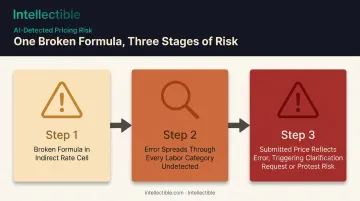
- A broken formula in an indirect rate cell throws off every labor category built on top of it
- Nobody catches the error until a reviewer spot-checks the math, if they catch it at all
- The submitted price reflects the error, triggering a clarification request, a protest risk, or worse
Deloitte's guidance on financial model assurance points to the same underlying problem: heavy reliance on end-user spreadsheet models creates operational and reporting risk, which is exactly why model-assurance controls exist for finance teams. Pricing teams face that same exposure, with a government evaluator instead of an auditor on the other end.
Key Features to Look for in GovCon Pricing Scenario Modeling Software
Not all "pricing tools" solve the actual problem. Here's what separates software that scales from software that just digitizes a spreadsheet:
- Real-time data integration. Every scenario should pull current labor categories, wrap and indirect rates, GSA schedule rates, and subcontractor quotes, not stale exports from three weeks ago.
- Side-by-side scenario comparison. You need to weigh a price-to-win position against a should-cost analysis without rebuilding the model twice. FAR 15.407-4 defines should-cost review as cost analysis that doesn't assume historical costs reflect efficient operations—your software should model both scenarios simultaneously.
- Built-in audit trail and version history. Every assumption change needs a timestamp and an owner, especially under DCAA scrutiny or post-award defensibility questions.
- Workflow automation. Go/No-Go decisions, capture assumptions, and pricing scenarios should live in one connected system, not siloed spreadsheets and email threads.
- AI-assisted scenario generation. The software should run staffing and pricing permutations automatically instead of requiring a rebuilt model for every new RFP.
- Exportable, presentation-ready outputs. Capture managers, contracts staff, and executive reviewers need a clean, submission-ready view before anything goes out the door.
How Intellectible's AI Build Platform Powers Scenario Modeling for GovCon Pricing Teams
Intellectible is a horizontal AI build platform, so pricing teams aren't rebuilding infrastructure from scratch for every bid. Its Pricing Engine is built specifically to replace what the industry calls "spreadsheet sprawl" with a governed costing workspace.
How It Works End-to-End
The platform's visual workflow builder uses connected nodes, AI, data, APIs, documents, decisions, and human review, to model a pricing scenario from Go/No-Go through final price inside one workspace.
When a Go/No-Go workflow reaches a decision, it writes a structured opportunity record directly into a shared, project-scoped PostgreSQL database. The downstream pricing workflow reads that same record automatically, with no manual re-entry and no lost context between capture and pricing teams.
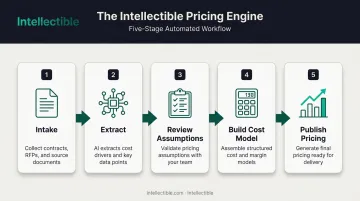
From there, the platform moves through five connected stages:
- Intake – captures customer, scope, volume, and commercial context from RFPs, discovery calls, and CRM notes
- Extract – AI normalizes documents into pricing inputs, tagging each value with a confidence score and source evidence
- Review Assumptions – flags missing fields and variance exceptions for human review before anything moves forward
- Build Cost Model – configures labor, rates, service levels, geography, materials, and risk variables in one workspace
- Publish Pricing – generates a clean, customer-ready pricing view while protecting internal margins and rate builds
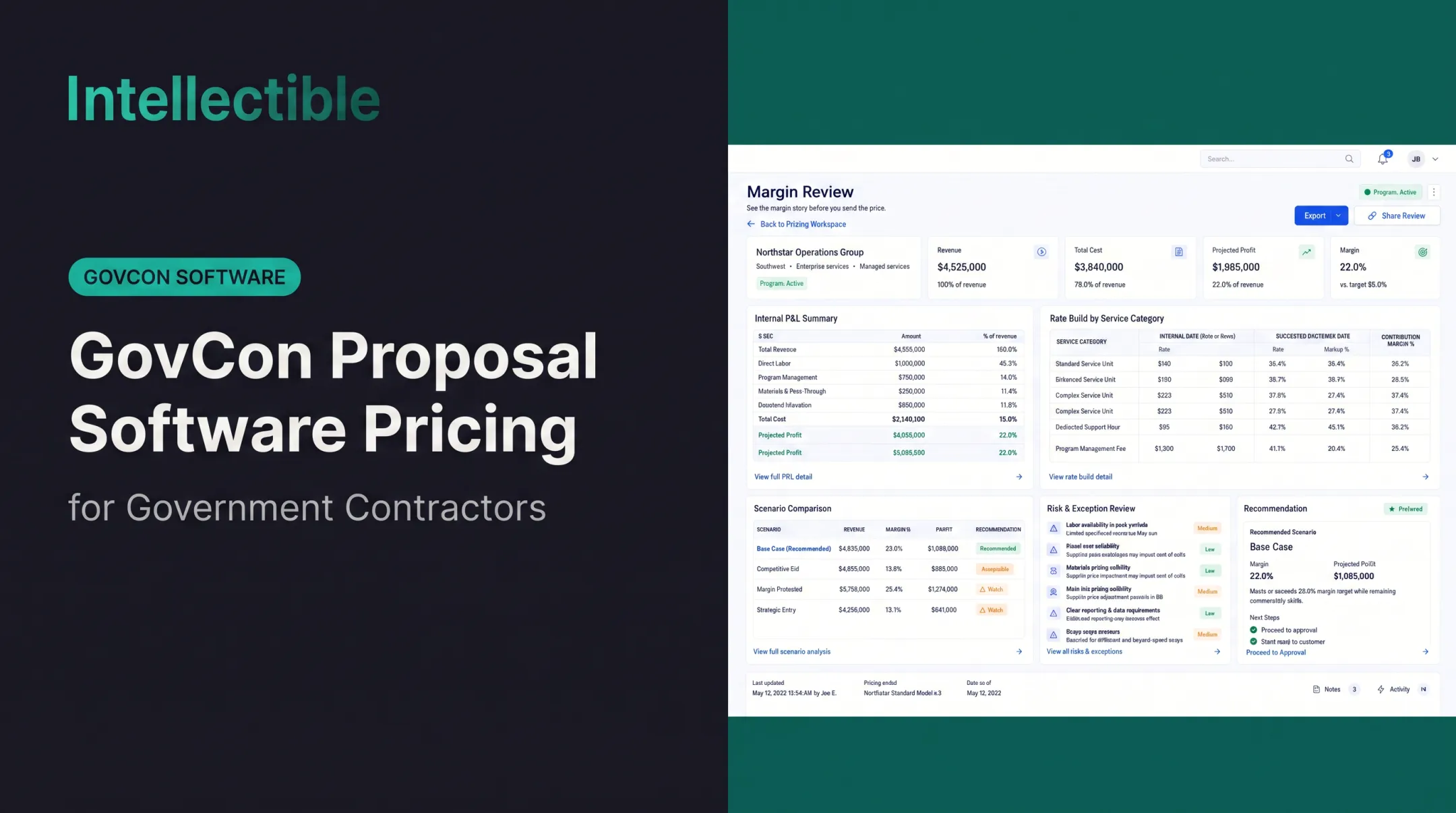
Teams can compare base case, competitive, protective, strategic, and incumbent-displacement scenarios side by side, each one tied to real deal context rather than a disconnected spreadsheet tab. That connected architecture is what drives Intellectible's platform-level benchmark: a 90% reduction in time to final pricing with full audit trail control.
Pricing, CRM, and revenue operations teams view and compare these scenarios through React-supported dashboards and data grids, sharing outputs with leadership without adding headcount.
"Intellectible is taking the tedious, monotonous hours of RFP efforts out of human hands. This allows us to do what we should be doing, analyzing and selling." — John Grady, Corporate Director of Business Development, HHS
Best Practices for Building a Scenario Modeling Process for Your Bids
Software alone won't fix a broken pricing process. A few practices matter regardless of which tool you use:
- Start with a defined baseline. Build your "most likely" scenario first, then branch into best-case and worst-case variations tied to specific RFP evaluation criteria, rather than jumping straight to optimistic numbers.
- Involve stakeholders early. Bring capture, pricing, and contracts staff together before the model gets built, so staffing plans and compliance requirements shape scenarios from day one instead of a last-minute scramble.
- Treat it as continuous, not one-off. Run scenario modeling across the full pipeline, from opportunity qualification through final pricing, instead of rebuilding a fresh spreadsheet for every RFP.
Frequently Asked Questions
What is scenario modeling?
Scenario modeling tests multiple plausible future outcomes by varying key assumptions, rather than relying on a single static forecast. It gives decision-makers a range of comparable results instead of one number.
What is scenario modeling used for in GovCon pricing?
It helps pricing teams compare staffing, rate, and margin combinations against specific RFP evaluation criteria before submitting a bid. This makes trade-offs between competitiveness and profitability visible early.
How is scenario modeling different from traditional cost estimating in bids?
Traditional cost estimating produces one point estimate. Scenario modeling produces multiple comparable outcomes tied to risk tolerance and evaluation criteria, giving teams more decision context before submission.
What data do I need to run a pricing scenario model for a bid?
Core inputs include labor categories, wrap and indirect rates, subcontractor quotes, and historical bid data. GSA schedule rates and staffing plan details also feed directly into most models.
Can scenario modeling help with should-cost analysis and price-to-win strategies?
Yes. Comparing scenarios side by side lets teams validate an efficient-cost baseline while separately testing competitive price-to-win positioning, without rebuilding the model for each analysis.
How does Intellectible support scenario modeling for GovCon teams without added headcount?
Intellectible connects Go/No-Go decisions, live cost data, and scenario comparisons in one workspace with automated audit trails. That connected workflow is what drives its reported 90% reduction in time to final pricing.