Introduction
Federal contracting teams face a volume problem that doesn't respond to traditional scaling. A single RFP response can require up to 84 hours of preparation, and firms managing double-digit pursuit pipelines are routinely asking proposal managers to track solicitation requirements, coordinate SMEs, chase past performance write-ups, and render Go/No-Go judgments — simultaneously, across multiple active bids.
The friction points are consistent across firms:
- Dense solicitations that take hours to read before any drafting can begin
- Section L instructions buried in amendments issued days before deadline
- Compliance certifications that require verification before a single section gets written
- Win themes that never get developed because assembly consumed the week
An RFP agent addresses the assembly problem. It ingests the solicitation, extracts requirements, retrieves approved content from your knowledge base, generates structured draft sections, and routes gaps to the right people. What it doesn't do is replace the judgment calls that determine whether a pursuit is worth winning.
That distinction matters for how you deploy one. This guide walks GovCon capture teams through using an RFP agent as a structured workflow system with governance built in — not a shortcut that bypasses the decisions that win contracts.
Key Takeaways
- RFP agents earn their value when pursuit volume outpaces your team's capacity to keep up
- A curated knowledge base — past proposals, certifications, approved templates — must exist before deployment
- The agent follows a defined sequence: ingest, extract, retrieve, draft, route — not ad hoc prompting
- Human review checkpoints are non-negotiable; the agent compresses assembly time, not reviewer accountability
- Post-submission feedback loops are what make the agent improve over time
When Should a GovCon Capture Team Use an RFP Agent?
The Right Threshold
The capacity problem tends to become visible before teams name it. Reviewers spend their time searching for prior proposals, formatting compliance matrices, and hunting down past performance write-ups — leaving little bandwidth for win theme development, competitive analysis, or pricing strategy.
Deltek's 2026 GovCon Clarity study found that more than one-third of respondents bid on 11 or more contracts requiring certified cost or pricing data, with an average of 12 such bids. At that volume, manual assembly processes become a strategic constraint.
An RFP agent is appropriate when:
- Reviewers spend more time searching and assembling than on strategy
- Active pursuits regularly exceed available proposal staff capacity
- Your team is responding to solicitations across multiple agencies, NAICS codes, or contract vehicles simultaneously
- Compliance matrix creation is consuming hours that should go to technical approach development
Where It's Commonly Misused
Deploying an agent without a structured knowledge base turns it into an expensive text generator. Common misuse patterns include:
- Running the agent on solicitations before the Go/No-Go decision is made
- Using it on sole-source or highly customized requirements where boilerplate retrieval adds minimal value
- Treating its output as finished copy rather than a structured first draft requiring SME review
- Uploading raw, unreviewed content and expecting reliable retrieval
When the agent is used correctly — in the right phase, against the right solicitations — it compounds the team's capacity rather than substituting for judgment.
Where It Fits Across the Capture Lifecycle
The agent's role shifts by phase:
| Phase | Agent Function |
|---|---|
| Pre-RFP / Draft Solicitation | Extraction, gap analysis, bid/no-bid signal support |
| Formal Proposal Response | Full draft generation, compliance mapping, SME routing |
| Post-Submission | Outcome capture, knowledge base update |
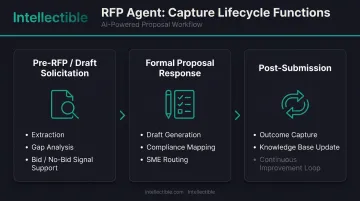
Go/No-Go confirmation is the gate. Draft generation doesn't begin until that decision is locked.
What You Need Before Deploying an RFP Agent
Skipping setup produces unreliable output. Before running the agent on a live solicitation, three things must be in place.
A Structured Knowledge Base
The agent retrieves from what you've loaded. Its output quality is directly proportional to the depth and accuracy of your knowledge base. This means:
- Past winning proposals organized by agency and contract type
- Past performance narratives — CPAR-backed write-ups with relevant project details
- Compliance certifications and socioeconomic qualifications current as of the offer date (FAR 52.204-8 requires representations updated within the prior 12 months)
- Approved boilerplate: teaming agreement language, management approach templates, company background sections
- Win themes and discriminator statements reviewed and approved by leadership
The most common setup error is uploading raw, unreviewed content — including outdated proposals or draft language that was never corrected. The agent will retrieve and repeat whatever you load.
A Library Organized for Contextual Retrieval
Generic content retrieval produces generic drafts. Organize your knowledge base by NAICS code, contract type (IDIQ, GWAC, BPA, task order), and agency so the agent pulls contextually relevant content rather than the most recent proposal regardless of fit.
Intellectible's GovCon Engine supports this directly — the platform filters opportunities and knowledge records by NAICS code, PSC classification, federal agency, and contract vehicle, so retrieval is matched to the specific pursuit context, not just keyword proximity. As an AI capture system built for capture teams, it finds best-fit opportunities, explains the fit, and maps incumbents using semantic fit analysis and configurable capture rules rather than simple keyword searches.
Defined Workflow Roles
The agent needs a human routing structure to escalate to. Before going live, assign:
- Who owns initial review of the extracted compliance matrix
- Who routes technical gaps to SMEs
- Who approves compliance language before submission
Teams using a production-ready platform reach their first live RFP faster. Intellectible's GovCon Engine is immediately deployable — solicitation ingestion, requirement extraction, compliance matrix generation, and SME routing come pre-configured, not built to order.
How to Use an RFP Agent: Step-by-Step for GovCon Capture Teams
Correct usage follows a defined sequence tied to the proposal lifecycle. Collapsing steps — skip knowledge validation or human review, and you get output that fails compliance checks or misses agency-specific requirements.
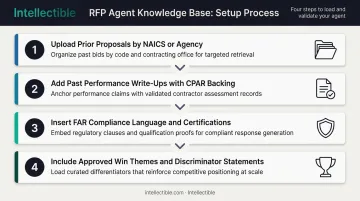
Loading and Validating Your Knowledge Base
Before running the agent on a live solicitation:
- Upload prior proposals in the relevant NAICS or agency category
- Add past performance write-ups with CPAR backing
- Insert standard compliance language — FAR clauses, certifications, socioeconomic qualifications
- Include approved win themes or discriminator statements
Intellectible's platform supports PDF, DOCX, CSV, Excel, plain text, and Markdown formats. It also ingests content from connected systems including SharePoint, Google Drive, and Salesforce, so solicitation documents and institutional knowledge flow in from existing infrastructure without re-uploading.
Critical checkpoint: Every document should be reviewed before it enters the approved knowledge base. Draft records sit in a review queue; only approved records become searchable. This separation prevents the agent from retrieving and repeating inaccurate claims.
Uploading the RFP and Initiating the Agent
Drop in the solicitation document (RFP, RFQ, task order, or draft RFP) along with attachments and any addenda. The agent parses:
- Section L: Instructions, conditions, and notices to offerors
- Section M: Evaluation criteria and their relative importance
- SOW/PWS: Scope and performance requirements
- Key dates and submission rules
Before moving to drafting, confirm the agent has correctly extracted all mandatory requirements, evaluation factors, and deadlines. Reviewing the extracted structure at this stage saves costly rework. Intellectible's system generates a compliance matrix, requirement summary, and risk list directly from the uploaded solicitation, so capture teams see exactly what needs to be answered before drafting begins.
Reviewing and Refining AI-Generated Draft Sections
The agent produces section-by-section responses with source citations pulled from the knowledge base. Treat these as structured first drafts, not finished deliverables.
During review, look for:
- Requirements flagged as unsupported — no approved source was found in the knowledge base
- Partial matches — retrieved content that approaches the requirement without fully addressing it
- Outdated compliance language — certifications or FAR clause references that may no longer apply
- Technical claims that need SME sign-off before submission
Every technical claim, compliance commitment, and past performance reference needs human sign-off. The agent surfaces and structures; reviewers validate.
Routing Gaps to Subject Matter Experts
When the agent flags an unsupported requirement or high-risk section, route it to the appropriate owner with context and a deadline:
- Technical gaps → technical lead
- Cost assumptions → pricing lead
- Terms, certifications, FAR clauses → legal or contracts
Intellectible's platform supports section-level ownership assignment: each requirement maps to a named owner with a due date and status tracked in the response plan. Leaving gaps for one reviewer to fill at the end is the most common cause of late, incomplete, or non-compliant submissions.
Exporting, Submitting, and Capturing Outcomes
After human review is complete:
- Apply formatting and compliance checks — page limits, font requirements, mandatory sections
- Export to the submission format required by the agency
- Complete the final review against RFP requirements, tone, and missing evidence
Post-submission: Capture the outcome — win, loss, or no-bid — and route reviewer edits back into the knowledge base. Without this feedback loop, the knowledge base stagnates and retrieval quality plateaus.
Best Practices for GovCon Teams Using an RFP Agent
Only run the agent after Go/No-Go is confirmed. Using it to draft a response before validating Pwin, resource availability, and competitive positioning wastes pursuit cycles and trains the knowledge base on proposals that should never have been written.
Treat knowledge base maintenance as an operational standing task. Assign a knowledge owner who refreshes content quarterly, removes outdated proposals and expired certifications, and adds newly awarded contracts as past performance. FAR 52.204-8 sets a hard compliance floor: representations and certifications must be current within 12 months of the offer date. That regulatory cadence is a maintenance minimum, not a refresh ceiling.
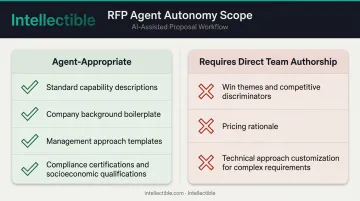
Scope the agent's autonomy to where it performs reliably:
- ✅ Standard capability descriptions
- ✅ Company background and management approach boilerplate
- ✅ Compliance certifications and socioeconomic qualifications
- ❌ Win themes and competitive discriminators (direct team authorship)
- ❌ Pricing rationale (direct team authorship)
- ❌ Technical approach customization for complex requirements (direct team authorship)
Maintain a documented audit trail for every agent run. Track which knowledge sources were retrieved, which sections were AI-drafted versus human-authored, and which reviewer approved each section. FAR Part 15 contains no express disclosure requirement for AI-drafted offers, but this documentation protects your team if an agency introduces new oversight rules mid-pursuit — and it gives reviewers a clear record of what the agent produced versus what the team wrote.
That governance discipline also determines how fast you can respond when requirements change. Intellectible's platform builds this infrastructure in: source citation visibility, a human-validation review queue, and change logs with user attribution are included by default. Capture teams can configure these controls to meet agency-specific oversight requirements without standing up separate tooling.
Frequently Asked Questions
What is an RFP agent?
An RFP agent is an autonomous AI system that manages the end-to-end proposal response workflow: ingesting the solicitation, extracting requirements, retrieving relevant content from a knowledge base, drafting responses, and routing gaps to human reviewers. It drives the structured process so the team doesn't have to manage each step manually.
What is an AI RFP agent?
An AI RFP agent uses large language model reasoning combined with retrieval-augmented generation (RAG) to match solicitation requirements against your organization's approved content sources, generate cited draft answers, and improve from reviewer feedback over time. This distinguishes it from a basic AI writing tool that generates text without organizational grounding.
How does an RFP agent fit into the GovCon capture lifecycle?
The agent is most useful once the Go/No-Go decision is confirmed and active proposal development begins. It can also parse draft solicitations, RFIs, and sources-sought notices to support bid/no-bid analysis, though output quality depends on how well the knowledge base is populated for the relevant agency and contract type.
What types of content should a GovCon capture team load into an RFP agent's knowledge base?
The highest-value sources include:
- Past winning proposals organized by agency and contract type
- CPARS-backed past performance narratives
- Compliance certifications and socioeconomic qualifications
- Approved teaming agreement language
- SME-vetted technical capability descriptions
Every document should pass human review before entering the approved knowledge base.
Can an RFP agent handle compliance-heavy sections like Section L and Section M requirements?
The agent can extract and map Section L instructions and Section M evaluation criteria to organize the draft structure (FAR 15.204-5 defines what each section governs). However, compliance language, certifications, and FAR clause responses must be reviewed and approved by a contracts lead before submission — the agent surfaces requirements, a human owns the final answer.
How do capture teams maintain human oversight and audit control when using an RFP agent?
Oversight is maintained through defined reviewer roles assigned to specific sections, SME routing workflows that escalate flagged gaps before the draft is finalized, and a logged audit trail that records which content was AI-retrieved versus human-authored. The agent functions as a workflow system with embedded checkpoints, not an autonomous submission tool.