According to Deltek's 2021 GovCon Industry Study, the average win rate across government contractors sits at just 40% — and that figure drops to 34% for mid-size firms. For most teams, that means more than half of every proposal sprint ends with nothing to show for it.
This post covers what a complete proposal solution actually looks like for federal and state GovCon teams — from opportunity identification through final pricing. Not writing tips. The full lifecycle.
Key Takeaways
- Most bid losses happen before writing starts — through poor opportunity qualification and weak capture management
- A complete proposal solution spans opportunity triage, Go/No-Go decisions, content management, pricing, and review workflows
- Automating Go/No-Go and pricing decisions lets teams pursue more high-probability bids without adding headcount
- A centralized past performance and content library delivers some of the highest ROI for any GovCon team
What Makes GovCon Proposals Different from Commercial Proposals
Commercial proposals give the seller control over structure, length, and presentation. Government proposals do not.
The Structural Reality of Federal RFPs
Under FAR 15.203, every competitive RFP must state the government's requirements, anticipated contract terms, proposal information requirements, and evaluation factors. Agencies evaluate proposals only against factors and subfactors stated in the solicitation — meaning your technical approach, management plan, past performance, and pricing must each respond to that specific agency's criteria, not a generic template.
Page limits are strictly enforced. GAO upheld an agency's determination that a proposal exceeding an applicable page limit was technically unacceptable — the content's quality was irrelevant once the limit was breached.
This creates a compliance burden that commercial proposals simply don't carry.
The Competitive Stakes
Government source selections are documented merit evaluations. A strong solution can lose on poor proposal execution. Common failure points include:
- Vague technical language that doesn't map to evaluation criteria
- Inconsistent formatting that signals weak internal controls
- Pricing volumes that don't survive cost realism analysis
Large primes and well-resourced incumbents compete with dedicated proposal teams and pre-positioned capture intel. Smaller contractors frequently enter proposal phase at a structural disadvantage.
The Volume Problem
Active GovCon teams track dozens to hundreds of opportunities simultaneously across SAM.gov and other portals. Without systems to filter and prioritize, opportunity triage becomes a full-time burden: one that crowds out the capture work that drives win rates.
Key Elements Every Government Proposal Must Include
FAR does not establish a universal set of proposal volumes. The individual RFP governs what's required. That said, most competitive federal proposals address five core areas:
Executive Summary and Understanding of the Requirement
Evaluators read the executive summary to gauge whether the offeror actually understands the problem. A strong executive summary signals alignment with the agency's mission, explicitly acknowledges evaluation criteria, and states a clear discriminator — what makes this team the right choice for this specific requirement.
Technical Approach
Evaluators look for specific methodology, tools, staffing rationale, and direct traceability to the Statement of Work or Performance Work Statement. Vague or templated approaches are a top source of low technical scores. If the approach could have been written for any agency's RFP, it's not strong enough.
Management Plan and Staffing
The management section demonstrates organizational capability. Evaluators want evidence across several areas:
- Org charts and key personnel qualifications
- Subcontractor oversight structure
- Transition plans and continuity provisions
- Defined roles with clear accountability
What evaluators are looking for is proof that delivery is planned, not assumed.
Past Performance
Under FAR 15.305, the government evaluates past performance on three factors: how recent the work is, how relevant it is to the current requirement, and the quality of documented results. CPARS records are typically used within three years of contract completion (six years for construction). Teams with an up-to-date repository of CPARS ratings, references, and project summaries can respond to past performance requirements in hours rather than days.
Pricing and Cost Volume
Pricing is often the most consequential section. Cost-reimbursement contracts require cost realism analysis — the government assesses whether proposed costs are realistic for the work scope. Rushed or undocumented pricing creates bid-loss risk and compliance exposure. Every cost element must tie back to a documented basis of estimate.
Where GovCon Teams Lose Bids Before Writing Begins
Most proposal losses are decided before a single word is written. These are the four process failures that drive the majority of them.
Poor Opportunity Qualification
Many teams pursue opportunities they should not. A structured Go/No-Go process evaluates incumbent status, customer relationship depth, past performance fit, competitive landscape, internal capacity, and realistic probability of award — before committing proposal resources. Most teams do this inconsistently, informally, or not at all.
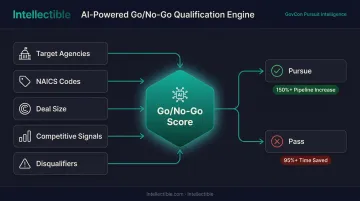
Intellectible's AI-powered Go/No-Go system automates this process, scoring opportunities against configurable capture criteria including target agencies, NAICS codes, deal size thresholds, competitive signals, and disqualifiers. Reported outcomes include 95%+ time saved on opportunity search and Go/No-Go decisions and a 150%+ increase in actionable pipeline opportunities — a result confirmed by Oceus CEO Jeff Harman, who noted the platform surfaced "more than double the qualified opportunities per week" after deployment.
Weak Capture Management Before the RFP Drops
Winning proposals are often decided before the solicitation is released. Teams that engage the customer, gather intelligence on requirements, and shape the acquisition have a structural advantage over teams that wait for the RFP and start from zero.
Without a formal capture process, organizations enter proposal phase without the customer knowledge needed to differentiate their technical approach.
Fragmented Opportunity Pipelines
Opportunity data spread across spreadsheets, email threads, and multiple portals creates a predictable set of problems:
- Missed solicitations that fall through the cracks
- Duplicated effort across BD and capture teams
- No pipeline visibility for resource allocation decisions
- Inconsistent pursuit tracking and status reporting
One centralized pipeline for all opportunities, with structured records, stage tracking, and team routing, eliminates most of this friction.
No Reuse System for Past Proposal Content
Teams without a centralized content library rebuild the same materials from scratch every proposal cycle. The most commonly recreated content includes:
- Past performance narratives revised inconsistently across submissions
- Key personnel bios stored in individual contributors' folders
- Technical boilerplate rewritten rather than retrieved and adapted
- Approved graphics hunted down from old email threads
Every hour spent recovering that content is an hour not spent on win themes, discriminators, or competitive positioning.
What a Complete Proposal Solution Covers for GovCon Teams
A complete proposal solution covers every stage where bids are won or lost — from opportunity triage through final pricing submission — operating as an integrated system rather than a collection of disconnected tools.
Opportunity Identification and Triage Automation
The process starts with automated opportunity sourcing — pulling federal notices and transforming each one into a structured capture record with agency details, NAICS and PSC codes, timing, scope, fit rationale, and risk signals. Opportunities are scored against the organization's target profile before any human reviews them.
Intellectible's pursuit platform processes thousands of opportunities continuously — with reported metrics of 3,200+ opportunities analyzed in a 24-hour period — and routes only the highest-fit bids to capture teams for review.
Structured Go/No-Go and Capture Workflows
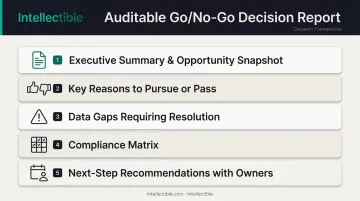
Standardized, automated workflows route each opportunity through a defined evaluation process with input from BD, capture, and operations — producing a documented, auditable decision rather than a hallway conversation. The Go/No-Go report includes:
- Executive summary and opportunity snapshot
- Key reasons to pursue or pass
- Data gaps that need resolution before committing
- Compliance matrix mapping requirements to proposal sections
- Next-step recommendations with owners and timelines
Proposal Content Library and Version Control
Proposal writers lose 30–40% of their time hunting for the right past performance blurb or policy language. A centralized knowledge base of approved content eliminates that drag — enabling faster volume builds and consistent submissions. Intellectible's platform supports:
- Semantic search across past performance narratives, bios, and boilerplate
- Approval workflows before content enters the retrievable library
- Version control tied to the pursuit workflow
- AI-assisted draft generation grounded in approved content and RFP requirements
Proposal Drafting and Review Workflow
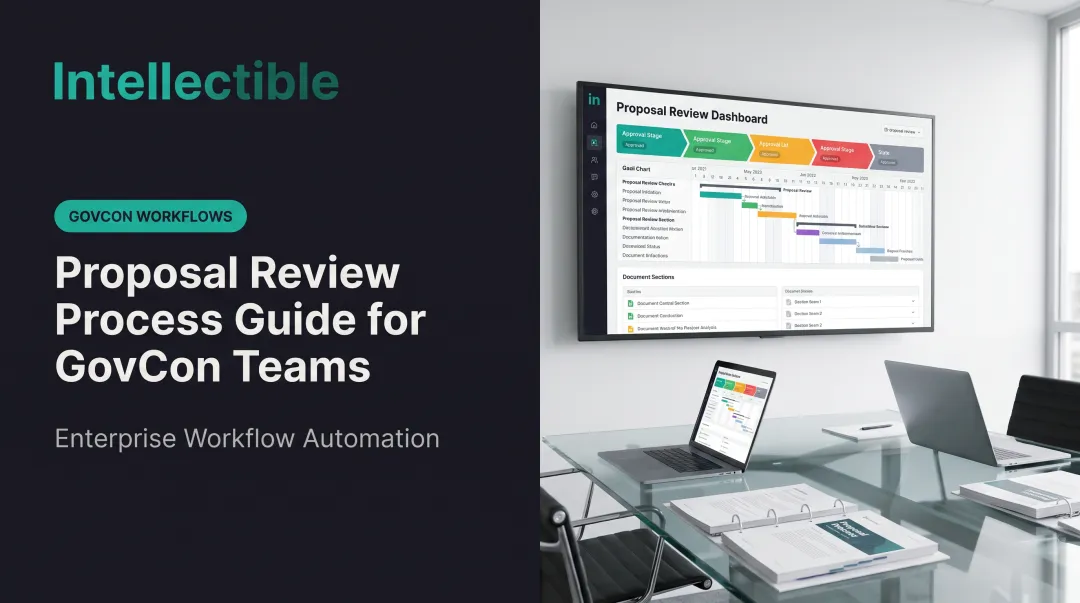
A proposal solution must support structured internal review cycles. Intellectible's Proposal & Pursuit Engine provides exactly that — it reads solicitations, attachments, and addenda to extract key dates, submission rules, required sections, evaluation criteria, and compliance obligations; generates section drafts grounded in the RFP, deal variables, approved knowledge, and historical proposal language; and reviews the assembled proposal against requirements, strategy, tone, and missing evidence. The platform routes drafts to subject matter experts, legal, operations, and executive approvers — maintaining context and version history throughout, with role-based access controls and export built in.
How to Automate the GovCon Proposal Process Without Adding Headcount
Deltek's 2026 pricing analysis found that a single RFP response can take up to 84 hours to prepare. For teams already stretched across contracts, business development, and operations, that ceiling is hit fast.
Automation targets the administrative and repetitive work that consumes proposal professionals' time — freeing them to focus on strategy, differentiation, and compliance instead.
The Four Automation Layers That Deliver the Most Value
| Layer | What It Automates | Impact |
|---|---|---|
| Opportunity filtering | Scoring and routing relevant bids | Eliminates noise, surfaces high-fit bids only |
| Go/No-Go decisioning | Structured qualification against preset criteria | Consistent decisions, documented rationale |
| Content retrieval | Semantic search across approved knowledge base | Writers start with context, not a blank page |
| Pricing calculation | Cost buildup, indirect rates, scenario modeling | Faster, more defensible cost volumes |
How to Phase Automation Adoption
Trying to automate everything at once is a reliable path to failed adoption. A more effective approach:
- Identify the process causing the most waste : for most teams, this is opportunity triage or pricing
- Build a workflow that works for that specific function before expanding
- Expand incrementally — connect Go/No-Go to proposal intake, pricing to content library, and so on
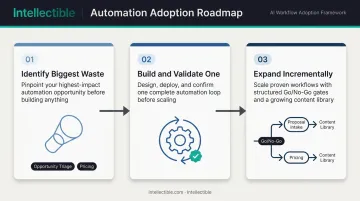
Each phase of this progression maps to a discrete workflow. Intellectible's pre-built systems cover each layer out of the box, so teams deploy against their specific capture logic rather than rebuilding infrastructure from scratch for every new workflow.
Frequently Asked Questions
What is a proposal solution?
A proposal solution is a system, process, or platform that helps organizations create, manage, and submit competitive proposals. In GovCon, that means going beyond document creation — covering opportunity qualification, pricing automation, content management, and compliance workflows across the full pursuit lifecycle.
What is an example of a proposal solution?
An automated GovCon system that pulls federal notices, scores them against the team's win criteria, routes them through a Go/No-Go workflow, and populates proposal sections with pre-approved past performance content. Intellectible is one example, combining opportunity triage, capture management, and proposal workflows in a single platform.
What are the key elements every proposal should include?
Competitive government proposals address five areas: executive summary, technical approach, management plan, past performance, and price/cost volume. Each section must directly respond to the evaluation criteria in the solicitation — not a generic template.
What are the three main types of proposals?
The three main types are solicited (responding to a formal RFP, RFQ, or RFTOP), unsolicited (submitted proactively without a formal solicitation under FAR Part 2), and task order (competing among IDIQ holders for specific orders). Each requires a different level of investment and strategic approach.
How do GovCon teams improve their proposal win rate?
Win rate improves most when teams pursue fewer, better-qualified opportunities through disciplined Go/No-Go, invest in capture before the RFP drops, maintain a live content library, and build a repeatable review process. Speed of writing rarely moves the win rate.