Introduction
Federal opportunity management is the systematic process government contracting teams use to identify, qualify, pursue, and win federal contracts. Business development professionals, capture managers, and proposal teams rely on this discipline to navigate procurement pipelines from SAM.gov monitoring through contract award.
Finding opportunities is rarely the hard part. Managing them is. SAM.gov publishes thousands of active notices, agencies release forecasts months ahead of solicitation, and response timelines compress around proposal deadlines.
Limited pursuit budgets and proposal capacity force contractors to decide quickly which pursuits justify investment. According to Deltek's 2021 industry study, small and medium firms win 33% of competitive submissions while large firms win 48%—making qualification discipline a financial necessity.
This guide walks through federal opportunity management at each pipeline stage, from initial discovery to post-submission follow-through. You will learn:
- When an opportunity is worth pursuing
- What to track across the pipeline
- How to structure Go/No-Go decisions under real pursuit conditions
Key Takeaways
- Run federal pursuits through five stages: identification, qualification, capture, proposal, and post-submission
- Set evaluation criteria, pull cross-functional input, and document go/no-go decisions before committing resources
- Early customer engagement during capture improves positioning far more than waiting until RFP release
- Keep pipeline visibility current and hold regular opportunity reviews with leadership
What is Federal Opportunity Management?
Federal opportunity management is the full process of monitoring procurement forecasts, qualifying opportunities against win criteria, running capture, and submitting competitive proposals. It coordinates business development, capture, pricing, contracts, technical SMEs, and leadership—not one person's job alone.
Strategic vs. transactional opportunities require different approaches:
Strategic opportunities align with your core capabilities, existing relationships, and past performance. They warrant early capture investment because they offer high win probability and long-term revenue potential. Strategic pursuits typically involve pre-RFP shaping, teaming arrangements, and solution design before solicitation release.
Transactional opportunities are quick-turn, commodity services where price drives the award decision. They require minimal capture activity beyond bid/no-bid screening and cost volume development. Response time matters more than relationship building.
Both types still move through the same pipeline. Depth of effort at each stage is what changes.
The five core pipeline stages:
- Identification — Monitor SAM.gov, agency forecasts, and procurement notices to discover opportunities early.
- Go/No-Go qualification — Evaluate strategic fit, competitive position, win probability, and resource requirements.
- Capture planning and shaping — Engage customers, build teaming relationships, and refine win themes before RFP release.
- Proposal development — Respond to solicitation requirements through compliant technical, management, and cost volumes.
- Post-submission — Conduct lessons learned, request debriefs on losses, and maintain customer relationships during evaluation.
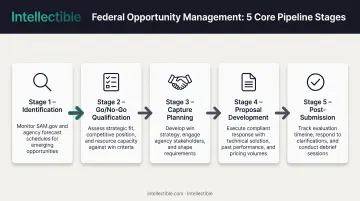
Mature GovCon teams track many opportunities across these stages at once. A shared workflow keeps qualification criteria, owners, and deadlines consistent so pursuits stay disciplined as volume grows.
When Should You Pursue a Federal Opportunity?
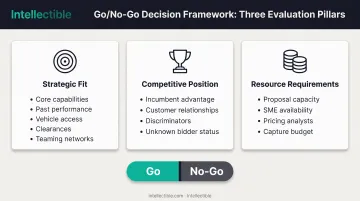
Pursuit decisions should run through formal Go/No-Go gates, not ad hoc judgment calls. Strong teams qualify at three levels—initial screening, preliminary review, and formal approval—using strategic fit, competitive position, and resource readiness as the decision criteria.
Strategic Fit Criteria
Ask whether the opportunity aligns with your:
- Core capabilities and technical expertise
- Relevant past performance references
- Contract vehicle access (GSA Schedule, IDIQs, GWACs)
- Required clearance levels and facility security
- Active teaming relationships and partner networks
If the work falls outside your documented capability set or requires unavailable past performance, strategic fit is low.
Competitive Positioning
Assess your position honestly:
- Incumbent advantage - Are you the current contract holder with in-place staff and customer knowledge?
- Customer relationships - Do you have agency relationships, program office access, or history on adjacent contracts?
- Discriminators - Can you show unique technical approaches, proprietary tools, or advantages rivals can't easily copy?
- Unknown bidder status - Are you bidding blind, with no customer contact, incumbent intel, or edge beyond price?
Incumbent status and real customer access usually matter more than checkbox qualifications. Competing as an unknown bidder against a strong incumbent drastically lowers win probability.
Resource Requirements
Evaluate whether your team has:
- Proposal capacity (writers, editors, desktop publishers) matched to the response timeline
- Subject matter experts who can support technical volumes without derailing delivery
- Pricing analysts who can model labor, materials, overhead, and competitive scenarios
- Capture budget for teaming calls, solution design, and pre-RFP customer engagement
Avoid low-probability "lottery ticket" bids that drain resources. Pursue work where you can credibly compete, not where you only meet minimum qualifications.
Prerequisites for Effective Opportunity Management
Before you can manage opportunities systematically, put the basics in place for early visibility and fast response.
Active SAM.gov Monitoring and Forecast Subscriptions
SAM.gov is the central source for federal pre-solicitations, solicitations, awards, and sole-source notices. Build saved searches by NAICS, agency, set-aside status, and capability keywords.
Supplement SAM.gov with:
- Agency procurement forecasts such as GSA's Forecast of Contracting Opportunities (FCO), treating projections as directional since they can change or cancel
- Set-aside tracking for small business, 8(a), HUBZone, SDVOSB, and WOSB when those statuses apply
- Industry days and RFIs so you can shape requirements and build agency relationships early
FAR 15.201 encourages early exchanges once a requirement is identified, including RFIs, draft RFPs, conferences, site visits, and one-on-one meetings.
Updated Marketing and Capability Documentation
Maintain ready-to-deploy materials so you can respond rapidly:
- Capability statements that cover company profile, socioeconomic status, NAICS codes, core strengths, differentiators, customers, and past performance
- Past performance packages with contract details, customer contacts, and outcomes (FAR 15.305 treats recent, relevant work as a key evaluation factor)
- Teaming agreements with complementary contractors locked in before opportunities surface, not during proposal crunch
- Contract vehicle access via GSA MAS, IDIQs, or GWACs (GSA reported more than $51.5 billion in FY2024 MAS sales)
Pre-Defined Go/No-Go Evaluation Criteria
Establish decision criteria in advance so evaluations stay consistent and defensible:
- Win probability thresholds based on competitive position and customer relationships
- Minimum contract value to justify pursuit costs
- Required resource availability (proposal team capacity, SME time, capture budget)
- Strategic value (new customer access, contract vehicle entry, capability expansion)
- Competitive assessment factors (incumbent status, discriminators, likely competitors)
Document the criteria and apply them the same way on every opportunity. Inconsistent qualification burns time and budget on pursuits you cannot win.
How to Manage Federal Opportunities (Step-by-Step)
Effective opportunity management follows a defined sequence from initial identification through post-decision action, with structured gates preventing resource waste on unwinnable pursuits.
Opportunity Identification and Initial Screening
Monitor multiple sources to discover opportunities early:
- SAM.gov - Search current notices including pre-solicitation, solicitation, award, and sole-source postings
- Agency forecast databases - Review GSA's FCO and agency-specific acquisition forecasts for planning signals 6-12 months ahead of RFP release
- Procurement office websites - Track Sources Sought notices, RFIs, and draft RFPs directly from agency acquisition pages
Conduct an immediate "30-second screen" on each new notice:
- Review NAICS code and contract value to confirm the work fits your business size and scope
- Check set-aside status (unrestricted, small business, 8(a), etc.) against your qualifications
- Scan the scope of work summary for obvious mismatches with your capabilities
- Research incumbent information via USAspending.gov to assess competitive dynamics
Dismiss obvious no-goes immediately. Early identification leaves time to shape the deal; finding the notice after RFP release leaves little room to position.
Opportunity Qualification and Go/No-Go Decision
Formal Go/No-Go evaluation prevents resource waste. Score opportunities against:
- Strategic fit - Alignment with core capabilities, past performance, vehicles, and teaming relationships
- Competitive position - Incumbent status, customer relationships, discriminators, and likely competitors
- Win probability - Honest assessment of your likelihood to win based on positioning factors
- Resource availability - Proposal team capacity, SME availability, and capture budget
- Financial attractiveness - Contract value, margin potential, and strategic account value
Conduct competitive assessment by:
- Researching incumbent contracts on USAspending.gov with filters for recipient, award ID, agency, NAICS, and set-aside
- Identifying past awardees for similar scope and agency work
- Gathering customer feedback through pre-RFP exchanges when allowed
- Assessing likely competitor capabilities based on public contract history
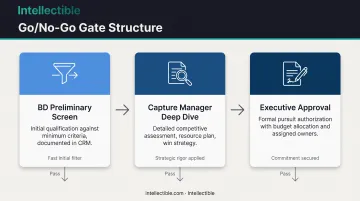
Typical Go/No-Go gates:
- BD preliminary screen - Initial qualification against minimum criteria, documented in CRM
- Capture manager deep dive - Detailed competitive assessment, resource plan, and win strategy
- Executive approval - Formal pursuit authorization with budget allocation and assigned owners
Document the rationale at each stage. Leadership needs to understand why you're pursuing or passing, especially when the decision contradicts initial assumptions.
Capture Planning and Customer Engagement
Capture begins after a "Go" decision and focuses on shaping customer requirements, building relationships, refining win themes, and positioning discriminators before RFP release.
Key capture activities include:
- Customer meetings - Engage program offices through industry days, one-on-one meetings, and agency-hosted exchanges when FAR 15.201 allows pre-solicitation communication
- Teaming partner identification - Secure subcontractors, joint venture partners, or mentor-protégé arrangements that fill capability gaps
- Solution design - Develop your technical approach, staffing model, and delivery methodology before the RFP drops
- Price-to-win analysis - Model competitive pricing scenarios to understand where you must land to win while maintaining acceptable margin
- Capture plan documentation - Assign owners and milestones for each activity, tracking customer intelligence, competitor moves, teaming status, and action items
Platforms like Intellectible's GovCon Engine convert federal notices into structured records with agency details, NAICS and PSC codes, timing, scope, fit rationale, and recommended actions. Teams track customer intelligence, competitive positioning, and teaming in real time instead of across disconnected spreadsheets.
Proposal Development and Submission
Proposal phase begins at RFP release and shifts focus from shaping to responding. Follow the solicitation's instructions, compliance matrix, and evaluation criteria exactly.
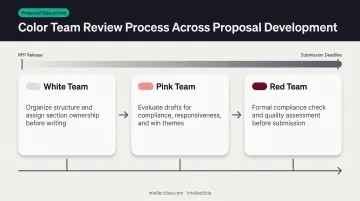
Color team review process:
- White team outline - Organize proposal structure and assign section ownership before writing begins
- Pink team draft review - Evaluate initial drafts for compliance, responsiveness, and win theme integration
- Red team final review - Conduct formal compliance check and quality assessment before submission
Pricing teams develop competitive cost volumes during this phase. FAR 15.305 requires evaluation under the solicitation's stated factors and relative importance, so your cost strategy must align with the agency's published evaluation weighting—not a universal percentage.
Proposal platforms help coordinate technical, management, and cost volumes across distributed teams. Intellectible's Proposal & Pursuit Engine runs work through Upload → Compliance → Variables → Draft, with compliance matrices, reviews, and approvals in one controlled workflow.
Post-Submission Actions and Pipeline Hygiene
After submission, conduct hot wash sessions to:
- Capture lessons learned while the pursuit is fresh in the team's memory
- Document what worked, what didn't, and what you'd change next time
- Update CRM pipeline status to reflect submission and expected award timeline
- Maintain customer communication during the evaluation period when allowed
For lost opportunities, request a debriefing under FAR 15.506. Generally, submit a written request within 3 days of notice; the agency should debrief within 5 days when practicable. Debriefs reveal evaluation weaknesses, helping you improve future win probability on similar pursuits.
Best Practices for Federal Opportunity Management
These practices help GovCon teams keep pipelines visible, engage customers before RFP release, and protect bid capacity with clear Go/No-Go discipline.
Maintain Pipeline Visibility Through Regular Reviews
Conduct weekly opportunity reviews with leadership to track:
- Pursuit status across all active opportunities
- Resource allocation and capacity constraints
- Upcoming gates (Go/No-Go decisions, proposal milestones, submission deadlines)
- Win probability shifts based on customer feedback or competitive intelligence
Deltek's 2021 study found that 35% of contractors cited pipeline forecasting and reporting as a challenge, while 54% faced limited BD resources. Regular reviews prevent surprises and enable proactive resource management.
Invest in Early Customer Engagement
Pre-RFP capture delivers better positioning than waiting for solicitation release. Agencies value industry feedback during requirements development and often shape solicitations based on capable contractor input.
GSA notes that Industry Days and forms-based RFIs improve mutual understanding and can produce more actionable, comparable feedback. FAR 15.201 explicitly encourages exchanges from the earliest requirement identification.
Document Go/No-Go Decisions With Scoring Rationale
Prevent "bid everything" cultures by requiring documented decision rationale and leadership approval. Each Go/No-Go should include:
- Scored evaluation against defined criteria
- Competitive assessment with named competitors and positioning factors
- Resource commitment (hours, budget, personnel)
- Win probability estimate with supporting evidence
- Approval signatures from relevant executives
Documentation protects proposal team capacity and keeps pursuit effort on winnable work.
Use AI-Powered Decision Support
Platforms that automate opportunity scoring reduce Go/No-Go analysis time while improving decision accuracy. Intellectible reports 95%+ time savings on opportunity search and Go/No-Go decisions, with a 150%+ increase in actionable top-of-funnel opportunities.
Oceus, a government contractor using Intellectible's platform, reported reviewing more than double the qualified opportunities (approximately seven to eight per month passing its qualification threshold). CEO Jeff Harman noted that potential customers entered Oceus's pipeline through AI-generated exposure that hadn't existed previously.
Automation doesn't replace human judgment; it surfaces relevant data faster so teams can make informed decisions with less manual research.
Conclusion
Managing federal opportunities effectively requires disciplined qualification, early capture investment, and focused allocation of resources to high-probability pursuits. Most opportunities should be dismissed at initial screening, preserving proposal team capacity for work where you hold a genuine competitive advantage.
Treat opportunity management as a core operating discipline. It protects team capacity and raises win rates when go/no-go decisions are documented, qualification is rigorous, and customer engagement starts early—so your pipeline favors winnable pursuits instead of every open RFP.
Frequently Asked Questions
What is a federal opportunity in government contracting?
A federal opportunity is any potential contract award identified through SAM.gov, agency forecasts, or procurement notices. Opportunities range from small task orders under existing vehicles to large full-and-open competitive solicitations spanning multiple years and millions of dollars in contract value.
How do I find federal contract opportunities?
SAM.gov serves as the central source for active federal opportunities, including pre-solicitation notices, solicitations, and awards. Supplement SAM.gov monitoring with agency-specific forecast databases like GSA's Forecast of Contracting Opportunities, industry day announcements, and GSA eBuy for schedule-based task orders.
What is a Go/No-Go decision in government contracting?
A Go/No-Go decision is the formal evaluation process where GovCon teams decide whether to pursue an opportunity. Teams score each opportunity against win probability, strategic fit, competitive position, and resource availability, then document the rationale and secure leadership approval before committing pursuit resources.
How long does federal opportunity management take from identification to award?
Timelines vary by contract type and agency. GAO's FY2022 DOD analysis found a median 32 days from solicitation to signed contract—139 days for awards above $50 million. MITRE notes the need-to-solicitation phase often takes 3–6 months and can exceed a year for complex requirements.
What is Pwin in federal contracting?
Pwin (probability of win) is a percentage score estimating your likelihood of award based on competitive position, customer relationships, solution strength, and past performance. Companies establish their own Pwin thresholds to justify pursuit investment, typically declining to bid when competitive disadvantages make the probability too low.
When should I start capture activities for a federal opportunity?
Start capture as early as possible—ideally when the requirement first appears in agency forecasts or pre-solicitation notices. Early engagement allows time for customer shaping, teaming arrangements, and solution refinement rather than scrambling after RFP release. FAR 15.201 encourages industry exchanges from the earliest requirement identification.