Introduction
Capture management is the strategic process government contractors use to position themselves to win contracts before the RFP is released. Rather than reacting to solicitations, successful GovCon teams qualify opportunities, gather intelligence, and build customer relationships 12–24 months in advance.
In regulated, high-stakes federal procurement, that early work is what separates consistent wins from resources burned on proposals that never had a chance.
This guide explains what the capture management process is, how it works step-by-step, what factors affect success, and common pitfalls to avoid. You'll learn how structured capture turns scattered pre-RFP activity into a repeatable system that improves win rates and cuts wasted effort in competitive federal procurement.
Key Takeaways
- Capture management is the pre-RFP discipline that positions your firm to win before the solicitation drops
- Strong capture spans opportunity ID, customer intel, competitive analysis, solution design, and relationship building
- Starting 12–24 months before RFP release sharply raises win probability and proposal quality
- AI platforms automate intel, scoring, and workflows so teams scale capture without adding headcount
- Late starts, skipped competitive analysis, and weak proposal handoffs are the mistakes that sink pursuits
What Is the Capture Management Process?
Capture management is the process of identifying, qualifying, and pursuing specific government contract opportunities before the solicitation is released. It means gathering intelligence on agency needs and decision-makers, sizing up competitors, and building relationships so you move from unknown vendor to preferred choice.
The intended outcome: Capture management raises your probability of win (P-Win). By the time proposals land, evaluators already see your solution as the best fit for their mission and requirements.
You are not introducing the company cold in a written proposal. Capture lets you shape requirements, validate your approach, and build credibility months before competitors know the opportunity exists.
How capture differs from related activities:
- Business development focuses on broader relationship building, market entry, and identifying potential revenue opportunities across accounts
- Capture management is opportunity-specific, concentrating on winning a single named contract through strategic positioning
- Proposal management begins after the RFP is released and focuses on planning, writing, reviewing, and submitting the response
- Account planning covers ongoing customer relationships and pursuits across multiple opportunities within an agency or program office
Capture management typically runs 12–24 months before RFP release and produces a capture plan that guides pre-RFP work. That plan feeds proposal strategy as soon as the solicitation drops.
Why Capture Management Is Critical for GovCon Teams
Federal contracting doesn't reward reactive proposal teams. The Office of Federal Procurement Policy (OFPP) emphasizes that program managers need current market information to define requirements, and contracting officers need it to plan acquisition strategy and identify appropriate contract vehicles.
Early, frequent engagement matters most on complex, high-risk acquisitions—exactly the pursuits most GovCon teams chase.
Capture must address these GovCon realities:
- Agency mission priorities and how your solution advances them
- FAR and agency supplements such as DFARS
- Right contract vehicles (IDIQs, GSA schedules, agency-specific)
- Set-asides for small business, SDVOSB, and other socioeconomic categories
What goes wrong without capture management:
- Resources burned on unwinnable work dominated by incumbents or better-positioned rivals
- Generic proposals that miss agency hot buttons and decision-maker priorities
- Rushed timelines that create quality problems, compliance gaps, and lower scores
- Falling win rates and rising cost-per-proposal that erode profitability
Capture management is a GovCon best practice for good reason. According to Deltek's 2021 GovCon Industry Study, the industry average win rate is 40%, with a median of 35%.
That study did not isolate capture as a single variable. Still, high-performing contractors rely on disciplined, early capture to improve positioning and put resources on winnable work.
How the Capture Management Process Works
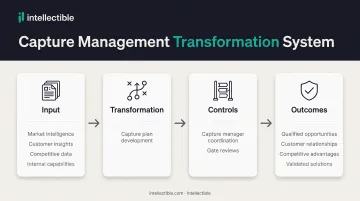
Capture management transforms scattered pre-RFP activities into a systematic process flowing from opportunity identification through intelligence gathering, strategy development, customer shaping, and transition to proposal. Instead of reacting to RFPs as they drop, capture teams proactively build the foundation for winning proposals months or years in advance.
Inputs
The process begins with multiple intelligence sources:
- Market intelligence: SAM.gov forecasts, agency procurement plans, budget documents, and procurement notices
- Customer insights: Agency pain points, mission priorities, decision-maker preferences, and operational challenges
- Competitive landscape data: Incumbent performance, likely competitors, past awards, and teaming partner availability
- Internal capability assessments: Your company's past performance, technical strengths, personnel availability, and differentiation opportunities
The Core Transformation
Teams analyze and synthesize raw intelligence into a strategic capture plan that positions your solution as the best fit for the agency's mission and requirements. That plan documents:
- Customer mission objectives and decision criteria
- Competitive advantages and win themes
- Solution framework and technical approach
- Pricing strategy and contract structure
- Stakeholder engagement plan
- Risk mitigation strategies
Process Controls
A dedicated capture manager owns the process end to end. Core responsibilities include:
- Coordinating cross-functional teams
- Maintaining the capture plan and tracking milestones
- Running gate reviews at key decision points
- Keeping pursuit work aligned with corporate strategy
Gate reviews—typically at pursuit, bid, and bid-validation stages—create explicit stop/continue decisions so teams avoid pouring resources into opportunities that no longer meet qualification criteria.
Outcomes
Capture management produces:
- Qualified opportunities with realistic win probability assessments
- Established customer relationships and access to decision-makers
- Documented competitive advantages and discriminators
- Validated technical solutions aligned with customer requirements
- A capture plan that feeds proposal development, cutting cycle time and raising quality
Step 1: Identify and Qualify Opportunities
Successful capture begins 12-24 months before RFP release with systematic opportunity monitoring. Teams track multiple sources to identify potential contracts early:
- SAM.gov Contract Opportunities for official federal solicitations and notices
- Agency procurement forecasts published annually or quarterly
- Industry days and vendor outreach events where agencies preview upcoming requirements
- Requests for Information (RFIs) and sources sought notices
- Budget documents that signal funding priorities
Qualify each opportunity against these questions:
- Does it match your capabilities, past performance, and growth objectives?
- Do you have decision-maker access, competitive advantages, or an incumbent position?
- Does the contract value justify 12-24 months of capture investment?
- Can you engage stakeholders to gather intelligence and shape requirements?
Early go/no-go decisions keep resources off poor-fit pursuits. Many contractors chase every opportunity in their capability area. Disciplined qualification focuses effort on winnable contracts where you can differentiate.
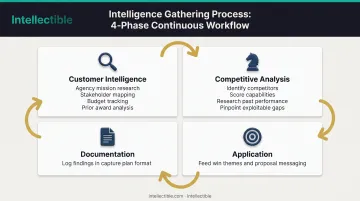
Step 2: Gather Customer and Competitive Intelligence
Customer and competitive intelligence turns early opportunity signals into decisions you can defend. What you learn here shapes teaming, win themes, and whether you bid at all.
Customer Intelligence Activities
- Research agency mission and priorities via strategic plans, congressional testimony, and program office sites
- Map key stakeholders—program managers, contracting officers, and technical evaluators—and how they influence the award
- Track budget cycles and funding sources to judge timing and whether the work is sustainable
- Analyze prior contract awards for procurement patterns, evaluation priorities, and incumbent performance
Competitive Analysis
- List likely competitors: the incumbent, firms with relevant past performance, and plausible teaming partners
- Score each competitor’s technical approach, customer access, and delivery risk—not only their brand strength
- Pull public award data and industry intel on how those firms performed on similar work
- Pinpoint gaps you can exploit where rivals are thin or the customer has already signaled dissatisfaction
Log findings in the capture plan in a format that links customer priorities to your solution advantages. That record feeds win themes, discriminators, and proposal messaging when the RFP drops.
Step 3: Develop Your Win Strategy and Solution
Intelligence gathering reveals what the customer needs and who you're competing against. Strategy development answers how you will win.
Win Strategy Components
- Pin down discriminators that only your team can claim for this customer and this requirement
- Build win themes that tie those discriminators to documented priorities, pain points, and evaluation factors
- Set a pricing posture that stays competitive and profitable, grounded in competitive intel and known budget constraints
- Bring in teammates only where they close a capability gap, strengthen past performance, or satisfy small-business requirements
Solution Development
Design a technical approach that addresses agency requirements and operational challenges. Keep it as a preliminary framework, not a full proposal. It should:
- Demonstrates you understand the customer's mission and constraints
- Shows how your approach solves their specific problems
- Validates feasibility with subject matter experts before the RFP drops
- Aligns your solution with the customer's stated objectives
Done before the RFP, this framework speeds proposal development. When the solicitation drops, your team adapts a validated approach instead of designing from scratch under deadline pressure.
Step 4: Engage Stakeholders and Shape Requirements
Relationship building and ethical shaping move your company from a qualified vendor to the preferred partner before competitors fully engage.
Relationship-Building Activities
- Attend industry days to meet program office staff and ask clarifying questions
- Request customer meetings to understand mission challenges and discuss potential approaches
- Participate in RFIs and sources sought notices to demonstrate capability and interest
- Provide white papers or capability briefs that educate the customer on solution options
Ethical Shaping
FAR 15.201 encourages exchanges between agencies and industry from the earliest identification of a requirement through proposal receipt. Acceptable engagement includes draft solicitations, presolicitation conferences, industry days, site visits, and one-on-one meetings, as long as no vendor receives preferential treatment.
How to shape requirements ethically:
- Highlight industry best practices that align with your strengths
- Demonstrate innovative approaches the customer may not have considered
- Educate the customer on solution options, trade-offs, and risk factors
- Share relevant past performance examples that illustrate successful outcomes
Legal boundaries: Never seek or use contractor bid/proposal information or source-selection information prohibited by FAR 3.104. Avoid organizational conflicts of interest under FAR 9.505, including situations that create biased ground rules or unequal access to information.
Consistent engagement positions your company as a trusted advisor. By the time the RFP is released, evaluators already understand your approach and see your solution as aligned with their needs. That familiarity is a real edge over competitors meeting the requirement for the first time.
Key Factors That Affect Capture Success
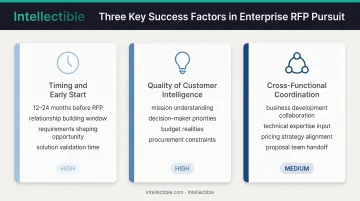
Not all capture efforts succeed. Three factors consistently separate winning capture programs from those that waste resources without improving win rates.
Timing and Early Start
According to Lohfeld Consulting's 2026 guidance, disciplined capture should begin 12-24 months before anticipated RFP release for standard opportunities, and earlier for large or mission-critical procurements. That window supports relationship building, requirements shaping, solution validation, and teaming.
Late starts—beginning capture only when the RFP drops or a few months before—eliminate the opportunity for shaping, severely limit relationship development, and force reactive positioning. Your team may still submit a compliant proposal, but you've surrendered the strategic advantages that early capture provides.
Quality of Customer Intelligence
Depth of understanding about agency mission, decision-maker priorities, budget realities, and procurement constraints directly impacts your ability to position a compelling solution. Incomplete intelligence leads to:
- Proposals that address generic requirements instead of specific customer pain points
- Win themes that miss the mark because you don't know what evaluators truly value
- Pricing that's either uncompetitive or leaves money on the table
- Technical approaches that solve the wrong problem
High-quality intelligence comes from multiple sources: public documents, stakeholder conversations, past performance analysis, and competitive research. Teams that treat intelligence gathering as a one-time event rather than a continuous process throughout capture consistently underperform.
Cross-Functional Coordination
Capture success depends on collaboration across business development, technical, pricing, and proposal teams. Poor communication between capture and proposal staff results in:
- Disconnected strategies where the proposal doesn't reflect months of capture positioning
- Lost intelligence as insights gathered during capture fail to transfer to writers
- Duplicated effort when proposal teams recreate analysis already completed during capture
- Missed opportunities because subject matter experts weren't engaged early enough
The most successful GovCon teams structure capture as a cross-functional effort from day one, with clear handoff processes that transfer strategy, intelligence, and commitments from capture to proposal without information loss.
Common Capture Management Mistakes and Misconceptions
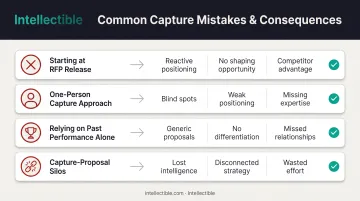
Even experienced GovCon teams make predictable capture mistakes that undermine their competitive position.
Misconception: Capture Can Start When the RFP Drops
This approach eliminates the opportunity for shaping, relationship building, and strategic positioning. By the time you see the RFP, agencies have already:
- Defined requirements based on input from engaged vendors
- Formed opinions about which contractors understand their mission
- Established evaluation criteria that may favor competitors with early access
Starting capture at RFP release turns "capture management" into reactive proposal preparation. You write to requirements shaped by others, propose unvalidated solutions, and compete against vendors who spent months becoming the preferred choice.
Mistake: Treating Capture as a One-Person Job
Capture requires cross-functional collaboration. Expecting a capture manager to gather all intelligence, develop strategy, design the technical solution, determine pricing, and coordinate transition in isolation creates blind spots and weak positioning.
Successful capture teams include:
- Business development staff with customer relationships
- Technical subject matter experts who validate solutions
- Pricing analysts who model costs and develop competitive strategies
- Operations staff who assess resource availability
- Proposal managers who prepare for smooth handoff
The capture manager coordinates these contributors and maintains the capture plan—but doesn't replace their specialized expertise.
False Assumption: Past Performance Alone Will Win Contracts
FAR 15.304 requires past-performance evaluation for most negotiated competitive acquisitions above the simplified acquisition threshold. FAR 15.305 treats it as a key indicator of future performance—but agencies still score it alongside technical approach, management capability, and price.
Without capture management, you can't:
- Communicate the relevance of your past performance to this specific customer's priorities
- Build relationships that help evaluators understand your qualifications beyond what's written
- Differentiate from competitors with similar credentials
- Demonstrate that you understand this customer's unique mission challenges
Past performance gets you qualified. Capture management gets you positioned to win.
Problem: Maintaining Capture and Proposal in Silos
When capture intelligence doesn't transfer effectively to the proposal team, valuable insights disappear. Writers don't know which win themes matter most, what customer hot buttons drive decisions, what competitors will propose, or what commitments were made during stakeholder engagement.
The result: proposals that don't reflect the strategic positioning developed during months of capture work. This siloed approach wastes the capture investment and produces generic proposals that could have been written without any capture effort at all.
Successful teams close that gap with:
- Clear handoff processes between capture and proposal
- Shared capture plan documentation
- Joint transition meetings before writing begins
When Capture Management May Not Be Appropriate
Full capture processes require significant investment. Not every opportunity justifies that commitment.
Consider abbreviated or minimal capture for:
- Low-value contracts where 12–24 months of capture effort would exceed realistic profit potential
- Strong incumbent recompetes with deep customer relationships, proven performance, and little competitive threat
- Highly commoditized procurements where price dominates and differentiation is limited
Constraints that reduce capture effectiveness:
- Very short timelines (under 3–6 months’ notice) that leave no room for relationship development or shaping
- Closed procurements with minimal pre-RFP engagement or restricted vendor access
- No viable path to customer access due to security restrictions, geography, or locked-in competitor relationships
Even when full capture isn't justified, basic competitive analysis and solution planning still improve proposal quality. Match capture investment to strategic value, competitive landscape, and realistic win probability. Don't skip capture discipline just because a contract looks small or straightforward.
Frequently Asked Questions
What is the capture management process?
The capture management process is the systematic approach to winning government contracts before RFP release through intelligence gathering, relationship building, and strategic positioning over a 12-24 month period. It transforms reactive proposal responses into proactive positioning that establishes your company as the preferred vendor choice.
What are the steps in the capture management process?
Core steps include identifying and qualifying opportunities, gathering customer and competitive intelligence, developing your win strategy and solution, and engaging stakeholders to shape requirements ethically.
When should capture management start for government contracts?
Capture should begin 12-24 months before anticipated RFP release for large, complex opportunities. Early starts enable relationship building, requirements shaping, solution validation, and teaming. For very large or mission-critical procurements, begin even earlier to maximize positioning opportunities.
What is the role of a capture manager in GovCon?
The capture manager serves as the single point of accountability for pursuing a specific opportunity. They coordinate intelligence gathering, develop and maintain the capture plan, facilitate cross-functional collaboration, lead gate reviews, and ensure smooth transition to the proposal team when the RFP is released.
How does capture management improve win rates?
Structured capture positions you as the preferred solution before evaluation by building relationships, shaping requirements around your strengths, and using intelligence-driven strategies. Disciplined qualification also cuts wasted effort so you focus on pursuits where you have a real edge.
What tools and technology support capture management?
CRM systems track relationships and engagement; capture software organizes intelligence, milestones, and collaboration. AI platforms like Intellectible's GovCon Engine automate opportunity scoring from SAM.gov, intelligence gathering, and workflow coordination so teams can scale capture without adding headcount.