That's the frustrating reality of FAR-governed procurement. Solicitations run long, come with attachments and last-minute amendments, and demand exact adherence to Section L instructions and Section M evaluation criteria. Manually tracking all of it across spreadsheets and shared drives is slow and error-prone.
This post breaks down what FAR compliance really requires, why manual tracking fails, what software should actually do about it, and how to evaluate a platform before you commit your proposal team's time.
Key Takeaways
- FAR solicitations add Uniform Contract Format, Section L/M mapping, and amendment rules beyond commercial RFP norms
- Most compliance failures are administrative: missed pages, wrong formats, or unacknowledged amendments
- Automated compliance matrices and Section L/M mapping free proposal hours for strategy
- One platform can link capture, compliance, and pricing without rebuilding workflow per solicitation
What Does FAR Compliance Actually Mean for Government RFPs
What Does FAR Compliance Actually Mean for Government RFPs?
The Federal Acquisition Regulation (FAR) sets the uniform rules executive agencies must follow when they buy goods and services: everything from how solicitations get structured to how proposals get evaluated. It exists to keep competitive bidding transparent and fair.
Compliance isn't a yes/no checkbox. It means fully addressing Section L instructions and Section M evaluation criteria, inside strict page and formatting constraints. Miss either one and your technical strength doesn't matter.
Three sections anchor every response:
- Section C — the Statement of Work, describing what the government actually needs
- Section L — Instructions to Offerors, dictating exactly how to structure and submit your proposal
- Section M — Evaluation Criteria, spelling out how the government will score you
FAR requires contracting officers to use the Uniform Contract Format (Table 15-1) for these sections, which is why federal RFPs look so different from commercial ones. You also get mandatory clauses, restricted Q&A channels, and formal protest rights that don't exist in private-sector procurement.
The Administrative Trap
GAO protest records show how unforgiving this structure can be. In one case, a bidder lost a contract simply for failing to acknowledge a solicitation amendment that changed a material term, even though most other bidders caught it.
The proposal wasn't technically weak. It was procedurally nonresponsive.
Why Manual Compliance Tracking Breaks Down on FAR Solicitations
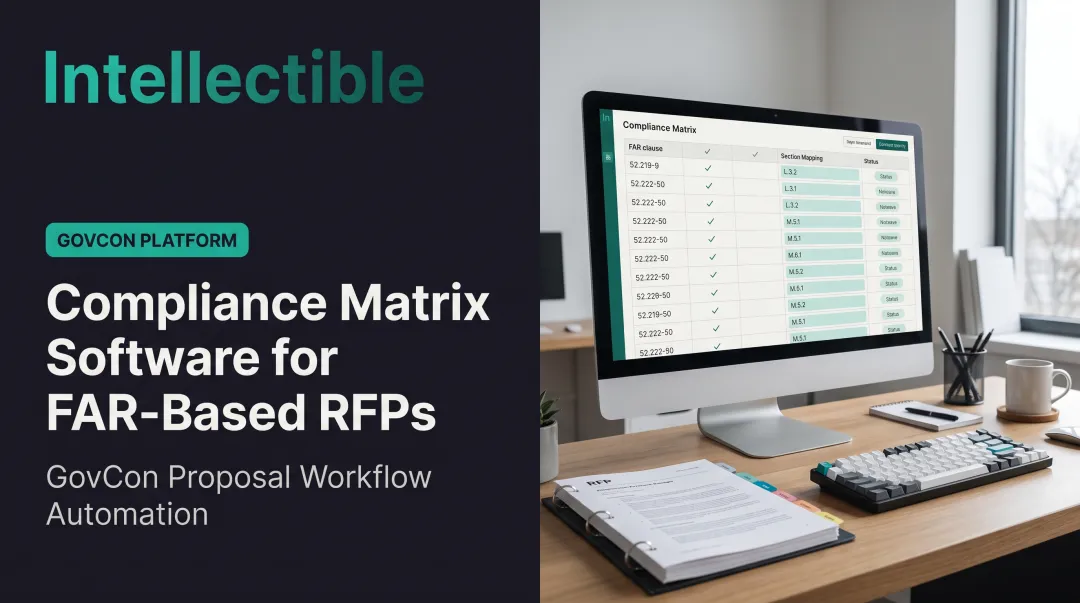
Most proposal teams still build compliance matrices by hand: someone reads through Section L and M, copies requirements into a spreadsheet, and assigns owners across a shared drive. That holds for simple RFPs. FAR solicitations rarely stay simple.
They routinely run over 100 pages once you count attachments. FAR 15.206 also requires amendments to be tracked and redistributed to every affected offeror, including amendment number, page count, and change description.

Where Manual Processes Fail
- Missed amendments — an update lands mid-response and never makes it into the working compliance matrix
- Inconsistent section mapping — different writers interpret Section L requirements differently across volumes
- Version control conflicts — multiple people editing the same tracker, overwriting each other's updates
- Last-minute formatting errors — page limits, font sizes, and required headers get caught (or missed) in the final hours before submission
None of these failures reflect weak technical writing. They're administrative gaps that steal time from proposal managers and subject matter experts. That time should go toward sharpening the win themes evaluators actually score, not chasing which spreadsheet tab holds the latest requirement list.

Core Features Government RFP Compliance Software Should Provide
Not every "compliance tool" solves the actual problem. Here's what a platform needs to genuinely reduce risk on FAR solicitations:
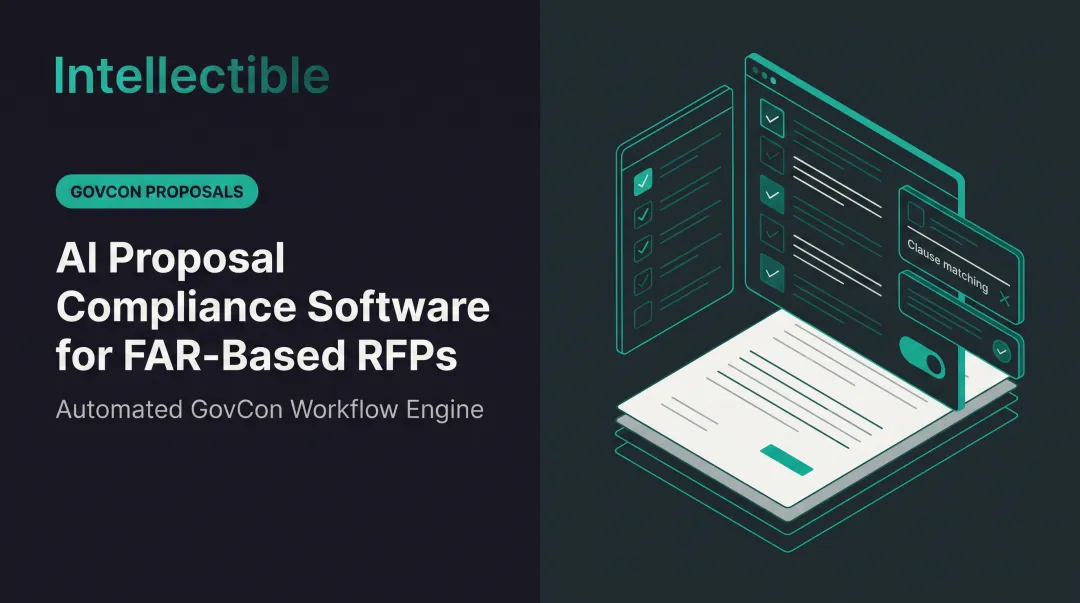
- Automated compliance matrix generation: Pulls requirements directly from Section L/M and maps them to proposal sections and named owners, instead of relying on someone's manual read-through
- Amendment tracking and alerts: Flags changes the moment they happen so requirement updates don't get lost mid-response
- Go/No-Go and opportunity scoring: Helps teams triage which solicitations are actually worth pursuing before burning resources on a long shot
- A centralized workspace: Connects capture data, past performance content, pricing, and compliance status in one place, rather than scattered across five tools
- Audit trail functionality: Documents who changed what and when, useful for internal governance and any post-submission review
- Integration with existing systems: Plugs into your CRM and document stores rather than forcing a rebuild for every new pursuit
Evaluation traceability is what ties those capabilities together. FAR 15.305 requires agencies to document strengths, weaknesses, deficiencies, and risks against the stated evaluation factors. Software that mirrors that structure internally makes your response easier to score favorably, because you're speaking the evaluator's language back to them.

How Intellectible Supports FAR Compliance Workflows Without Adding Headcount
Intellectible is built as a horizontal AI platform with production-ready engines and a full developer suite, so proposal teams aren't rebuilding infrastructure every time a new FAR solicitation lands.
The GovCon Engine processes uploaded solicitation documents, including attachments and addenda, and extracts:
- Requirement summaries and submission obligations
- Evaluation factors and compliance deadlines
- Risk lists and coverage gaps
- Compliance matrices mapping requirements to proposal sections and owners
The visual workflow builder connects document nodes, AI extraction, structured data, decision logic, and human review into one pipeline. Instead of a spreadsheet someone updates by hand, requirements flow through a system that routes work to owners, flags missing evidence, and preserves a record of every change.
That structure follows the Upload → Compliance → Variables → Draft sequence inside the Proposal & Pursuit Engine, giving teams a consistent process regardless of how different each solicitation looks on the surface.
Clients report measurable results:
- 95%+ time saved on opportunity search and Go/No-Go decisions
- 90% reduction in time to final pricing, with full audit trail control
- No added headcount required to scale pursuit and FAR compliance volume
Project-level workspaces keep pursuit and pricing teams working from the same source of truth: files, workflows, roles, and compliance status all in one governed environment, rather than split across email threads and disconnected folders. That shared system is how teams take on more FAR work without hiring to keep up.

Best Practices for Choosing and Implementing Compliance Software
Before committing to a platform, run it through these checks:
- Can it ingest the full RFP package? Base solicitation plus every attachment and amendment, not just the cover document
- Does it reflect Section M weighting? A tool that generates outlines matching evaluation priorities beats one that only checks boxes
- Does it support structured review stages? Look for clear ownership and status tracking through pink, red, and gold team equivalents
Once you choose a platform, treat rollout with the same rigor:
- Map your color-team process into the tool before the first live pursuit
- Assign owners for solicitation intake, the compliance matrix, and amendment tracking
- Run one completed RFP through as a dry run to surface gaps early
A platform that clears the selection checks and supports a clean rollout lowers the odds that a strong technical proposal gets undercut by something avoidable: a missed page limit, an unacknowledged amendment, or a review that never happened.
Frequently Asked Questions
Where does compliance most often slip after solicitation release?
In the amendment and Q&A window. Requirements move after the compliance matrix is built, and teams patch individual rows instead of re-baselining against the amended solicitation. That gap between the matrix and the current requirement set is where experienced teams lose responsiveness.
How do you track requirement changes through multiple amendments?
Treat each amendment as a new baseline rather than a patch. Re-run the requirement extraction, diff it against the previous version, and reassign any changed rows to owners with the deadline they now carry. Teams that track amendments as a list of changes rather than a re-baselined matrix tend to miss the second-order effects on Section L instructions.
What's the difference between an RFI and an RFP?
An RFI gathers market and capability information with no intent to award a contract; responses aren't binding offers. An RFP requires a full proposal evaluated against binding, stated criteria.
How is FAR compliance different from general RFP compliance?
FAR adds mandatory clauses, a structured Uniform Contract Format with Section L/M requirements, and formal protest rights. Commercial RFPs typically include none of these.
Can software fully automate FAR compliance, or is human review still needed?
Software handles administrative tracking, requirement extraction, and drafting support well. Strategic judgment and final review decisions still need human proposal expertise.