Introduction
Federal contract types decide who absorbs cost overruns, how profit is calculated, and what accounting infrastructure you need before you bid. The rules are firm: each type allocates cost risk, profit incentives, and compliance obligations between the government and the contractor.
For GovCon teams, that allocation drives pricing accuracy, compliance burden, and whether a win stays profitable. A fixed-price contract that looks like a $5 million revenue win can turn into a six-figure loss if you underestimate cost. A cost-reimbursement award can sit unexecutable if your accounting system is not ready.
This guide covers the primary government contract types: firm-fixed-price, cost-plus-fixed-fee, fixed-price-incentive-firm-target, time-and-materials, and indefinite-delivery/indefinite-quantity. You will see how they differ on risk and execution requirements, and how to match the right structure to your opportunities.
Key Takeaways
- Contract type sets who bears cost risk, how you earn profit, and which compliance systems you need before bidding
- Fixed-price puts full overrun risk on you; cost-reimbursement shifts it to the government but needs DCAA-compliant accounting
- T&M requires a finding that no other type fits and brings strict government oversight
- IDIQs guarantee only the stated minimum; multiple-award holders compete for every order above the micro-purchase threshold
What Are Government Contract Types?
Government contract types are the regulatory structures defined in FAR Part 16 that determine how the government pays contractors, who bears performance and cost risk, and what compliance requirements apply. FAR 16.101 states that contract types allocate the degree and timing of contractor cost responsibility and the amount and nature of profit incentive.
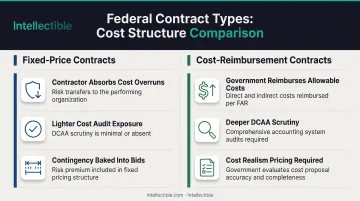
Contract type shapes how you bid, price, staff, and execute government work. Choosing fixed-price versus cost-reimbursement changes the deal in concrete ways:
- You absorb cost overruns on fixed-price work; the government reimburses allowable costs on cost-reimbursement contracts
- Fixed-price work usually means lighter cost audit exposure; cost-reimbursement work brings deeper DCAA scrutiny
- Fixed-price bids often bake in contingency; cost-reimbursement pricing must show cost realism
Why Contract Types Matter in Government Contracting
Contract type selection drives real business outcomes: profitability, cash flow, resource planning, audit burden, and competitive positioning.
A firm-fixed-price (FFP) contract rewards efficient execution with higher realized margins—but you own every overrun. A cost-plus-fixed-fee (CPFF) contract shields you from cost uncertainty, yet every cost element faces allowability reviews and rate audits.
What typically goes wrong:
- Underestimating FFP costs and skipping contingency, then delivering at a loss
- Bidding cost-reimbursement work without a DCAA-compliant accounting system, which triggers unallowable cost disputes and erodes profit
- Winning T&M work without infrastructure for daily timekeeping, cost ceilings, and invoice substantiation—then facing payment delays and compliance failures
Map the risk, cash flow, and compliance load of each contract type before you bid—not after award.
Types of Government Contracts
Government contracts fall into distinct types based on how risk is allocated between the government and contractor. Each type needs different operational approaches, accounting systems, and pricing strategies.
FAR 16.104 lists selection factors such as requirement complexity, urgency, performance duration, contractor accounting-system adequacy, and acquisition history. Choosing the right structure is critical for proposal success and contract profitability.
Firm-Fixed-Price (FFP) Contracts
What FFP contracts are:
FAR 16.202-1 defines FFP as a contract with a price that is not adjusted based on the contractor's cost experience. The contractor agrees to deliver specific goods or services for a predetermined price and absorbs cost overruns while keeping savings from efficiencies. The price does not change merely because your actual costs change.
How it differs from other types:
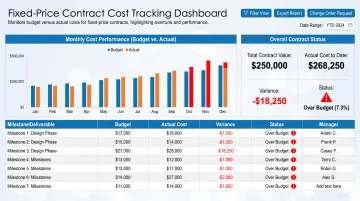
The contractor bears 100% of cost risk. If you estimate $1 million and it costs $1.2 million, you absorb the $200,000 loss. If it costs $900,000, you keep the extra $100,000 profit. The government pays the agreed amount regardless of your actual performance costs.
Best suited for:
- Well-defined requirements with reliable cost estimates (commercial items, repeat buys, production contracts)
- Contractors with strong cost estimating, a proven track record on similar work, and reserves to absorb overruns
Key strengths:
- Predictable revenue recognition and minimal government oversight of costs
- Reduced audit burden and faster payment processing
- Maximum profit potential for efficient contractors who beat their cost estimate
Limitations:
- Underestimating costs can produce significant losses
- Scope creep without price adjustments threatens profitability
- Robust project controls are required to avoid overruns
- Poor estimating can turn a win into a contract that consumes more cash than it generates (often called "bet the company" work)
Cost-Plus-Fixed-Fee (CPFF) Contracts
What CPFF contracts are:
FAR 16.306 defines CPFF as a contract where the government reimburses the contractor's allowable costs and pays a fixed fee negotiated at inception. The fee does not vary with actual cost, although changed work may adjust it. FAR 52.216-8 permits the contracting officer to withhold up to 15% of the total fixed fee or $100,000 (whichever is less) until contract completion, with staged release conditions.
How it differs from other types:
The government bears cost risk. The contractor receives the same dollar fee amount regardless of cost performance, though the fee as a percentage of cost decreases if costs exceed estimates. If the target cost is $1 million with a $100,000 fee (10%) and actual allowable cost comes in at $1.2 million, the contractor still receives $100,000—but the realized fee rate drops to 8.3%.
Best suited for:
- High cost uncertainty or evolving requirements (R&D, prototypes, early-stage technology, studies and analyses)
- Contractors with compliant accounting systems, strong cost tracking, and experience under government audit
FAR 16.301-3 also requires an accounting system adequate to determine costs applicable to the contract, and adequate government resources for surveillance.
Key strengths:
- Protects contractor from cost uncertainty
- Allows flexibility for evolving requirements
- Government shares financial risk of complex technical work
- Appropriate for novel or first-of-kind efforts
Limitations:
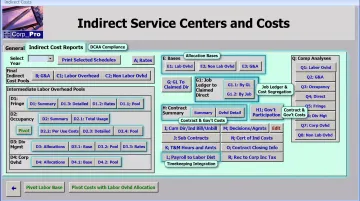
- Requires DCAA-compliant accounting system before award
- Subjects contractor to extensive cost audits and voucher reviews
- Lower profit margins than fixed-price work
- Government scrutiny of cost allowability under FAR Part 31
- Administrative burden of cost proposal and voucher preparation
- Limited cost control incentives since the fee is fixed
Fixed-Price-Incentive-Firm-Target (FPIF) Contracts
What FPIF contracts are:
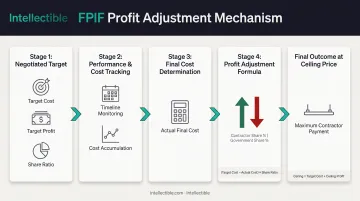
FAR 16.403-1 defines FPIF as a fixed-price contract with provisions for adjusting contractor profit based on actual cost performance against negotiated targets. The parties negotiate four elements: target cost, target profit, ceiling price, and share ratio. After performance, actual allowable costs are determined, and profit adjusts up or down using the share formula. Government liability is capped at the ceiling price.
How it differs from other types:
FPIF shares cost risk between parties using a predetermined formula. The contractor's profit increases for cost savings and decreases for overruns, but the government caps its maximum payment obligation at the ceiling. FAR 52.216-16 implements the negotiated share percentages: target profit is reduced by the stated contractor share of cost overrun or increased by its share of underrun.
Best suited for:
- Moderate cost uncertainty: too much for pure FFP, not enough for full cost-reimbursement (initial production, development with a reasonable cost basis)
- Complex requirements where cost control incentives benefit both parties
- Contractors who can set reliable cost estimates, maintain compliant cost accounting, and negotiate share ratios
Key strengths:
- Incentivizes contractor cost control and efficiency through the share mechanism
- Balances risk between parties
- Rewards strong cost management with higher realized profit margins
- More predictable than pure cost-reimbursement, less risky than firm-fixed-price
Limitations:
- Complex pricing requires sophisticated proposal development and financial modeling
- Final profit is known only after costs are substantiated and the formula is applied
- Compliant cost accounting is required to support final cost negotiation
- Allowable-cost disputes can delay final pricing
- Share ratio negotiations are critical: a weak ratio can shift too much risk to you or leave profit on the table
Time-and-Materials (T&M) Contracts
What T&M contracts are:
FAR 16.601 defines T&M as a contract where the government pays for direct labor hours at specified loaded rates plus actual material costs. The contractor invoices for hours worked at pre-negotiated labor category rates that include direct labor, overhead, G&A, and profit. Materials are reimbursed at cost. The government pays as work is performed with no predetermined total price, subject to a stated ceiling.
How it differs from other types:
The government bears cost risk because there's no cap on total contract price other than the ceiling. The contractor has limited incentive to control hours since profit increases with hours worked. FAR expressly states that T&M provides no positive profit incentive for cost control or labor efficiency, so the government must provide closer oversight to manage costs and prevent inefficiency.
Use threshold:
FAR 16.601 permits T&M only when the extent, duration, or cost of work cannot be estimated with reasonable confidence. The contracting officer must execute a determination and findings (D&F) that no other contract type is suitable and set a ceiling price that, if exceeded, is at the contractor's risk.
For DoD contracts, DFARS 216.601 adds approval gates: T&M portions over $1 million need senior contracting official approval of the D&F, and contracts over three years require nondelegable HCA approval.
Best suited for:
- Undefined scope, uncertain level of effort, or urgent start before requirements are fully known (staff augmentation, maintenance, repair, advisory support, emergency response)
- Specialized services where output-based pricing isn't feasible and the government must direct work incrementally
Key strengths:
- Maximum flexibility for undefined or evolving requirements
- Quick contract award when needs are urgent
- Simple invoicing based on timesheets and material receipts
- Low financial risk to contractor
Limitations:
- Government bears highest cost risk of any contract type
- Contractor not incentivized to limit hours
- Heavy government oversight burden to monitor efficiency
- FAR 52.232-7 requires daily timekeeping records and notification when projected cost will exceed 85% of ceiling within 30 days
- DFARS strict approval requirements for DoD contracts
- While not labeled "least preferred" in FAR, the no-other-type-suitable D&F and mandatory surveillance effectively make T&M a last-resort arrangement
Indefinite-Delivery/Indefinite-Quantity (IDIQ) Contracts
What IDIQ contracts are:
FAR 16.504 defines IDIQ as contracts for indefinite quantities of goods or services during a fixed period, with delivery or performance occurring when the government places individual orders. The base contract establishes terms, conditions, pricing structure, and ordering procedures but does not commit the government to specific quantities beyond the stated minimum.
How it works:
The government issues task orders (for services) or delivery orders (for supplies) as needs arise. The contract specifies minimum and maximum order quantities. Orders can use various pricing types—fixed-price, cost-reimbursement, or T&M—depending on the base contract terms and the nature of each order.
How it differs from other types:
IDIQ establishes a contracting vehicle with pre-competed terms but doesn't guarantee work beyond the minimum. Actual work is awarded through separate task or delivery orders over the contract period. Often structured as multiple-award contracts where several vendors compete for each order. FAR 16.505 requires that every awardee generally receive fair opportunity to be considered for orders exceeding the micro-purchase threshold.
Best suited for:
- Recurring needs where quantities, timing, or specs are hard to predict in advance (IT services, professional services, construction, variable-demand product delivery)
- Contractors who can respond quickly to task order competitions, run multiple projects at once, and manage uneven revenue across ordering periods
Key strengths:
- Cuts the need for a new full-and-open competition on every requirement
- Provides government flexibility in timing and quantities
- Creates multi-year revenue opportunities for contractors
- Reduces proposal costs after initial award
- Enables faster task order awards than standalone contracts
Limitations:
- No guarantee of work beyond the contract minimum
- Ongoing business development is required to win task orders
- Multiple-award IDIQs mean continuous competition with other holders
- Teams and capacity must stay proposal-ready without guaranteed revenue
- Uneven workflow complicates resource planning and overhead recovery
How to Choose the Right Contract Type for Your Opportunity
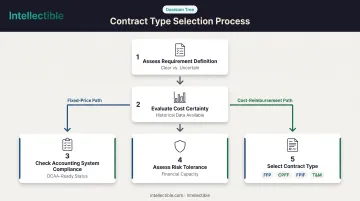
Choosing which contract types to pursue should match your operational capabilities, risk tolerance, accounting infrastructure, and competitive strengths, not just opportunity size. Under FAR 16.103, contract type is negotiated with price. The goal is reasonable contractor risk and strong incentive for efficient performance.
Requirement definition and cost certainty
FAR 16.104 favors FFP when requirements are well defined and predictable risk is low. Complex or unique work shifts more risk to the government and supports cost-reimbursement approaches.
Lean fixed-price when:
- Specifications are clear and quantities are known
- You have historical cost data from similar work
Prefer cost-reimbursement or T&M when:
- Requirements are exploratory or scope may evolve
- Technical uncertainty is high enough that a firm price would be guesswork
Company financial strength and risk tolerance
FFP contracts need capital reserves that can absorb losses. If your cost estimate is off by 15%, can your balance sheet cover the shortfall through completion?
Cost-reimbursement protects you from cost uncertainty, but you still invest in compliant accounting systems and audit-ready financials. Confirm you can finance performance before reimbursement, especially on long payment cycles.
Accounting system compliance and maturity
FAR 16.301-3 bars cost-reimbursement awards unless your accounting system can determine costs applicable to the contract. DCAA runs pre-award surveys on systems for new cost-reimbursement contractors.
You typically need:
- Job cost accounting
- Compliant timekeeping integrated with payroll
- Adequate indirect rate structures
- Controls that segregate allowable from unallowable costs
FPIF and T&M also require cost substantiation. FFP usually needs less sophisticated tracking because the government does not audit your internal costs.
Competitive landscape and procurement strategy
Contract type shapes competitive positioning. Proposing FFP when competitors offer CPFF signals confidence in your cost control. Offering an alternative type in negotiations can show flexibility, but only when the solicitation allows it. Your choice tells evaluators how you handle risk and delivery.
Before you commit, check:
- What contract type the incumbent used
- Whether the government's stated preference reflects real procurement needs or simply mirrors the expiring contract
When type tradeoffs collide with tight proposal deadlines, speed on assessment and pricing matters. Intellectible helps GovCon teams cut time to final pricing by up to 90% while keeping a full audit trail for reviewers.
Operational capacity for government oversight and reporting
Cost-reimbursement and T&M contracts take far more administrative effort than FFP. Plan capacity for:
- Detailed cost proposals
- Regular cost vouchers
- Audit-ready records
- DCAA audit responses
- Indirect rate negotiations
- Government surveillance
That workload hits resource allocation and overhead. Without dedicated contracts administration and cost accounting staff, CPFF or T&M pursuits can overwhelm your team.
Common Mistakes When Evaluating Contract Types
Even experienced GovCon teams misjudge contract-type fit. These three errors show up often, and each one can wipe out the margin you thought you locked in.
Skipping cost rigor on fixed-price work
Contractors underestimate FFP costs by leaving out labor hours, materials, subcontractor markups, travel, ODCs, or contingency. Poor estimating turns a projected 10% profit into a 5% loss. Build detailed bottom-up cost models and include contingency for scope ambiguity and performance risk.
Bidding cost-reimbursement without a compliant accounting system
Winning a CPFF award before your systems meet DCAA adequacy standards leads to unallowable cost disputes, provisional billing rate challenges, and profit erosion. Confirm system adequacy before you bid, or plan the investment to reach compliance before contract start.
Ignoring administrative burden and overhead
Cost-reimbursement and T&M contracts require proposal prep, cost reporting, voucher submission, audit support, and rate negotiations. That work consumes real indirect labor. Teams that treat CPFF as "low-risk" without pricing the compliance load often see realized fees fall well below expectations.
Conclusion
Contract type shapes risk allocation, pricing, execution, and profit. FFP, CPFF, FPIF, T&M, and IDIQ structures decide who absorbs a cost overrun, which accounting systems you need before you bid, how profit is calculated, and which compliance obligations follow you through performance.
Knowing those differences helps GovCon teams pursue the right work, price competitively within regulatory rules, and run contracts with the right controls. Choose the type that matches your capabilities and risk tolerance—not only the one named in the solicitation.
Frequently Asked Questions
What are the four types of government contracts?
There is no official FAR list of four contract types. FAR 16.101 identifies two broad categories—fixed-price and cost-reimbursement—with incentive contracts bridging them. FAR Part 16 also covers indefinite-delivery and time-and-materials, with risk allocation as the key distinction across all types.
How do I know which contract type is right for my opportunity?
Contract type suitability depends on requirement definition clarity, your cost estimating confidence, accounting system compliance, financial risk tolerance, and operational capacity to manage government oversight and reporting. Match well-defined requirements with fixed-price; match cost uncertainty with cost-reimbursement; use T&M only when scope cannot be estimated and no other type is suitable.
What's the difference between fixed-price and cost-reimbursement contracts?
Fixed-price places agreed cost-performance risk on the contractor, who must deliver for a set price regardless of actual costs. Cost-reimbursement places cost risk on the government, who reimburses the contractor's allowable costs plus a negotiated fee. Fixed-price rewards efficiency; cost-reimbursement requires accounting system adequacy and subjects costs to audit.
What contract type carries the most risk for contractors?
Firm-fixed-price contracts carry the highest financial risk for contractors because they bear 100% of cost overrun risk with no reimbursement relief. Cost-plus-fixed-fee contracts carry the least cost risk since the government reimburses allowable costs, though fee pressure and audit burden still apply when costs run high.
How does contract type affect my proposal pricing strategy?
Fixed-price proposals need detailed cost buildup with contingency built into the offered price. Cost-reimbursement proposals emphasize estimating methodology, accounting system compliance, and audit-ready cost projections. FPIF needs defensible targets, a share ratio, and a ceiling; T&M needs loaded labor rates, material projections, and a not-to-exceed ceiling.
Do I need different accounting systems for different contract types?
Basic accounting is required for all contracts, but cost-reimbursement and T&M require DCAA-compliant systems with job cost accounting, integrated timekeeping, and compliant indirect rates before award. FPIF needs systems that support final-cost negotiation. Firm-fixed-price typically needs less sophisticated cost tracking because the government does not audit internal costs.