Introduction: Why RFP Consultants Matter for GovCon Success
Government contracting remains one of the most competitive environments in federal procurement. Deltek's 2026 study of more than 900 contractors reports an industry-average win rate of 48%, with top performers reaching 72%. Many teams still struggle to break through.
A single RFP response can consume up to 84 hours of team capacity, and 38% of contractors cite pricing defensibility as the number-one reason proposals fail.
RFP consultants bring specialized expertise to close these gaps. They raise win rates with proven capture strategies, shorten proposal cycles through disciplined process ownership, and supply skills many internal teams lack: pricing analysis, FAR/DFARS compliance, and color team reviews.
For GovCon teams facing resource constraints, declining win percentages, or high-stakes pursuits outside their usual domain, consultants offer a measurable way to compete more effectively without expanding headcount.
This guide explains when to bring in external support, how to select the right consultant, and how to integrate their expertise into your capture and proposal operations.
Key Takeaways:
- Industry win rates average 48% (top performers hit 72%); pricing defensibility is the top proposal weakness
- Consultants cover capture planning, proposal management, writing, pricing, compliance, and color teams
- Hire when win rates lag, resources run thin, or pursuits involve unfamiliar vehicles or agencies
- Specialist types include capture strategists, proposal managers, pricing experts, graphics leads, and domain advisors
- Platforms like Intellectible automate screening, compliance checks, and workflow routing to multiply consultant impact
What Is an RFP Consultant for GovCon Teams?
An RFP consultant is an external specialist who supports government contractors through the full proposal lifecycle: from opportunity identification and capture planning through final submission. Unlike general business consultants, they bring deep fluency in the Federal Acquisition Regulation (FAR), Defense Federal Acquisition Regulation Supplement (DFARS), federal evaluation criteria, past performance requirements, and agency-specific procurement behaviors.
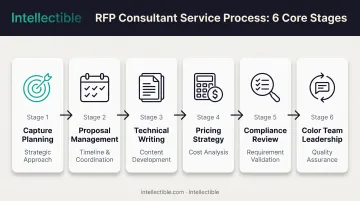
Core services include:
- Capture planning: Customer engagement strategy, competitive intelligence, solution shaping, teaming arrangements, and win-strategy development
- Proposal management: Coordinating subject-matter experts (SMEs), enforcing schedules, maintaining compliance, and leading structured color team reviews
- Technical writing: Translating complex solutions into evaluation-criteria-focused, compliant narrative that speaks directly to government scorers
- Pricing strategy: Building defensible cost/price volumes with labor-rate analysis, basis of estimate (BOE) development, wrap rates, and competitive positioning
- Compliance review: Mapping requirements to proposal sections, surfacing risks before kickoff, and ensuring every submission obligation is met
- Color team leadership: Running Pink, Red, Green, and Gold reviews with independent challenge and actionable feedback
Key deliverables typically include:
- Proposal outlines and compliance matrices
- Win themes and discriminators aligned to evaluation factors
- Volume drafts (technical, management, past performance, cost/price)
- Pricing models with BOE documentation
- Final production support (editing, graphics, desktop publishing)
Consultants may embed with your business development and capture team—joining strategy sessions, leading kickoffs, and coordinating with internal SMEs—or work more independently and deliver finished artifacts at set milestones.
The APMP Winning Business Ecosystem defines distinct roles for Capture Manager, Proposal Manager, Writer, Pricing Analyst, Designer, and Reviewer. Consultants fill whichever gaps your team needs most.
How consultants differ from general advisors:
General strategy or operations advisors rarely work the mechanics of how government agencies evaluate proposals: documented strengths, deficiencies, significant weaknesses, and risks scored against stated evaluation factors.
RFP consultants also know FAR 15.4 cost and pricing data requirements, which set a $2.5M threshold for certified cost or pricing data and require detailed estimating-process support. On defense work, they apply DFARS 215.4 price reasonableness standards that bar reliance solely on historical government prices.
That fluency keeps technical narrative, management approach, past performance, and pricing aligned to the same evaluation factors—so the offer clears compliance checks and still competes on discriminators.
When Your GovCon Team Needs an RFP Consultant
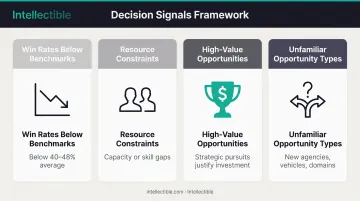
Not every pursuit justifies external support, but specific operational signals indicate when a consultant will deliver measurable return. Evaluate your situation against these four signals:
Signal #1: Win Rates Below Benchmarks or Declining Trends
If your win percentage has fallen or consistently trails industry norms, a consultant can diagnose root causes: weak capture, non-compliant proposals, pricing deficiencies, or an unconvincing past performance narrative.
Deltek's 2021 size-based study reported win rates of 33% for small/medium contractors and 48% for large firms, with an overall average of 40% and a median of 35%. Use these as baseline comparisons, not absolute targets. Your vertical, contract type mix, and competitive environment all influence realistic win rates.
Signal #2: Resource Constraints and Expertise Gaps
When pursuit volume exceeds internal capacity, or your team lacks specialized skills—consultants provide surge support without permanent headcount. Common gaps include:
- Proposal-process ownership (no one accountable for schedule, compliance, and submission)
- Independent review capability (teams reviewing their own work miss blind spots)
- Defensible cost-volume development (pricing is the leading proposal weakness cited by 38% of contractors)
- Production capacity (graphics, desktop publishing, final formatting)
- Domain knowledge (new technical area or agency the team hasn't served)
APMP assigns distinct responsibilities to Capture Manager, Proposal Manager, Writer, Coordinator, Pricing Analyst, SME/Engineer, Designer, and Reviewer. If your internal roster can't cover these functions, external specialists fill the gap.
Signal #3: High-Value or Strategic Opportunities
For pursuits where contract value, strategic positioning, or customer importance justify the investment, consultants reduce execution risk and improve your probability of win (Pwin). The cost-benefit calculation weighs consultant fees against:
- Potential contract value (total award or task-order ceiling)
- Estimated Pwin improvement (how much external expertise raises your competitive standing)
- Internal resource costs (opportunity cost of pulling SMEs off delivery work)
Even a modest Pwin increase on a multi-million-dollar contract can justify consultant investment.
Signal #4: Unfamiliar Opportunity Types
When pursuing a new agency, contract vehicle (GSA Schedule, IDIQ, SeaPort-NxG), acquisition strategy (Other Transaction Authority), or technical domain for the first time, consultants shorten your learning curve and reduce avoidable mistakes.
They understand agency-specific evaluation preferences, vehicle-specific compliance requirements, and domain-specific past performance expectations.
Example: A contractor pursuing its first Department of Defense IDIQ may lack experience with DFARS pricing requirements, multi-award fair-opportunity processes, or task-order evaluation frameworks. A consultant who has won similar contracts brings that institutional knowledge immediately.
Types of RFP Consultants for Government Contractors
Consultants specialize by lifecycle phase, function, and industry vertical. Match the specialty to the gap on your team.
Capture Consultants
Focus: Pre-RFP positioning and win-strategy development
Capture consultants begin work after your pursuit decision and before the RFP drops. Shipley defines capture planning as opportunity-specific, action-oriented, and decision-gated. These consultants:
- Build customer engagement strategies and identify key decision-makers
- Gather competitive intelligence on likely bidders and incumbents
- Shape your technical solution and teaming arrangements
- Develop win themes, discriminators, and proof points
- Create capture plans with named objectives, schedules, and decision gates
Typical engagement: 3–12 months before RFP release, continuing through award. The earlier they start, the more they can influence customer requirements and solution design, which directly raises your Pwin.
Proposal Managers and Writers
Focus: Post-RFP process ownership and compliant content development
Proposal Managers own the proposal process so nothing falls through the cracks under deadline pressure. They typically:
- Set milestones and enforce the schedule
- Coordinate SMEs and maintain compliance
- Orchestrate color team reviews
- Deliver the final submission
Technical writers translate your solution into evaluation-criteria-focused narrative. They:
- Align content to RFP evaluation factors and scoring rubrics
- Convert technical complexity into clear, persuasive language
- Maintain compliance with page limits, formatting rules, and submission instructions
- Apply proposal-specific writing techniques (active voice, customer focus, evidence-based claims)
When to engage: At RFP release or proposal kickoff for full-lifecycle support, or mid-cycle if your team is behind schedule or struggling with quality.
Pricing Specialists
Focus: Defensible cost/price volume development
With pricing defensibility cited as the number-one proposal weakness, pricing consultants bring critical expertise. They:
- Develop labor-rate analysis, basis of estimate (BOE), and wrap rates
- Apply FAR 15.4 cost and pricing data requirements and DFARS 215.4 standards
- Build competitive pricing strategies (cost leadership, differentiation, or hybrid)
- Reconcile cost/price volumes with technical and management narratives
- Prevent deficiencies that trigger questions or evaluation downgrades
Contract types where they add most value: Cost-reimbursable (CPFF, CPAF), Time & Materials (T&M), and Firm-Fixed-Price (FFP) with complex labor-category or material structures.
Graphics and Production Specialists
Focus: Visual communication and professional presentation
These consultants transform dense text into compliant graphics, manage page layout and formatting, and ensure your proposal meets every visual and production requirement. Services include:
- Create solution diagrams, process flows, org charts, and schedules
- Design compliant page templates and style guides
- Manage desktop publishing and final production
- Ensure Section 508 accessibility compliance when required
When to engage: Early enough to integrate graphics into drafts (not just final production), typically at outline or Pink review stage.
Consulting Firms vs. Independent Consultants
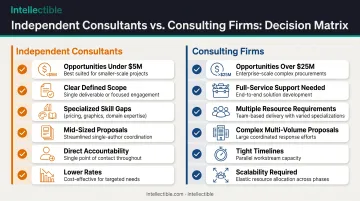
Large consulting firms offer multiple specialties under one contract, deeper resource pools for large pursuits, and established methodologies. They cost more—often 50–100% premium over independents—but provide continuity and scalability.
Independent consultants bring specialized expertise, scheduling flexibility, lower rates, and direct accountability. They work best for mid-sized opportunities, targeted skill gaps, or teams with strong internal coordination.
Selection guidance:
- Opportunities under $5M with clear scope → Independent consultant
- Opportunities over $25M requiring full-service support → Consulting firm
- Specialized gaps (pricing, graphics, domain expertise) → Independent specialist
- Complex multi-volume proposals with tight timelines → Firm with multiple resources
Industry-Specific Specialists
Domain specialists bring technical credibility and agency knowledge in areas such as IT modernization, cybersecurity, defense systems, healthcare IT, and professional services. They know vertical-specific evaluation priorities, common past performance themes, and the technical hot buttons government evaluators care about.
Example verticals:
- IT and systems integration
- Cybersecurity and zero trust
- Defense and aerospace
- Health and medical services
- Professional and advisory services
How to Select the Right RFP Consultant
The right consultant delivers measurable value; the wrong one consumes budget without improving outcomes. Follow this structured selection process:
Step 1: Define Your Need
Start with clarity about what you're hiring for:
- Capture support (strategy, customer engagement, competitive intelligence)
- Proposal management (process ownership, schedule enforcement, submission coordination)
- Technical or management writing (content development aligned to evaluation criteria)
- Pricing and cost-volume development (BOE, labor rates, competitive analysis)
- Graphics and production (visual communication, desktop publishing)
- Full-service support (integrated capture through submission)
Ask yourself: Are we filling a temporary capacity gap, acquiring specialized expertise we don't have, or reducing risk on a high-stakes pursuit?
Step 2: Establish Selection Criteria
Evaluate candidates against these dimensions:
Relevant GovCon experience:
- Contract types you're pursuing (FFP, T&M, cost-reimbursable, IDIQ)
- Agencies and buying offices (DoD, civilian, state/local)
- Technical domains matching your solution
- Similar contract value and complexity
Demonstrated performance:
- Win rates on comparable pursuits (request specifics, not generalities)
- Past performance examples with verifiable outcomes
- Client references willing to discuss deliverables and collaboration
Regulatory fluency:
- Understanding of FAR evaluation standards and pricing requirements
- Experience with DFARS pricing for defense contracts
- Familiarity with agency-specific evaluation preferences
Operational fit:
- Availability through your full proposal schedule (verify no conflicts)
- Security clearances if your work requires classified access
- Cultural fit with your team (collaborative vs. directive style)
- Communication approach (frequency, format, escalation paths)
Step 3: Vet Through a Structured Process
Request case studies and artifacts:
- Ask for 2–3 past performance examples on similar pursuits
- Review proposal excerpts, compliance matrices, or pricing models (redacted as needed)
- Evaluate writing samples for clarity, compliance focus, and persuasiveness
Check references with specific questions:
- "What deliverables did the consultant provide, and how did they meet your needs?"
- "How did they collaborate with your internal SMEs and leadership?"
- "Would you hire them again for a similar pursuit?"
- "What could they have done better?"
Conduct working interviews:
- Present a realistic scenario (abbreviated RFP section, pricing challenge, compliance issue)
- Ask how they would approach it
- Assess their methodology, problem-solving style, and communication clarity
Step 4: Understand Costs and Billing Models
Consultant fees vary widely based on experience, specialty, engagement scope, and opportunity value. Most bill hourly, daily, or by project milestone. Request detailed quotes that specify:
- Billing unit (hourly, daily, or fixed-fee per deliverable)
- Estimated total cost with assumptions clearly stated
- Payment terms and schedule
- Expenses (travel, materials, subcontractors) and how they're handled
Factors that drive cost:
- Years of relevant GovCon experience and demonstrated win rates
- Specialty depth (pricing and graphics command premiums over general writing)
- Engagement duration and intensity (full-time embedded vs. part-time advisory)
- Opportunity value (high-stakes pursuits justify higher rates)
- Geographic location and security clearance level
Certifications and qualifications to consider:
Credentials help you filter candidates before you compare rates. APMP Foundation certification requires at least one year in a bid/proposal environment and validates core competencies. Practitioner and Professional tiers require more experience and continuing education.
APMP shows proposal-process knowledge, but it does not prove FAR/DFARS fluency, agency experience, or domain expertise on its own. Verify those separately.
Security clearances matter for classified work. DCSA requires both personnel clearance and need-to-know. Individuals cannot apply themselves; they must process through a cleared contractor sponsor.
Working Effectively with Your RFP Consultant
Hiring the right consultant is half the battle; integrating them productively is the other half. Follow these principles to maximize their impact:
Engage Early
Bring consultants in during capture, not just the proposal phase, to maximize their influence on win strategy and solution design. Capture planning follows the pursuit decision and precedes proposal planning. Early engagement allows consultants to shape customer perceptions, competitive positioning, and teaming arrangements before the RFP locks requirements.
Optimal timing:
- Capture consultants: After pursuit decision, ideally 3–6 months before RFP
- Proposal managers: At RFP release or proposal kickoff
- Pricing specialists: Early enough to align cost assumptions with technical solution
- Independent reviewers: Scheduled for Pink and Red reviews at defined maturity points
Define Roles and Authority Upfront
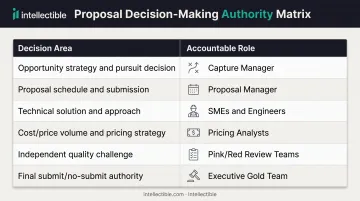
Ambiguity about decision-making authority creates friction during high-pressure proposal periods. Use this framework:
| Decision area | Accountable role |
|---|---|
| Opportunity strategy and pursuit decision | Capture Manager |
| Proposal schedule, assignments, review orchestration, submission | Proposal Manager |
| Technical solution and approach | SMEs and engineers |
| Cost/price volume and pricing strategy | Pricing Analysts |
| Independent quality challenge | Pink/Red review teams |
| Final submit/no-submit authority | Executive Gold Team |
Clarify upfront:
- Who owns the proposal schedule and has authority to enforce deadlines?
- Who resolves conflicts between technical approach and pricing assumptions?
- Who makes the final decision on strategy trade-offs?
- What approval gates must the consultant pass before delivering artifacts?
Maintain Active Internal Team Involvement
Consultants complement your team; they don't replace it. They need access to:
- SMEs for technical content, solution validation, and customer insight
- Pricing data (labor rates, wrap rates, historical costs, competitive benchmarks)
- Past performance information (contract references, performance metrics, lessons learned)
- Decision-makers for strategy approvals, risk acceptance, and final sign-off
Integration best practices:
- Schedule recurring touchpoints (daily stand-ups during proposal, weekly during capture)
- Use shared workspaces for documents, schedules, and compliance tracking
- Establish clear communication channels (Slack, Teams, email escalation paths)
- Provide feedback loops so consultants can refine their approach
For teams using workflow platforms, Intellectible's GovCon Engine automates opportunity screening, compliance analysis, and document routing. That cuts manual coordination so consultants can focus on strategy, content, and review instead of administrative tasks.
The platform reports 95%+ time savings on Go/No-Go decisions and 150%+ increases in actionable opportunities.
Leverage Color Team Reviews
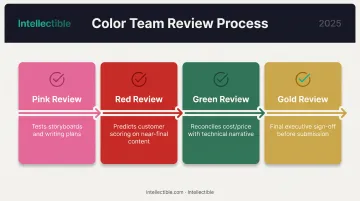
Color team reviews provide structured checkpoints for independent quality challenge:
- Pink Review: Tests storyboards and writing plans against win strategy before full drafting begins
- Red Review: Predicts customer scoring on near-final content; identifies weaknesses in focus, completeness, and strategy
- Green Review: Reconciles cost/price volume with technical and management narrative
- Gold Review: Final executive sign-off before submission
Consultants often lead these reviews, bringing external perspective and disciplined evaluation against RFP criteria. Their independence from internal politics and solution attachment surfaces issues internal teams miss.
Frequently Asked Questions
How much does an RFP consultant cost?
Pricing varies by experience, specialty, engagement scope, and opportunity value. Most consultants bill hourly, daily, or per project milestone. Ask for quotes that spell out billing unit, estimated total, assumptions, payment terms, expenses, and any premiums for pricing, graphics, or clearance work.
Who prepares and issues an RFP?
Federal contracting officers issue RFPs under agency acquisition authority. The RFP states requirements, anticipated contract terms, required proposal content, and evaluation factors. Contractors (with or without consultant support) prepare and submit proposals in response.
What is the difference between an RFP and a proposal?
An RFP is the government's solicitation document in negotiated acquisitions. It requests solutions and states evaluation criteria. A proposal is the contractor's response: technical approach, management plan, past performance, and pricing.
When should a GovCon team hire an RFP consultant?
Hire during capture, after the pursuit decision and before RFP release, so they can shape strategy and solution design. For proposal support, engage at release or kickoff to leave room for compliance analysis, drafting, and reviews. FAR 5.203 requires at least 30 days' response time above the simplified acquisition threshold; complex bids often need 60–90 days.
What certifications or qualifications should GovCon consultants have?
APMP certification validates bid/proposal competence, but verify FAR/DFARS pricing expertise, past performance with relevant agencies and contract types, demonstrated win rates, role-specific work samples, and security clearances separately. Certifications establish baseline knowledge; verified outcomes and relevant experience matter most.
Can technology platforms replace RFP consultants?
No. Platforms like Intellectible automate screening, compliance checks, document parsing, and drafting workflows so consultants spend less time on manual work. Strategy, customer relationships, creative problem-solving, and executive judgment still need human expertise.
Final recommendation: Match your win rates, capacity, and pipeline to the signals in this guide. If gaps show up, start the consultant search during capture, not in crisis. Pair outside expertise with workflow automation, and keep internal owners engaged so consultants have the access to deliver results.