That triage work adds up fast. Teams juggle manual opportunity searches, Go/No-Go meetings, compliance matrix building, and last-minute pricing runs, often across five or six disconnected tools. Deadlines don't move for federal contracting, so any lag in this process directly costs pipeline.
This article compares the RFx platforms GovCon capture teams actually use today, from opportunity intelligence tools to full-lifecycle capture platforms, so you can match the right tool to your team's stage of growth.
Key Takeaways
- RFx tools help GovCon teams find, qualify, and respond to RFIs, RFPs, and RFQs faster
- GovCon RFx differs from commercial deals via FAR/DFARS rules and SAM.gov monitoring
- This guide compares five platforms on features, best-fit use cases, and pricing
- Prioritize compliance support and pricing automation over brand recognition alone
- Scaling pursuit volume without new hires favors AI-native, full-lifecycle platforms
Overview of RFx Tools in the GovCon Capture Market
In the GovCon world, an RFx tool needs to do more than manage RFP responses. The full capture lifecycle spans several stages, each feeding the next:
- Opportunity discovery
- Go/No-Go decisioning
- Compliance matrix creation
- Proposal drafting
- Pricing
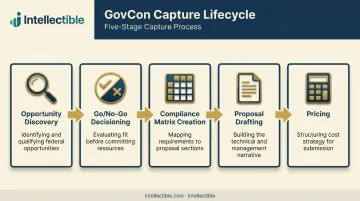
That lifecycle matters because of the sheer scale of the market. GAO reports roughly $793 billion in FY2025 federal contract commitments, $17.8 billion more than FY2024 after adjusting for inflation. That's a lot of competition chasing a lot of dollars.
Contractors are responding by adopting new tools faster than ever. Deltek's 2025 Clarity study of nearly 900 GovCon firms found 45% now use AI for operations and business development, up 10 percentage points year over year. That's a GovCon-wide adoption figure, not limited to capture teams specifically, but it signals where the industry is heading.
The tools below occupy different layers of that lifecycle. Some focus on finding opportunities early, while others sprint straight to drafting compliant responses. A handful attempt to cover the whole chain end to end. Here's how they stack up.
How GovCon RFx Differs from Commercial Procurement
Commercial RFx tools are built around a buyer-defined process: send a questionnaire, collect vendor answers, compare pricing. Federal negotiated acquisitions add layers commercial tools rarely touch.
Federal-specific requirements include:
- FAR/DFARS compliance — the Federal Acquisition Regulation governs executive agency purchasing, and DFARS layers on DoD-specific provisions
- Section L/M mapping — Section L covers instructions to offerors, Section M defines the scored evaluation factors, and both must be tracked in a compliance matrix
- Past performance narratives — FAR 15.305(a)(2) treats past performance as a required evaluation factor with its own recency and relevance rules
- Security clearance and ITAR considerations — relevant for defense and intelligence pursuits
- Teaming and subcontracting plans — often mandatory for small business set-asides and large program pursuits
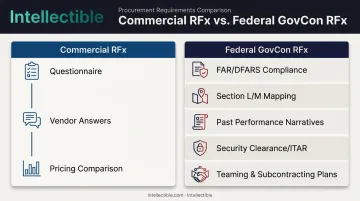
There's also a monitoring difference: commercial RFx is typically a one-off vendor request, while GovCon capture depends on continuous opportunity monitoring across SAM.gov, GovWin, and agency forecasts. Without that ongoing intelligence layer, teams miss early signals on procurements that haven't formally posted yet, losing weeks of positioning time.
Top RFx Tools for GovCon Capture Teams Compared
We evaluated each platform against five criteria that matter for GovCon specifically:
- GovCon-specific compliance support: FAR/DFARS awareness, not generic RFP logic
- Opportunity intelligence depth: how early and accurately it surfaces relevant procurements
- Proposal and pricing automation: speed from draft to submission-ready pricing
- CRM/pipeline integration: how well it connects to existing capture workflows
- Scalability without added headcount: can volume grow without a proportional staffing increase
GovWin IQ (Deltek)
GovWin IQ has been the industry standard for opportunity intelligence for years. Federal, state, and local capture teams use it to track upcoming procurements, monitor agency forecasts, and research contract award history long before a solicitation drops.
Its differentiator is depth of historical data. GovWin's analyst-tracked database gives teams a head start on positioning, which matters when incumbent advantage is real. It isn't an end-to-end capture or pricing solution, though; it's built for the discovery and qualification stage.
| Category | Details |
|---|---|
| Key Features | Opportunity tracking, agency forecasting, market intelligence, contract award history |
| Best Fit For | BD teams needing early-stage pipeline visibility |
| Considerations | Subscription-based pricing; limited native proposal drafting or pricing automation |
Intellectible
Intellectible takes a different approach: rather than a point solution for one stage of capture, it's a horizontal AI build platform that connects opportunity search, Go/No-Go automation, proposal support, and pricing in one connected workspace.
The GovCon Engine inside the platform processes federal and state opportunities at scale, turning every notice into a structured capture record with agency fit, NAICS/PSC codes, risk signals, and next-step recommendations. From there, pricing connects downstream when deal economics need to be modeled.
The results speak to that connected structure. Oceus, a defense contractor, now reviews more than double its qualified opportunities per month (about 7-8 clearing threshold), up from roughly half that before.
"Intellectible is taking the tedious, monotonous hours of RFP efforts out of human hands. This allows us to do what we should be doing, analyzing and selling." — John Grady, Corporate Director of Business Development, HHS
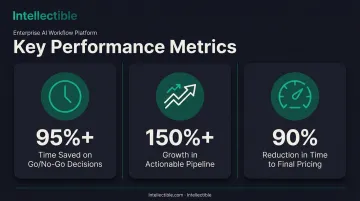
Platform-wide, Intellectible reports:
- 95%+ time saved on Go/No-Go decisions
- 150%+ growth in actionable pipeline
- 90% reduction in time to final pricing
| Category | Details |
|---|---|
| Key Features | Visual workflow builder, AI-powered opportunity scoring, incumbent and award mapping, connected databases and dashboards |
| Best Fit For | Capture and RevOps teams scaling pipeline volume and pricing speed without adding headcount |
| Considerations | Best suited for teams ready to configure workflows rather than use a rigid out-of-box template |
Vultron
Vultron is an AI-native proposal writing platform built specifically for federal contractors. It's designed to help capture and proposal teams draft compliant responses faster than manual writing allows.
What sets Vultron apart is its training data: the AI is built specifically on federal proposal language and Shipley-style compliance structuring, which shows in how it handles solicitation instructions and evaluation criteria compared to general-purpose writing tools.
| Category | Details |
|---|---|
| Key Features | AI proposal drafting, compliance matrix generation, past performance reuse |
| Best Fit For | Proposal teams focused on drafting speed and compliance accuracy |
| Considerations | Narrower scope than full capture-to-pricing platforms; primarily addresses the writing stage |
Loopio
Loopio is a widely adopted RFP response platform with a mature content library and collaboration tools, used across industries and by a fair number of GovCon primes and subs.
Its strength is content reuse. Loopio's search functionality cuts down on duplicate proposal writing across pursuits, which matters when the same past performance narrative gets rewritten five different ways for five different RFPs. That said, it wasn't built for federal-specific compliance.
| Category | Details |
|---|---|
| Key Features | Content library, AI-assisted answer suggestions, real-time collaboration |
| Best Fit For | Teams needing centralized content management across frequent, similar RFPs |
| Considerations | Not GovCon-specific; lacks native compliance/FAR-focused features and opportunity intelligence |
Unanet
Unanet is a GovCon-focused CRM and ERP platform with capture management and pipeline tracking built in. It's less an RFx tool in the traditional sense and more an operational backbone.
The differentiator here is financial integration. Unanet ties capture data directly to project accounting, cost management, and compliance reporting, giving finance and capture teams a shared source of truth from pipeline to profit.
| Category | Details |
|---|---|
| Key Features | Capture management, CRM pipeline tracking, GovCon financial/ERP integration |
| Best Fit For | Mid-size to large GovCons needing capture data tied directly to contract financials |
| Considerations | Heavier implementation lift; less focused on AI-driven proposal drafting or pricing automation |
How We Chose the Best RFx Tools for GovCon
We prioritized GovCon-specific compliance handling, opportunity intelligence depth, proposal automation, and pricing automation over general brand recognition or commercial procurement feature sets. A tool built for enterprise sales RFPs won't necessarily handle FAR-governed federal pursuits.
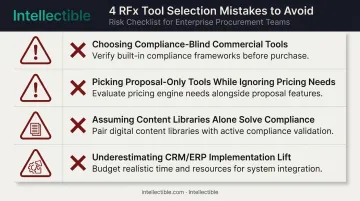
Common mistakes GovCon teams make when selecting RFx tools:
- Choosing a commercial RFP tool without FAR/DFARS-aware compliance features, then discovering gaps mid-pursuit
- Picking a proposal-only tool while ignoring pricing and capture pipeline needs, creating a handoff gap right when speed matters most
- Assuming a content library alone solves compliance, when Section L/M mapping requires more structure than keyword search
- Underestimating implementation lift for CRM/ERP-heavy platforms, then missing early pursuit windows during rollout
Conclusion
There's no single "best" RFx tool for every GovCon capture team. The right pick depends on your actual bottleneck: is it finding opportunities early enough, drafting compliant responses fast enough, or getting pricing out the door before the deadline?
Before committing, evaluate tools against measurable outcomes: time saved per Go/No-Go decision, proposal turnaround time, and pricing cycle time. Those numbers tell you more than a vendor's marketing page ever will.
Once you've identified your bottleneck, look for a platform that closes that specific gap instead of adding another disconnected tool. Intellectible's AI build platform consolidates opportunity search, Go/No-Go automation, and pricing into one system for teams scaling pursuit volume without adding headcount. You can book a demo to see the platform in action.
Frequently Asked Questions
What does RFX stand for?
RFx is shorthand for "Request for X," covering RFI (Request for Information), RFP (Request for Proposal), RFQ (Request for Quote), and other formal procurement document types used across commercial and government purchasing.
What are RFx tools?
RFx tools are software platforms that help teams create, manage, and respond to RFIs, RFPs, and RFQs. They automate tasks like document generation, opportunity tracking, compliance checks, and evaluation scoring.
What are common RFx mistakes?
Missing compliance requirements ranks high, like one GAO protest where a non-compliant font pushed content past the page limit. Other frequent errors include outdated content libraries, weak Go/No-Go screening, and generic tools lacking GovCon-specific compliance checks.
Is it RFX or RFQ?
RFx is an umbrella term encompassing RFQ, RFP, and RFI. RFQ specifically refers to a Request for Quote, used when pricing is the primary decision factor for well-defined requirements.
What is the best RFx tool for GovCon capture teams?
It depends on whether you need opportunity intelligence, proposal drafting, or full capture-to-pricing automation. Platforms like Intellectible are built to cover the full lifecycle in one workspace rather than a single stage.
How much do GovCon-focused RFx tools typically cost?
Pricing varies widely, from a few hundred dollars a year for basic opportunity intelligence tools to custom enterprise quotes for full capture platforms. Weigh cost against measurable time and pipeline gains rather than sticker price alone.