Introduction
Government contracts aren't won on price alone. They're won on compliance and clarity, and lost the moment a proposal misses a single Federal Acquisition Regulation (FAR) requirement or formatting rule.
Just ask the offeror in Horizons Youth Services. The company used Arial Narrow font instead of the prescribed typeface, which pushed the proposal past the page limit. GAO upheld the agency's decision to exclude it entirely, ruling the formatting deviation material.
GovCon teams face real operational headaches. They chase subject matter experts (SMEs) for input, rebuild compliance matrices from scratch on every solicitation, and manually track opportunities across SAM.gov and a dozen agency portals.
This post breaks down what an RFP writer actually does, how that role plays out across the proposal lifecycle, and where AI platforms are changing the speed and quality of government proposals.
Key Takeaways
- RFP writers turn SME input and compliance rules into an evaluator-ready proposal
- GovCon RFP writers face stricter FAR compliance and agency scoring rules than commercial writers
- AI now automates Go/No-Go scoring, compliance matrices, and pricing workflows
- Human judgment still owns win themes, differentiation, and final sign-off
What Is an RFP Writer?
An RFP writer is the person who turns a government solicitation's requirements into a compliant, persuasive proposal response. That's worth clarifying immediately, because the term gets used two different ways.
On the government side, the contracting officer issues the RFP. FAR 15.203 requires that document to describe the requirement, anticipated terms, proposal instructions, and evaluation factors. The contractor-side RFP writer works on the other end: reading that solicitation and building the response that answers it.
In GovCon specifically, the role blends three skill sets:
- Technical writing that translates SME knowledge into buyer-ready language
- Compliance interpretation, since agencies score against explicit published criteria
- Capture strategy, shaping win themes around what the evaluator actually cares about
The role differs from adjacent GovCon positions that often get confused with it:
| Role | Primary Focus |
|---|---|
| RFP writer | Turns solicitation requirements into compliant, persuasive content |
| Proposal manager | Owns timelines, page design, and process |
| Proposal coordinator | Tracks action items and SME availability |
In smaller GovCon shops, one person often wears all three hats, moving fluidly between writing, managing, and coordinating.
Whichever hats they wear, RFP writers work across every volume, technical, management, past performance, and pricing, and stay responsible for keeping terminology and win themes consistent throughout. The role sits inside the broader capture and business development process, working alongside capture managers, contracts staff, and pricing teams rather than in isolation.
The RFP Writer's Role Across the GovCon Proposal Lifecycle
The work looks different at each stage of a pursuit. Here's how it breaks down.
Go/No-Go Decision and Capture Planning
Before committing hours to a bid, someone has to flag whether the company is actually positioned to win it. RFP writers support this by checking mandatory requirements, set-aside eligibility, and past performance gaps.
This stage is where poor qualification wastes the most hours. Teams routinely chase solicitations they were never competitive for, burning weeks of SME time on a bid with no realistic shot.
Compliance Matrix and Requirements Analysis
Every "shall" statement in an RFP needs a section owner. Writers build a compliance matrix mapping each requirement to the person responsible for addressing it.
Treat this step as pass/fail, not optional. Agencies frequently disqualify bids for administrative non-compliance.
In QED Systems, a subcontractor's cost submission failed to fully sanitize proprietary data, and GAO found the agency was right to exclude the proposal without further evaluation. The matrix has to mirror the actual RFP language, not generic FAR assumptions.
SME Coordination and Volume Drafting
SMEs know the technical solution, but they rarely know how to write it for an evaluator scoring against a rubric. The RFP writer's job is translating raw engineering, contracts, and pricing input into language that actually scores points.
Mature GovCon shops run structured color-team reviews to pressure-test drafts before submission:
- Pink Team – reviews storyboards and outlines before full drafting begins
- Red Team – scores the near-final proposal from the customer's perspective
- Gold Team – executive sign-off authorizing final submission
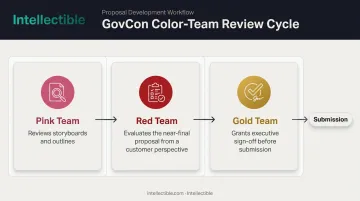
The writer usually facilitates these reviews, incorporating feedback without losing the thread of the win strategy.
Pricing Narrative and Final Submission
The cost volume can't contradict the technical approach, so writers work with pricing teams to make sure the price-to-win narrative tells a consistent story.
Final compliance checks matter just as much: page limits, required forms, SAM.gov registration proof, and portal-specific submission rules. FAR 52.215-1 requires the first page to include the solicitation number, offeror contact details, and an authorized signature.
Miss any of it, and the proposal risks being deemed late or non-responsive.
Skills and Challenges Unique to GovCon RFP Writers
Commercial proposal writers rarely deal with what's routine for GovCon writers.
Regulatory fluency is non-negotiable. A working knowledge of FAR/DFARS language, socio-economic set-asides (8(a), HUBZone, WOSB, SDVOSB), and agency-specific formatting rules is table stakes, not a nice-to-have.
Beyond regulation, three operational pressures define the job:
- Deadlines are fixed and unforgiving. There's no extension for a slow SME, yet SME availability is almost always the bottleneck.
- Formatting rules leave no room for error. A missed page limit or font requirement can disqualify an otherwise strong proposal.
- Knowledge retention is a persistent drain. Past performance write-ups, boilerplate, and pricing narratives tend to live scattered across shared drives and email threads instead of a searchable library.
That last point isn't a minor inconvenience. Enterprise service providers can lose 30 to 40% of a proposal writer's time just hunting for the right SOP or past-performance blurb that already exists somewhere in the organization.
How AI Improves GovCon Proposals
The strategic judgment an RFP writer brings to a pursuit still can't be automated. What AI does handle is the repetitive research, tracking, and drafting work that eats most of the week.
Faster, Smarter Go/No-Go Scoring
Stop treating every RFP like it deserves a yes. When a solicitation lands, the first decision is whether to bid at all - and that decision deserves a structured process, not gut instinct.
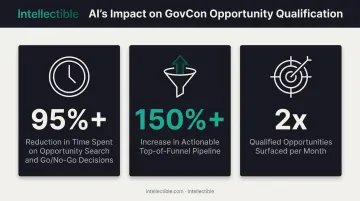
Run a structured go/no-go that makes the tradeoffs explicit. Score fit, urgency, risk, contract terms, and capability match against the actual solicitation in hand. Each dimension surfaces the real question: is this a pursuit worth the team's time, or a bid that looks attractive on the surface but carries hidden risk? Only the solicitations that pass that filter become qualified leads worth pursuing.
Capture the win thesis before writing starts. A go/no-go is only useful if it produces a decision, not a committee conversation. Once the scoring is complete, turn the decision into owners, actions, and a response plan - so the team moves from "we're bidding" to "here's who owns what" without losing a day to follow-up emails.
Automated Compliance Tracking
Manually reading a 200-page solicitation line by line to build a compliance matrix used to take hours. The Proposal & Pursuit Engine can extract requirements from a lengthy solicitation and auto-populate that matrix directly, structuring deadlines, submission rules, required sections, and evaluation criteria into a usable document from the start.
Centralized Knowledge and Content Reuse
AI-driven content libraries let writers search past proposals and approved answers by meaning rather than exact keywords. That matters because a writer searching "healthcare facility maintenance" should still find a relevant past performance write-up filed under "medical campus operations."
This kind of semantic search cuts down on outdated or inconsistent boilerplate creeping into new proposals, one of the most common ways compliance-heavy responses lose points on consistency.
AI-Accelerated Pricing with Audit Trail Control
Pricing is often the last mile of a proposal, and traditionally one of the slowest. When pricing workflows connect to the proposal, teams have reduced time to final pricing by roughly 90%, while preserving a full audit trail for compliance review, covering extracted assumptions, approval routing, and the finance sign-off chain.
AI adoption across the industry backs up why this matters. Deltek's 2025 Clarity Government Contracting study, surveying nearly 900 contractors, found that 45% of GovCon firms now use AI to improve operations and business development, up 10 percentage points year over year. Adoption is accelerating fast, and proposal writing, still one of the most manual parts of the pursuit, is next in line.
RFP Writer + AI: Where Human Judgment Still Wins
AI can't independently develop a win theme. It can't judge how a differentiator will land with a specific contracting officer or technical evaluation panel that's read fifteen other proposals this week. That's a human read, built on relationship context AI doesn't have access to.
AI-generated drafts also still require human review for accuracy. In a compliance-heavy GovCon response, "almost correct" language is riskier than leaving a section blank, because a subtle misstatement can trigger disqualification where an honest gap wouldn't.
The ideal setup splits the work: AI handles the searching, drafting, and tracking, while the writer owns:
- Strategy and win theme development
- SME relationships and technical validation
- Final quality control and sign-off
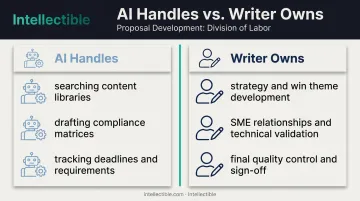
That division lets teams scale proposal volume without adding headcount.
Teams using the platform to govern their pursuit workflows report results like this:
"The platform took the tedious, monotonous hours of RFP efforts out of human hands, freeing the team to focus on analyzing and selling instead." — John Grady, Corporate Director of Business Development, HHS
Frequently Asked Questions
What is an RFP writer?
An RFP writer turns a government solicitation's requirements, SME input, and win strategy into a compliant, persuasive proposal response. The role sits on the contractor side, not the agency side.
How is a GovCon RFP writer different from a commercial proposal writer?
GovCon writers carry the added weight of FAR compliance, socio-economic set-aside rules, and rigid pass/fail evaluation criteria. Commercial proposals typically allow more flexibility in format and negotiation than a federal solicitation does.
Can AI replace an RFP writer in government contracting?
No. AI handles research, drafting, and compliance tracking well, but strategic positioning and win theme development still need a human writer's final judgment.
What is the difference between an RFP writer and a proposal manager?
The proposal manager owns overall project timelines, page design, and reviews, while the RFP writer focuses on drafting and shaping the narrative. Smaller GovCon teams often combine both roles into one person.
How much time can AI actually save on GovCon Go/No-Go decisions?
AI-assisted capture and qualification platforms have delivered over 95% time savings on opportunity search and go/no-go analysis for clients, alongside a 150%+ increase in actionable pipeline.
What registrations or certifications should a GovCon RFP writer be familiar with?
Writers should understand SAM.gov registration requirements, Unique Entity ID (UEI) assignment, and common socio-economic set-aside categories like 8(a), HUBZone, WOSB, and SDVOSB, since these directly affect proposal eligibility.