Introduction
Imagine you're a small cybersecurity firm with deep technical expertise. You discover a perfect $10M opportunity that aligns with your capabilities—but the solicitation requires three years of program management experience you don't have. You need a teaming partner, fast.
This scenario plays out hundreds of times across government contracting. Teaming agreements let contractors combine complementary capabilities and bid on opportunities neither could pursue alone.
Yet most teaming agreements fail before they ever deliver value. The core problem? Many are drafted as vague "agreements to agree" that courts consistently refuse to enforce, leaving subcontractors empty-handed after award despite promises made during proposal development.
This guide covers what teaming agreements are, when to use them versus other structures, and the contractual elements that make them enforceable under federal and state law. You'll also see how to avoid drafting mistakes that turn partnership promises into unenforceable paper.
Whether you're a prime seeking specialized capabilities or a subcontractor protecting your position, these distinctions determine whether your agreement creates binding obligations or merely good intentions.
Key Takeaways
- Teaming agreements lock in pre-award roles between prime and sub for one specific federal opportunity
- Enforceability needs definite scope %, pricing method, and "shall award" language—not "negotiate in good faith"
- On small business set-asides, primes must perform ≥50% of service work and avoid ostensible subcontractor status
- Virginia courts void agreements that leave pricing or scope to later negotiation, even with stated workshare %
What is a Teaming Agreement in Government Contracting?
A teaming agreement is a contractual arrangement between a potential prime contractor and one or more subcontractors to collaborate on pursuing a specific federal procurement opportunity. Under FAR 9.601, these arrangements allow companies to combine unique capabilities and offer the government a better combination of performance, cost, and delivery than either could provide independently.
Teaming agreements are pre-award documents. They govern roles, responsibilities, and obligations during the capture and proposal phases, before any contract is awarded. Once the government awards the prime contract, a separate subcontract must be negotiated to cover performance and payment. The teaming agreement itself typically expires when the opportunity is won or lost.
The FAR recognizes contractor team arrangements under Subpart 9.6 but does not mandate specific content, format, or language. This regulatory silence creates risk: without carefully drafted, specific terms, teaming agreements become unenforceable frameworks rather than binding commitments.
Core Purpose and Function
Teaming agreements establish four critical elements during the pursuit phase:
- Role clarity - Defines which party will serve as prime contractor and which will serve as subcontractor(s)
- Work division - Allocates specific contract requirements, deliverables, and responsibilities to each party
- Exclusivity - Controls whether the subcontractor may pursue the same opportunity with competing primes
- Proposal coordination - Assigns responsibilities for proposal sections, pricing, and submission logistics
Agencies often require teaming agreements when evaluating proposals, especially when the offeror relies on subcontractor past performance, security clearances, or specialized capabilities.
In the GAO protest Global Patent Solutions, LLC, the solicitation required signed agreements committing at least 10% of work to small businesses. The agency properly rejected language promising "up to" 10% (which could mean zero) because it failed to show the mandatory minimum commitment.
Types of Teaming Arrangements
Vertical teaming (the most common structure) follows FAR 9.601(2): one company serves as the potential prime, and one or more companies agree to serve as subcontractors. The government holds the prime fully responsible for all contract performance. This structure keeps a clear hierarchy and separate legal entities.
Horizontal teaming under FAR 9.601(1) is different: two or more companies form a partnership or joint venture and bid as one entity. Shared control and shared liability replace the prime-sub split.
GSA Contractor Team Arrangements (CTAs) work under a third model. Under GSA Multiple Award Schedule (MAS) rules, two or more Schedule holders combine capabilities while each keeps a direct contract with the government for its portion of the work.
GSA explicitly states that FAR Subpart 9.6 does not apply to MAS CTAs. These arrangements avoid traditional prime-sub power dynamics. Each CTA member operates as a prime for its scope, and the agreement coordinates task assignments, liability, invoicing, and payment flows.
Why Government Contractors Use Teaming Agreements
Federal opportunities frequently demand capabilities, clearances, certifications, or past performance that exceed any single contractor's portfolio. Rather than forgo the pursuit, contractors use teaming agreements to assemble the full capability set the solicitation requires.
Access to Set-Aside Opportunities
Small businesses can tap large-business infrastructure, capital, and corporate resources through teaming while keeping their size status and set-aside eligibility, as long as they follow SBA limitations on subcontracting.
Large businesses, in turn, can reach small business set-asides only as subcontractors. That creates mutual incentives for strategic partnerships.
That access comes with hard limits. On service contracts above the simplified acquisition threshold, the small business prime cannot pay more than 50% of the government payment to firms that are not similarly situated (other small businesses in the same category). Work a similarly situated entity further subcontracts also counts toward that 50% cap.
Strengthening Competitive Proposals
Combining complementary capabilities creates technically superior proposals. A systems integrator with program management past performance can team with a niche technical provider who holds specialized certifications the prime lacks. Together, they demonstrate comprehensive solution coverage that neither could claim alone.
Agencies evaluate these arrangements carefully. Contracting officers check whether the team collectively meets every solicitation requirement and whether the prime's reliance on the subcontractor raises ostensible subcontractor risk. That risk appears when the subcontractor, not the prime, controls the contract's primary and vital work.
Building Past Performance for Future Growth
Subcontracting roles provide small businesses a pathway to build relevant past performance, customer relationships, and capability demonstrations. After completing one or more contracts as a subcontractor in a particular domain, the small business gains the credentials needed to pursue future opportunities as the prime contractor.
Over time, strong teaming relationships compound. Partners build shared processes, train against the same playbooks, and stake out complementary lanes that rivals cannot copy overnight.
Meeting Agency Subcontracting Requirements
Many solicitations explicitly require submission of signed teaming agreements to verify:
- Proposed work division complies with FAR and SBA regulations
- The prime will perform the required percentage of work for set-aside compliance
- The prime maintains management authority (not unduly reliant on the subcontractor)
- All solicitation requirements are covered by qualified team members
Agencies use these agreements during responsibility determinations and organizational conflict-of-interest reviews. Failure to submit a compliant teaming agreement when required can result in proposal rejection.
Essential Elements of a Strong Teaming Agreement
Most courts treat teaming agreements as unenforceable "agreements to agree" unless they contain specific, binding contractual terms. Virginia law, where many GovCon disputes are decided because of the region's dense contractor base, requires detailed provisions for enforceability.
Four landmark Virginia cases illustrate the pattern:
| Case | Agreement Terms | Court Holding |
|---|---|---|
| W.J. Schafer v. Cordant (1997) | Future subcontract lacked agreed price, quantity, or purchase commitment | No enforceable obligation; essential terms absent |
| Cyberlock v. Information Experts (2013) | 49% workshare stated but subcontract terms deferred to negotiation | Unenforceable agreement to agree; Fourth Circuit affirmed |
| Navar v. Federal Business Council (2016) | Minimum 51% work allocation but pricing and terms required future agreement | Too indefinite; no mandatory subcontract obligation |
| CGI Federal v. FCi Federal (2018) | 41% workshare and defined positions, but scope and financial terms deferred | No enforceable duty to award subcontract; only a negotiation framework |
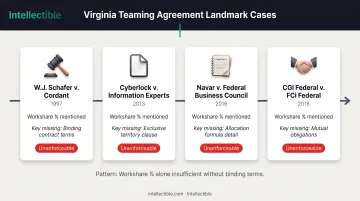
The common thread: Stating a workshare percentage is not enough. Agreements that condition award on future agreement over material terms (scope details, pricing, or subcontract provisions) are unenforceable.
Detailed Scope of Work and Work Share Percentages
Enforceable agreements must define:
- Exact percentage of total contract work the subcontractor will receive (for example, "30% of total contract value")
- Specific contract requirements the subcontractor will fulfill (reference RFP sections or CLINs by number)
- Labor categories and FTE counts the subcontractor will provide
- Deliverables and equipment each party will furnish
- Geographic locations where work will be performed
Vague promises like "significant portion" or "major role" create both enforceability problems and SBA compliance risks. Agencies evaluate these percentages during responsibility determinations to ensure limitations on subcontracting compliance.
Pricing Methodology and Payment Terms
The agreement must specify:
- Pricing structure - Fixed-price, time-and-materials, cost-plus-fee, or hybrid
- Specific rates or pricing formulas - Labor category rates, material markups, fee percentages
- Total estimated subcontract value or clear methodology to calculate it
- Payment schedule - Net 30, progress payments, milestone-based payments
- Invoice and approval procedures
The strongest approach: attach a substantially complete draft subcontract as an exhibit with all material commercial terms pre-negotiated. This eliminates the "agreement to agree" problem by demonstrating that parties have already reached consensus on material terms.
Mandatory Subcontract Award Language
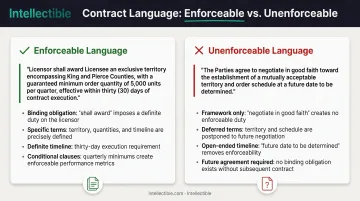
This is the single most critical enforceability element. Use binding "shall award" language, not permissive "will negotiate" phrasing.
Enforceable language:
"Upon prime contract award, Prime shall award Subcontractor a subcontract for the scope and pricing defined in Exhibit A within 10 business days, contingent only upon Subcontractor's execution of the attached draft subcontract and compliance with prime contract flowdown requirements."
Unenforceable language:
"Upon prime contract award, Prime and Subcontractor will negotiate in good faith to reach agreement on a mutually acceptable subcontract for the identified scope of work."
The second example is merely a framework for future negotiation—exactly what courts refuse to enforce. Include specific conditions (subcontractor execution, flowdown compliance) and a definite timeline (10 business days) to demonstrate binding commitment.
Proposal preparation responsibilities
Define each party's specific duties:
- Proposal sections each party will draft (technical volume, past performance, pricing)
- Submission logistics - who consolidates, quality-reviews, and submits the final proposal
- Pricing responsibility - who provides cost data, who develops the overall pricing strategy
- Past performance references each party will provide
- Proposal costs - whether each party bears its own costs or shares them
Clear assignment demonstrates to the SBA that the prime is not unduly reliant on the subcontractor and maintains management authority. Both are critical factors in avoiding ostensible subcontractor violations.
Exclusivity and non-compete provisions
Specify whether:
- The subcontractor must pursue this opportunity exclusively with this prime (cannot team with competitors)
- The prime may consider alternative subcontractors for the same scope
- Exclusivity applies to related procurements, follow-on contracts, or only the named solicitation
- The exclusivity period has a defined end date (for example, 30 days after award or final decision)
Exclusivity protections prevent subcontractors from shopping the same capabilities to multiple competing primes, but overly broad market-wide restraints may raise antitrust concerns.
Confidentiality and intellectual property protections
Protect:
- Proprietary pricing data, rate structures, and margin calculations
- Technical approaches, methodologies, and solution architectures
- Past performance information and customer relationships
- Background IP each party brings to the proposal
- Jointly developed proposal content and ownership rights
Include carve-outs for required government disclosures and flowdown obligations.
FAR 52.203-18 requires offerors to represent they will not bar employees or subcontractors from lawfully reporting waste, fraud, or abuse to the government. Keep teaming agreement confidentiality terms consistent with that representation and the subcontract flowdown under FAR 52.203-19.
Termination conditions and agreement duration
List specific termination triggers:
- Contract award to another offeror
- Prime decides not to submit a proposal
- Government cancels or materially changes the solicitation
- Either party files a size or eligibility protest against the other
- Failure to reach agreement on only non-material subcontract terms after good-faith negotiation
- A specified number of days after final agency decision (award or no-award)
Define whether termination for convenience is permitted, required notice periods (for example, 5 business days written notice), and which provisions survive termination (confidentiality, IP ownership, dispute resolution).
Teaming Agreements vs. Joint Ventures vs. Subcontracts
Teaming Agreement vs. Subcontract
Teaming agreements are pre-award documents governing the proposal phase. They establish the intent to subcontract and outline anticipated terms but are not performance contracts. Most teaming agreements explicitly state they create no obligation until the prime awards a formal subcontract.
Subcontracts are post-award binding contracts executed after the prime receives the government contract. They incorporate FAR flowdown clauses, define performance specifications, establish payment terms, include warranties and indemnification, and create enforceable obligations for delivery and payment.
Critical implication: A signed teaming agreement does not guarantee a subcontract. If it only contains an "agreement to agree" on future terms, the subcontractor has no enforceable right to the work even if the prime wins.
Post-award, the parties still must negotiate a separate subcontract. If they cannot reach agreement, the subcontractor may have no remedy.
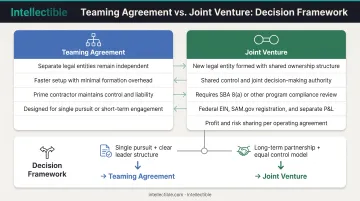
Teaming Agreement vs. Joint Venture
Joint ventures create a new legal entity—typically an LLC or partnership—that serves as the offeror and prime contractor. Under 13 CFR 125.8, a qualifying small business joint venture must:
- Obtain a separate Employer Identification Number (EIN)
- Register in SAM.gov as a unique entity
- Submit a written joint venture agreement meeting SBA requirements
- Share profits, losses, management, and risk according to specified percentages
- For SBA mentor-protege JVs, ensure the protege performs at least 40% of work performed by JV partners
Joint ventures allow size status aggregation (both venturers' receipts and employees combine for size determination, subject to exceptions) but require more administrative overhead: separate accounting, joint tax filings, governance meetings, and profit distribution.
When to Choose Each Structure
Use teaming agreements when:
- You have a clear prime-subcontractor hierarchy (one party leads)
- The opportunity is a single procurement, not a long-term partnership
- You want faster setup without creating a new legal entity
- The prime wants full management control and the sub accepts subordinate role
Use joint ventures when:
- Both parties need equal governance and profit-sharing
- You need size status aggregation to qualify under a size standard
- You're pursuing a long-term IDIQ or program requiring sustained partnership
- You want to share equity risk and management authority
Match the structure to the relationship you need. If one party should lead and the deal is a single pursuit, a teaming agreement is usually enough. If you need shared control, size aggregation, or a multi-year partnership, a joint venture is the stronger fit.
Common Mistakes and Red Flags to Avoid
Vague or Incomplete Work Share Definitions
Avoid generic language like "substantial role," "meaningful participation," or "significant portion" without defining exact percentages. These phrases create enforceability problems and SBA compliance risks.
Agencies evaluate work share allocations to verify:
- The prime performs the required percentage of work (50% for services) under limitations on subcontracting rules
- The prime—not the subcontractor—performs the contract’s primary and vital work
Under 13 CFR 121.103(h)(3), the prime is treated as an ostensible subcontractor—and ineligible—when a non-similarly situated subcontractor will perform the contract’s primary and vital requirements, or when the prime is unusually reliant on that subcontractor.
SBA offers a safe harbor: primes and small business subs that meet the 13 CFR 125.6 limitations are treated as performing the primary work and not unduly reliant.
One-Sided Terms Favoring the Prime
Red flags subcontractors should negotiate:
- Prime may terminate the agreement without cause at any time
- Prime has unilateral discretion to change scope, pricing, or work share percentages
- No guaranteed subcontract award—only a promise to "negotiate"
- Subcontractor must provide pricing and technical data but receives no exclusivity protection
- Prime may use subcontractor's technical approach even if teaming terminates
These imbalances hurt both sides. Subcontractors spend proposal resources without protection, and primes risk losing partners who walk away from one-sided terms.
Missing SBA Compliance Provisions
Agreements must explicitly address:
- Limitations on subcontracting for set-asides (50% rule for services under FAR 52.219-14)
- Who holds final authority on performance, schedules, and technical direction
- Controls that keep the subcontractor from effectively managing the contract (ostensible subcontractor risk)
Failure to show compliance at proposal time can trigger ineligibility findings or post-award protests. In fiscal year 2025, SBA reported nearly $179 billion in small business prime awards—about $273 billion when subcontracts are included—so agencies and protesters watch these clauses closely.
Inadequate IP and Proprietary Information Protections
Unprotected technical approaches, pricing methodologies, and proprietary tools can be misappropriated. Without enforceable confidentiality provisions:
- Primes may share subcontractor pricing with competitors during future negotiations
- Subcontractors may repurpose prime-developed technical content for competing proposals
- Either party may use joint proposal work without compensating the contributor
Build in at least the following:
- Mutual confidentiality obligations
- Use limits tied to the proposal only
- Return-or-destroy requirements on termination
- Clear ownership of jointly developed proposal content
- Remedies for breach, with protections that survive termination
How to Create and Execute a Teaming Agreement
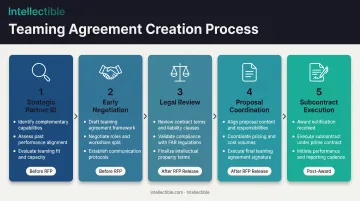
Successful teaming starts during market research and capture planning, not when the RFP drops. Last-minute agreements rushed together after solicitation release often lack the detailed terms needed for enforceability and compliance.
Start with Strategic Partner Identification
Identify potential partners with:
- Complementary capabilities - technical skills, certifications, past performance, or geographic presence you lack
- Relevant contract history - demonstrated success on similar scope, contract type, and agency customers
- Compatible company culture - aligned quality standards, ethics, communication style, and risk tolerance
- Appropriate size status - small business designations (8(a), SDVOSB, WOSB) or large business resources, depending on opportunity
Research potential partners' past teaming relationships, subcontracting track record, and any history of disputes or bid protests. Poor performers or litigious partners introduce risk even if their technical capabilities appear strong.
Negotiate Terms Early and Document Everything
Before RFP release, negotiate:
- Anticipated workshare percentages based on draft scope understanding
- Pricing structure and rough order-of-magnitude rates
- Exclusivity terms and duration
- Proposal preparation roles and cost-sharing
After RFP release, finalize:
- Exact scope tied to RFP sections and requirements
- Detailed pricing matched to the government's pricing structure
- Mandatory subcontract award language and timeline
- Compliance with solicitation-specific teaming requirements
Engage legal counsel experienced in government contracting to review agreements for enforceability under applicable state law (typically Virginia for federal contractors). The cost of legal review is minimal compared to the risk of losing a subcontract worth millions after investing in proposal development.
Manage Teaming Workflows During Capture and Proposal
Coordinating proposal development, technical reviews, pricing iterations, and final submissions across multiple companies requires structured processes. Manual email threads, version-control conflicts, and missed deadlines derail teams fast.
Tools such as Intellectible's visual workflow automation help primes and subcontractors run that coordination in one place. You can organize pursuit milestones, track document reviews, route approvals to the right owners, and automate deadline reminders so submission dates do not slip.
Transition from Teaming Agreement to Subcontract Post-Award
Upon prime contract award, immediately begin formal subcontract negotiation. Recommended steps:
- Notify the subcontractor within 2 business days of prime contract award
- Share the awarded prime contract (or relevant sections) to verify scope and pricing alignment
- Execute the draft subcontract attached to the teaming agreement, including required FAR flowdown clauses
- Resolve gaps between the proposed and awarded prime contract (scope, pricing, or terms)
- Sign the subcontract within 10–15 business days to meet agency expectations and avoid performance delays
Include subcontract negotiation timelines and success metrics in the original teaming agreement so both parties understand expectations. Define what happens if negotiation stalls: binding arbitration, mediation, or specific performance remedies.
Frequently Asked Questions
What is a teaming agreement?
A teaming agreement is a pre-award contract between a prime and a subcontractor to pursue a specific government opportunity together. It defines each party's roles, scope, responsibilities, and commitments during the proposal phase.
What is the purpose of a teaming agreement?
Teaming agreements combine complementary capabilities to strengthen proposals and set clear post-award subcontracting expectations. They also establish exclusivity and protect proprietary information shared during proposal development.
What is a teaming partner?
A teaming partner is a company, prime or subcontractor, that agrees to collaborate on a specific federal contract pursuit. Under the teaming agreement, it contributes capabilities, past performance, certifications, or resources the other party lacks.
What is the difference between a teaming agreement and a subcontract?
Teaming agreements are pre-award documents governing proposal collaboration and establishing intent to subcontract. Subcontracts are post-award binding contracts governing actual performance, payment, and legal obligations once the government awards the prime contract.
What is the difference between a joint venture and a teaming agreement?
Joint ventures create a new legal entity with shared equity, profits, management, and SBA approval requirements. Teaming agreements maintain separate legal entities in a prime-subcontractor relationship with faster setup, no new entity formation, and simpler administration.
Can you provide an example of a teaming agreement?
A small cybersecurity firm teams with a large systems integrator on a $50M DoD contract: 30% workshare for penetration testing and threat intelligence, 70% for the prime's program management and infrastructure. The agreement locks scope by CLIN, labor rates, exclusive teaming, confidentiality, and a mandatory subcontract award within 10 days of prime award.