Introduction
Government agencies use RFPs to invite qualified contractors to propose solutions for complex, high-value contracts. How a company responds to those invitations often determines whether it grows or stagnates in the federal market — making the proposal process one of the highest-leverage activities in GovCon.
The challenge is structural. RFPs arrive on compressed timelines, demand exhaustive compliance, and still require each response to stand out from competitors who are equally qualified on paper. For proposal and pursuit teams, that tension — speed versus thoroughness versus differentiation — is a constant source of pressure and, when mismanaged, burnout.
This guide breaks down how the government RFP process actually works: the regulatory framework behind it, the end-to-end bidding sequence from a contractor's perspective, and what winning responses include.
It also covers the most common mistakes that eliminate proposals before evaluators read a single page — whether you're new to federal contracting or working to sharpen a pursuit process that's already in motion.
Key Takeaways
- A government RFP evaluates technical approach, past performance, and price together — not just cost.
- Compliance comes before persuasion: a non-compliant proposal is disqualified regardless of quality.
- The bidding process follows a defined sequence: opportunity identification → Go/No-Go → proposal development → submission → evaluation → award.
- Incumbency and evaluation factor weighting are two of the strongest predictors of win probability.
- Scalable, repeatable pursuit processes allow teams to compete for more opportunities without adding headcount.
What Is an RFP in Government Contracting?
A Request for Proposal (RFP) is a formal solicitation document issued by a federal, state, or local government agency describing a project's scope, requirements, and evaluation criteria — and inviting contractors to submit a detailed proposal for how they would fulfill the contract. It is the primary vehicle for complex procurements where the government needs contractors to propose a solution, not just a price.
How RFPs Differ from Other Procurement Vehicles
Government contracting uses several solicitation types. Knowing which one you're responding to changes everything about how you prepare:
| Instrument | When Used | How Award Is Made |
|---|---|---|
| RFP | Complex projects requiring judgment and customization | Best value or tradeoff across technical, past performance, and price |
| RFQ | Known requirements, primarily seeking price | Purchase order issued by government (quotation is not an offer) |
| IFB | Fully defined requirements, price-driven | Lowest compliant price; no qualitative evaluation |
| RFI | Market research before solicitation | No award — information gathering only |
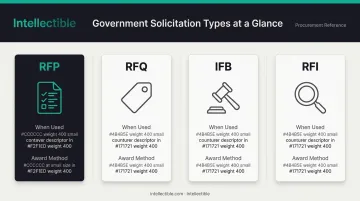
RFPs apply when the government needs expertise or judgment — not just the lowest price. FAR Part 15 governs the competitive and noncompetitive negotiated acquisitions framework under which RFPs operate.
The Regulatory Foundation
FAR 6.101 — grounded in 10 U.S.C. 3201 and 41 U.S.C. 3301 — requires contracting officers to promote full and open competition, with limited exceptions. Two thresholds matter most for GovCon companies:
- $25,000: Proposed contract actions over this amount generally must be synopsized through SAM.gov, the government's public procurement portal
- $350,000: The Simplified Acquisition Threshold (SAT), effective October 1, 2025 — above this, full competition requirements under FAR Part 6 apply, including minimum 30-day response periods for solicitations
Note that FAR 5.202 does allow exceptions to public posting requirements — unusual urgency, national security, and certain sole-source situations can result in solicitations that don't appear on SAM.gov, even above the SAT.
How the Government RFP Bidding Process Works
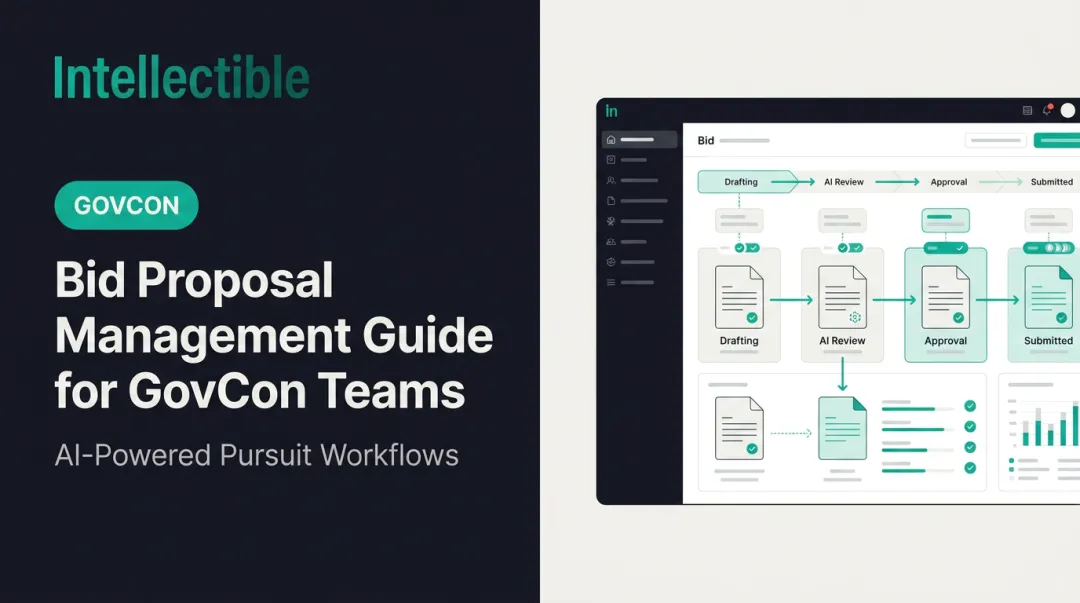
From a contractor's perspective, the RFP bidding process runs through a clear sequence: opportunity discovery → Go/No-Go decision → proposal development → submission → government evaluation → award or debrief.
Understanding the government's parallel sequence helps contractors time their responses strategically. Agencies follow their own procurement timeline:
- Conduct market research
- Issue a draft solicitation
- Release the solicitation publicly
- Accept questions and issue amendments
- Receive proposals, evaluate, and award
Contractors who engage during the pre-solicitation phase by attending industry days and responding to RFIs are better positioned when the formal RFP drops.
Step 1: Opportunity Identification and Go/No-Go Decision
GovCon companies monitor federal procurement portals (SAM.gov is the primary source for federal contract opportunities), agency forecast tools, and market intelligence platforms to identify RFP opportunities, ideally before the official solicitation releases.
Early pipeline intelligence is a real competitive advantage. Companies that know about a requirement six months out can begin capture activities, while latecomers are writing proposals cold.
Once an opportunity surfaces, the Go/No-Go decision determines whether the company should invest resources in a response. A structured Go/No-Go framework evaluates:
- Fit — alignment with core capabilities and target agencies
- Incumbent status — whether an entrenched incumbent exists
- Past performance match — whether recent, relevant references support the technical approach
- Set-aside eligibility — whether the company qualifies for any applicable program
- Win probability — an honest assessment of competitive position
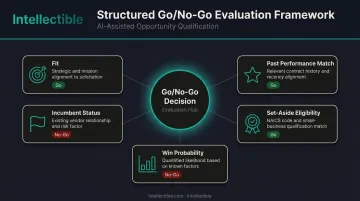
The Go/No-Go decision is where discipline separates high-performing business development teams from those that spread resources too thin. John Grady, Corporate Director of Business Development at HHS, put it plainly after implementing Intellectible: "Intellectible is taking the tedious, monotonous hours of RFP efforts out of human hands. This allows us to do what we should be doing, analyzing and selling."
Oceus, a defense contractor, used the same platform to more than double the qualified opportunities its team surfaces and reviews monthly — now reaching seven to eight qualified opportunities per month clearing their threshold, with Intellectible delivering 95%+ time savings on opportunity search and Go/No-Go analysis.
Step 2: Proposal Development
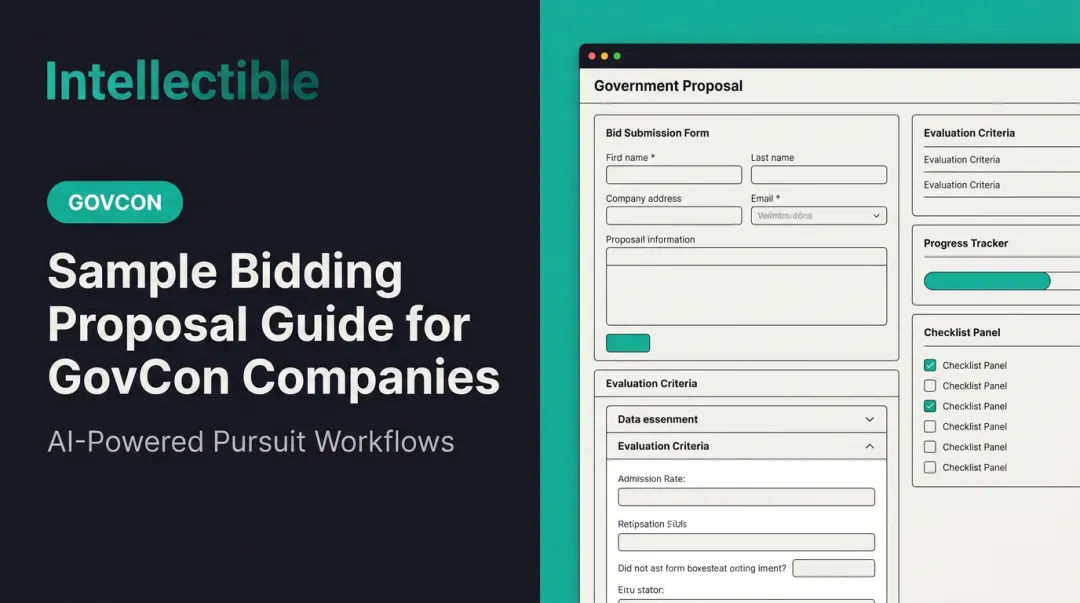
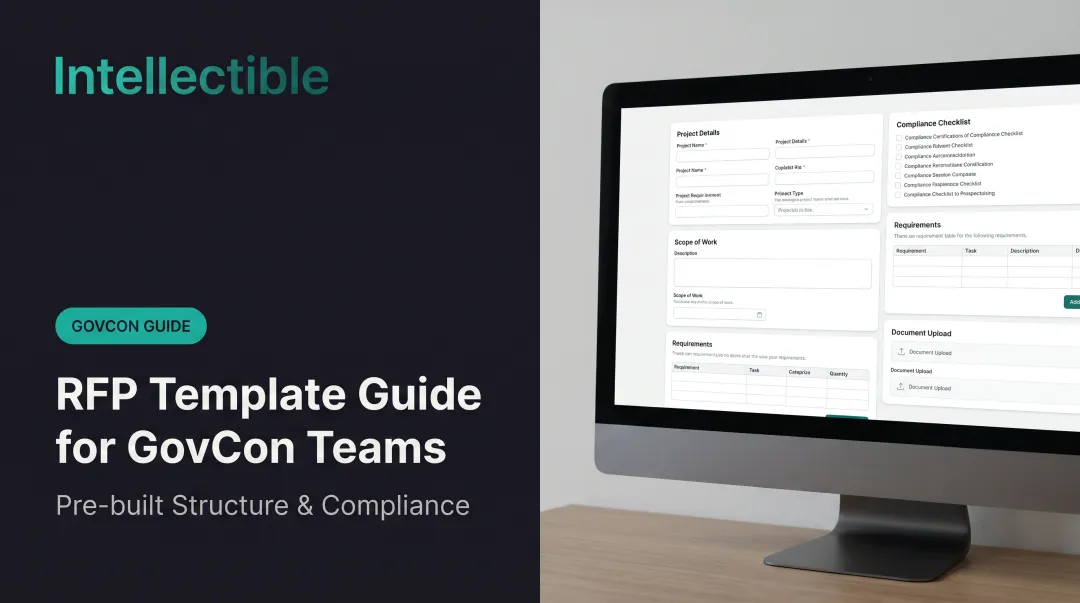
Proposal development begins with RFP decomposition: reading every section of the solicitation, identifying all requirements, and building a compliance matrix that maps each requirement to a proposal section, owner, and evidence source.
Section L (Instructions to Offerors) defines format, page limits, and submission rules. Section M (Evaluation Factors) defines how the government will score responses. Read both together before drafting any proposal content.
The core deliverables in most federal proposal responses:
- Technical/Management Volume — how you'll do the work
- Past Performance Volume — evidence you've done similar work
- Price/Cost Volume — your fully built cost model
A proposal that fails to follow Section L instructions (wrong font, exceeded page limits, missing mandatory sections) is disqualified before evaluation begins. Persuasion doesn't matter if the evaluator never reads your response. The compliance matrix is the structural foundation of any serious proposal effort, not a formality.
Step 3: Submission, Evaluation, and Award
After submission, the government's evaluation panel scores proposals against the criteria stated in the solicitation. Two primary frameworks are used:
- Best Value Tradeoff (FAR 15.101-1): The source selection authority may award to other than the lowest-priced or highest-technically-rated offeror, with documented rationale for tradeoffs
- Lowest Price Technically Acceptable / LPTA (FAR 15.101-2): Proposals are evaluated for technical acceptability; once acceptable, the award goes to the lowest price. Extra credit for exceeding minimums is prohibited
The agency must notify unsuccessful offerors within three days after award. Contractors may then request a debrief. Under FAR 15.506, a timely request (within three days of award notification) generally results in a debrief within five days. Required content includes the significant weaknesses in your proposal, overall evaluated price and technical rating of your submission versus the winner, and a summary of the award rationale. Debriefs are one of the most underutilized tools in GovCon. The feedback is actionable and directly informs your next pursuit.
Key Components of a Winning Government RFP Response
Technical/Management Volume
The technical volume must directly respond to every requirement in the Statement of Work, demonstrate a clear understanding of the agency's problem, and articulate an approach that differentiates you from a generic capability statement.
Use the government's own language from the RFP. Evaluators score against the solicitation, and a response that mirrors their terminology signals genuine comprehension — not just competence.
Intellectible's Proposal & Pursuit Engine addresses this through a governed proposal workflow — reading the RFP, attachments, and addenda to extract key dates, submission rules, required sections, and evaluation criteria; running a structured go/no-go that covers fit, urgency, risk, contract terms, and capability match; and turning requirements into a response plan with mandatory versus strategic sections, owners, deadlines, and an evidence-backed compliance matrix. Deal-specific inputs are captured before any draft content is generated. The platform's explicit goal: "Make every draft sound like this deal — not a recycled template."
Past Performance Volume
Agencies evaluate whether contractors have delivered similar work at similar scale. Under FAR 15.305, evaluators weigh currency, relevance, source, and general trends as indicators of successful performance. Individual solicitations define what counts as "recent" — a 2024 Navy solicitation defined it as 100% complete within seven years of RFP issuance.
Typical past performance references include:
- Contract/task order number
- Agency name and contracting office
- Point of contact with current contact information
- Award amount and final price
- Contract type and performance role (prime or sub)
- Relevance narrative explaining similarity to the current requirement
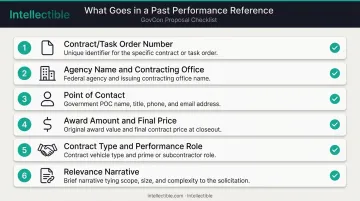
CPARS (Contractor Performance Assessment Reporting System) is the official federal source for past performance information. Strong CPARS ratings are a material asset in competitive evaluations.
Pricing is where many technically strong proposals fall apart. Understanding contract type before you build your cost model is non-negotiable.
Price/Cost Volume
Government pricing must be defensible, internally consistent, and competitive relative to the Independent Government Cost Estimate (IGCE) — the agency's internal projection of what the work should cost.
Contract type carries significant risk implications:
- Firm-Fixed-Price: Contractor bears full cost risk; price is not adjusted for actual cost experience
- Cost-Reimbursable: Government pays allowable incurred costs up to an estimated ceiling; requires adequate contractor accounting systems and government surveillance resources
Intellectible's platform routes cost volume approvals with a full audit trail, with a documented 90% reduction in time to final pricing.
Executive Summary
The executive summary is often written last and treated as an afterthought. It shouldn't be. A strong executive summary frames the evaluator's reading of everything that follows.
It should not be a company bio. Instead, it should answer three questions from the agency's perspective:
- Why you? Connect your specific capabilities to their stated problem
- Why now? Demonstrate awareness of the agency's current priorities and pressures
- Why at this price? Preview the value proposition before evaluators reach the cost volume
Key Factors That Affect RFP Bid Success
Incumbency is one of the strongest predictors of win probability in government contracting. Existing contractors bring performance history, established relationships, and institutional familiarity that challengers must overcome — with a demonstrably superior technical approach, a materially better price, or documented evidence of incumbent performance problems.
Where you're eligible to compete matters just as much as how you compete. Set-aside designations reshape the competitive landscape by narrowing the eligible bidder pool to firms that meet specific certification criteria:
| Program | Core Eligibility Requirements |
|---|---|
| 8(a) | Socially/economically disadvantaged owners; net worth ≤$850K; assets ≤$6.5M |
| HUBZone | Principal office in HUBZone; 35%+ employees reside in HUBZone |
| WOSB | 51%+ owned/controlled by women who are U.S. citizens |
| SDVOSB | 51%+ owned/controlled by service-disabled veterans; SBA certification required |
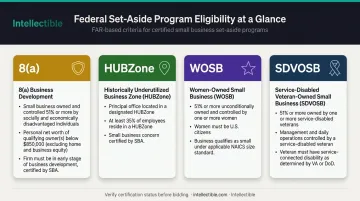
In FY2025, SBA reported nearly $179 billion in prime-contract awards to small businesses — approximately 28% of all prime awards, exceeding the 23% governmentwide goal. Verify your certification status before bidding; competing outside your eligible category wastes the bid investment and risks a formal protest.
Teaming arrangements fill capability gaps a single company can't cover alone. If you lack required past performance, clearances, or technical expertise, teaming with a prime or sub can provide qualifying credentials. Teaming agreements must be executed before submission and must clearly define work-share percentages.
Once your team is set, evaluation factor weighting determines where to invest your writing effort. Misreading the structure — submitting an elaborate technical volume for an LPTA procurement — is one of the most costly strategic errors in proposal development. Study the RFP's evaluation section before outlining a single section:
- LPTA procurements: meet the technical threshold, then compete on price
- Best value/tradeoff procurements: differentiate on technical approach and past performance
- Past performance-heavy RFPs: surface relevant contract examples early and specifically
Common RFP Bid Mistakes GovCon Companies Make
Compliance Failures
The most preventable losses come from not following Section L instructions precisely:
- Exceeding page limits
- Using the wrong font size or margin specifications
- Failing to address every evaluation factor in Section M
- Submitting a generic capability statement where a tailored technical response was required
These are automatic disqualifiers or scoring penalties. A single missed requirement can eliminate an otherwise strong proposal.
The Copy-Paste Trap
Proposal teams under deadline pressure routinely reuse content from previous proposals without tailoring it to the current RFP's specific language, requirements, or agency context. Evaluators can tell. Recycled content signals a lack of genuine understanding of the problem, and evaluators score accordingly.
Intellectible's Proposal & Pursuit Engine addresses this directly — it flags missing deal-specific inputs before drafting begins, generates section drafts grounded in the RFP and approved knowledge, and reviews the assembled proposal against requirements, strategy, tone, and missing evidence, so every response stays grounded in the current opportunity.
Poor Go/No-Go Discipline
Many GovCon companies bid on too many RFPs they can't realistically win — low past performance alignment, no incumbent relationship, incomplete teaming — which dilutes proposal quality across the board.
Walk away when you see these signals:
- The incumbent is entrenched with no visible performance issues
- Evaluation criteria heavily favor experience you don't have
- The teaming ecosystem hasn't come together
- The deadline leaves insufficient time for a compliant, compelling response
- Contract value doesn't justify the bid and proposal cost
A disciplined No-Go preserves proposal capacity for pursuits where your past performance, teaming, and positioning actually give you a shot.
Frequently Asked Questions
What is the difference between a request for proposal and a bid?
An RFP evaluates multiple factors together — technical approach, qualifications, past performance, and price. A traditional bid, or Invitation for Bid (IFB), awards solely to the lowest compliant price with no qualitative evaluation. RFPs are used for complex work requiring judgment; bids are used when requirements are fully defined and price is the only differentiator.
Which comes first, RFP or RFQ?
An RFQ typically comes before an RFP in the procurement lifecycle. Agencies issue RFQs under simplified acquisition procedures when they know what they want and primarily seek pricing. An RFP comes when the government needs contractors to propose a solution — requiring contractors to develop and price their own technical approach rather than simply quote against a defined scope.
What sections must be included in a government RFP response?
Most federal RFP responses require a Technical/Management Volume, a Past Performance Volume, and a Price/Cost Volume, with additional attachments (representations and certifications, subcontracting plans) as directed. Section L of the solicitation defines the exact sections, page limits, and formats — follow it precisely.
What is a Go/No-Go decision in government contracting?
A Go/No-Go is a structured internal evaluation where a GovCon company scores an RFP against key criteria — incumbent status, past performance match, set-aside eligibility, and win probability — before committing proposal resources. Teams that skip this step routinely chase opportunities they cannot win.
Can small businesses compete on government RFPs?
Yes. Small businesses compete actively on government RFPs, particularly through set-aside programs (8(a), HUBZone, SDVOSB, WOSB) that restrict competition to eligible firms. Federal agencies are required by statute to meet small business contracting goals, which keeps the market accessible — though small businesses must still satisfy all technical and compliance requirements to win.