According to Shipley Associates, industry veterans widely agree that customers identify their preferred vendor before proposals are even submitted 40–60% of the time. That's not a proposal problem — it's a capture problem.
This article covers the analytical groundwork, the strategic pillars, and the execution discipline that separate capture teams with consistently high win rates from those who treat every bid as a long shot. If you're managing federal pursuits, this is the playbook.
Key Takeaways
- A win strategy is a set of pre-RFP decisions — not a proposal outline
- The four analyses (opportunity, customer, competitor, self) form the intelligence foundation — skip one and you're building on guesswork
- Discriminators must be identified during capture, not invented during proposal writing
- A disciplined Go/No-Go process protects B&P budget for high-probability pursuits
- Proposal themes, pricing positions, and teaming decisions must all trace back to capture-stage win strategy
What Is a Win Strategy in GovCon?
A win strategy is the documented set of choices that directs how a company positions itself to win a specific opportunity. It covers business objectives, customer intelligence, competitive posture, solution approach, and pricing — and it must be developed before the RFP is released.
Win Strategy vs. Proposal Plan
These two things get confused constantly, and it costs firms real money.
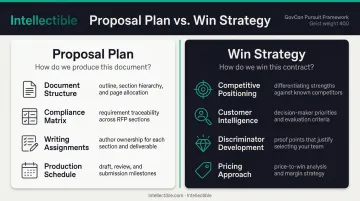
- A proposal plan answers: How do we produce this document?
- A win strategy answers: How do we win this contract?
Confusing the two pushes teams into production mode without a strategic foundation. The result is a compliant proposal that doesn't resonate with evaluators. Evaluators score on differentiation, not documentation quality — and a bid that checks every box but stands for nothing rarely wins.
Three Criteria Every Win Strategy Must Meet
An effective win strategy must pass all three of these tests:
- Unique to your firm — If the customer awards to a competitor, they don't get this benefit
- Valued by the customer — If the customer doesn't care, it won't move evaluation scores
- Provable at an acceptable price — If you can't demonstrate it in the proposal within budget, it's not a real discriminator
Shipley defines a discriminator as a feature that differs from a competitor's offer and is acknowledged by the customer as important. Both conditions must be true. A feature that competitors also offer is just a feature. Listing it as a strength doesn't strengthen your bid; it tells evaluators you ran out of real differentiators.
The Four Analyses Every Capture Team Must Complete
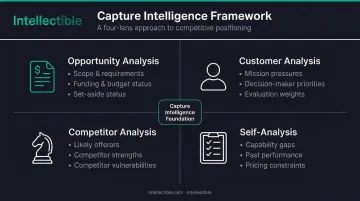
A win strategy is only as strong as the intelligence behind it. These four analyses give capture teams the evidence base to make sound pursuit and strategy decisions.
Opportunity Analysis
Before committing B&P dollars, teams must understand:
- Contract scope and period of performance
- Funding profile and set-aside status
- Contract vehicle requirements
- Incumbent situation and recompete timing
The core question is whether the opportunity is real, funded, and appropriately structured for your firm. If the answer to any of those is uncertain, that uncertainty belongs in your Go/No-Go scoring — not ignored.
Customer Analysis
Reading the SOW is not customer analysis. Real customer analysis requires understanding what actually drives this specific customer's evaluation:
- Mission pressures and budget constraints
- Incumbent satisfaction levels
- Key decision-maker priorities
- Past performance expectations and evaluation weightings
Capture teams who demonstrate they understand the mission, not just the requirements, consistently outscore those who address the PWS line by line.
Competitor Analysis
Competitor analysis must deliver three things:
- A realistic list of likely offerors (not just obvious primes)
- An honest assessment of each competitor's strengths and vulnerabilities
- A clear picture of where your firm sits relative to the field
This is also where you identify the discriminators you can exploit and the competitor advantages you need to neutralize in your proposal. Shipley's Black Hat review is the standard tool here — predicting competitors' likely solutions and testing your own strategy against them.
Self-Analysis
This is the most frequently softened of the four. Teams list strengths; they minimize gaps. That's a mistake.
An honest self-analysis surfaces:
- Capability gaps that require teaming or subcontracting
- Past performance mismatches against the requirement
- Pricing challenges relative to competitors
- Resource constraints that affect proposal quality
This analysis protects leadership from approving a bid the company cannot credibly win. Skip it, and those gaps surface as proposal weaknesses during Red Team review instead.
The Five Win Strategy Pillars That Move Bids Forward
Many companies treat win strategy as purely a proposal writing exercise — narrowing their focus to what goes on paper rather than what wins the award. Each of these five pillars can shift evaluation outcomes independently, which means weaknesses in any one of them carry real risk.
Business Strategy
Define what you want from this specific opportunity:
- Prime, team, or sub — and why
- Acceptable financial outcomes (profit, margin, market entry)
- How this contract fits your portfolio growth goals
A business strategy that doesn't align with the opportunity's scope or risk profile is a signal to revisit the bid decision before resources are committed.
Solution / Service Strategy
Identify the two or three technical or management differentiators that best match the customer's stated and unstated requirements. These become the seeds of your win themes.
They must be specific enough that an evaluator can distinguish your solution from a generic response. "Experienced team with proven processes" is not a differentiator. A specific methodology with measurable past performance results is.
Marketing and Discriminator Strategy
This pillar has three components:
- Identify discriminators — provable capabilities exclusive to your firm that this customer values
- Identify deficiencies — gaps relative to competitors that need to be addressed or mitigated
- Build the amplification plan — how you'll reinforce discriminators before and during the proposal
The critical discipline here: discriminators must be tied to customer outcomes, not internal capabilities the customer doesn't care about. "We use an ISO-certified process" is internal. "Our ISO-certified process reduced defect rates by 34% on a comparable DHS program" is customer-facing.
Political / Relationship Strategy
Pre-RFP customer engagement, RFI responses, industry day positioning, teaming partner alignment — these take time to build and cannot be manufactured during the proposal period.
If your first substantive contact with the customer is the proposal kickoff, you've already lost ground to whoever shaped the requirement.
Pricing Strategy
Pricing strategy requires more than a cost buildup. It involves:
- Estimating the probable customer budget
- Modeling competitor pricing and price-to-win targets
- Making deliberate decisions about where to be competitive vs. where to invest margin
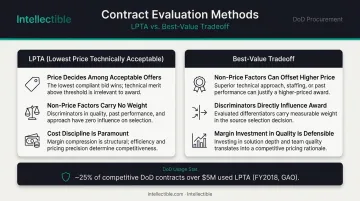
- Understanding whether the solicitation uses LPTA or best-value tradeoff — because the rules are different
GAO estimated that LPTA was used in approximately 25% of FY2018 competitive DoD contracts valued at $5M or more. Under LPTA, price decides among technically acceptable offers — non-price factors don't move the needle. Your pricing strategy must follow the evaluation method.
These decisions belong in capture, not in the final days before submission. Pricing strategy that isn't grounded in capture intelligence — incumbent positioning, agency budget signals, and competitive field analysis — leaves your team guessing under deadline pressure rather than making evidence-backed calls.
How to Run a Disciplined Go/No-Go Decision Process
Go/No-Go is a resource allocation decision, not a formality. Every opportunity pursued consumes B&P budget that could fund a higher-probability bid.
Deltek's 2021 GovCon Clarity Study reported an overall average win rate of 40% across firms — with B&P costs averaging 5.9% of revenue. B&P budgets are finite. Companies that chase too many low-probability opportunities rarely have the focus or resources to win the ones they should.
What a Go/No-Go Framework Should Evaluate
A structured scoring rubric should assess:
| Factor | What to Assess |
|---|---|
| Win probability | Scores across all four analyses |
| Strategic fit | Alignment with business objectives |
| Teaming readiness | Partners identified and aligned |
| Customer access | Relationship depth and pre-RFP engagement |
| Competitive position | Honest ranking against likely offerors |
| Pricing viability | Ability to reach target price at acceptable margin |
A structured rubric gives leadership an evidence-backed rationale for every pursuit decision — not a gut call. APMP's guidance frames the post-RFP gate question clearly: "Are we in a strong enough position to justify writing a proposal?" Answer it with data, not instinct.
The Real Cost of Skipping Go/No-Go
When teams get pulled into proposal production on pursuits where they have no customer relationship, no incumbent advantage, and no credible discriminators, the lost bid is only part of the damage. The depleted capacity to pursue the contract they could have won is the real competitive harm.
That capacity problem is exactly what purpose-built tooling addresses. Intellectible's GovCon Engine converts federal notices into structured capture records — with fit rationale, risk signals, and competitive context — using semantic fit analysis rather than keyword matching. The platform triages the federal market by turning every notice into a structured capture record covering agency, office, NAICS, PSC, timing, scope, fit rationale, risk signals, and recommended action, then maps the contract behind each opportunity — surfacing award history, likely incumbents, expiring contracts, and competitive threats before any human review begins.
Clients including Oceus have reported more than double the qualified opportunities surfaced per month. Across the platform, teams see 95%+ time savings on opportunity search and Go/No-Go decisions, which means capture teams can evaluate more pursuits without adding BD headcount.
Translating Win Strategy Into Proposal Execution
Even well-developed win strategies often fail to influence the final proposal. The strategy document doesn't get translated into concrete writing direction before kickoff — and what's left in the capture plan stays there.
The Five Channels Where Strategy Must Appear
Win strategy must show up in each of these proposal elements:
- Theme statements in section headers — not section titles, strategic statements tied to evaluation criteria
- Action captions on graphics — every figure should reinforce a win theme, not just illustrate a process
- Executive summary narrative — this is the only section many evaluators read in full, and it must carry the full strategy
- Past performance selection and framing — choose references that prove your discriminators, not just your volume
- Pricing rationale in the cost volume — price without narrative context leaves evaluators to draw their own conclusions
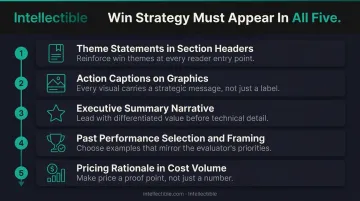
Checking these five channels is how you verify the strategy survived the handoff from capture to proposal writing.
Color Team Reviews as Strategy Validators
Pink Team and Red Team reviews should explicitly check whether the win strategy is being communicated — not just whether the proposal is compliant.
Per Shipley's defined review standards:
- Pink Team reviews storyboards and writing plans against the approved win strategy before text is drafted
- Red Team predicts customer scoring on the near-final proposal — checking strategy fidelity, not just completeness
Reviewers should ask: If I didn't know our win strategy going in, would I be able to infer it from this section? If the answer is no, the strategy isn't showing up.
Teams that use a structured capture platform gain a material advantage here: win themes, competitive context, and Go/No-Go rationale developed during capture are available to the writing team from day one of the proposal period rather than reconstructed from memory.
Frequently Asked Questions
What is a win strategy?
A win strategy is a documented set of pre-RFP decisions that tells a company how it intends to win a specific opportunity — covering competitive position, customer priorities, solution approach, and pricing. It differs from a proposal plan, which addresses production logistics, not strategic positioning.
What are the 4 pillars of a winning strategy?
The four foundational analyses behind any GovCon win strategy are opportunity analysis, customer analysis, competitor analysis, and self-analysis. Each analysis feeds directly into the others: what you learn about the customer shapes how you assess competitors, which in turn determines whether your self-assessment reveals a genuine path to winning.
How does a capture team differ from a proposal team?
The capture team is responsible for pre-RFP intelligence gathering, relationship building, and strategy development. The proposal team executes the written response. High win rates depend on capture teams handing off a clear, evidence-backed strategy. When proposal writers start from scratch, they're compensating for capture work that didn't happen.
What is a Go/No-Go decision in government contracting?
Go/No-Go is a structured bid decision checkpoint where leadership evaluates win probability, strategic fit, and resource requirements before committing B&P funds. A disciplined process protects capacity for high-probability pursuits by keeping teams off bids they can't credibly win.
How early should capture begin before an RFP is released?
For major programs, capture should begin 12 to 18 months before anticipated RFP release. Customer shaping, teaming decisions, and discriminator development each require sustained effort that a 30-to-60-day proposal period cannot replicate. Starting late means inheriting the incumbent's advantages rather than building your own.
What makes a discriminator different from a feature in a GovCon proposal?
A discriminator is a capability that is unique to your firm, valued by this specific customer, and provable in the proposal. A feature is simply something your solution does. Features that competitors also offer cannot differentiate your bid — they're table stakes, not discriminators.