Consulting firms juggling multiple pursuits at once feel this pain acutely. Basis of Estimate (BOE) documentation lives in one spreadsheet, labor rate justification in another, and the audit trail connecting them exists mostly in someone's memory. Add FAR Part 15 compliance requirements, and pricing teams end up spending more time reconciling documents than actually pricing work.
This guide breaks down the three core pricing models (FFP, Cost-Plus, T&M), what FAR compliance actually demands, and how purpose-built pricing software eliminates the manual bottlenecks slowing your pursuits down.
Key Takeaways
- FFP, Cost-Plus, and T&M shift risk and audit burden differently; pick wrong and you're overexposed or over-audited
- FAR Part 15 requires cost realism and a defensible BOE for most competitive submissions
- Pricing software slashes time-to-final-pricing and builds a DCAA-ready audit trail for evaluator review
- GSA Schedule pricing runs on pre-negotiated rates, not per-bid competition
Understanding Government Contract Pricing Models
Pricing models determine one thing above all else: who bears the financial risk, and how closely the government will audit your costs to manage that risk.
Firm-Fixed-Price (FFP) Contracts
Under FFP, the price is locked regardless of your actual cost to deliver. Per FAR Part 16, price isn't adjusted for cost experience — the contractor absorbs any overrun.
FFP works well for consulting engagements with a clearly defined deliverable: a compliance assessment, a fixed-scope study, a defined set of workshops.
- Advantage: Low administrative burden, minimal government oversight
- Disadvantage: You absorb the full cost of any scope misestimate
Cost-Reimbursement Contracts
Here, the government reimburses allowable costs plus a fee, with your estimate functioning as a funding ceiling rather than a fixed price. These contracts fit R&D-style consulting work where requirements can't be defined precisely upfront.
- Advantage: Government bears most cost risk when scope cannot be defined upfront
- Disadvantage: Requires a DCAA-approved accounting system and active surveillance—a real compliance lift without mature back-office infrastructure
Time-and-Materials (T&M) Contracts
T&M bills labor at negotiated fixed hourly rates (wages, overhead, and profit baked in) plus materials at actual cost. This is the default for staff-augmentation consulting work where duration is uncertain but labor categories are well established.
- Advantage: Flexible when duration is uncertain but labor categories are established
- Disadvantage: No built-in incentive for labor efficiency, so you need a ceiling price, a determination that no other type fits, and ongoing timekeeping surveillance

How to Price Consulting Services for Government Contracts
The core formula for pricing consulting labor comes down to three components: hourly overhead + labor rate + profit margin.
Here's how each piece works:
- Calculate hourly overhead. Divide total monthly business costs (rent, admin, benefits, non-billable staff) by average billable hours. This gives you your burden rate per hour.
- Benchmark your labor rate. Wage rates must be tied to industry salary data and past performance, not guesswork. DCAA auditors specifically test proposed base rates against market surveys, prior compensation, and public wage records.
- Layer in profit margin. FAR 15.404-4 doesn't set a universal profit percentage. Instead, it requires weighing factors like cost risk, contract complexity, and past cost-control performance. Fixed-price work generally supports a higher margin than cost-reimbursement work, since you're carrying more risk.

Labor category structure matters as much as the math. GSA's OASIS+ contract publicly names four seniority tiers mapped to specific occupational categories:
- Junior
- Journeyman
- Senior
- Subject Matter Expert
GSA does not publicly disclose specific OASIS+ ceiling rates. Contracting officers with platform access can confirm whether your proposed rate falls above or below ceiling, but the exact figures aren't published.
Build your rate structure around tier logic and documented benchmarks, not an assumed public rate card.
Building a Defensible Cost Volume and Basis of Estimate
Your BOE documents the rationale behind every cost figure in your proposal. It's your primary defense when evaluators question cost realism. What evaluators expect to see:
- Labor hours tied directly to your staffing plan
- Indirect rates tied to your actual accounting system
- Escalation factors sourced from a recognized federal benchmark The most common failure point? Misalignment between your technical volume's staffing plan and your cost volume's labor mix. If your technical narrative describes three senior consultants and your cost volume prices five journeyman consultants, evaluators will flag it immediately.
Under FAR 15.404-1(d), agencies can adjust your proposed costs upward when BOE documentation is thin. That adjustment signals execution risk to evaluators and hurts your competitive position even when the underlying price was accurate. GAO protest decisions make this concrete. In Apprio (B-420627), GAO sustained a protest because the agency failed to evaluate direct labor rates and option-year escalation with any contemporaneous rationale. Contrast that with ATA Aerospace (B-417427.2), where the agency documented a specific historical-data comparison and uncertainty margin, and GAO upheld it. A reasoned, documented judgment survives review; an unsupported one does not. Keeping that documentation aligned is the hard part. Manually cross-referencing cost assumptions against technical narratives on every RFP burns pricing-team capacity and does not scale as pursuit volume grows.

Why Pricing Model Software Is Replacing Spreadsheets for GovCon Consulting Firms
Spreadsheet-based pricing breaks down in predictable ways: version-control errors, BOE justifications scattered across disconnected files, and audit trails that simply don't exist once a proposal goes out the door.
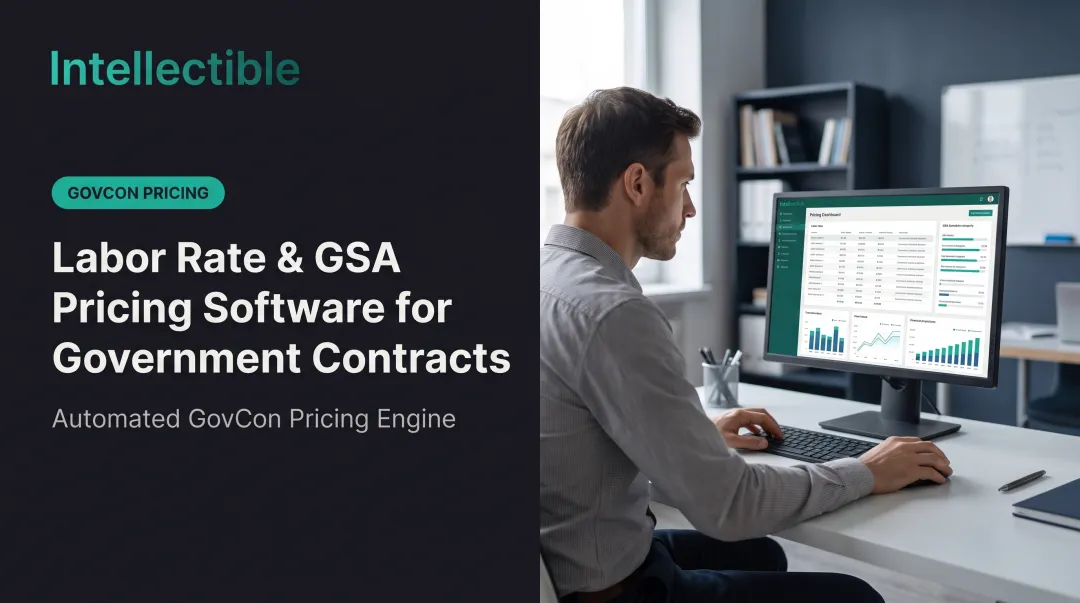
Workflow automation platforms solve this by connecting labor rate data, indirect cost rates, and RFP requirements into one traceable system, instead of pricing analysts toggling between six open documents.
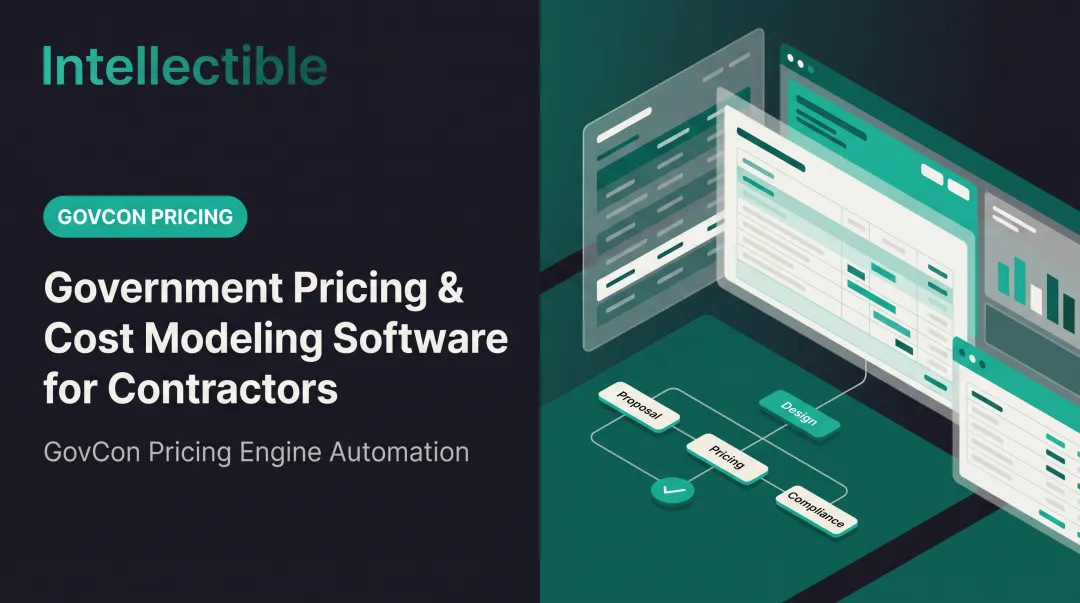
Intellectible's Pricing Engine is one example of this in practice. It runs a connected five-step workflow:
- Intake — captures RFPs, scope documents, and discovery notes automatically
- Extract — AI parses and normalizes labor assumptions and pricing inputs, preserving source evidence
- Review Assumptions — teams validate wage rates and benchmarks before costing begins
- Build Cost Model — the costing workspace applies labor rates, indirect rates, and cost drivers to calculate margins and scenarios
- Publish Pricing — approved economics convert into customer-ready pricing while protecting internal assumptions
Firms using this structure see a 90% reduction in time-to-final-pricing, with full audit-trail control and no added headcount on the pricing team.

Because it's built on a horizontal AI platform, pricing teams can connect PostgreSQL databases, structured cost records, and decision logic into one pricing workflow rather than rebuilding infrastructure for every new pursuit.
Teams working GSA Schedules, IDIQs, and task orders can reuse pricing logic and rate cards across bids instead of starting from a blank spreadsheet each time.
Understanding GSA Contract Pricing
GSA pricing works differently from per-bid competitive pricing. Under the Multiple Award Schedule (MAS) program, rates are pre-negotiated at the contract level, not competed fresh on every task order.
GSA requires pricing to be "fair and reasonable," benchmarked against your commercial sales practices. Since Refresh 31, Transactional Data Reporting (TDR) is mandatory for all MAS SINs. Contractors must report monthly within 30 days of month-end. TDR replaced older Commercial Sales Practice (CSP) and price-reduction tracking requirements.
To pursue a GSA Schedule, consulting firms generally need:
- At least two years in business (GSA's Startup Springboard offers alternative paths for newer firms)
- Financial stability sufficient to support contract performance
- Consistent pricing between commercial and government customers
Common Pricing Mistakes That Hurt Consulting Firms in Evaluations
Three mistakes show up repeatedly in cost realism findings and protest decisions:
- Unsupported labor rates — rates not tied to salary surveys or historical actuals remain the top cost realism trigger
- Staffing plan misalignment — mismatch between the technical volume's labor mix and the cost volume's pricing is an immediate credibility red flag
- Untraceable indirect rates — outdated or unexplained indirect rates that fail to connect to DCAA-audited or negotiated rate agreements
Each mistake shares the same root cause: pricing assumptions disconnected from the technical proposal and the accounting system that should support them.
Frequently Asked Questions
How do I price consulting services for government contracts?
Build the rate from three inputs: hourly overhead (total business costs ÷ billable hours), a labor rate benchmarked to salary data, and a profit margin suited to the contract type. Fixed-price work generally supports higher margins than cost-reimbursement work.
How do you choose and defend a pricing model for consulting work?
Match the model to how well the outcome is bounded: fixed-price where deliverables are defined, T&M where scope will move, cost-reimbursement where the client accepts risk for exploratory work. On a GSA Schedule the ceiling rates are pre-negotiated against "fair and reasonable" standards benchmarked to your commercial pricing, so the defence rests on consistency with that basis.
What's the difference between price and cost volumes in a government proposal?
The price volume states what the government will pay. The cost volume proves that price is realistic and that you understand the requirement well enough to execute it.
How does cost realism analysis affect my proposed price?
Under FAR 15.404-1(d), agencies can adjust your proposed costs upward if your BOE documentation is thin or unconvincing. That adjustment can hurt your competitive position even when your original price was accurate.
Can small consulting firms use pricing software without a large finance team?
Yes. Platforms like Intellectible's Pricing Engine deliver pricing accuracy and full audit trails without adding finance headcount.