Introduction: Why Your GovCon Proposal Cover Letter Could Be Costing You Millions
Government contracting teams typically invest 30+ hours perfecting technical volumes and pricing models, yet often spend less than an hour on the cover letter. That's a costly mistake.
In federal procurement, your cover letter is frequently the only section every evaluator reads in full. While technical reviewers dive into specific volumes, the Source Selection Authority and evaluation panel members often use your cover letter to form initial impressions, confirm compliance, and gauge your understanding of the mission.
A weak or generic cover letter signals that your proposal may lack the same care.
Government proposal cover letters differ from commercial business proposals. They must address compliance requirements, map to structured evaluation criteria, reference specific past performance, and speak directly to agency mission objectives—not just ROI.
Federal acquisition follows the Federal Acquisition Regulation (FAR), while state and local procurements follow their own rules. This guide shows how to write a cover letter that meets those standards, aligns to evaluation criteria, and keeps your proposal in contention.
Key Takeaways
- Map every claim to Section M criteria: technical, past performance, management, and price
- Include all mandatory compliance elements: solicitation number, UEI, authorized signature, and compliance statement
- Show mission fit by tying your solution to the agency's strategic objectives
- Select 2-3 relevant, quantified past-performance examples tied directly to the requirement
- Customize every section to the specific RFP and agency—skip generic boilerplate
What Makes a GovCon Proposal Cover Letter Different
Understanding Government Evaluation Criteria
Government evaluators follow a structured methodology defined in Section M (Evaluation Criteria) of the solicitation. Unlike commercial buyers who may weigh factors subjectively, federal evaluators must assess proposals against explicitly stated criteria—typically technical approach, past performance, management capability, and price.
Your cover letter must map directly to these factors. If past performance carries the highest weight, lead with relevant, recent contract examples.
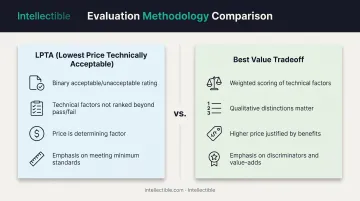
If the solicitation uses Lowest Price Technically Acceptable (LPTA) evaluation, emphasize meeting all technical acceptability standards rather than added features. Evaluators cannot rank non-price factors beyond "acceptable" or "unacceptable."
Under tradeoff (Best Value) evaluations, agencies may select a higher-priced proposal when the benefits justify the added cost. Here, your cover letter should highlight discriminators that align with the highest-weighted evaluation factors, using the exact terminology from Section M.
Critical rule: Use the government's language. If Section M references "cyber incident response capability," use that phrase, not "security operations excellence."
Federal vs. State/Local Requirements
Federal cover letters typically require:
- Unique Entity Identifier (UEI) and CAGE code (DUNS is no longer valid as of April 2022)
- Solicitation number, contracting officer's name and title, and agency address
- Explicit compliance statements confirming all certifications and representations are current and accurate
- Authorized signature from someone with binding contractual authority
State and local requirements vary by jurisdiction. California's Department of General Services, for example, requires adherence to specific instruction sections within RFPs, while New York City mandates criteria, relative weights, and best-value justification. These procurements are often less formal than federal but still demand professional presentation and clear qualifications.
Action step: Read Section L (Instructions to Offerors) carefully to identify mandatory versus discretionary cover letter elements. Missing a required item can lead to disqualification before your technical approach is ever reviewed.
The Compliance Imperative
Evaluators check compliance first. Even an exceptional cover letter cannot save a proposal that arrives late, exceeds page limits, lacks required signatures, or omits mandatory volumes.
Federal acquisition case law reinforces this. In Ace Electronics Defense Systems (2022), GAO denied a protest after the offeror's final proposal revision exceeded the 30MB server limit and was not received.
In Guidehouse (2024), quote emails that never reached designated inboxes resulted in rejection. The solicitation stated that one late volume made the entire quote late.
Common compliance requirements:
- Page limits (typically 1-2 pages for cover letters)
- Font size and style (e.g., 12-point Times New Roman)
- Signature authority (must be an authorized representative)
- Organizational conflict of interest statements when applicable
Mission Alignment Over Sales Pitch
Federal agencies buy to accomplish their mission, not to maximize profit. Your cover letter must demonstrate understanding of the agency's strategic objectives—whether that's improving veteran healthcare delivery, strengthening cybersecurity resilience, or modernizing IT infrastructure.
Ground the letter in the agency's world:
- Cite the mission statement, a recent strategic plan, or a documented operational challenge
- Tie your solution to those goals, not to vendor ROI or generic competitive advantage
Commercial sales letters sell upside. GovCon cover letters show mission fit.
The Role of Past Performance
Past performance is often the highest-weighted evaluation factor in federal source selections. FAR generally requires past-performance evaluation in negotiated competitive acquisitions above the simplified acquisition threshold.
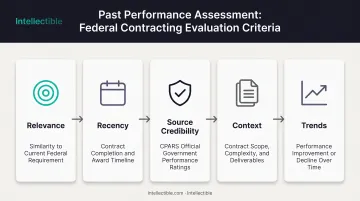
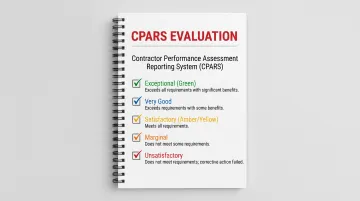
Agencies assess relevance, recency, source credibility, context, and trends. The Contractor Performance Assessment Reporting System (CPARS) provides official ratings (Exceptional, Very Good, Satisfactory, Marginal, or Unsatisfactory) covering technical quality, cost control, schedule, management, and small-business subcontracting.
In your cover letter:
- Reference 2-3 highly relevant contracts with outcomes that mirror the requirement
- Quantify results where possible (e.g., "Delivered 15 similar systems on schedule with an average CPARS rating of Exceptional")
- Don't substitute cover-letter summaries for required past-performance volumes; complement those volumes instead
Offerors with no relevant past performance may receive a neutral evaluation, so teaming with partners who bring proven track records can strengthen your position.
Essential Elements Every GovCon Cover Letter Must Include
Proper Letterhead and Formatting
Your cover letter must include:
- Company letterhead with logo and address
- Date of submission
- Contracting officer's name, title, agency name, and full address
- Solicitation number (critical: omitting this can cause immediate rejection)
- Formal salutation (such as "Dear Ms. Johnson:")
Follow Section L formatting requirements exactly. While FAR does not mandate universal font or margin standards, individual solicitations often specify 12-point font, one-inch margins, and single or double spacing. Page limits typically range from one to two pages.
Compliance and Representations Statement
Explicitly state your compliance:
"[Company Name] hereby submits this proposal in full compliance with Solicitation [Number]. All certifications and representations are complete, current, and accurate. Our UEI is [Number], and we are actively registered in the System for Award Management (SAM)."
If applicable, add:
- Small business status (for example, "We are a certified 8(a), HUBZone, SDVOSB, or WOSB firm")
- Security clearance levels your personnel hold
- Facility clearances or special requirements
Understanding of the Requirement
Show you've analyzed the Performance Work Statement (PWS) or Statement of Work (SOW) by citing specific requirements, not generic capabilities.
Weak: "Our company has extensive experience in IT modernization."
Strong: "We understand that the Department seeks to migrate 12 legacy systems to a cloud-native architecture within 18 months while maintaining zero downtime for mission-critical operations. Our approach directly addresses your PWS requirements in Section 3.2 for phased migration and Section 4.1 for security authorization."
Use the government's terminology and show you grasp both the technical requirements and the underlying mission need.
Your Unique Qualifications
Present 2-3 key discriminators that align with the highest-weighted evaluation factors. Quantify your capabilities with specific metrics:
- "Delivered 15 similar systems on schedule and within budget with an average CPARS rating of Exceptional"
- "Reduced incident response time by 40% for a federal agency managing 50,000+ endpoints"
- "Achieved 99.7% uptime across five years of operations and maintenance support"
Link each discriminator to an evaluation criterion. If management approach is heavily weighted, emphasize your program management methodology and key personnel qualifications.
Teaming and Subcontracting Approach
If your team includes partners who bring critical capabilities or past performance, introduce them briefly:
"Our team pairs [Prime]'s program management and security expertise with [Subcontractor]'s cloud migration experience, including recent successful migrations for [Agency]. This unified team brings 20+ relevant contracts and the depth required to execute your requirement."
For large businesses on full-and-open solicitations: Mention your small-business subcontracting commitment if required. FAR 19.702 mandates subcontracting plans for negotiated acquisitions expected to exceed $900,000 ($2M for construction) with subcontracting possibilities.
Clear Call to Action and Contact Information
Close with a firm offer and complete contact details:
"We are prepared to begin performance immediately upon award and remain available to discuss any aspect of our proposal. This offer is valid for 180 days from the date of submission."
Include:
- Proposal point of contact name and title
- Phone number and email address
- Offer validity period (typically 60-180 days)
Signature requirement: The letter must be signed by an authorized representative with binding contractual authority. If signed by an agent, provide evidence of authority as required by FAR 52.215-1.
Step-by-Step: Writing Your GovCon Proposal Cover Letter
Step 1: Analyze the RFP Before You Write
Extract key information systematically:
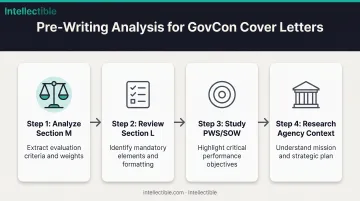
- Section M: Identify evaluation criteria, their relative importance, and any stated weights
- Section L: Note mandatory cover letter elements, page limits, font requirements, and submission format
- PWS/SOW: Highlight critical performance objectives and technical requirements
- Agency context: Research the agency's mission, strategic plan, and recent initiatives
Create a cover letter outline that maps each paragraph to a major evaluation factor before writing a single sentence. This ensures alignment from the start.
Step 2: Craft a Strong Opening Paragraph
Lead with the solicitation, the mission need, and proof you can meet it—in that order.
Weak: "ABC Company is pleased to submit this proposal in response to Solicitation 12345."
Strong: "[Company Name] submits this proposal for Solicitation [Number], offering a cloud migration approach aligned to your Zero Trust strategy and the PWS goal to modernize 12 legacy systems in 18 months. We have delivered eight similar federal migrations with average CPARS ratings of Very Good or higher."
Formula: Solicitation acknowledgment + mission/requirement understanding + relevant capability snapshot.
Step 3: Build Your Value Proposition
Structure 2-3 paragraphs addressing major evaluation factors with specific past-performance evidence. Use the Challenge-Action-Result format:
Example:
"When [Agency] needed to migrate mission-critical systems with zero downtime, we used a phased microservices approach. We finished two weeks early, held 99.9% uptime, and earned an Exceptional CPARS for technical quality. That work maps directly to your Section 3.2 phased migration requirement."
Tie each example to the current requirement explicitly. Evaluators should immediately see the relevance.
Step 4: Address Risk and Mitigation
Proactively address potential concerns:
- If you're not the incumbent: "We are not the current contractor, but we have led five transitions with a knowledge-transfer method that protects continuity from day one."
- If you're a small business scaling up: "For added surge capacity, we partnered with [Teammate] so we can scale scope without losing agility or direct customer access."
Frame weaknesses as managed risks with clear mitigation—not as liabilities you hope evaluators will overlook.
Step 5: Close With Confidence and Compliance
End professionally:
"[Company Name] is fully prepared to execute this requirement and deliver the outcomes your agency needs. We confirm that all certifications, representations, and proposal volumes are complete and compliant. We welcome the opportunity to discuss our approach and remain available at [phone] or [email]."
Signature block:
- Typed name and title of authorized signatory
- Handwritten signature
- Date
The signatory must have authority to bind the company. Keep documentation ready if the government questions that authority later.
Step 6: Review Against the Checklist
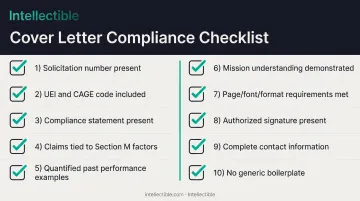
Quality control checklist:
- ✅ Solicitation number, agency, and contracting officer listed correctly?
- ✅ UEI and CAGE code included (for federal)?
- ✅ Compliance statement present?
- ✅ Every claim tied to a Section M evaluation factor?
- ✅ 2-3 relevant, quantified past-performance examples?
- ✅ Mission understanding demonstrated with specific agency references?
- ✅ Page limit, font, and format requirements met?
- ✅ Authorized signature present?
- ✅ Contact information complete?
- ✅ No generic boilerplate language?
Have someone unfamiliar with the opportunity review your cover letter. If they can't immediately understand why you're qualified, rewrite for clarity.
Common Mistakes That Cost GovCon Teams Contracts
Even strong technical volumes lose points when the cover letter trips over avoidable errors. These three mistakes show up constantly in debriefs—and each one is fixable before you hit submit.
Generic, Template-Heavy Language
Boilerplate language signals that you haven't customized your approach. Evaluators read dozens of proposals and immediately recognize recycled text.
Before (Generic):
"ABC Company is a leading provider of innovative solutions with a proven track record of excellence and a commitment to customer satisfaction."
After (Specific):
"ABC Company has delivered cloud migration services for three Cabinet-level agencies over the past four years, completing 22 system transitions on schedule with an average CPARS rating of Very Good. Our cybersecurity approach aligns with your agency's Zero Trust mandate outlined in your 2024 IT Modernization Plan."
The second version gives evaluators proof, agency context, and a clear signal that you read their documents.
Missing Mandatory Compliance Elements
Simple omissions can trigger immediate disqualification:
- Omitting the solicitation number
- Exceeding the stated page limit (even by a single line)
- Using an unauthorized signatory
- Forgetting to include required small-business representations
Compliance checklist for cover letters:
- Solicitation number present
- UEI and CAGE code listed (federal)
- Authorized signature and title
- Page count within limit
- Font and margin specs met
- Date of submission included
- All required statements present
FAR 52.215-1 specifies required first-page information when that clause applies. Review it and Section L carefully.
Compliance keeps you in the game. Tone and focus decide whether evaluators see a partner or a vendor brochure.
Focusing on Your Company Instead of Their Mission
Writing about your company's history and capabilities without connecting them to the government's need is a common error.
Before (Company-Centric):
"Founded in 2005, ABC Company has grown to 200 employees and serves clients nationwide. We pride ourselves on innovation and quality."
After (Mission-Focused):
"Your agency's mission to improve veteran healthcare delivery requires a partner with proven EHR integration experience in VA environments. Our team has implemented interoperability solutions at five VA medical centers, reducing patient data retrieval time by 60% and supporting your Section 2.1 requirement for real-time clinical data access."
Every sentence should answer: "How does this help the government accomplish their mission?"
Cover Letter Templates for Different GovCon Scenarios
Different pursuit types need different cover letter structures. Use the templates below as starting points, and replace every bracketed field with solicitation-specific detail.
Template 1: Prime Contractor, Federal Agency, Best Value
[Your Company Letterhead]

[Date]

[Contracting Officer Name and Title]
[Agency Name]
[Address]
[City, State ZIP]

Re: Solicitation [Number] – [Title]

Dear [Contracting Officer Name]:

[Company Name] submits this proposal for Solicitation [Number], offering [brief description of solution that directly addresses the PWS primary objective]. Our approach aligns with [Agency]'s mission to [specific mission statement or strategic goal] and addresses your requirement to [specific SOW/PWS requirement].

[PARAGRAPH 2 – Technical Approach/Past Performance]
Our team has successfully delivered [number] similar [type of service/product] for federal agencies, including [specific relevant contract]. For [Agency Name], we [describe challenge], implemented [specific approach], and achieved [quantified results: schedule, cost, quality metrics]. This experience directly applies to your [specific SOW section] requirement for [specific capability]. We earned a CPARS rating of [rating] for [relevant performance area].

[PARAGRAPH 3 – Management/Key Personnel or Second Discriminator]
[If management approach is heavily weighted, describe your program management methodology, key personnel qualifications, and organizational structure. If another factor is weighted higher, address it here with specific past-performance evidence.]

[PARAGRAPH 4 – Small Business/Teaming if applicable]
Our small-business subcontracting plan commits [percentage]% to small businesses, including [specific set-asides if applicable]. [Or: Our team pairs [Prime]'s [capability] with [Subcontractor]'s [complementary capability], bringing [number] relevant contracts and the depth required to execute your requirement.]

We confirm that [Company Name] is fully compliant with all solicitation requirements. Our UEI is [Number], and we are actively registered in SAM. All certifications and representations are current and accurate. [Add any required compliance statements, security clearances, or facility requirements.]

[Company Name] is prepared to begin performance immediately upon award. This offer is valid for [number] days from the date of submission. We welcome the opportunity to discuss our approach and remain available at [phone] or [email].

Respectfully submitted,

[Signature]
[Typed Name]
[Title]
[Company Name]
[Phone]
[Email]
Annotations:
- Opening immediately connects your solution to the agency mission and PWS
- Each middle paragraph addresses a major evaluation factor with quantified past performance
- Compliance paragraph includes all required federal identifiers
- Closing is confident but professional
Template 2: Small Business, State/Local Government
[Your Company Letterhead]

[Date]

[Procurement Officer Name and Title]
[Agency/Department Name]
[Address]
[City, State ZIP]

Re: RFP [Number] – [Title]

Dear [Procurement Officer Name]:

[Company Name], a certified [8(a)/HUBZone/SDVOSB/WOSB] small business, submits this proposal for RFP [Number]. We offer [description of solution] that directly supports [Agency]'s goal to [specific agency objective or project outcome].

As a local small business based in [City/Region], we bring [specific advantage: rapid response, local workforce, community investment]. Our team has delivered [number] similar projects for [type of clients: municipalities, counties, state agencies], including [specific relevant project]. For [Client Name], we [describe challenge and solution], completing the project [on time/under budget/with specific outcome] and achieving [specific result or satisfaction metric].

Our approach combines [key capability 1], [key capability 2], and [key capability 3], ensuring [specific benefit tied to RFP requirement]. We understand your [specific requirement from SOW] and will [specific approach or methodology].

[Company Name] confirms full compliance with all RFP requirements and submission instructions. [Include any required state/local certifications, registrations, or representations.] Our proposed pricing of [$amount] reflects both competitive value and the quality you expect.

We are prepared to begin work immediately upon contract award and remain available to discuss our proposal at [phone] or [email].

Sincerely,

[Signature]
[Typed Name]
[Title]
[Company Name]
[Phone]
[Email]
Annotations:
- Opens with small-business certification when applicable to set-aside or evaluation preference
- Emphasizes local presence and agility—common small-business advantages
- Balances competitive pricing message with capability demonstration
- State/local format is less formal but still professional and complete
Template 3: Teaming Arrangement with Past Performance Gaps
[Prime Contractor Letterhead]

[Date]

[Contracting Officer Name and Title]
[Agency Name]
[Address]
[City, State ZIP]

Re: Solicitation [Number] – [Title]

Dear [Contracting Officer Name]:

[Prime Company Name], in partnership with [Key Subcontractor Name], submits this proposal for Solicitation [Number]. Our unified team brings the combination of [Prime's core capability] and [Subcontractor's complementary capability] required to meet your [specific PWS objective].

While [Prime Company] brings [specific strength: program management, customer relationship, technical approach], we have partnered with [Subcontractor Name] to provide [specific capability or past performance the prime lacks]. [Subcontractor Name] has delivered [number] similar [service/product] for federal agencies, including [specific relevant contract that mirrors the requirement]. For [Agency], [Subcontractor] [describe relevant accomplishment with quantified results], earning a CPARS rating of [rating].

This teaming arrangement ensures [specific benefit: continuity, deep expertise, surge capacity, geographic coverage]. [Prime Company] will serve as the single point of accountability, managing all aspects of contract performance while leveraging [Subcontractor]'s proven [capability]. Our teaming agreement, included as [Attachment X], formalizes our commitment and defines roles, responsibilities, and work allocation.

Together, our team has completed [total number] relevant contracts valued at over [$total value], demonstrating the depth and capacity your requirement demands. Our approach to [specific critical requirement] draws on both partners' experience and addresses your [specific SOW section] requirement for [specific capability].

[Company Name] confirms full compliance with all solicitation requirements. Our UEI is [Number], and we are actively registered in SAM. All certifications and representations are current and accurate. [Include subcontractor UEI if required by Section L.]

We are prepared to begin performance immediately upon award. This offer is valid for [number] days from the date of submission, and we remain available at [phone] or [email] to discuss our team's qualifications.

Respectfully submitted,

[Signature]
[Typed Name]
[Title]
[Prime Company Name]
[Phone]
[Email]
Annotations:
- Introduces the team as unified from the opening sentence
- Clearly explains why the teaming arrangement strengthens the offer
- Presents the subcontractor's past performance as part of the team's collective capability
- Emphasizes single point of accountability (the prime remains fully responsible)
- References the teaming agreement attachment
For teams running multiple proposals at once, tools like Intellectible can pull requirements from Section L and Section M, map past performance to evaluation factors, and draft tailored cover letter content.
That kind of support can cut cover letter creation time by up to 95% without losing the customization evaluators expect.
Frequently Asked Questions
What is a proposal letter?
A proposal letter (or cover letter) is a formal one-to-two page document that introduces your proposal response to the government. It shows you understand the requirement, why your company is the best choice, and that you comply with solicitation terms. It is often the first substantive content evaluators read.
What is a cover letter for an RFP?
A cover letter for an RFP is the opening section of your proposal package (after items like the table of contents). It summarizes your key qualifications, relevant past performance, and approach. For government RFPs, include mandatory compliance details: solicitation number, UEI, and authorized signature.
Can you provide an example of a proposal letter?
The template section above includes three complete examples for common GovCon scenarios: prime/federal/best value, small business/state-local, and teaming. Strong letters use proper solicitation formatting, a clear statement of understanding, 2-3 quantified past-performance examples, and explicit compliance confirmation.
Should I mention my small business status in my cover letter?
Yes, if you hold relevant certifications (8(a), HUBZone, SDVOSB, WOSB) and the solicitation is a set-aside or includes small-business evaluation preferences. Small businesses received nearly $179B (28% of federal prime-contract dollars) in FY2025. Cite only certifications that are current, applicable, and verifiable in SAM.
How do I address teaming arrangements in a cover letter?
Introduce key partners (especially those with critical past performance or technical capabilities) in a dedicated paragraph. Present the team as unified, explain each partner’s role, and cross-reference your teaming agreement. FAR requires full disclosure of arrangements, with the prime retaining single-point accountability.
What's the difference between federal and state/local cover letters?
Federal cover letters need more formal compliance language: UEI (DUNS retired April 2022), CAGE code, explicit certifications, and FAR-based Section L formatting. State and local letters vary by jurisdiction and are often less formal, but still require clear qualifications and strict adherence to that RFP’s instructions.