Introduction
The government RFP process is the formal, federally-regulated sequence by which contractors identify, qualify, and respond to government solicitations to compete for public contracts.
If you've worked in commercial B2B sales, the structure here will feel unfamiliar. Government procurement isn't driven by relationships, brand recognition, or a persuasive pitch deck. It's a scored competition governed by the Federal Acquisition Regulation (FAR), with publicly defined criteria and legal protest rights. Mandatory compliance requirements can disqualify a proposal before an evaluator reads the first sentence.
This guide is written for proposal managers, BD leads, capture teams, and pricing professionals pursuing federal, state, or local contracts. It covers the process end-to-end — from opportunity identification through award and debrief — and explains where teams consistently lose points, burn resources, and walk away from bids they could have won.
Key Takeaways
- Government RFPs are scored against pre-published criteria in Section M — not buyer preference or incumbent familiarity
- The Go/No-Go decision is the highest-leverage checkpoint; pursuing low-probability bids drains resources from winnable ones
- Non-compliance with Section L formatting rules can disqualify a proposal before technical evaluation begins
- Past performance is a formal scored factor — document it deliberately, with the same rigor applied to technical volumes
- A repeatable capture process reduces bid costs, shortens cycle time, and raises win rates across pursuits
What Is the B2B RFP Process in Government Contracting?
A government RFP (Request for Proposal) is a formal solicitation issued by a federal, state, or local agency inviting contractors to submit competitive proposals for a defined scope of work, evaluated against pre-published criteria.
Federal RFPs are publicly available — primarily through SAM.gov, the official centralized system for federal contracting research, entity registration, and contract opportunities. Each solicitation includes a full specification package:
- Section C — Statement of Work (SOW) or Performance Work Statement (PWS)
- Section L — Instructions to offerors: formatting rules, page limits, submission requirements
- Section M — Evaluation factors and their relative weights
- Section B — Contract line item numbers (CLINs), quantities, and pricing structure
How RFPs Differ From Other Solicitation Types
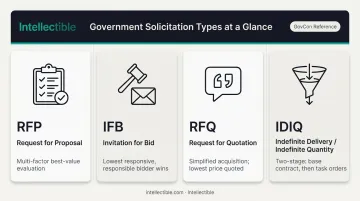
Not every government solicitation is an RFP. The distinctions matter for strategy:
| Solicitation Type | How Award Is Made |
|---|---|
| RFP | Multi-factor evaluation: technical, past performance, price |
| IFB (Invitation for Bid) | Sealed bidding — lowest responsive, responsible price wins |
| RFQ (Request for Quotation) | Used for smaller purchases; a quotation is not a binding offer |
| IDIQ | Two-stage: contract award establishes a ceiling, then task orders are competed under FAR 16.505 |
The RFP process exists to give agencies a documented, competition-based justification for award — and to give contractors a fair, rules-based pathway to compete. Contractors who understand the structure — and respond directly to Sections L and M — consistently outperform those who treat RFPs as generic bids.
Why Government Contracting RFPs Are Different From Commercial B2B RFPs
Government RFPs operate under a governance framework that commercial procurement doesn't. The FAR (Chapter 1 of Title 48, CFR) and its agency-specific supplements set binding rules for every solicitation.
The current FAR inventory includes 26 named acquisition regulations — DFARS for defense, HSAR for Homeland Security, GSAR for GSA procurements. Non-compliance disqualifies proposals regardless of solution quality.
Evaluation Is Predetermined — Not Subjective
Section M defines evaluation factors and their relative weights before proposals are submitted. Evaluators score against this rubric. There is no room to impress a buyer with a compelling narrative if the technical volume doesn't directly address the stated factors. This is the single most important structural difference from commercial procurement.
Set-Aside Designations Change Eligibility
Small business set-aside programs restrict competition to qualifying firms. Understanding which designations you hold — or which teammates hold — determines which opportunities you can pursue:
- 8(a) — SBA program for socially and economically disadvantaged small businesses
- HUBZone — Businesses in historically underutilized geographic zones
- SDVOSB — Service-disabled veteran-owned small businesses
- WOSB/EDWOSB — Women-owned small businesses in eligible NAICS industries
In FY2025, nearly 28% ($179 billion) of federal prime-contract dollars went to small businesses, making set-aside awareness a direct competitive advantage.
LPTA vs. Best Value Changes Everything
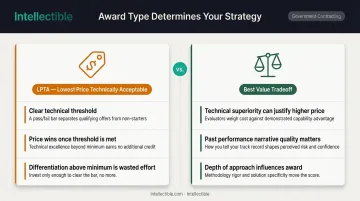
Award type determines your entire proposal strategy:
- LPTA (Lowest Price Technically Acceptable): Once you clear the technical threshold, price wins. Differentiation effort above the minimum is wasted.
- Best Value Tradeoff: Technical superiority can justify a higher price. Here, depth of approach and past performance narrative quality directly influence award.
Misreading award type leads to either over-investing in a price-wins competition or under-pricing in a quality-wins competition. Either error can eliminate a winnable bid before the final evaluation round.
Past Performance Is a Scored Factor
CPARS (Contractor Performance Assessment Reporting System) records are the official federal mechanism for capturing contractor performance evaluations, and contracting officers use them in source selections. Strong CPARS ratings on relevant contracts are a strategic asset.
Weak or absent ratings on contracts similar to the RFP scope create a measurable scoring gap — one that narrative alone rarely closes.
How the Government RFP Process Works: From Solicitation to Award
Step 1: Opportunity Identification and Pipeline Building
FAR generally requires agencies to publicize proposed contract actions over $25,000 through SAM.gov, with a synopsis at least 15 days before solicitation release and 30 days for responses above the simplified acquisition threshold.
Effective contractors don't wait for solicitations. They build pipeline 6–18 months before RFP release using:
- SAM.gov for active solicitations, presolicitations, and awards
- Agency forecast tools such as GSA's Forecast of Contracting Opportunities and DHS's Acquisition Planning Forecast System (for actions over $350,000)
- Third-party platforms like FPDS for early-stage leads and analyst intelligence
The goal of this phase isn't to find RFPs — it's to position before they drop. Pre-RFP engagement through RFIs, industry days, and capability briefings builds the agency familiarity that distinguishes a warm pursuit from a cold response.
Step 2: Capture and Go/No-Go Decision
Capture is the pre-proposal intelligence phase. It answers: Do we understand this agency's priorities? Can we beat the incumbent? Does our solution fit? Do we have the capacity to respond well?
The Go/No-Go decision formalizes whether to commit proposal resources. Factors that Shipley and APMP identify as core inputs include strategic alignment, core-capability fit, customer access, competitive position, margin expectations, and resource availability.
This is the highest-leverage checkpoint in the process. Pursuing low-Pwin opportunities doesn't just waste resources — it degrades proposal quality on the opportunities you should be winning.
Oceus, a defense contractor and Intellectible client, used Intellectible's pursuit platform to automate opportunity qualification and capture triage. Their team went from manually reviewing federal notices to surfacing more than double the qualified opportunities per month — roughly 7–8 per month reaching their pursuit threshold, with net-new pipeline from AI-generated outreach that hadn't existed before.
The platform cut the time spent on opportunity search and Go/No-Go analysis by over 95%.
Step 3: Solicitation Analysis and Compliance Matrix
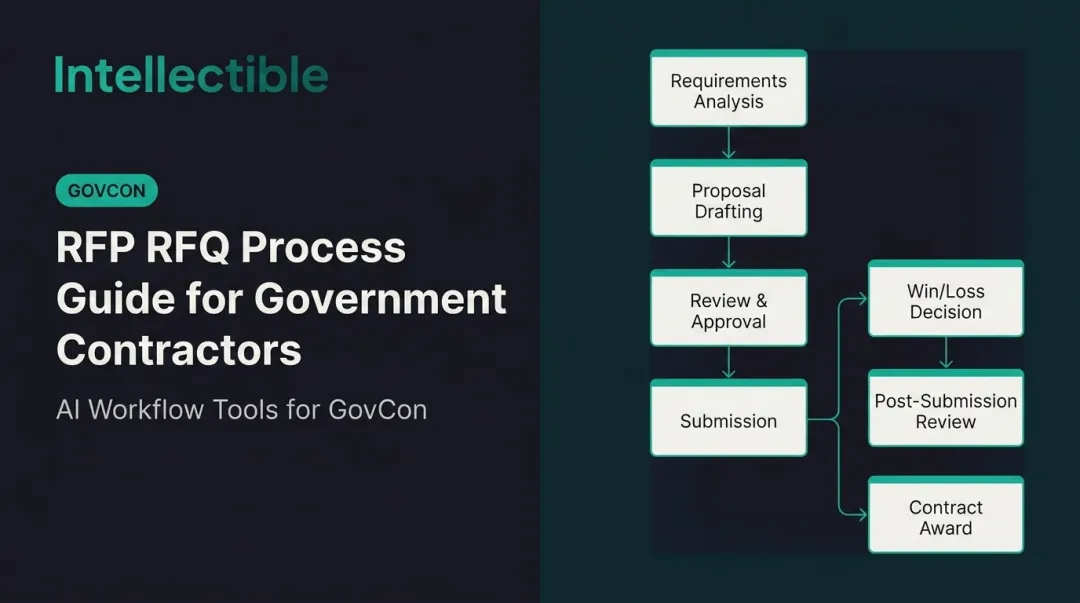
When the RFP drops, the first deliverable isn't a draft — it's a compliance matrix.
A compliance matrix cross-references every Section L instruction and Section M evaluation criterion to a proposal section and assigns an owner. It ensures:
- No requirement is missed
- The response structure mirrors the government's scoring framework
- Every team member knows what they're responsible for
Intellectible's Proposal & Pursuit Engine reads the solicitation, attachments, and addenda to extract key dates, submission rules, required sections, evaluation criteria, and compliance obligations — generating compliance matrices automatically alongside requirement summaries, risk lists, and document Q&A functionality. Days of manual review compress into a structured deliverable your team can act on immediately.
Step 4: Proposal Development Across Volumes
Government proposals are typically organized into separate volumes, each evaluated against specific factors:
- Technical Volume — Demonstrates understanding of requirements and proposed approach
- Management Volume — Covers staffing, program management, and quality assurance
- Past Performance Volume — References prior contracts with measurable, relevant outcomes
- Price/Cost Volume — Compliant cost build-up aligned to CLINs and evaluation criteria
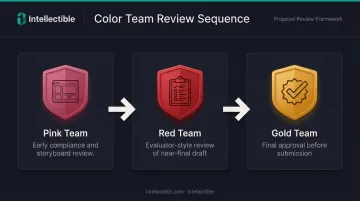
Color team reviews are the practitioner standard for quality control:
- Pink Team — Early review of storyboards and compliance against the matrix
- Red Team — Evaluator-style review of a near-final draft
- Gold Team — Final approval before submission
These are not FAR requirements — they are process discipline. Teams that skip structured reviews consistently submit proposals with scoring gaps that a second set of eyes would have caught.
Step 5: Pricing and Cost Volume Development
The price volume must comply with FAR Part 31 cost accounting requirements. A cost must satisfy reasonableness, allocability, and applicable limitations. Knowing what's unallowable — entertainment, lobbying, certain executive compensation — is non-negotiable.
Award type determines pricing strategy:
- LPTA competitions demand tight market pricing. Margin protection is secondary to meeting the technical threshold at the lowest compliant price.
- Best Value competitions require a price-to-win strategy that balances competitiveness with profitability, often requiring scenario modeling against competitive benchmarks.
For contractors subject to DCAA audits or post-award cost reviews, traceability from RFP intake to submitted price volume is a compliance requirement, not a nice-to-have.
Step 6: Submission, Award, and Debrief
Once pricing is locked and volumes are finalized, submission mechanics become the critical risk. FAR 15.208 requires delivery to the specified office by the authorized method and time stated in the solicitation — late proposals are generally not considered. In ICS Nett, Inc. (GAO B-422575, July 2024), GAO denied a protest where the offeror completed PIEE submission approximately two minutes after a 5:00 p.m. deadline. Contracting officers have little discretion under the rules.
Electronic submission portals vary by agency — DoD uses PIEE, GSA uses eOffer. Know the submission channel before the deadline.
Post-award debriefs are a legal right under FAR 15.506. They require the agency to disclose your evaluated weaknesses, your overall technical rating, and the successful offeror's corresponding information. Use every debrief — win or loss — to calibrate your next pursuit.
Key Factors That Shape Your Government RFP Outcome
Five factors drive evaluation scores and award probability more than anything else. Two act as eligibility gatekeepers — get them wrong and your proposal may never reach technical review. The other three are scoring differentiators that separate competitive bids from also-rans.
Eligibility gatekeepers:
- Competing outside your designated NAICS code or exceeding SBA size standards (based on employees or receipts, including affiliates) can disqualify a bid before evaluators read a single page.
- Past performance is scored on similarity of scope, dollar value, and complexity — a flawlessly executed contract in an unrelated domain contributes little to your rating.
Scoring differentiators:
- Teaming arrangements can fill capability gaps and strengthen past performance portfolios, but poorly structured agreements introduce compliance risk that evaluators will flag.
- Section M weighting determines whether price or technical factors dominate — this dictates where proposal investment is actually justified.
- Contractors who responded to RFIs, attended industry days, or held capability briefings before solicitation release arrive with agency context that cold responders can't replicate.
Common Mistakes in Government RFP Responses
Four mistakes account for the majority of avoidable losses in government proposal evaluations. Each one is fixable — but only if you recognize it before submission.
Formatting non-compliance. Page limits, font size, margin rules, and file naming conventions in Section L are compliance requirements, not suggestions. A formatting violation can get your proposal disqualified before an evaluator reads the first sentence. Commercial proposals allow formatting flexibility; government proposals do not.
Relying on reputation instead of writing. Evaluators score only what is written. Past performance on contracts not referenced in your past performance volume doesn't count. Incumbent familiarity doesn't compensate for a thin technical narrative. If it isn't in the proposal, it doesn't exist for scoring purposes.
Treating past performance as a form-fill. Past performance is a strategic narrative, not a reference list. The contracts you cite must match the RFP's scope in complexity, dollar value, and delivery context. Quantified outcomes tied to the agency's evaluation criteria are what convert prior work into scored value — this is one of the most recoverable gaps in government proposals, and one of the most frequently ignored.
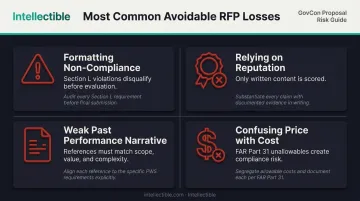
Confusing price with cost. Contractors new to government work often submit prices without understanding FAR Part 31 unallowable cost categories or the distinction between firm-fixed-price and cost-reimbursement vehicles. Pricing errors create compliance risk, margin exposure, or both.
When Not to Respond to a Government RFP
A disciplined no-bid process is a structural competitive advantage, not a concession.
Clear signals to pass on a solicitation:
- Requirements are written with unusual specificity around an incumbent's past deliverables
- Response window is unusually short with no prior market engagement history
- Your firm lacks mandatory qualifications — required clearances, certifications, or facility accreditations
- The NAICS or set-aside category excludes your eligibility
Proposal teams that chase every borderline opportunity produce weaker submissions across the board. A disciplined Go/No-Go gate means fewer bids, but stronger proposals on each — and a more defensible win rate over time.
If a solicitation matters strategically but your Pwin is low, partial engagement is often the smarter play. Responding to the RFI or attending the industry day builds agency familiarity for the next contract cycle — without burning full proposal resources on a long-shot submission.
Conclusion
The government RFP process rewards preparation, compliance precision, and strategic qualification — not proposal volume or writing quality alone. Contractors who invest in repeatable capture processes, Go/No-Go discipline, and structured proposal infrastructure outperform those who treat each RFP as a standalone effort.
The process itself is the differentiator. Three habits, in particular, separate contractors who win from those who just bid:
- Calibrate every response to the specific evaluation criteria in Section M
- Build a compliance matrix before writing a single word
- Make hard no-bid decisions on low-Pwin opportunities rather than chasing volume
These habits compound over time. Each qualified pursuit strengthens your pipeline intelligence, sharpens your pricing assumptions, and tightens the institutional knowledge your next proposal team inherits.
Frequently Asked Questions
What is RFP in B2B?
In B2B contexts, an RFP (Request for Proposal) is a formal document issued by a buying organization to solicit competitive proposals from vendors. In government contracting specifically, RFPs are publicly published, regulation-governed solicitations evaluated against predefined scoring criteria — distinct from commercial RFPs where buyer discretion plays a larger role.
What is a B2B proposal?
A B2B proposal is a formal response submitted by a vendor to a buyer's RFP. In government contracting, proposals are organized into separate volumes — technical, management, past performance, and price — and evaluated against the criteria defined in Section M of the solicitation, not the buyer's subjective assessment.
What is the difference between an RFP and an IFB in government contracting?
An IFB (Invitation for Bid) uses sealed bidding and awards solely to the lowest responsive, responsible bidder with no technical evaluation. An RFP involves multi-factor evaluation including technical approach, past performance, and price — making RFPs appropriate for complex or performance-sensitive requirements where solution quality matters beyond price alone.
What is Section L and Section M in a government RFP?
Section L contains instructions to offerors — formatting rules, page limits, volume structure, and submission requirements. Section M defines the evaluation factors and their relative weights used to score proposals. Read both sections together before writing a single word of your response.
How long does a government RFP response typically take to prepare?
Timelines vary by contract size and complexity. Small task orders may allow 2–3 weeks; large IDIQ or GWAC solicitations can require 60–90 days of proposal development. Teams with pre-built capture intelligence and past performance libraries on hand can compress that window significantly.
What happens if you miss a government RFP submission deadline?
Late submissions are generally disqualified under FAR rules, with very limited exceptions for documented government-caused delays or system failures. GAO upheld rejection of a proposal submitted approximately two minutes late in ICS Nett, Inc. (B-422575, 2024) — contracting officers have minimal discretion to accept late proposals.