Introduction
Every week, GovCon business development teams scroll through hundreds of SAM.gov postings, agency forecasts, and incumbent contract records. Most of that time gets spent searching. Very little gets spent strategizing.
That's a problem, because the federal contracting universe is enormous. The Government Accountability Office (GAO) reports the federal government spent roughly $755 billion on contracts in FY2024 alone.
The real challenge is fragmentation, not volume. Opportunity data, spend history, and pricing benchmarks all live in separate systems:
- Opportunity data sits in SAM.gov
- Spend history lives in USAspending.gov and FPDS
- Pricing benchmarks live on GSA eLibrary
None of it talks to your internal CRM. The result: missed opportunities, slow Go/No-Go decisions, and proposal effort wasted on pursuits that never had a real shot.
This guide breaks down what procurement intelligence actually means for GovCon teams, how it differs from procurement analytics, the core types you need to track, and what a platform needs to deliver so you can operationalize all of it without hiring another analyst.
Key Takeaways
- Procurement intelligence is sell-side and forward-looking, helping you win contracts instead of managing purchasing
- GovCon teams need five intelligence types: opportunity, agency/spend, competitive, pricing, and teaming
- AI-driven scoring and automated data integration cut manual research time from days to minutes
- Intellectible clients like Oceus and HHS see 95%+ time savings on opportunity search and Go/No-Go decisions
What Is Procurement Intelligence for GovCon Teams?
Procurement intelligence, in the GovCon context, is the structured collection and AI-driven analysis of federal and state buying signals: agency spend, active solicitations, incumbent contracts, and budget forecasts. Teams use this data to identify, qualify, and win the right opportunities faster.
Here's where most content on this topic gets it wrong. Search "procurement intelligence" and you'll find articles about companies analyzing their own purchasing to manage suppliers. That's buy-side intelligence, and it's a different discipline entirely.
GovCon procurement intelligence works in the opposite direction. You're not managing spend. You're analyzing how government agencies buy so you can position your company to win their business.
The Technology Behind It
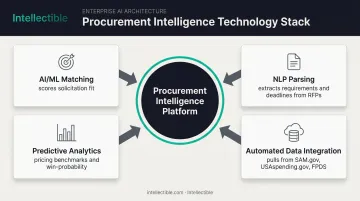
Modern platforms rely on a handful of core technologies working together:
- AI/ML matching that scores solicitation fit against your capabilities and certifications
- NLP parsing that extracts requirements, deadlines, and evaluation criteria from RFPs and RFIs automatically
- Predictive analytics for pricing benchmarks and win-probability signals
- Automated data integration pulling from SAM.gov, USAspending.gov, and FPDS without manual exports
The result: a different cadence for winning work. Instead of reacting to RFPs as they drop, teams build a qualified, forecastable pipeline months before a solicitation ever hits SAM.gov.
Procurement Intelligence vs. Procurement Analytics: What GovCon Teams Need to Know
These two terms get used interchangeably, and that's a mistake. They answer different questions.
| Category | Procurement Analytics | Procurement Intelligence |
|---|---|---|
| Direction | Backward-looking | Forward-looking |
| Answers | What happened in past captures? | What's coming, and can we win it? |
| Inputs | Win/loss history, historical pricing, agency spend by category | Upcoming solicitations, budget cycles, incumbent expirations |
| Use case | Post-mortem, performance reporting | Go/No-Go decisions, pipeline building |
Procurement analytics tells you your win rate on IDIQ recompetes last year. Procurement intelligence tells you which agency is about to release a similar opportunity next quarter, and whether the incumbent's contract is expiring.
You need both. Analytics grounds your Go/No-Go framework in what has actually worked. Intelligence tells you where to point that framework next. Teams that rely on one without the other either repeat old mistakes or chase opportunities with no data to back the pursuit.
Key Types of Procurement Intelligence GovCon Teams Should Track
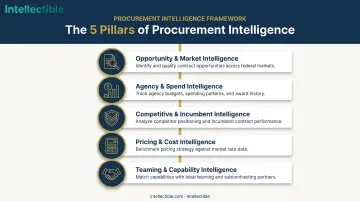
Five distinct intelligence types feed a well-run capture process. Skip one, and you're making decisions with a blind spot.
Opportunity & market intelligence starts with tracking SAM.gov postings alongside agency long-range acquisition forecasts and industry day announcements. Together, these surface opportunities long before an RFP officially posts. GSA's Forecast of Contracting Opportunities is a genuinely useful planning tool here, listing estimated award dates, NAICS codes, acquisition strategy, and set-aside status. Just don't treat those forecast dates as fixed; GSA itself notes projections can shift or get canceled.
Agency & spend intelligence comes from USAspending.gov and FPDS data, which reveal which agencies are actively buying, which contract vehicles they favor, and how their budget cycles run. Scale matters here: GSA's FY2024 Annual Performance Report recorded $51.50 billion in Multiple Award Schedule sales, with 35.84% of that spend going to small businesses. That's a real, sizable lane for smaller GovCon players tracking vehicle-level activity.
Competitive & incumbent intelligence means knowing who currently holds a contract, what it's worth, and when it expires. Those details tell you whether a re-compete is winnable or a long shot. Track incumbent performance history alongside contract value and expiration timing before committing capture resources.
Pricing & cost intelligence relies on benchmarking labor rates against real award data to support pricing that's both competitive and defensible. GSA's CALC tool publishes fully burdened, not-to-exceed hourly ceiling rates actually awarded under MAS contracts, filterable by labor category, experience, and security clearance. That's a far more reliable reference point than guessing at market rate.
Teaming & capability intelligence closes the loop. Identifying capability gaps against a specific opportunity early lets you find the right teaming partner or subcontractor before you've committed to a bid you can't fully staff.
Must-Have Features in a Procurement Intelligence Platform for GovCon
Not every tool billed as "procurement intelligence" actually replaces manual work. Here's what a platform needs to genuinely move the needle:
- AI-powered opportunity matching that scores solicitation fit against your capabilities, certifications (SDVOSB, 8(a), WOSB), and past performance, going beyond keyword search to semantic fit
- An automated Go/No-Go scoring framework replacing hours of manual review with a repeatable decision process, delivering 95%+ time savings on opportunity decisions for clients using Intellectible's platform
- Centralized data integration pulling from SAM.gov, USAspending.gov, FPDS, and GSA eLibrary into one workspace, instead of manual CSV exports stitched together in a spreadsheet
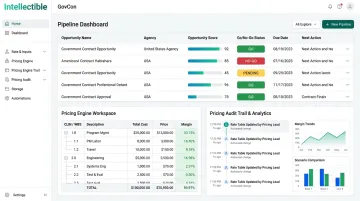
- Pricing intelligence tools with a full audit trail for rate benchmarking, cost volume support, and compliance documentation
- Workflow automation connecting opportunity identification directly to proposal development, pricing, and CRM tracking — closing the handoff gaps between BD, capture, and pricing teams
- Configurable dashboards giving leadership real-time visibility into pipeline health and capture stage without building custom reports from scratch
The common thread: each feature removes a manual handoff. Without them, teams end up re-entering the same opportunity data three or four times across different tools before a proposal ever gets drafted.
Best Practices for Building an Intelligence-Driven Capture Process
Even the best platform underperforms without process discipline behind it.
Define SMART Go/No-Go criteria upfront (capability fit, contract vehicle eligibility, incumbent strength, budget size) before opportunities reach evaluation. This keeps decisions consistent across pursuit teams instead of varying by reviewer.
Centralize data and communication across BD, capture, proposal, and pricing teams. Duplicate research and conflicting opportunity assessments waste more hours than any single missed deadline.
Set a regular review cadence for forecasts and incumbent expirations. Positioning and relationship-building need to happen before the RFP posts, not in the two weeks after.
Skip step one, and you'll chase every opportunity that looks vaguely relevant. Skip step three, and you'll be cold-calling agencies the week a solicitation drops, competing against firms that have spent months building relationships.
How Intellectible Powers Procurement Intelligence for GovCon Teams
Intellectible is a horizontal AI build platform purpose-built to deliver procurement intelligence for federal markets. For GovCon teams, that means the platform's GovCon Engine already handles opportunity discovery, award mining, RFP analysis, and Go/No-Go reporting, so your team skips rebuilding data pipelines, parsing infrastructure, or approval workflows from scratch.
The platform converts every notice into a structured capture record that includes:
- Agency, office, NAICS and PSC codes
- Timing and scope details
- Fit rationale and risk signals
Each record is scored using semantic fit analysis rather than basic keyword search.
Results from actual GovCon clients:
| Metric | Client | Detail |
|---|---|---|
| 2x+ qualified opportunities reviewed monthly | Oceus | Moved from roughly 3-4 to 7-8 qualified pursuits monthly |
| 95%+ time saved | GovCon clients | On opportunity search and Go/No-Go decisions |
| 150%+ increase | GovCon clients | In actionable top-of-funnel pipeline opportunities |
"Intellectible is taking the tedious, monotonous hours of RFP efforts out of human hands. This allows us to do what we should be doing, analyzing and selling." — John Grady, Corporate Director of Business Development, HHS
On the capture side, the platform mines award history to identify likely incumbents and expiring contracts. For early-stage opportunities, it builds pre-RFP market reports comparing related awards, likely incumbents, bidder signals, and benchmark values. Daily match summaries route high-fit pursuits to capture, BD, and leadership automatically.
Frequently Asked Questions
What is procurement intelligence?
Procurement intelligence is the structured use of data, AI, and market research to guide purchasing decisions or, for GovCon teams specifically, opportunity pursuit decisions. It turns fragmented federal data into forward-looking, actionable insight.
How is procurement intelligence different from procurement analytics for GovCon teams?
Analytics reports on past bid history and agency spend patterns. Intelligence predicts upcoming opportunities, agency budget cycles, and competitive positioning before an RFP even posts.
What data sources should a GovCon procurement intelligence platform pull from?
Core sources include SAM.gov, USAspending.gov, FPDS, and GSA eLibrary, integrated alongside your internal CRM and proposal data so opportunity intelligence connects directly to your pipeline.
How can AI improve Go/No-Go decisions for government contractors?
AI scores opportunity fit against your capabilities, certifications, and past performance automatically, cutting manual review time and making decisions more consistent across pursuit teams.
Do I need a dedicated procurement intelligence platform if I already use SAM.gov?
Yes. SAM.gov shows raw postings, but it doesn't score fit, provide competitive context, offer pricing intelligence, or automate workflow handoffs — capabilities a dedicated platform adds on top of the raw listings.
How much time can GovCon teams save by adopting procurement intelligence tools?
Teams using automated scoring and pricing tools report time savings exceeding 90% on opportunity decisions and final pricing, compared to manual research and spreadsheet-based review.