This is a leadership problem before it is a research problem. A rep can assemble ten good accounts by hand in an afternoon; nobody can do that for a market of four thousand, so teams buy a 50,000-row database instead, blast it, and wonder why reply rates crater. In fact, 73% of B2B buyers actively avoid suppliers who send irrelevant outreach, according to Gartner's 2025 survey of 632 buyers. The question for a sales or RevOps leader is not how to research an account well. It is how to get that same standard applied to every account in the market, every month, without hiring researchers.
Public data, when gathered with discipline, reveals real fit: certifications, procurement activity, hiring surges, facility expansions. The results depend on source quality, how tightly you define your ideal customer, and whether you verify what you collect.
This article walks through the full workflow at that scale: define the target, pick sources, build account records, enrich and verify contacts, prioritize, and keep the list current as the market moves underneath it.
Key Takeaways
- Define your ICP and a specific business question before touching any data source
- Pull evidence from company sites, government registries, procurement portals, and job boards instead of one generic database
- Separate account discovery from contact enrichment, and log the source and date for every data point
- Rank prospects by fit, evidence of need, and timing, not by how many rows you've collected
- Build in privacy rules, opt-outs, and refresh schedules from day one
How to Build a Prospect List From Public Data
Step 1: Define the ICP and Prospecting Question
Start with the account, not the person. Document the firmographic traits that separate a real fit from a maybe: industry, size, location, operating model, customer type, certifications, and procurement eligibility.
Buyer roles come next, listed separately from the account profile. For each role, note the business problems, trigger events, or public signals that would make outreach timely right now.
Turn all of this into two short lists:
- Inclusion checklist: traits that confirm a company belongs in your target segment
- Exclusion checklist: traits that disqualify a company even if it looks close on paper
These checklists keep researchers consistent, whether there's one person doing the work or five.
Step 2: Choose Public Sources That Contain Evidence of Fit or Intent
Not every source proves the same thing. Match each ICP criterion to a source likely to confirm it.
| Criterion | Source type |
|---|---|
| Offerings, locations | Company websites |
| Niche membership | Association directories |
| Registrations, contract awards | Government registries, procurement portals |
| Qualifications | Certification databases |
| Participation in an industry | Event and trade show pages |
| Growth activity | Job boards |
US teams can combine national registries (SAM.gov, USAspending), state filings (like California's bizfile portal), and niche sources like trade associations. But a listing or registration is not proof of readiness to buy. It's one data point, not a green light.
Before collecting anything, check:
- Current access rules and whether an account or API key is required
- Update frequency (SAM.gov's full entity extract runs monthly; USAspending refreshes daily but with contract-reporting lag)
- Licensing terms: Indeed's Hiring Lab data is CC BY 4.0, while IAF CertSearch requires written authorization for commercial reuse
- Platform terms that prohibit scraping, such as LinkedIn's user agreement
Step 3: Build Account Records Before Enriching Contacts
Resist the urge to find contacts first. Build the account record, confirm fit, then move to people.
Each record should include:
- Company name and canonical website
- Industry and location
- Source URL and source date
- Fit evidence and the relevant signal
- Signal date and qualification status
Normalize names, domains, and locations so the same company doesn't show up three times under three names. A subsidiary with its own filing, a regional office, and the parent company often need to be merged into one canonical account. This is where most lists get bloated.
Add one short evidence note per account: what you found, where, and why it supports inclusion. If you can't write that sentence, the account probably doesn't belong yet.
Step 4: Enrich, Verify, and Prioritize
Only after an account clears your fit checklist should you identify decision-makers. Pull contact details from company-published sources or other appropriately sourced material, and record the role, source, and verification status for each.
Cross-check key fields against at least two sources. Flag conflicts for human review instead of guessing. Drop records you can't verify — a stale contact is worse than no contact.
From there, score or segment accounts using:
- Fit: how closely the account matches your ICP
- Signal strength: how strong the evidence of need is
- Timing: whether the trigger event is recent
- Reachability: whether a verified contact exists
- Confidence: how solid the underlying data is
Route high-fit, high-signal accounts to active outreach. Everything else goes to a monitoring or nurture queue instead of getting deleted.
Step 5: Connect the List to a Repeatable Revenue Workflow
A spreadsheet works for 50 accounts. It breaks down at 500. The handoff to sales, RevOps, or proposal teams needs defined fields: owner, next action, outreach angle, qualification status, and suppression or opt-out flags.
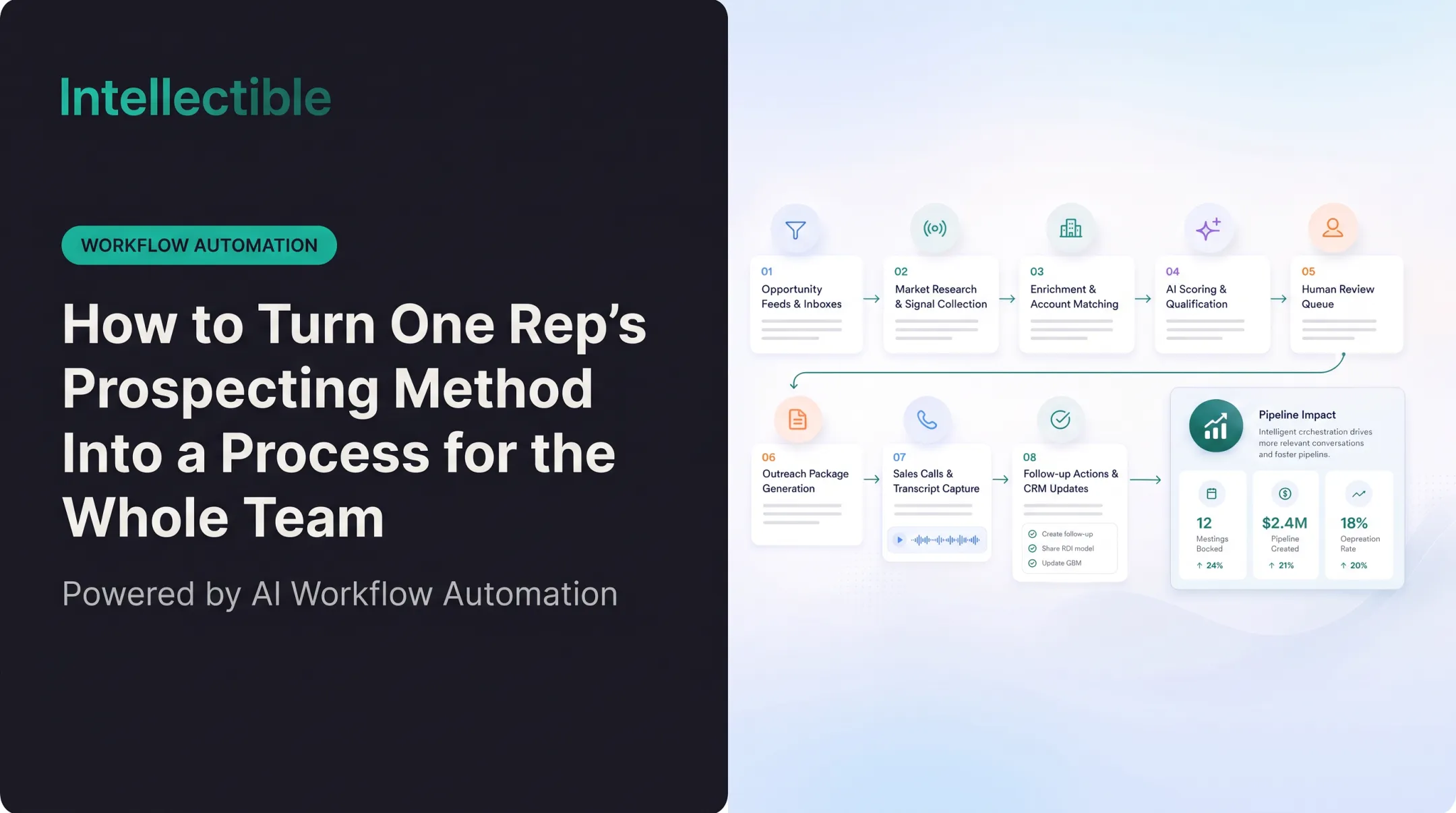
This is where an AI-enabled workflow earns its keep. It can connect multiple sources, structure incoming records, apply your inclusion/exclusion logic automatically, route uncertain records to a human reviewer, and publish the result into a CRM or a usable interface.
Intellectible's Revenue Discovery engine, for example, runs on a sequence of Detect → Gate → Promote → Draft → Approve → Call → Qualified, scoring each account for fit and urgency with weights a team can edit themselves. Review and job-posting monitoring run daily; parent-group searches run weekly; Salesforce syncs refresh nightly.

Four approval gates sit before outreach, Salesforce updates, survey sends, or marking a lead "Qualified for Costing." There's no bulk email, no LinkedIn automation, and no auto-CRM writes built in. It's one way to connect the steps above into something repeatable, not a replacement for defining your ICP in the first place.
When Should You Build a Prospect List From Public Data, and What Do You Need First?
Public-data prospecting shines in niche or shifting markets that generic databases tend to miss, like active procurement participants, certified subcontractors, or companies showing hiring surges in a specific region.
It's a weaker fit when:
- The ICP still isn't clearly defined
- Contact-level data for the segment barely exists publicly
- A key source can't be used lawfully for your purpose
- The list needs constant, high-volume refreshes you can't staff
- Your team has no capacity for verification
Tools and System Requirements
You'll need:
- A source inventory and research workspace or database
- A deduplication method and verification process
- A CRM or export destination
- Clear ownership rules and a documented suppression list
Inputs and Preconditions
Before starting, have in hand:
- A written ICP, target geography, and segment
- Inclusion/exclusion rules and a minimum evidence standard
- Required fields and acceptable sources
- An outreach objective and a refresh schedule
Compliance and Skill Readiness
Public visibility is not the same as legal permission to contact. Under FTC's CAN-SPAM guide, B2B commercial email still requires accurate headers, a working opt-out mechanism, and honoring opt-out requests within 10 business days.
Build a compliance checkpoint that covers:
- Email and calling rules (CAN-SPAM, TCPA for autodialed/prerecorded calls)
- State-specific privacy treatment (California's B2B exemption expired in 2022; Virginia's did not)
- Source terms of use and platform restrictions
- Data minimization and retention
- A clear path to escalate uncertain cases to legal counsel
Key Parameters That Affect Prospect-List Quality
List performance hinges on controllable variables, not raw count.
Source quality and diversity. A single generic database rarely beats a mix of first-party, government, association, and procurement sources. Check each source's authority, update cadence, and access terms before relying on it.
ICP precision and evidence threshold. Broad labels like "healthcare" or "government contractor" create noise. Define the specific evidence (a certification number, a contract award, a job posting) that proves an account belongs.
Data freshness and provenance. Every record needs a source URL, collection date, signal date, and a recheck date. Without these, teams can't tell a live signal from stale history.
Contact verification and account matching. A valid-looking email isn't a verified contact, and a verified contact isn't always the right decision-maker. Match domains, check role recency, catch duplicates, and suppress bounced contacts before they go back into rotation.
Fit, signal, timing, and prioritization. Keep fit, signal, and timing separate instead of blending them into one vague "score." Measure what's working using qualification rate, deliverability, reply quality, and meetings booked. For context, Gong's cold-calling research found reply rates of 3.44% with cold calling added to outreach versus 1.81% without. That gap is a reminder that channel mix affects outcomes, not just list quality.

Common Mistakes, Troubleshooting, and Alternatives
Skipping the ICP and Collecting Everything
Likely cause: Starting with a tool or source instead of a business question. Fix: Go back to the inclusion checklist, cut unsupported accounts, and rebuild around traits of your actual best customers.
Treating Public Availability as Proof of Accuracy or Permission
Likely cause: Assuming a visible record is current, complete, and compliant to reuse. Fix: Confirm the source, date, terms, and legal basis for outreach, and whether the record should be kept at all.
Enriching Contacts Before Qualifying Accounts
Likely cause: Measuring progress by contact count instead of account relevance. Fix: Filter and dedupe accounts first, then enrich only the top-priority segment.
Duplicate, Conflicting, or Stale Records
Likely cause: Collecting the same business from multiple sources without a canonical domain or matching rule. Fix: Merge records, preserve source history, route conflicts to human review, and recheck high-value accounts before outreach.
Alternatives to a Public-Data Build
Sometimes building from scratch isn't the right call:
- Referrals and customer lookalikes: faster when you already have strong accounts to model against
- Inbound engagement: lower effort, but limited volume
- Trade association relationships: strong for niche, relationship-driven markets
- Commercial databases: faster coverage, weaker specificity
- A specialized research service: useful when internal capacity is the bottleneck
Manual research gives full control but costs time. A purchased database gives speed but less precision.
A custom automated workflow, like the account-scoring and signal-monitoring approach used in Intellectible's Revenue Discovery engine, sits in between. It trades setup effort for ongoing freshness and control. A hybrid of manual judgment and automated structuring often wins on both fronts.

Conclusion
Building a prospect list from public data works when you start with a precise ICP, gather evidence from the right sources, verify what you collect, and prioritize fit and timing over sheer volume.
Treat the list as a maintained asset, not a one-time export. Keep it usable over time:
- Preserve provenance on every record
- Honor opt-outs
- Track which sources actually convert
- Refresh records as companies and contacts change
Prove the schema manually on one segment, then run it as a monitored process rather than repeating the exercise by hand. Sources are re-queried on a fixed cadence, accounts are re-scored as signals land or go stale, and the team's review time goes only to the records that moved since the last pass. That is the difference between a list that decays from the day it is exported and a standing view of the market that is still accurate in six months.
Frequently Asked Questions
What is the golden rule of prospecting?
There's no single universally agreed "golden rule." The practical version: target relevant prospects with a clear reason to reach out and useful, timely messaging. Treat any specific formulation as one author's framing, not a fixed standard.
What is the 3-3-3 rule in sales?
Versions vary across sales content. One common definition: spend three minutes researching, find three relevant insights, and write a three-sentence outreach message. Define whichever version you're using rather than treating it as universal.
What is the 30-day rule in prospecting?
The commonly cited idea, from Jeb Blount's Fanatical Prospecting, is that consistent prospecting in a 30-day window pays off over the following 90 days. Treat it as a planning heuristic, not a guaranteed timeframe — measure against your own sales cycle.
What public sources can I use to build a prospect list?
Company websites, government and procurement registries, industry and association directories, certification databases, job postings, trade show pages, and public announcements all work. Always check source terms and verify records before outreach.
How do I keep a prospect list built from public data accurate?
Match accounts to a canonical domain, log source and date on every field, verify contacts against more than one source, and remove duplicates. Schedule regular refreshes and recheck high-priority records before you reach out.