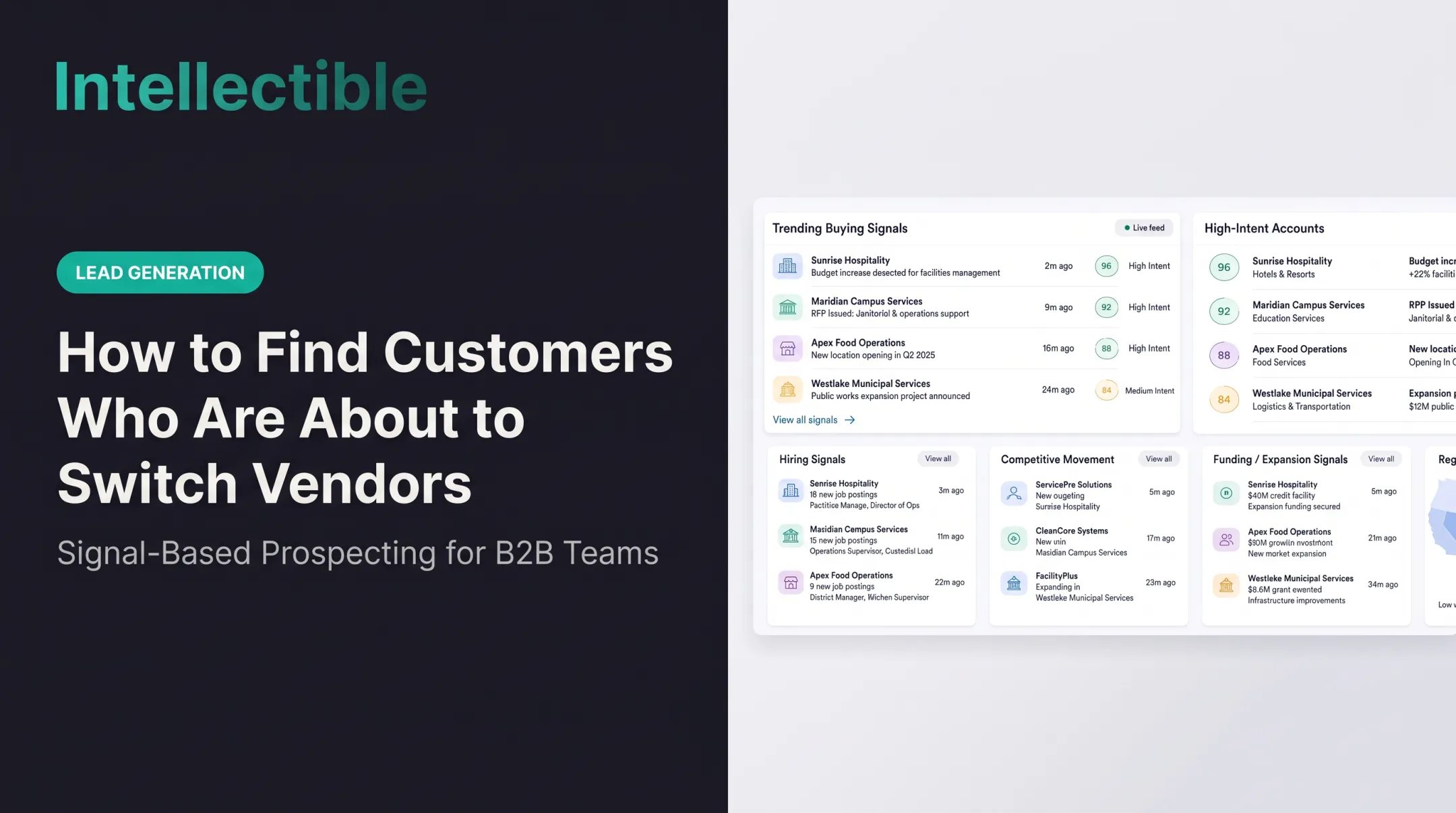
The difficulty is not finding postings. It is separating expansion from churn, continuously, across thousands of manufacturers rather than the ten a rep can watch. Most listings are backfill, evergreen reposts, or staffing-agency duplicates of the same role, and a territory of that size produces more noise than any team can read by hand.
This guide covers where hiring data comes from, how to tell a growth signal from routine turnover, and how to turn the whole thing into a monitored process rather than a list someone rebuilds each quarter.
Key Takeaways
- Hiring volume and role mix are a capacity signal: who is adding shifts, lines, or plants, and roughly when
- Most postings are backfill or duplicates; the filtering rules matter more than the source
- Role type tells you more than headcount — a controls engineer and a packer imply very different spend
- Run it as a monitored feed against your whole territory, not a quarterly list refresh
How to Find Manufacturers that Are Hiring
Four sources carry the signal, each with a different trade-off:
- Company career pages. The most reliable and the least convenient. Postings are first-party, rarely duplicated, and usually dated. Covering a territory means crawling or monitoring several thousand sites.
- Job aggregators. Broad coverage in one place, at the cost of heavy duplication. The same role appears from the employer, two staffing agencies, and a syndication partner.
- State and regional workforce boards. Thinner coverage, but often carry postings that never reach national aggregators, and they are organized by geography, which suits a territory model.
- Staffing-agency listings. Useful as a leading indicator. Agencies are engaged before a direct posting appears, though the employer is frequently anonymised.

Match the source to the question. If you want to know which plants in a region are expanding, workforce boards and career pages beat aggregators. If you want national coverage of a specific job title, aggregators win.
When Hiring Signals Are Useful—And What You Need First
Hiring is a useful signal when the thing you sell scales with headcount, throughput, or a new line: equipment, automation, MRO supply, staffing, safety, logistics, insurance, or facilities work. It is a weak signal when your product is tied to a compliance date or a contract renewal, because those have their own clocks.
Before running this at scale you need three things settled:
- A defined territory list. Which manufacturers you care about, matched to a firmographic source so postings can be attached to an account rather than a company name string.
- A role taxonomy. Which titles count as expansion, which are routine backfill, and which are irrelevant to you.
- A deduplication rule. How you collapse the same role posted by the employer and three agencies into one event.
Without the first, you get postings you cannot action. Without the second and third, volume becomes meaningless.
Key Variables, Common Mistakes, and Troubleshooting

Reposts read as new demand. The same requisition reappears every thirty days. Track a first-seen date per requisition and treat later appearances as the same event.
Agency duplicates inflate the count. One opening advertised by three agencies looks like three. Match on role, location, and posting window before you count.
Headcount is mistaken for spend. Twenty warehouse pickers and one controls engineer are different signals. Weight by role, not volume.
Corporate postings are attributed to the wrong site. A posting listed at headquarters may be for a plant three states away. Resolve to the facility, not the parent.
Evergreen listings never close. Some manufacturers run permanent postings for high-turnover roles. These say nothing about expansion. Flag them once and exclude them.
Alternatives to Tracking Job Postings
Job postings tell you a manufacturer is adding people. They do not tell you why. Pair them with:
- Building permits and certificates of occupancy for physical expansion
- UCC filings for recently financed equipment
- Customs manifest data for changes in import volume
- WARN notices as the inverse signal, so you are not prospecting into a contraction
A hiring spike alongside a permit filing is a far stronger case than either alone.

Conclusion
Finding manufacturers that are hiring is straightforward once. Keeping it true across a whole territory is the actual problem, and it is a process problem rather than a research one.
Make it repeatable: define the territory and role taxonomy once, attach every posting to an account, deduplicate on first-seen date, and weight by role rather than headcount. Then monitor it continuously, so a new shift at a plant surfaces the week it is posted rather than in next quarter's list. A one-time export is stale within a month. A monitored feed, reviewed on a set cadence and scored against the same rules each time, is what turns hiring data into a pipeline your team can work.
Frequently Asked Questions
How do I find manufacturers that are hiring across a whole territory?
Combine company career pages, job aggregators, and state workforce boards, then match every posting back to an account in your territory list. Coverage comes from using more than one source; usefulness comes from attaching postings to accounts rather than reading them as a feed.
How do I tell expansion from routine backfill?
Look at role mix and persistence. A cluster of new roles across functions, or a first-time role such as a controls engineer or shift supervisor, suggests added capacity. A single recurring operator posting usually means turnover.
Why do the same openings appear multiple times?
Employers and staffing agencies post the same requisition, and aggregators syndicate it further. Deduplicate on role, location, and posting window, and track a first-seen date so reposts do not register as new demand.
Does a high posting count mean a bigger opportunity?
Not reliably. Weight by role type and the spend it implies. One automation engineer can indicate a larger budget than twenty seasonal pickers.
How often should this be refreshed?
Continuously rather than periodically. Hiring signals decay quickly; a posting is most useful in the weeks it is live. A monitored process surfaces changes as they happen, which is the difference between this and a purchased list.
What should this be paired with?
Permit data, UCC filings, and import records. Hiring says a manufacturer is adding people; those sources help explain why, and together they make a far stronger reason to reach out.