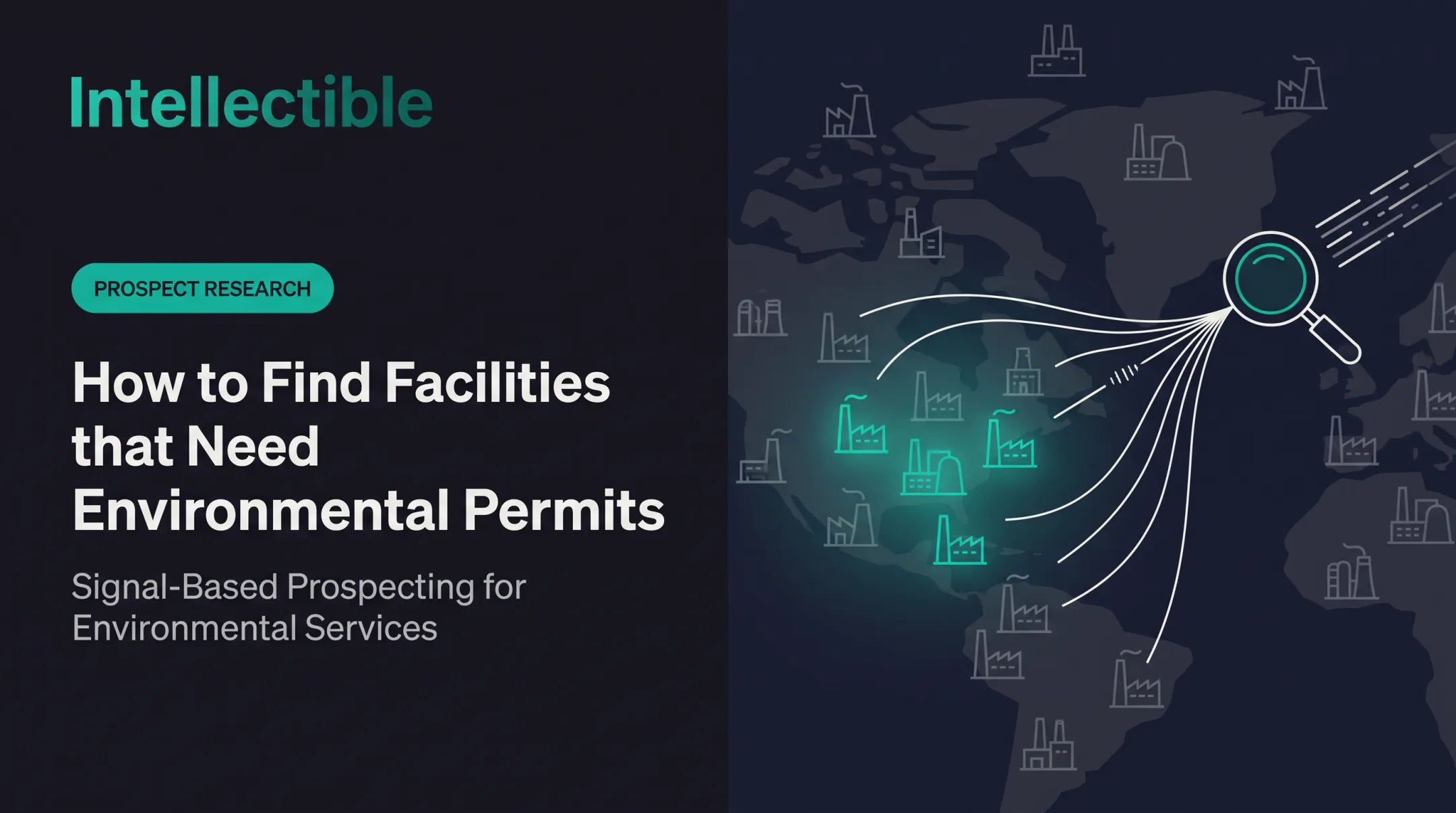
The challenge is that an "EPA record" can mean a lot of different things. An inspection isn't a violation. An alleged violation isn't a conviction. A settlement from eight years ago isn't evidence of what's happening at a facility today. Pulling up a database entry without understanding its status can lead to flawed conclusions, and on a sales call that means opening with a problem the facility fixed years ago.
Doing that for one company is a lookup. Doing it across thousands of facilities in a territory, without turning a resolved notice from 2018 into a cold-call talking point, takes rules. This guide covers where the official records live, how to search by company and facility identifiers, how to read what you find, and how to document it responsibly. Everything here points to public, government-maintained sources rather than third-party summaries.
Key Takeaways
- Start with EPA's ECHO database, then cross-check findings against state environmental agency records.
- Search facilities and legal entities separately — companies often operate under multiple names or subsidiaries.
- Evaluate violation type, status, date, and resolution instead of trusting a single search-result label.
- Treat every record as a time-stamped snapshot, not a final verdict on current compliance.
Where to Find EPA Violation Records
Most searches should begin with the Enforcement and Compliance History Online (ECHO) system. It's a free public tool from EPA's Office of Enforcement and Compliance Assurance. According to the EPA's ECHO FAQ, it covers compliance and enforcement data for more than one million regulated facilities.
ECHO pulls together facility profiles, inspection history, violations, enforcement actions, and assessed penalties across air, water, hazardous waste, and drinking water programs.
Start your search at the ECHO facility search or the ECHO enforcement case search, depending on whether you're looking for a site or a legal case.
When to Use Envirofacts and Program-Specific Databases
ECHO is the best starting point, but it's not the only resource. Depending on what you're researching, these databases go deeper:
- Envirofacts: multisystem search across facilities, pollutants, and permits
- ICIS-Air: stationary source air compliance and operating permits
- ICIS-NPDES: water discharge permits, monitoring data, and enforcement
- RCRAInfo: hazardous waste handler records and cleanup activity
- TSCA enforcement: now folded into ECHO's case search rather than a standalone Envirofacts tool
Why State Agencies Matter
Many environmental programs are federally authorized but state-administered. Under the Clean Water Act, for example, EPA authorizes states to run NPDES permitting and enforcement, with EPA retaining oversight. That means some inspection records exist only at the state level and never make it into the national database.
Texas's TCEQ Compliance History Database is one example of a state tool worth checking alongside ECHO. If your target company operates in a specific state, search that state's environmental agency site directly. Don't assume a federal search captures everything.
Records rarely use a company's consumer-facing brand name. You're more likely to find a facility address, EPA ID number, permit number, or an owner/operator entity instead.
Step-by-Step: How to Search for a Company
Finding the right record takes more than typing a company name into one search box. Here's a repeatable process.
- Gather every name variant. Legal name, trade name, former name (post-acquisition or rebrand), and any known subsidiary or facility names. Searching only one spelling is the most common way to miss relevant results.
- Narrow by location. Use state, city, ZIP code, or street address to separate your target from similarly named businesses elsewhere.
- Apply ECHO's search filters. Facility type, environmental program (Air, Water, Hazardous Waste, Drinking Water), inspection date range, violation status, and enforcement action type are all filterable fields. Document which filters you used so the search can be reproduced later.
- Cross-reference identifiers. Check the company's permit documents, public filings, and state records for its EPA Registry ID (FRS ID), NPDES ID, or RCRA Handler ID. These identifiers connect a facility record to the correct legal entity far more reliably than a name match.
- Open the underlying document. Don't stop at a database summary line. Pull the actual facility profile, Notice of Violation, or enforcement case file, and record the case number, publication date, and source URL.

Turning This Into a Repeatable Workflow
Once this lookup runs across every facility in a territory, every month, doing it manually in a spreadsheet stops working fast. Platforms like Intellectible are built to organize that recurring, multi-step research.
Instead of re-running the same ECHO and state-agency checks by hand each time, build a workflow with connected nodes:
- A database query pulls the company's known identifiers
- An API request checks ECHO or a state portal
- A human review step confirms the match
- The result, with source links attached, is written into a PostgreSQL record for audit
It doesn't replace reading the underlying document yourself. It keeps the search process consistent and traceable across a team.
How to Interpret and Verify the Results
A single word in a database ("violation," "inspection," or "enforcement") can mean very different things depending on where it sits in the process.
| Term | What it actually means |
|---|---|
| Inspection | A site visit or records review to check compliance; not itself a finding of wrongdoing |
| Alleged/potential violation | Flagged by inspection or self-report, without final adjudication |
| Notice of Violation (NOV) | States EPA's belief a violation occurred; explicitly not a final determination |
| Administrative order | Nonjudicial directive to comply or clean up, with or without a penalty |
| Civil judicial action | A formal lawsuit, typically filed by the Department of Justice on EPA's behalf |
| Settlement / consent decree | Agreed resolution, either administrative or filed in court |
| Civil penalty | A monetary assessment tied to confirmed noncompliance |
EPA is explicit that a Notice of Violation "does not constitute a final agency determination," according to EPA's NOV guidance. That distinction matters before a rep references the record in outreach.
Checking Dates, Ownership, and Resolution
Before drawing any conclusion, verify:
- Who's actually named. Is it the company itself, a previous owner, a parent company, or a contractor? Ownership changes can make old records misleading.
- The timeline. Compare the event, filing, and resolution dates. Coverage windows differ: ECHO facility searches (about five years), Detailed Facility Reports (up to ten), and compliance-history views (often three), so "no recent violations" depends on which view you use.
- Whether it's resolved. "No Violation Identified" for an air facility means no new high-priority violation showed up in that monitoring window, not full compliance with every rule.
Records refresh on a lag, sometimes a week to three months, so a very recent enforcement action might not appear yet. When in doubt, go back to the original enforcement document rather than inferring beyond what it states.

How to Use the Findings Responsibly
Finding a record is only half the job. How you summarize and act on it matters just as much.
Describe findings neutrally. Name the facility, the source agency, the record type, the date, and the resolution status. Avoid shorthand like "this company is noncompliant" when the record shows a single resolved NOV from several years ago.
Build a consistent qualification policy. Define these rules upfront, before any record reaches a rep:
- A lookback period (for example, five years)
- Materiality thresholds (which violation types make an account worth calling)
- Required legal or compliance review before a record is referenced in outreach
EPA itself describes its Corporate Compliance Screener as a tool for initial screening across multiple facilities — not a final determination of liability, according to the Corporate Compliance Screener FAQ. It also has no automatic corporate-family linkage, so you have to manually confirm which subsidiaries or facilities actually belong to the parent company you're reviewing.
Don't overreach from one data point. A single facility's history shouldn't stand in for an entire parent company's operations. A database entry alone shouldn't be the basis for a message that tells a prospect they are noncompliant.
Keep an audit trail. Record your search date, the exact terms and filters used, source links, and your rationale for any conclusion. If a prospect ever asks where your information came from, this record shows it was drawn from the official source documents.
Conclusion
EPA enforcement data rewards precision over volume. An inspection is not a violation, an alleged violation is not a finding, and a settlement from eight years ago says little about the facility today. Every rule in this guide exists to keep those distinctions intact once the record count runs into the thousands.
The part that decides whether this is worth doing at all is cadence. Enforcement records change state continuously: cases open, facilities return to compliance, penalties are agreed. A list pulled once is wrong within weeks. Run as a monitored process, the sources are re-queried on a schedule, status changes surface against the accounts already in the CRM, and the team reviews only what moved since the last pass. That is the difference between a dataset the sales team trusts and a spreadsheet nobody opens twice.

Frequently Asked Questions
Which companies with EPA violations are worth calling first?
Open cases with an administrative order or compliance schedule, at facilities whose violation type matches what you sell. A resolved notice from several years ago rarely creates a buying window; an open order with a deadline usually does.
What is the most commonly cited violation of environmental regulations?
It varies by industry and program. Hazardous-waste handling, permit or reporting failures, air emissions, and water discharge violations all show up regularly in enforcement data. Check current ECHO records for the specific industry you're researching rather than relying on a generic ranking.
How often should EPA enforcement data be re-checked?
Monthly at minimum for an active territory. ECHO refreshes on a lag of a week to three months, and case status changes as facilities return to compliance, so re-query on a schedule and work only the records that changed.
How can I find out if a company has an EPA violation?
Search EPA's ECHO database and Envirofacts, then check the relevant state environmental agency site. Use the company's legal name, facility address, permit number, and EPA facility ID to narrow your results.
Are EPA violations public record?
Most inspections, enforcement actions, settlements, and penalties are publicly accessible. However, the level of detail and how quickly records are updated varies by program and by state.
Does an EPA violation mean a company is currently breaking the law?
Not necessarily. Records can be historical, alleged, resolved, or still open. Always check the record's status, dates, and any corrective action before assuming ongoing noncompliance.