This guide is written for proposal managers, BD teams, pricing leads, and revenue operations professionals at government contracting firms. It covers what the digital RFP process actually is, how it works step by step, where it happens, what drives outcomes, and where contractors consistently fail.
Key Takeaways
- Government RFPs are issued through regulated federal portals — SAM.gov, GSA eBuy, PIEE — not email; active registration is a prerequisite to bid
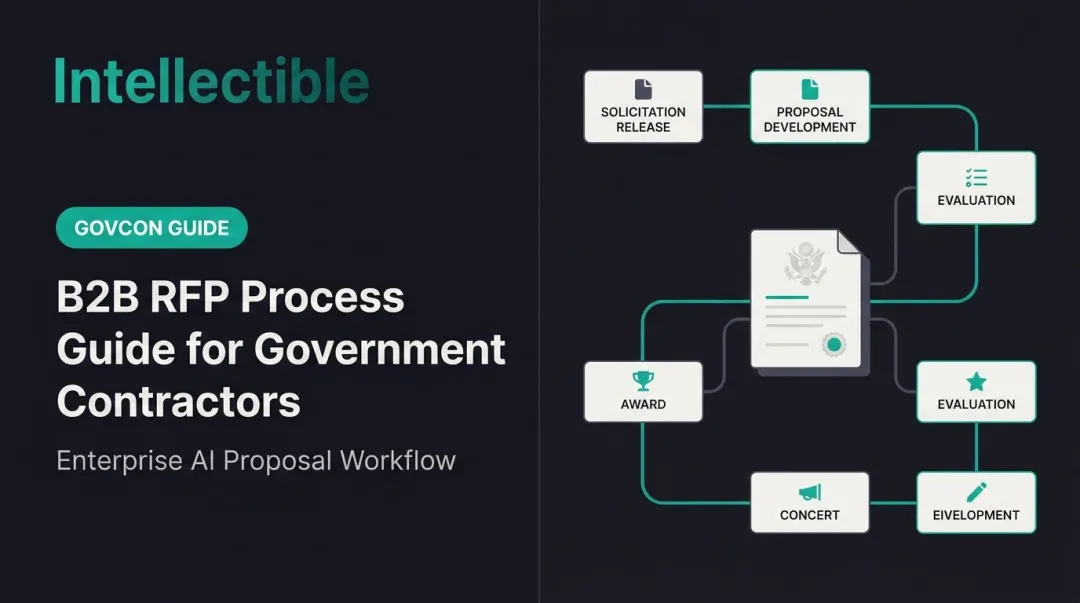
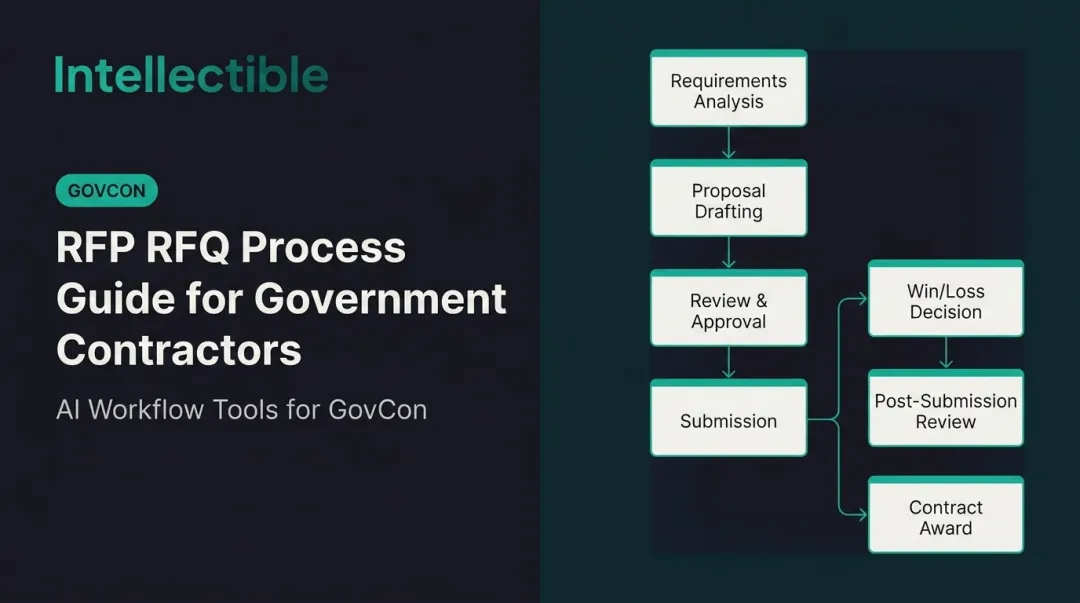
- The process follows a defined sequence: opportunity identification → Go/No-Go → proposal preparation → portal submission → post-submission tracking
- FAR and DFARS govern every requirement; missing a mandatory form or certification renders a proposal technically unacceptable before scoring begins
- Pricing submissions on larger contracts must include detailed cost breakdowns, and certified cost or pricing data requirements apply above $2.5 million
- Contractors who automate opportunity tracking and Go/No-Go qualification pursue more winnable bids and burn fewer resources on low-probability competitions
What Is Digital RFP Bidding for Government Contractors?
FAR 15.203(a) defines an RFP as the mechanism through which the government communicates requirements to prospective contractors and solicits competitive proposals. FAR 15.203(c) permits electronic commerce to issue those RFPs and receive proposals, modifications, and revisions.
A "digital RFP" is simply the electronically issued version of this regulated solicitation — managed through a designated online platform rather than paper exchange.
How It Differs from Commercial RFPs
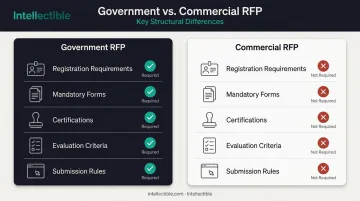
Government RFPs are not business documents. They are legal instruments governed by the Federal Acquisition Regulation (FAR) and, for defense contracts, DFARS. The differences are substantive:
- Registration requirements — Active SAM.gov entity registration is legally required before submitting any offer or receiving an award (FAR 52.204-7)
- Mandatory forms — Standard forms like SF-33 and SF-1449 are required; there is no commercial equivalent
- Certifications — Small business status, CAGE codes, and past performance records must be on file
- Evaluation criteria — Evaluation factors and their relative importance must be disclosed per FAR 15.304
- Submission rules — FAR 15.208 makes the solicitation-designated submission method controlling; unauthorized delivery methods do not count
What a Government Digital RFP Contains
Once you understand what makes government RFPs legally distinct, knowing what's actually inside them helps you bid more effectively. A typical solicitation includes:
- Statement of Work (SOW) or Performance Work Statement (PWS) defining the scope
- Contract Line Item Numbers (CLINs) structuring the pricing
- Evaluation factors and their relative importance (technical approach, past performance, price)
- Submission instructions specifying portal, file format, naming conventions, and volume structure
- Q&A period with public posting of all government responses
How the Government Digital RFP Process Works: Step by Step
The process is sequential and deadline-driven. Each stage builds on the last, and missing a step — or a deadline — typically means disqualification with no recourse.
Step 1: Opportunity Identification and Monitoring
Federal opportunities are published on SAM.gov, the central governmentwide source for contract notices. Contractors use NAICS codes, PSC codes, and set-aside categories (8(a), SDVOSB, HUBZone, WOSB) to filter relevant solicitations from the volume of active postings.
Manual monitoring works at low pipeline volumes. At scale, it breaks down. Intellectible's platform addresses this by automatically pulling federal notices and converting each into a structured capture record with agency details, NAICS and PSC codes, timing, scope, and fit rationale — reporting a 150%+ increase in actionable opportunities surfaced for users compared to manual search.
Step 2: Go/No-Go Qualification
Before committing proposal resources, contractors must evaluate whether a bid is actually worth pursuing. The factors that matter:
- Capability alignment — Does your past performance match what's required?
- Competitive positioning — Are you the incumbent? Do you have teaming strength?
- Eligibility — Can you meet set-aside requirements and certification conditions?
- Timeline feasibility — Can your team respond within the solicitation window?
Many contractors skip this discipline and respond to everything they can access. The result is proposal resources spread across low-probability bids and teams burned out on non-competitive submissions.
Intellectible's Proposal & Pursuit Engine automates this step by generating structured Go/No-Go reports from uploaded solicitation documents — scoring fit, urgency, risk, contract terms, and capability match, and capturing the win thesis — including an opportunity snapshot, key reasons to pursue or avoid, identified data gaps, and next-step recommendations.
For Oceus, a defense contractor, this approach more than doubled the qualified opportunities reviewed monthly, reaching roughly seven to eight opportunities clearing their qualification threshold each month.
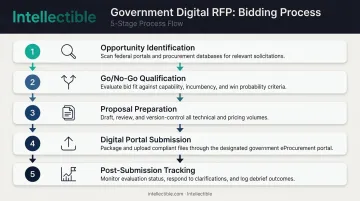
Step 3: Proposal Preparation
Government proposals are typically organized into distinct volumes, each with specific page limits, formatting rules, and required attachments:
- Technical/Management — approach, staffing, and execution methodology
- Past Performance — relevant contracts, outcomes, and references
- Price/Cost — detailed cost buildup, rates, and basis of estimate
FAR 15.203 requires each RFP to state what information proposals must contain; volume structure varies by solicitation.
FAR 15.203(c) requires at least 30 days from solicitation issuance for noncommercial actions above the simplified acquisition threshold — that's the regulatory minimum, not a comfortable window. Proposal teams must coordinate across subject matter experts (SMEs), pricing analysts, legal, and subcontractors within that timeline.
Intellectible's Proposal & Pursuit Engine handles this coordination through a four-stage workflow (Upload → Compliance → Variables → Draft), with requirements mapped to owners, deadlines, status, and evidence paths — tracking coverage gaps continuously rather than catching them at review.
Step 4: Digital Submission Through the Designated Portal
FAR 15.208 is unambiguous: the solicitation-designated submission method is controlling. Each RFP specifies its system and its rules. Common submission platforms include:
| Portal | Primary Use |
|---|---|
| SAM.gov | Opportunity discovery and contractor registration |
| GSA eBuy | Task order competitions under GSA Schedule and GWACs |
| PIEE (Procurement Integrated Enterprise Environment) | DoD solicitations and award management |
| DoD SAFE | Secure large-file exchange for DoD submissions |
| Agency portals (NIH eCPS, DHS APFS) | Agency-specific submissions |
PIEE-specific technical constraints include a 1.9 GB per-attachment limit, enumerated file formats (PDF, DOCX, XLSX, PPTX, TXT, XML, ZIP), and prohibited filename characters including apostrophes, ampersands, and angle brackets. These are PIEE-specific — other portals have their own rules.
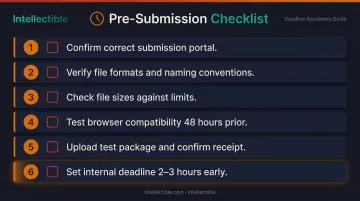
Run this pre-submission checklist before every deadline:
- Confirm the exact submission portal listed in the solicitation — not the discovery portal
- Verify file formats, naming conventions, and volume folder structure
- Check file sizes against the portal's attachment limits
- Test browser compatibility with the portal at least 48 hours before deadline
- Upload a test package and confirm receipt notification before the live submission
- Set a hard internal deadline 2–3 hours before the published close time
Step 5: Post-Submission Tracking and Debriefs
After submission, monitor the portal for evaluation notices, clarification requests (Evaluation Notices), and award announcements.
When award decisions are issued, contractors have the right to request a debrief — and most don't use it. Under FAR 15.505 and 15.506:
- Preaward debriefings must be requested in writing within 3 days of exclusion notice
- Postaward debriefings must be requested within 3 days of award notification; agencies should conduct them within 5 days of a timely request
- Required disclosures include significant weaknesses or deficiencies, evaluated prices, overall rankings when developed, and award rationale
Most contractors skip debriefs after a loss and move on. That's a missed opportunity: debriefs reveal evaluator scoring, specific deficiencies, and competitive pricing data you can't get anywhere else. Requesting one after every award decision — won or lost — is how capture teams close the gap between submissions.
Key Portals and Bid Systems
Understanding which portal governs which type of acquisition prevents a common and costly mistake of submitting through the wrong system.
Federal platforms:
- SAM.gov — The central federal system for entity registration and opportunity discovery. Every contractor pursuing federal work must be registered here. SAM.gov is not universally the proposal submission portal; that role belongs to whichever system the individual solicitation designates.
- GSA eBuy — GSA's acquisition tool for issuing and responding to RFQs, RFPs, and RFIs under GSA Schedule and GWAC vehicles. Eligible contractors respond electronically through this system.
- PIEE — The DoD-specific system for posting solicitations, attachments, and securely receiving industry responses. The primary platform for defense contracting submissions.
- NASA SEWP — A Government-Wide Acquisition Contract for federal IT, communications, and audiovisual products and services.
- NIH eCPS — Secure electronic submission and tracking for NIH and health-agency contract proposals.
- DHS APFS — A forecast portal for anticipated DHS contract actions over $350,000; it's a discovery and forecasting tool, not a proposal submission system.
State and local systems operate entirely separately. Each state maintains its own eProcurement portal, and contractors pursuing state-level work must register and monitor these independently from federal SAM.gov activity.
SAM.gov Registration: What You Need to Know
Three registration facts every contractor must know:
- Renewal cadence: Registration expires every 365 days and must be renewed to stay active
- Processing time: Renewals can take up to 10 business days — don't wait until the deadline
- FAR 52.204-7 requirement: Active registration is required at the time of offer submission and at award
A lapsed registration is a disqualifying event. In TLS Joint Venture, B-422275 (April 1, 2024), GAO sustained a protest after the awardee's registration lapsed for a single day. Set a calendar alert 60 days before your annual renewal date.
Critical Factors That Determine Your Digital Bid Outcome
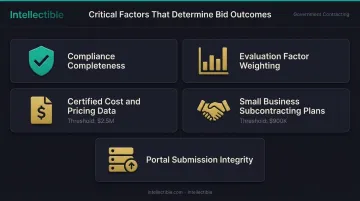
Missing a required section, form, or certification can render a proposal technically unacceptable before scoring even starts. Evaluators run compliance checks first — Intellectible's platform maps every RFP requirement to a proposal section and flags gaps before they become disqualifying omissions.
Per FAR 15.304, solicitations must disclose evaluation factors and their relative importance. Proposals that over-invest in low-weight areas and under-develop high-weight ones consistently lose — mirror the stated weighting, not your internal priorities.
Certified cost or pricing data requirements kick in above $2.5 million when no exception applies. Cost-reimbursable contracts need fully built-up pricing with supporting rationale; fixed-price competitions require competitive market analysis. Intellectible's platform maintains a full audit trail — every assumption, rate, and approval documented — while keeping internal margins separate from the customer-facing document.
FAR 19.702 requires small business subcontracting plans in negotiated acquisitions above $900,000 (or $2 million for construction) when the apparent awardee is other than small — failure to negotiate an acceptable plan makes an offeror ineligible. Identify teaming partners before the RFP drops; reactive conversations rarely close in time.
File format errors, corrupted attachments, wrong folder submissions, and portal outages on deadline day are recurring failure points. Run a full pre-submission checklist every time — treat it as required procedure, not an optional step.
Common Mistakes in Government Digital Bidding
Treating it like a commercial proposal. Government solicitations have mandatory forms, prescribed volume structures, legal certifications, and evaluation criteria — none of which are optional. Treating any of them as flexible is one of the most direct paths to technical non-compliance.
Responding to everything. Spreading proposal resources across every accessible opportunity dilutes win rates and burns proposal teams. Go/No-Go qualification — assessing past performance alignment, competitive positioning, teaming strength, and timeline feasibility — is what separates contractors who win consistently from those who stay busy but don't grow.
Confusing a sources sought with an RFP. FAR 15.201(e) clarifies that an RFI does not constitute a solicitation, and responses cannot form a binding contract. A sources sought notice is market research, not a proposal opportunity. Responding to one as though it were an RFP wastes resources.
More damaging: waiting for a formal solicitation before starting teaming conversations misses the window when teaming decisions actually get made.
Underestimating portal deadlines. This point deserves direct treatment. Three GAO decisions illustrate the stakes:
- In ICS Nett (B-422575, July 24, 2024), a PIEE submission completed at 5:02:18 p.m. for a 5:00 p.m. deadline — after the offeror began the upload process at 4:58 p.m. — was rejected as late. Protest denied.
- In NAG Marine (B-422899, December 12, 2024), DoD SAFE recorded the first file after a 3:00 p.m. deadline. The full proposal arrived at 3:14:06 p.m. Protest denied.
- In People, Technology and Processes (B-419385, February 2, 2021), a GSA ASSIST upload was not completed, and an unauthorized fallback email arrived after deadline. Protest denied.
The pattern is consistent: portal access and upload initiation do not excuse untimeliness unless a qualifying government-system failure can be documented. Plan your submission window to be complete — not just started — before the deadline.
Frequently Asked Questions
What is a digital RFP?
A digital RFP is an electronically issued solicitation managed through an online portal rather than paper or email. In government contracting, these are published through regulated portals like SAM.gov and governed by FAR compliance requirements, mandatory forms, and structured evaluation criteria that commercial procurement does not require.
How does Responsive (formerly RFPIO) compare for government bidding?
Responsive (RFPIO) is strong at response management — content libraries, question assignment, answer reuse, and document generation — and it is widely used for commercial RFPs and security questionnaires. What federal bidding adds on top is FAR-governed responsiveness: Section L and M requirement extraction, a compliance matrix that survives amendments, past-performance retrieval, and pricing approvals with an audit record. Intellectible is built around those pursuit-governance steps, so the practical comparison is response management alone versus capture, compliance, pricing, and approvals in one system.
What should I test when evaluating Responsive, Loopio, or Intellectible?
Run one live solicitation through each shortlisted platform and compare what it produces. Does the compliance matrix hold after an amendment lands? Does drafted text cite a traceable source? Does review routing match your actual approval chain, including pricing sign-off? Responsive and Loopio were built for high-volume questionnaire response; Intellectible is built for FAR-governed pursuits. Feature lists rarely separate the two — a live test does.
How is a government RFP different from a commercial RFP?
Government RFPs are legally governed by FAR/DFARS, require active SAM.gov registration, mandate specific forms and certifications, follow prescribed evaluation criteria, and must be submitted through regulated digital portals. Commercial RFPs have none of these legal requirements and can typically be submitted by email or document-sharing tools.
What is SAM.gov and why do government contractors need it?
SAM.gov is the federal government's central portal for contractor registration and opportunity discovery. Active SAM.gov registration is a legal prerequisite for receiving any federal contract award — lapsed registration disqualifies bids regardless of proposal quality, and registration can take up to 10 business days to process, so timing matters.
What is a Go/No-Go decision in government contracting?
A Go/No-Go is a structured internal evaluation conducted before committing resources to a bid, assessing capability fit, competitive positioning, teaming needs, and timeline feasibility. Platforms like Intellectible automate this step by generating Go/No-Go reports directly from solicitation documents, cutting manual review time considerably.