Introduction
Federal contracting is a $793 billion market — and winning a piece of it requires more than a well-written document. According to GAO's FY2025 snapshot, federal contract obligations hit $793 billion in FY2025, yet Deltek's 2026 survey of 900+ government contractors shows an industry-average win rate of just 48% — with top performers reaching 72%.
That 24-point gap between average and top-performing contractors comes down to process — specifically, whether your pursuit team has a repeatable, structured approach to building compliant, scoreable proposals.
Generic proposal advice won't close that gap. Government bid proposals must comply with the Federal Acquisition Regulation (FAR), address formally structured evaluation volumes, and be engineered to score points against stated criteria — not just read well.
This guide gives pursuit teams a practical foundation: how the GovCon bidding process works, what a compliant proposal must contain, and the writing and structure strategies that move win rates toward the top-performer benchmark.
Key Takeaways
- GovCon bid proposals are compliance documents first — FAR requirements and evaluation factors dictate structure, not sales instincts
- The Go/No-Go decision is the highest-leverage moment in any pursuit; skipping it wastes resources on unwinnable bids
- Your proposal structure should mirror the RFP's evaluation factors — not follow a generic template
- Past performance and pricing are the two most scrutinized volumes — both require dedicated processes built before writing begins
What Makes a GovCon Bid Proposal Different from a Commercial Proposal
Regulatory Compliance Is Non-Negotiable
Commercial proposals can be flexible. Government bid proposals cannot. Every federal proposal must comply with the Federal Acquisition Regulation (FAR), and for Department of Defense contracts, the Defense Federal Acquisition Regulation Supplement (DFARS) as well.
This means specific formatting rules, certification obligations, and submission requirements that can disqualify a bid before a single evaluator reads a word of the technical content — regardless of how strong that content is.
Three Solicitation Types, Three Different Responses
Government solicitations take three distinct forms, each requiring a different approach:
| Type | Governing Rule | What You Submit |
|---|---|---|
| RFP (Request for Proposal) | FAR 15.203 | Full technical, management, past performance, and price volumes evaluated on multiple factors |
| RFQ (Request for Quote) | FAR 13.004 | Primarily pricing and capability statements; the government's purchase order is the offer |
| IFB (Invitation for Bid) | FAR 14.101 | Sealed bid awarded to the lowest-priced technically acceptable offeror — no discussions, no negotiation |
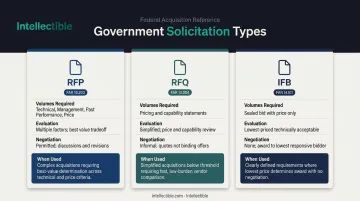
Responding to an IFB with an RFP-style narrative wastes effort. Responding to an RFP with a quote-level capability statement loses.
Evaluation Is Governed by Publicly Stated Criteria
This is the most important structural difference: the government must disclose how it will evaluate proposals under FAR 15.304. Evaluation methods include:
- Best Value Trade-Off (FAR 15.101-1) — Award may go to other than the lowest price when quality justifies it
- Lowest Price Technically Acceptable (LPTA) (FAR 15.101-2) — Lowest price among technically acceptable proposals wins; no quality tradeoffs
- Adjectival ratings — DoD uses Outstanding/Good/Acceptable ratings rather than numerical scores
Winning proposals are engineered to score the highest against the stated criteria — not simply the ones that read the best.
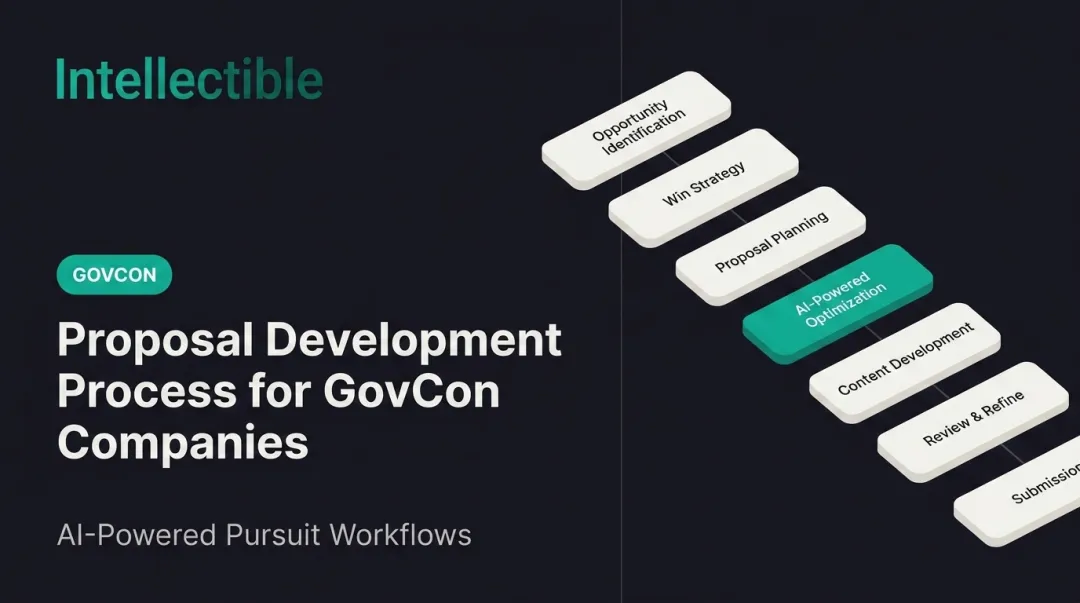
The 5 Steps of the GovCon Bidding Process
Step 1: Identify and Monitor Opportunities
Federal opportunity tracking starts with SAM.gov, the government's official contract opportunity database (which absorbed FedBizOpps in November 2019). Beyond SAM.gov, active pursuit teams also monitor:
- Agency forecast and acquisition planning sites
- IDIQ task order portals like GSA eBuy and NASA SEWP
- Market intelligence platforms that surface pre-solicitation signals
Before any of this matters, verify your prerequisites: active SAM.gov registration, correct NAICS codes, and any applicable set-aside certifications (8(a) per FAR Subpart 19.8, HUBZone per 19.13, SDVOSB per 19.14, WOSB per 19.15). These aren't administrative formalities; they determine which solicitations you're eligible to compete on.
Small businesses captured nearly 28% of FY2025 prime-contract dollars ($179 billion) according to the SBA's FY2025 scorecard, making set-aside eligibility a meaningful competitive advantage worth maintaining carefully.
Step 2: Make a Go/No-Go Decision
The Go/No-Go decision is where pursuit resources are either protected or wasted. Before committing any proposal writing time, evaluate:
- NAICS and certification alignment — Are you eligible to compete?
- Incumbent status — Is there a deeply entrenched incumbent? What's the competitive landscape?
- Past performance match — Do you have relevant contracts that mirror the scope and dollar value?
- Available capacity — Do you have the proposal team bandwidth and subject matter experts?
- Probability of win (Pwin) — Based on your honest assessment, is this winnable?
Most GovCon companies lose significant budget by skipping this filter entirely. Deltek's 2026 GovCon research shows that top performers — those reaching 72% win rates — are markedly more selective than the 48% industry average.
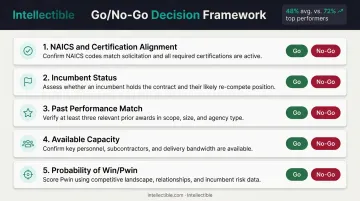
Platforms like Intellectible automate this triage layer. The Proposal & Pursuit Engine converts every federal notice into a structured capture record with fit rationale, risk signals, competitive intelligence, and a scored Go/No-Go report — covering fit, urgency, risk, contract terms, and capability match, and capturing the win thesis — including incumbent identification and bidder density analysis. It processes over 3,200 opportunities per 24-hour period, delivering 95%+ time savings on the Go/No-Go workflow.
Oceus, a defense contractor, doubled its qualified monthly opportunity volume after deploying the platform — a direct result of filtering faster and more consistently.
Step 3: Analyze the Solicitation Thoroughly
Once you've decided to pursue, read the full solicitation package before writing a single word. This includes:
- The RFP or solicitation document
- Statement of Work (SOW) or Performance Work Statement (PWS)
- Section L (instructions to offerors) and Section M (evaluation factors)
- Contract Data Requirements Lists (CDRLs)
- All issued amendments
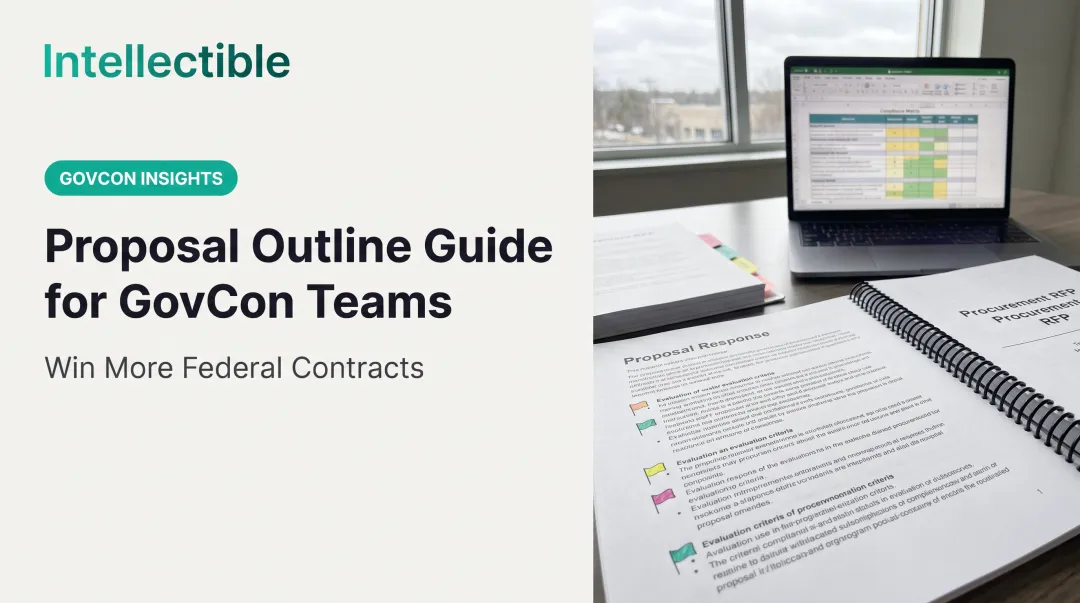
From this, build a compliance matrix — a table mapping every Section L instruction and Section M evaluation criterion to the corresponding proposal section. This is the single most effective tool for ensuring nothing is missed and no requirement is misaddressed.
Step 4: Write and Assemble the Proposal Volumes
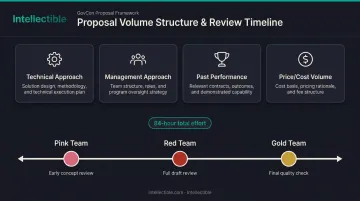
Competitive government proposals are organized into distinct volumes, each addressing different evaluation dimensions:
- Technical Approach — How you'll fulfill the SOW/PWS, task by task
- Management Approach — How you'll staff, lead, and quality-control the work
- Past Performance — Recent, relevant contracts that demonstrate capability
- Price/Cost Volume — A fully transparent, auditable pricing build
Write each volume to address Section M criteria directly — using the government's own language from the solicitation. A useful technique: annotate each paragraph during drafting with the evaluation factor it addresses, then confirm nothing is unsubstantiated before review.
The industry-standard review cycle consists of three milestones:
- Pink Team — Early concept review before full drafting begins
- Red Team — Critical review of the full draft against the solicitation
- Gold Team — Final quality check before submission
Deltek reports that a single RFP response can take up to 84 hours from estimate through submission. Build all three review milestones into your schedule from day one, with buffer time allocated before each. Teams that treat review as optional rarely win.
Step 5: Submit, Track, and Debrief
Submission requirements are strict. Under FAR 15.208, proposals may use any transmission method the solicitation authorizes — SAM.gov, DoD SAFE, or agency-specific portals — but late submissions are generally excluded with only narrow exceptions.
After award decisions:
- Request a debriefing from the contracting officer — this is your right and one of the most valuable inputs for improving future bids
- File a protest with the GAO if you believe procedural irregularities affected the award decision
FY2025 GAO data shows 1,617 protests filed, a 14% sustain rate, and a 52% effectiveness rate (including corrective actions). Protests are a legitimate tool, but timing is firm: filings must be submitted within 10 days after a required debriefing under 4 CFR 21.2(a)(2).
Essential Components of a Government Bid Proposal
Page limits, font size, and margin requirements specified in the RFP are not suggestions. Exceeding them can trigger automatic disqualification before evaluation begins.
Executive Summary
A 1–2 page overview written after the other volumes are complete. In GovCon, it should:
- Reference the agency's mission directly
- Restate your understanding of the requirement
- Lead with your strongest differentiators: relevant past performance, key personnel, and technical expertise
Technical Approach
Demonstrates how you'll fulfill the SOW or PWS. Effective technical volumes:
- Address each task area with a clear methodology
- Describe deliverables and processes in concrete, measurable terms
- Include graphics that help evaluators visualize the solution
- Substantiate every Section M scored element
Past Performance
Past performance is a standalone evaluated volume — not a paragraph in your company background section. Most federal solicitations require 3–5 recent, relevant contracts that include:
- Contract value and period of performance
- Agency or client name and contracting officer reference
- Scope description that maps to the current requirement
- A relevance statement explaining why this example mirrors the current opportunity's size, scope, and complexity
FAR 15.305 requires evaluators to consider both currency and relevance — and to treat offerors with no relevant history neutrally, not negatively.
If your past performance is thin, pursue subcontracting or teaming arrangements before bidding prime contracts.
Price/Cost Volume
Government pricing must be fully transparent and auditable. The approach differs by contract type:
- Firm-Fixed-Price (FAR 16.202-1): Provide a bottom-line price with a clear basis of estimate; the contractor bears maximum cost risk
- Cost-Reimbursement (FAR 16.301-1): Requires a full cost build-up, with direct labor multiplied by loaded rates covering fringe, overhead, G&A, and fee
Price reasonableness matters in both directions. Under FAR 15.404-1, unrealistically low pricing can trigger concern just as an uncompetitive high price eliminates a bid. Unbalanced pricing must be analyzed and may support rejection when it creates unacceptable risk.
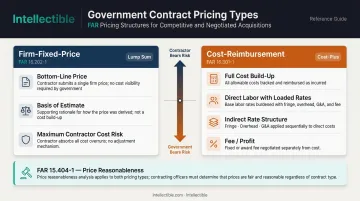
Managing that compliance complexity — across multiple contract types, rate builds, and revision cycles — is where pricing teams lose the most time. Intellectible's platform cuts time to final pricing by 90% through structured, governed workflows with a complete audit trail capturing every data input, assumption, approval, and exception.
Tips for Writing a Winning GovCon Proposal
Compliant proposals get through the door. Competitive proposals win. These four habits separate the two:
- Mirror the government's language — Use the exact terminology, task descriptions, and acronyms from the solicitation. Paraphrasing creates ambiguity, and ambiguity lowers scores.
- Write to the evaluation criteria, not the reader — Every paragraph in your technical and management volumes should tie back to a specific Section M criterion. Annotate paragraphs during drafting to confirm nothing is unsubstantiated.
- Make past performance relevance explicit — Listing a contract isn't enough. For each example, include a relevance statement explaining how prior work maps to the current PWS in scope, complexity, and dollar value. The connection should be obvious, not implied.
- Protect the review schedule — Build Pink/Red/Gold Team milestones into the proposal calendar from day one. The review phase is when proposals go from compliant to competitive.
Common GovCon Proposal Mistakes to Avoid
Bidding Without a Go/No-Go Filter
Spreading pursuit resources too thin produces lower-quality proposals. Top-performing GovCon companies pursue fewer opportunities with higher investment per bid rather than generating high volumes of average responses.
Ignoring Amendments and Q&A Releases
Under FAR 15.206, agencies must issue amendments when requirements or terms change. Proposals written against an outdated solicitation version are frequently non-compliant; GAO decisions confirm that failing to acknowledge a material amendment can make a bid nonresponsive. Check for amendments before every draft and again before submission.
Recycling a Prior Proposal
Evaluators recognize boilerplate immediately. Every proposal must be written from scratch around the specific PWS, the agency's stated priorities, and your unique qualifications for that contract. A lightly edited prior submission isn't a proposal — it's a disqualification risk.
Frequently Asked Questions
What are 5 things all proposals should include?
Government proposals should always include an executive summary, a technical and management approach addressing the PWS task by task, past performance documentation with relevance statements, a compliant pricing volume, and a compliance matrix mapping every Section L requirement to the corresponding response section.
What are the 5 steps in the bidding process?
The five steps are:
- Identify and monitor opportunities on SAM.gov and related sources
- Conduct a structured Go/No-Go decision
- Analyze the solicitation fully and build a compliance matrix
- Write and review proposal volumes through Pink/Red/Gold Team milestones
- Submit on time, request a debrief after award, and apply lessons learned
What is the difference between an RFP, RFQ, and IFB in government contracting?
RFPs (FAR 15.203) require a full technical, management, past performance, and price response across multiple evaluated factors. RFQs (FAR 13.004) focus on pricing and capability under simplified acquisition procedures. IFBs (FAR 14.101) are sealed-bid awards to the lowest-priced technically acceptable offeror — no negotiation involved.
How important is past performance in a government bid proposal?
Past performance is a formally evaluated volume in most federal RFPs under FAR 15.304, and it can be weighted equally to or above technical approach depending on the solicitation. Offerors with no relevant past performance should pursue subcontracting or teaming arrangements before bidding prime contracts to establish a documented record.
What is a compliance matrix and why does it matter?
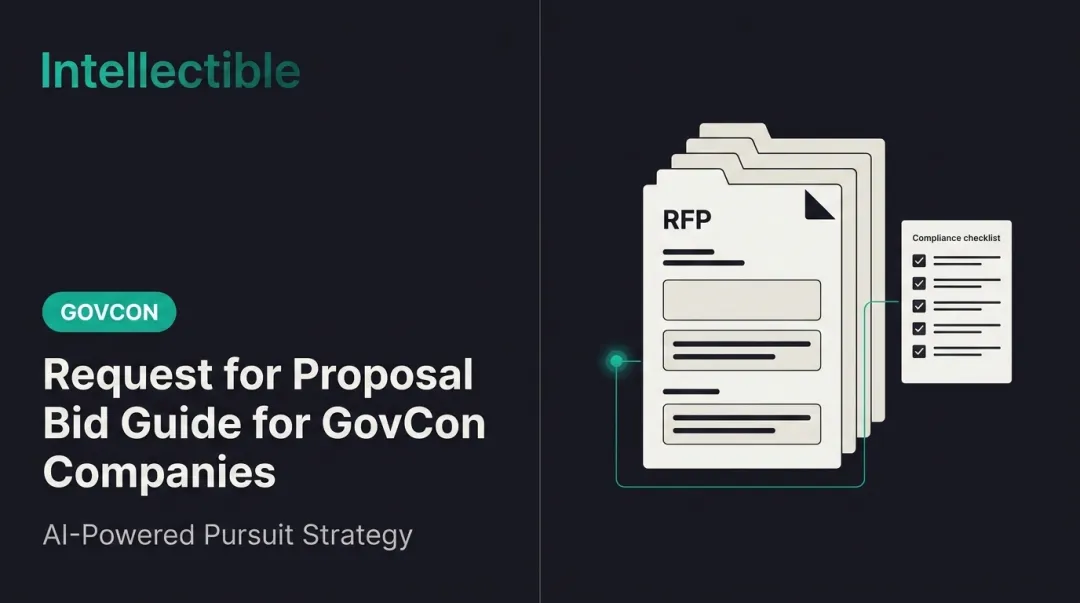
A compliance matrix is a table cross-referencing every Section L instruction and Section M evaluation factor to the corresponding proposal section, ensuring no requirement is missed. It also helps evaluators quickly verify that your proposal is fully responsive — proposals that force evaluators to hunt for required content score lower and risk rejection.